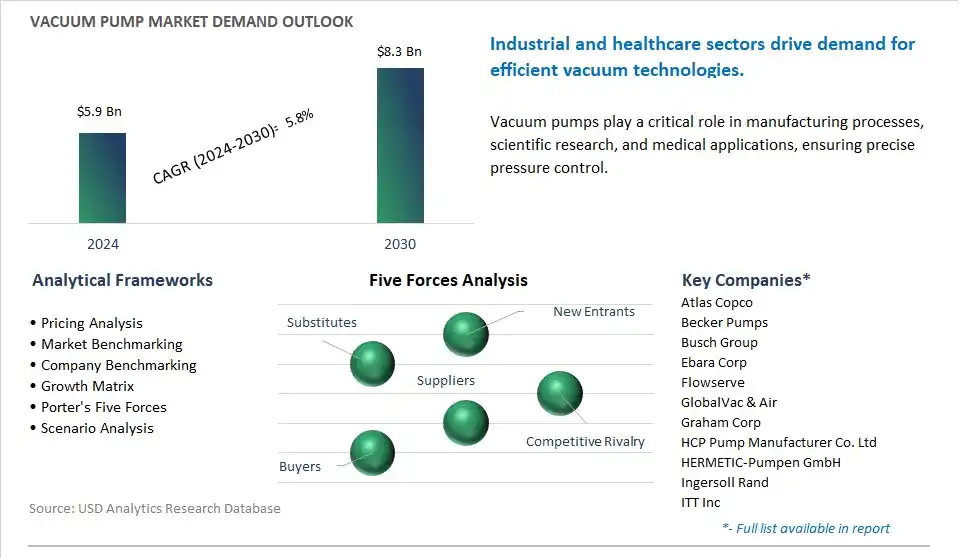
The global Vacuum Pump Market is poised to register a 5.8% CAGR from $5.9 Billion in 2024 to $8.3 Billion in 2030.
The global Vacuum Pump Market Study analyzes and forecasts the market size across 6 regions and 24 countries for diverse segments -By Lubrication (Dry, Wet), By Vacuum Level (Low, Medium, High), By End-User (Chemical & Petrochemical, Semiconductor & Electronics, Manufacturing, Pharmaceutical, Food & Beverage, Others).
An Introduction to Global Vacuum Pump Market in 2024
The vacuum pump market is undergoing significant changes driven by key trends shaping the future of various industries, including manufacturing, healthcare, and semiconductor processing. One notable trend is the demand for energy-efficient, compact, and environmentally friendly vacuum pump solutions to meet the evolving needs of modern industrial processes and applications. Manufacturers are investing in research and development to engineer next-generation vacuum pumps with advanced technologies such as variable frequency drives, oil-free operation, and intelligent control systems that optimize energy consumption, reduce operating costs, and minimize environmental impact, aligning with sustainability initiatives and regulatory requirements worldwide. Additionally, the trend towards Industry 4.0 and smart manufacturing is driving innovations in vacuum pump automation, remote monitoring, and predictive maintenance, enabling real-time performance optimization, fault detection, and condition-based servicing to maximize uptime, productivity, and reliability in industrial production facilities. Furthermore, the integration of vacuum pump systems into emerging applications such as additive manufacturing, thin-film deposition, and bioprocessing is driving market growth by expanding the scope of vacuum technology across diverse industries and driving innovations in process efficiency, product quality, and manufacturing flexibility. Moreover, collaborations between vacuum pump manufacturers, end-users, and research institutions are driving innovation and market growth by delivering customized vacuum pump solutions that meet the specific performance, reliability, and sustainability requirements of diverse applications and industries, ensuring continued advancement and adoption of vacuum pump technology as a critical enabler of modern manufacturing and industrial processes.
Vacuum Pump Market Competitive Landscape
The market report analyses the leading companies in the industry including Atlas Copco, Becker Pumps, Busch Group, Ebara Corp, Flowserve, GlobalVac & Air, Graham Corp, HCP Pump Manufacturer Co. Ltd, HERMETIC-Pumpen GmbH, Ingersoll Rand, ITT Inc, Pfeiffer Vacuum GmbH, Schlumberger Ltd, Sulzer Ltd, ULVAC Inc.
Vacuum Pump Market Dynamics
Vacuum Pump Market Trend: Transition towards Energy-Efficient and Sustainable Vacuum Pump Solutions
A significant trend in the vacuum pump market is the transition towards energy-efficient and sustainable pump solutions. With increasing awareness of environmental concerns and the need to reduce energy consumption, industries are seeking vacuum pump technologies that offer higher efficiency and lower carbon footprints. Manufacturers are responding to this trend by developing innovative vacuum pump designs that optimize energy usage, incorporate advanced control systems for better regulation of vacuum levels, and utilize sustainable materials and manufacturing processes. This trend is driven by both regulatory pressures and the voluntary commitment of industries to sustainability goals, leading to a shift towards eco-friendly vacuum pump solutions across various sectors, including manufacturing, chemical processing, and semiconductor production.
Vacuum Pump Market Driver: Industrial Automation and Technological Advancements in Vacuum Pump Systems
The primary driver for the vacuum pump market is the increasing adoption of industrial automation and technological advancements in pump systems. As industries strive to improve operational efficiency, reduce downtime, and enhance production processes, there is a growing demand for vacuum pump technologies that offer greater reliability, precision, and automation capabilities. Technological advancements such as the integration of intelligent sensors, predictive maintenance algorithms, and remote monitoring capabilities enable vacuum pump systems to operate more efficiently, optimize performance, and minimize unplanned downtime. Additionally, innovations in pump design, materials, and manufacturing processes contribute to the development of more robust and versatile vacuum pump solutions, driving market growth across diverse industrial applications.
Vacuum Pump Market Opportunity: Expansion into Emerging Industries and Applications
An opportunity for market expansion in the vacuum pump segment lies in the exploration of emerging industries and applications. As new industries emerge and existing ones evolve, there is a growing need for vacuum pump solutions tailored to specific requirements and challenges. For example, in the burgeoning field of additive manufacturing (3D printing), vacuum pumps are used for removing trapped gases and achieving high-quality prints. Similarly, in the growing biotechnology and pharmaceutical sectors, vacuum pumps play a crucial role in processes such as filtration, freeze drying, and solvent recovery. By expanding into these emerging industries and applications, vacuum pump manufacturers can diversify their customer base, tap into new revenue streams, and drive innovation in pump technology to address evolving market demands. Collaborations with industry stakeholders, research institutions, and technology partners can facilitate market entry and enable the development of specialized vacuum pump solutions for emerging sectors.
Vacuum Pump Market Share Analysis: Dry Vacuum Pumps segment is poised to register the fastest growth rate (CAGR) over the forecast period to 2030
Dry vacuum pumps offer significant advantages over their wet counterparts, primarily in terms of reduced maintenance requirements, lower operating costs, and environmental friendliness. Unlike wet pumps, dry vacuum pumps eliminate the need for lubricating fluids, which not only reduces the risk of contamination but also minimizes the potential for process contamination in sensitive applications such as semiconductor manufacturing and pharmaceutical production. Additionally, dry pumps are known for their reliability and efficiency, making them increasingly preferred across various industries including chemical, automotive, and food processing. The dry vacuum pump segment is witnessing rapid growth due to the increasing demand for clean and dry vacuum environments, particularly in industries such as electronics, where any contamination can lead to product defects and compromised performance. Further, stringent environmental regulations regarding the use and disposal of lubricating fluids have prompted many industries to transition to dry vacuum pump technologies. Furthermore, advancements in dry pump technology, such as improved sealing mechanisms and enhanced performance capabilities, are further fueling the adoption of these pumps. As industries continue to prioritize efficiency, reliability, and environmental sustainability, the dry vacuum pump segment is expected to maintain its momentum and exhibit sustained growth in the foreseeable future.
Vacuum Pump Market Share Analysis: High Vacuum Level segment is poised to register the fastest growth rate (CAGR) over the forecast period to 2030
The high vacuum level segment is experiencing the fastest growth within the vacuum pump market due to its adoption. High vacuum pumps are essential for applications requiring extremely low pressures, such as in semiconductor manufacturing, analytical instrumentation, and aerospace technologies. With the increasing demand for precision and miniaturization in various industries, the need for high vacuum levels to achieve optimal performance has surged. Additionally, advancements in materials science and pump technology have enabled the development of high vacuum pumps that offer superior performance, reliability, and energy efficiency, further propelling their adoption. Further, industries such as electronics and research laboratories are continually pushing the boundaries of vacuum technology, driving the demand for high vacuum pumps to support cutting-edge innovations. As these trends persist and evolve, the high vacuum level segment is poised to maintain its rapid growth trajectory in the vacuum pump market.
Vacuum Pump Market Share Analysis: Semiconductor & Electronics segment is poised to register the fastest growth rate (CAGR) over the forecast period to 2030
The semiconductor & electronics segment is the fastest-growing segment in the vacuum pump market. As the semiconductor and electronics industries continue to advance technologically, there is a growing need for high-precision manufacturing processes that require clean and controlled vacuum environments. Vacuum pumps play a crucial role in processes such as semiconductor wafer fabrication, LCD panel manufacturing, and vacuum deposition, where even minor contamination can lead to significant defects and yield losses. Further, the proliferation of consumer electronics, the rise of emerging technologies such as IoT and AI, and the increasing demand for electronic components in automotive and healthcare sectors further fuel the demand for semiconductor and electronics manufacturing equipment, including vacuum pumps. Additionally, ongoing innovations in semiconductor technology, such as the development of smaller and more powerful microchips, are driving the need for advanced vacuum pump solutions capable of meeting increasingly stringent performance requirements. As these industries continue to expand and evolve, the semiconductor & electronics segment is expected to sustain its rapid growth momentum in the vacuum pump market.
Vacuum Pump Market Report Segmentation
By Lubrication
Dry
Wet
By Vacuum Level
Low
Medium
High
By End-User
Chemical & Petrochemical
Semiconductor & Electronics
Manufacturing
Pharmaceutical
Food & Beverage
Others
Regions Included
North America (US, Canada, Mexico)
Europe (Germany, UK, France, Spain, Italy, Russia, Rest of Europe)
Asia Pacific (China, India, Japan, South Korea, Australia, South East Asia, Rest of Asia)
South America (Brazil, Argentina, Rest of South America)
Middle East and Africa (Saudi Arabia, UAE, Rest of Middle East, South Africa, Egypt, Rest of Africa)
Vacuum Pump Companies Profiled in the Market Study
Atlas Copco
Becker Pumps
Busch Group
Ebara Corp
Flowserve
GlobalVac & Air
Graham Corp
HCP Pump Manufacturer Co. Ltd
HERMETIC-Pumpen GmbH
Ingersoll Rand
ITT Inc
Pfeiffer Vacuum GmbH
Schlumberger Ltd
Sulzer Ltd
ULVAC Inc
*- List Not Exhaustive
TABLE OF CONTENTS
1 Introduction to 2024 Vacuum Pump Market
1.1 Market Overview
1.2 Quick Facts
1.3 Scope/Objective of the Study
1.4 Market Definition
1.5 Countries and Regions Covered
1.6 Units, Currency, and Conversions
1.7 Industry Value Chain
2 Research Methodology
2.1 Market Size Estimation
2.2 Sources and Research Methodology
2.3 Data Triangulation
2.4 Assumptions and Limitations
3 Executive Summary
3.1 Global Vacuum Pump Market Size Outlook, $ Million, 2021 to 2030
3.2 Vacuum Pump Market Outlook by Type, $ Million, 2021 to 2030
3.3 Vacuum Pump Market Outlook by Product, $ Million, 2021 to 2030
3.4 Vacuum Pump Market Outlook by Application, $ Million, 2021 to 2030
3.5 Vacuum Pump Market Outlook by Key Countries, $ Million, 2021 to 2030
4 Market Dynamics
4.1 Key Driving Forces of Vacuum Pump Industry
4.2 Key Market Trends in Vacuum Pump Industry
4.3 Potential Opportunities in Vacuum Pump Industry
4.4 Key Challenges in Vacuum Pump Industry
5 Market Factor Analysis
5.1 Value Chain Analysis
5.2 Competitive Landscape
5.2.1 Global Vacuum Pump Market Share by Company (%), 2023
5.2.2 Product Offerings by Company
5.3 Porter’s Five Forces Analysis
5.4 Pricing Analysis and Outlook
6 Growth Outlook Across Scenarios
6.1 Growth Analysis-Case Scenario Definitions
6.2 Low Growth Scenario Forecasts
6.3 Reference Growth Scenario Forecasts
6.4 High Growth Scenario Forecasts
7 Global Vacuum Pump Market Outlook by Segments
7.1 Vacuum Pump Market Outlook by Segments, $ Million, 2021- 2030
By Lubrication
Dry
Wet
By Vacuum Level
Low
Medium
High
By End-User
Chemical & Petrochemical
Semiconductor & Electronics
Manufacturing
Pharmaceutical
Food & Beverage
Others
8 North America Vacuum Pump Market Analysis and Outlook To 2030
8.1 Introduction to North America Vacuum Pump Markets in 2024
8.2 North America Vacuum Pump Market Size Outlook by Country, 2021-2030
8.2.1 United States
8.2.2 Canada
8.2.3 Mexico
8.3 North America Vacuum Pump Market size Outlook by Segments, 2021-2030
By Lubrication
Dry
Wet
By Vacuum Level
Low
Medium
High
By End-User
Chemical & Petrochemical
Semiconductor & Electronics
Manufacturing
Pharmaceutical
Food & Beverage
Others
9 Europe Vacuum Pump Market Analysis and Outlook To 2030
9.1 Introduction to Europe Vacuum Pump Markets in 2024
9.2 Europe Vacuum Pump Market Size Outlook by Country, 2021-2030
9.2.1 Germany
9.2.2 France
9.2.3 Spain
9.2.4 United Kingdom
9.2.4 Italy
9.2.5 Russia
9.2.6 Norway
9.2.7 Rest of Europe
9.3 Europe Vacuum Pump Market Size Outlook by Segments, 2021-2030
By Lubrication
Dry
Wet
By Vacuum Level
Low
Medium
High
By End-User
Chemical & Petrochemical
Semiconductor & Electronics
Manufacturing
Pharmaceutical
Food & Beverage
Others
10 Asia Pacific Vacuum Pump Market Analysis and Outlook To 2030
10.1 Introduction to Asia Pacific Vacuum Pump Markets in 2024
10.2 Asia Pacific Vacuum Pump Market Size Outlook by Country, 2021-2030
10.2.1 China
10.2.2 India
10.2.3 Japan
10.2.4 South Korea
10.2.5 Indonesia
10.2.6 Malaysia
10.2.7 Australia
10.2.8 Rest of Asia Pacific
10.3 Asia Pacific Vacuum Pump Market size Outlook by Segments, 2021-2030
By Lubrication
Dry
Wet
By Vacuum Level
Low
Medium
High
By End-User
Chemical & Petrochemical
Semiconductor & Electronics
Manufacturing
Pharmaceutical
Food & Beverage
Others
11 South America Vacuum Pump Market Analysis and Outlook To 2030
11.1 Introduction to South America Vacuum Pump Markets in 2024
11.2 South America Vacuum Pump Market Size Outlook by Country, 2021-2030
11.2.1 Brazil
11.2.2 Argentina
11.2.3 Rest of South America
11.3 South America Vacuum Pump Market size Outlook by Segments, 2021-2030
By Lubrication
Dry
Wet
By Vacuum Level
Low
Medium
High
By End-User
Chemical & Petrochemical
Semiconductor & Electronics
Manufacturing
Pharmaceutical
Food & Beverage
Others
12 Middle East and Africa Vacuum Pump Market Analysis and Outlook To 2030
12.1 Introduction to Middle East and Africa Vacuum Pump Markets in 2024
12.2 Middle East and Africa Vacuum Pump Market Size Outlook by Country, 2021-2030
12.2.1 Saudi Arabia
12.2.2 UAE
12.2.3 Oman
12.2.4 Rest of Middle East
12.2.5 Egypt
12.2.6 Nigeria
12.2.7 South Africa
12.2.8 Rest of Africa
12.3 Middle East and Africa Vacuum Pump Market size Outlook by Segments, 2021-2030
By Lubrication
Dry
Wet
By Vacuum Level
Low
Medium
High
By End-User
Chemical & Petrochemical
Semiconductor & Electronics
Manufacturing
Pharmaceutical
Food & Beverage
Others
13 Company Profiles
13.1 Company Snapshot
13.2 SWOT Profiles
13.3 Products and Services
13.4 Recent Developments
13.5 Financial Profile
Atlas Copco
Becker Pumps
Busch Group
Ebara Corp
Flowserve
GlobalVac & Air
Graham Corp
HCP Pump Manufacturer Co. Ltd
HERMETIC-Pumpen GmbH
Ingersoll Rand
ITT Inc
Pfeiffer Vacuum GmbH
Schlumberger Ltd
Sulzer Ltd
ULVAC Inc
14 Appendix
14.1 Customization Offerings
14.2 Subscription Services
14.3 Related Reports
14.4 Publisher Expertise
By Lubrication
Dry
Wet
By Vacuum Level
Low
Medium
High
By End-User
Chemical & Petrochemical
Semiconductor & Electronics
Manufacturing
Pharmaceutical
Food & Beverage
Others
Countries Analyzed
North America (US, Canada, Mexico)
Europe (Germany, UK, France, Spain, Italy, Russia, Rest of Europe)
Asia Pacific (China, India, Japan, South Korea, Australia, South East Asia, Rest of Asia)
South America (Brazil, Argentina, Rest of South America)
Middle East and Africa (Saudi Arabia, UAE, Rest of Middle East, South Africa, Egypt, Rest of Africa)
