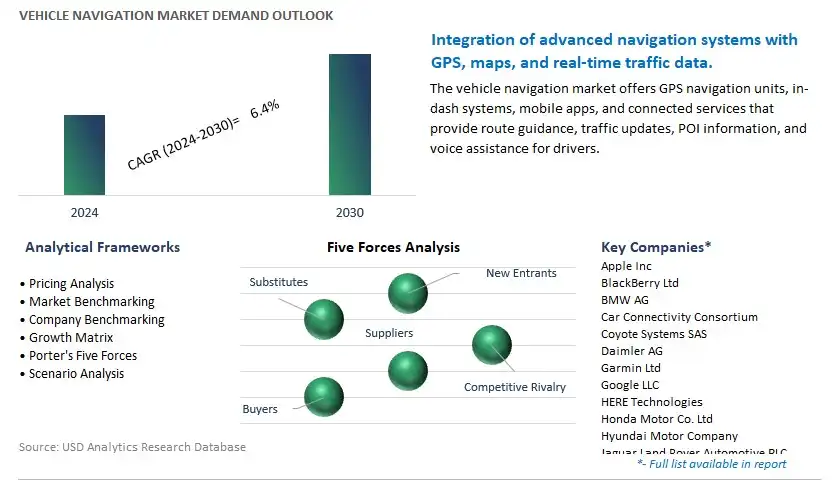
Vehicle Navigation Market is estimated to increase at a growth rate of 6.4% CAGR over the forecast period from 2024 to 2030.
The global Vehicle Navigation Market study analyzes and forecasts the market size across 6 regions and 24 countries for diverse segments including By Vehicle (Passenger car, Commercial car), By Component (Hardware, Software), By Sales Channel (OEM, Aftermarket).
An Introduction to Global Vehicle Navigation Market, 2024
The Vehicle Navigation Market in 2024 continues to witness remarkable growth, driven by advancements in navigation technologies and the rising demand for integrated navigation systems in automobiles. With the increasing adoption of connected vehicles and the proliferation of smart infrastructure, the market is experiencing a surge in demand for real-time traffic updates, predictive route analysis, and enhanced user interfaces. Key players are focusing on developing advanced navigation solutions incorporating artificial intelligence, augmented reality, and machine learning algorithms to offer personalized and seamless navigation experiences to users. Additionally, the integration of navigation systems with vehicle-to-everything (V2X) communication technologies is poised to revolutionize the way vehicles navigate through complex urban landscapes, fostering safety, efficiency, and convenience.
Vehicle Navigation Competitive Landscape
The global Vehicle Navigation market is highly competitive with a large number of companies focusing on niche market segments. Amidst intense competitive conditions, Vehicle Navigation Companies are investing in new product launches and strengthening distribution channels. Key companies operating in the Vehicle Navigation Market Industry include- Apple Inc, BlackBerry Ltd, BMW AG, Car Connectivity Consortium, Coyote Systems SAS, Daimler AG, Garmin Ltd, Google LLC, HERE Technologies, Honda Motor Co. Ltd, Hyundai Motor Company, Jaguar Land Rover Automotive PLC, Mercedes-Benz Group AG, Microsoft Corp, Moovel Group GmbH, Navdy Inc, Navteq (HERE Technologies), Sony Corp, TomTom N.V., Toyota Motor Corp, Volvo Cars, Waze (Google).
Vehicle Navigation Market Trend: Integration of Augmented Reality (AR) Navigation
A significant trend in the Vehicle Navigation Market is the integration of augmented reality (AR) technology into navigation systems, driven by the demand for more intuitive and immersive navigation experiences. AR navigation overlays digital information, such as route guidance, points of interest, and real-time traffic data, onto the driver's view of the road, enhancing situational awareness and reducing distractions. Automakers and technology companies are developing AR navigation solutions that utilize head-up displays (HUDs), windshield projections, or augmented reality glasses to provide drivers with visual cues and directions directly within their field of view. This trend reflects the industry's focus on enhancing navigation accuracy, user experience, and safety, shaping the market towards greater adoption and innovation in AR-enabled navigation systems to meet the evolving needs of drivers and passengers.
Vehicle Navigation Market Driver: Growing Demand for Real-Time Traffic Information and Smart Routing
A key driver propelling the Vehicle Navigation Market is the growing demand for real-time traffic information and smart routing capabilities, fueled by increasing traffic congestion, urbanization, and the need for efficient navigation solutions. Drivers seek navigation systems that can provide accurate and up-to-date traffic data, suggest alternative routes to avoid congestion and optimize travel times based on current road conditions. Furthermore, the rise of connected vehicles and smart cities enables navigation systems to leverage vehicle-to-vehicle (V2V) and vehicle-to-infrastructure (V2I) communication to access real-time traffic updates, road closures, and construction information, enhancing route planning and navigation accuracy. As consumers prioritize convenience and time-saving features in their vehicles, the demand for navigation systems with advanced traffic management capabilities continues to grow, driving market expansion and innovation in vehicle navigation technologies to meet the increasing demands for efficient and stress-free navigation experiences.
Vehicle Navigation Market Opportunity: Integration of Voice-Activated Navigation and Natural Language Processing
An opportunity within the Vehicle Navigation Market lies in the integration of voice-activated navigation and natural language processing (NLP) capabilities to offer hands-free and intuitive navigation experiences for drivers. By incorporating voice recognition technology and NLP algorithms into navigation systems, manufacturers can enable drivers to interact with the navigation interface using natural voice commands and receive spoken directions and guidance in real time. Voice-activated navigation systems can enhance driver safety by minimizing distractions and allowing drivers to keep their eyes on the road while receiving navigation instructions. Additionally, NLP-enabled navigation systems can understand and process complex voice commands, such as asking for directions to specific locations or searching for nearby points of interest, offering a more user-friendly and conversational navigation experience. By embracing voice-activated navigation and NLP technologies, manufacturers can differentiate their navigation systems, improve user satisfaction, and capitalize on the growing demand for intuitive and hands-free navigation solutions in vehicles. This opportunity aligns with the automotive industry's focus on enhancing connectivity, convenience, and safety features in vehicles, driving market growth and innovation in-vehicle navigation systems to meet the evolving needs of drivers and passengers.
Vehicle Navigation Market Segmentation
By Vehicle
Passenger car
Commercial car
By Component
Hardware
Software
By Sales Channel
OEM
AftermarketGeographical Analysis
North America (United States, Canada, Mexico)
Europe (Germany, France, United Kingdom, Spain, Italy, Rest of Europe)
Asia Pacific (China, India, Japan, South Korea, Rest of Asia Pacific)
South America (Brazil, Argentina, Rest of South America)
Middle East and Africa (Saudi Arabia, UAE, Rest of Middle East, South Africa, Egypt, Rest of Africa
Vehicle Navigation Companies
Apple Inc
BlackBerry Ltd
BMW AG
Car Connectivity Consortium
Coyote Systems SAS
Daimler AG
Garmin Ltd
Google LLC
HERE Technologies
Honda Motor Co. Ltd
Hyundai Motor Company
Jaguar Land Rover Automotive PLC
Mercedes-Benz Group AG
Microsoft Corp
Moovel Group GmbH
Navdy Inc
Navteq (HERE Technologies)
Sony Corp
TomTom N.V.
Toyota Motor Corp
Volvo Cars
Waze (Google)
*- List not Exhaustive
TABLE OF CONTENTS
1 Introduction to 2024 Vehicle Navigation Market
1.1 Market Overview
1.2 Quick Facts
1.3 Scope/Objective of the Study
1.4 Market Definition
1.5 Countries and Regions Analyzed
1.6 Units, Currency, and Conversions
1.7 Industry Value Chain
2 Research Methodology
2.1 Market Size Estimation
2.2 Sources and Research Methodology
2.3 Data Triangulation
2.4 Assumptions and Limitations
3 Executive Summary
3.1 Global Vehicle Navigation Market Size Outlook, $ Million, 2021 to 2030
3.2 Vehicle Navigation Market Outlook by Type, $ Million, 2021 to 2030
3.3 Vehicle Navigation Market Outlook by Product, $ Million, 2021 to 2030
3.4 Vehicle Navigation Market Outlook by Application, $ Million, 2021 to 2030
3.5 Vehicle Navigation Market Outlook by Key Countries, $ Million, 2021 to 2030
4 Market Dynamics
4.1 Key Driving Forces of Vehicle Navigation Industry
4.2 Key Market Trends in Vehicle Navigation Industry
4.3 Potential Opportunities in Vehicle Navigation Industry
4.4 Key Challenges in Vehicle Navigation Industry
5 Market Factor Analysis
5.1 Value Chain Analysis
5.2 Competitive Landscape
5.2.1 Global Vehicle Navigation Market Share by Company (%), 2023
5.2.2 Product Offerings by Company
5.3 Porter’s Five Forces Analysis
5.4 Pricing Analysis and Outlook
6 Growth Outlook Across Scenarios
6.1 Growth Analysis-Case Scenario Definitions
6.2 Low Growth Scenario Forecasts
6.3 Reference Growth Scenario Forecasts
6.4 High Growth Scenario Forecasts
7 Global Vehicle Navigation Market Outlook by Segments
7.1 Vehicle Navigation Market Outlook by Segments, $ Million, 2021- 2030
By Vehicle
Passenger car
Commercial car
By Component
Hardware
Software
By Sales Channel
OEM
Aftermarket
8 North America Vehicle Navigation Market Analysis and Outlook To 2030
8.1 Introduction to North America Vehicle Navigation Markets in 2024
8.2 North America Vehicle Navigation Market Size Outlook by Country, 2021-2030
8.2.1 United States
8.2.2 Canada
8.2.3 Mexico
8.3 North America Vehicle Navigation Market size Outlook by Segments, 2021-2030
By Vehicle
Passenger car
Commercial car
By Component
Hardware
Software
By Sales Channel
OEM
Aftermarket
9 Europe Vehicle Navigation Market Analysis and Outlook To 2030
9.1 Introduction to Europe Vehicle Navigation Markets in 2024
9.2 Europe Vehicle Navigation Market Size Outlook by Country, 2021-2030
9.2.1 Germany
9.2.2 France
9.2.3 Spain
9.2.4 United Kingdom
9.2.4 Italy
9.2.5 Russia
9.2.6 Norway
9.2.7 Rest of Europe
9.3 Europe Vehicle Navigation Market Size Outlook by Segments, 2021-2030
By Vehicle
Passenger car
Commercial car
By Component
Hardware
Software
By Sales Channel
OEM
Aftermarket
10 Asia Pacific Vehicle Navigation Market Analysis and Outlook To 2030
10.1 Introduction to Asia Pacific Vehicle Navigation Markets in 2024
10.2 Asia Pacific Vehicle Navigation Market Size Outlook by Country, 2021-2030
10.2.1 China
10.2.2 India
10.2.3 Japan
10.2.4 South Korea
10.2.5 Indonesia
10.2.6 Malaysia
10.2.7 Australia
10.2.8 Rest of Asia Pacific
10.3 Asia Pacific Vehicle Navigation Market size Outlook by Segments, 2021-2030
By Vehicle
Passenger car
Commercial car
By Component
Hardware
Software
By Sales Channel
OEM
Aftermarket
11 South America Vehicle Navigation Market Analysis and Outlook To 2030
11.1 Introduction to South America Vehicle Navigation Markets in 2024
11.2 South America Vehicle Navigation Market Size Outlook by Country, 2021-2030
11.2.1 Brazil
11.2.2 Argentina
11.2.3 Rest of South America
11.3 South America Vehicle Navigation Market size Outlook by Segments, 2021-2030
By Vehicle
Passenger car
Commercial car
By Component
Hardware
Software
By Sales Channel
OEM
Aftermarket
12 Middle East and Africa Vehicle Navigation Market Analysis and Outlook To 2030
12.1 Introduction to Middle East and Africa Vehicle Navigation Markets in 2024
12.2 Middle East and Africa Vehicle Navigation Market Size Outlook by Country, 2021-2030
12.2.1 Saudi Arabia
12.2.2 UAE
12.2.3 Oman
12.2.4 Rest of Middle East
12.2.5 Egypt
12.2.6 Nigeria
12.2.7 South Africa
12.2.8 Rest of Africa
12.3 Middle East and Africa Vehicle Navigation Market size Outlook by Segments, 2021-2030
By Vehicle
Passenger car
Commercial car
By Component
Hardware
Software
By Sales Channel
OEM
Aftermarket
13 Company Profiles
13.1 Company Snapshot
13.2 SWOT Profiles
13.3 Products and Services
13.4 Recent Developments
13.5 Financial Profile
List of Companies
Apple Inc
BlackBerry Ltd
BMW AG
Car Connectivity Consortium
Coyote Systems SAS
Daimler AG
Garmin Ltd
Google LLC
HERE Technologies
Honda Motor Co. Ltd
Hyundai Motor Company
Jaguar Land Rover Automotive PLC
Mercedes-Benz Group AG
Microsoft Corp
Moovel Group GmbH
Navdy Inc
Navteq (HERE Technologies)
Sony Corp
TomTom N.V.
Toyota Motor Corp
Volvo Cars
Waze (Google)
14 Appendix
14.1 Customization Offerings
14.2 Subscription Services
14.3 Related Reports
14.4 Publisher Expertise
By Vehicle
Passenger car
Commercial car
By Component
Hardware
Software
By Sales Channel
OEM
Aftermarket
