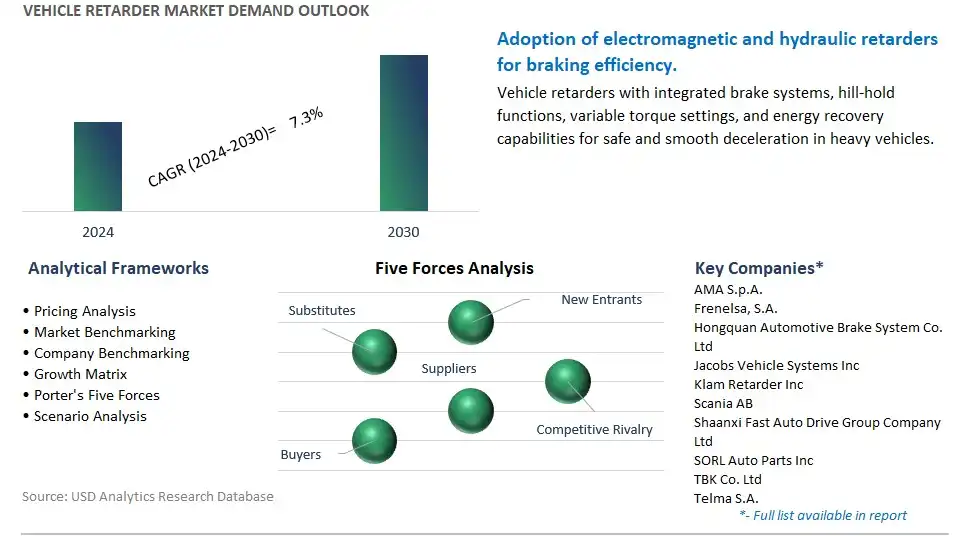
Vehicle Retarder Market is estimated to increase at a growth rate of 7.3% CAGR over the forecast period from 2024 to 2030.
The global Vehicle Retarder Market study analyzes and forecasts the market size across 6 regions and 24 countries for diverse segments including By Product (Electric Retarders, Hydraulic Retarders), By Application (18 to 55 MT, 55 to 100 MT, Above 100 MT), By Vehicle (Commercial Vehicles, Transport Vehicles, Others).
An Introduction to Global Vehicle Retarder Market, 2024
In 2024, the vehicle retarder market is witnessing steady growth propelled by the increasing demand for enhanced braking systems in commercial vehicles and heavy-duty trucks. Vehicle retarders play a critical role in complementing traditional braking systems by providing supplementary braking force, thereby improving vehicle control, stability, and safety, especially in challenging driving conditions such as steep slopes or heavy loads. With advancements in technology, modern vehicle retarders offer higher efficiency, reduced maintenance requirements, and improved integration with other vehicle systems. Moreover, the emphasis on reducing fuel consumption and emissions is driving the adoption of energy-efficient retarder solutions that help optimize overall vehicle performance. As transportation regulations become more stringent and safety standards evolve, the vehicle retarder market is poised for sustained growth, catering to the evolving needs of the automotive industry.
Vehicle Retarder Competitive Landscape
The global Vehicle Retarder market is highly competitive with a large number of companies focusing on niche market segments. Amidst intense competitive conditions, Vehicle Retarder Companies are investing in new product launches and strengthening distribution channels. Key companies operating in the Vehicle Retarder Market Industry include- AMA S.p.A., Frenelsa, S.A., Hongquan Automotive Brake System Co. Ltd, Jacobs Vehicle Systems Inc, Klam Retarder Inc, Scania AB, Shaanxi Fast Auto Drive Group Company Ltd, SORL Auto Parts Inc, TBK Co. Ltd, Telma S.A., Terca S.L., Voith Group, ZF Friedrichshafen AG.
Vehicle Retarder Market Trend: Emphasis on Vehicle Safety and Enhanced Braking Systems
A prominent trend in the Vehicle Retarder Market is the increasing emphasis on vehicle safety and the adoption of enhanced braking systems. As road safety regulations become more stringent and consumer awareness of vehicle safety features grows, there is a rising demand for technologies that improve braking performance and reduce stopping distances. Vehicle retarders play a crucial role in enhancing vehicle braking systems by providing additional braking force, particularly in heavy-duty vehicles such as trucks, buses, and commercial vehicles. With advancements in retarder technology, including electromagnetic, hydraulic, and electric variants, there is a growing trend towards the integration of retarders into vehicle braking systems to improve safety and control, driving market growth in the Vehicle Retarder Market.
Vehicle Retarder Market Driver: Growth in Commercial Vehicle Fleet Size and Freight Transportation
A key driver propelling the Vehicle Retarder Market is the growth in the commercial vehicle fleet size and freight transportation. With increasing global trade, e-commerce activities, and logistics operations, there is a growing demand for commercial vehicles to transport goods and commodities over long distances. Commercial vehicles, including trucks, trailers, and buses, often operate under heavy loads and encounter challenging road conditions, necessitating reliable braking systems to ensure safe and efficient operation. Vehicle retarders offer an effective solution to manage braking heat and reduce wear on traditional friction brakes, thereby improving braking performance and prolonging brake system lifespan. The expansion of the commercial vehicle fleet and freight transportation industry drives market demand for vehicle retarders as essential components for ensuring safe and reliable operation of commercial vehicles.
Vehicle Retarder Market Opportunity: Integration with Hybrid and Electric Vehicle Platforms
An opportunity within the Vehicle Retarder Market lies in the integration of retarders with hybrid and electric vehicle platforms. As the automotive industry transitions towards electrification and sustainability, there is a growing demand for advanced braking solutions that complement the unique characteristics of hybrid and electric vehicles (EVs). Vehicle retarders offer benefits such as regenerative braking, which recovers kinetic energy during deceleration and stores it in the vehicle's battery for later use, enhancing overall energy efficiency and range in hybrid and electric vehicles. Manufacturers can capitalize on this opportunity by developing retarder systems optimized for integration with hybrid and electric vehicle platforms, offering custom solutions that meet the specific braking requirements and performance metrics of electrified vehicles. Additionally, there is potential to collaborate with electric vehicle manufacturers to develop integrated braking systems that seamlessly combine retarder technology with regenerative braking capabilities, further enhancing the safety and efficiency of hybrid and electric vehicles. By embracing the shift towards electrification and sustainability, manufacturers can position themselves as leaders in providing innovative braking solutions for the next generation of vehicles, driving market growth and expansion in the Vehicle Retarder Market.
Vehicle Retarder Market Segmentation
By Product
Electric Retarders
Hydraulic Retarders
By Application
18 to 55 MT
55 to 100 MT
Above 100 MT
By Vehicle
Commercial Vehicles
Transport Vehicles
OthersGeographical Analysis
North America (United States, Canada, Mexico)
Europe (Germany, France, United Kingdom, Spain, Italy, Rest of Europe)
Asia Pacific (China, India, Japan, South Korea, Rest of Asia Pacific)
South America (Brazil, Argentina, Rest of South America)
Middle East and Africa (Saudi Arabia, UAE, Rest of Middle East, South Africa, Egypt, Rest of Africa
Vehicle Retarder Companies
AMA S.p.A.
Frenelsa, S.A.
Hongquan Automotive Brake System Co. Ltd
Jacobs Vehicle Systems Inc
Klam Retarder Inc
Scania AB
Shaanxi Fast Auto Drive Group Company Ltd
SORL Auto Parts Inc
TBK Co. Ltd
Telma S.A.
Terca S.L.
Voith Group
ZF Friedrichshafen AG
*- List not Exhaustive
TABLE OF CONTENTS
1 Introduction to 2024 Vehicle Retarder Market
1.1 Market Overview
1.2 Quick Facts
1.3 Scope/Objective of the Study
1.4 Market Definition
1.5 Countries and Regions Analyzed
1.6 Units, Currency, and Conversions
1.7 Industry Value Chain
2 Research Methodology
2.1 Market Size Estimation
2.2 Sources and Research Methodology
2.3 Data Triangulation
2.4 Assumptions and Limitations
3 Executive Summary
3.1 Global Vehicle Retarder Market Size Outlook, $ Million, 2021 to 2030
3.2 Vehicle Retarder Market Outlook by Type, $ Million, 2021 to 2030
3.3 Vehicle Retarder Market Outlook by Product, $ Million, 2021 to 2030
3.4 Vehicle Retarder Market Outlook by Application, $ Million, 2021 to 2030
3.5 Vehicle Retarder Market Outlook by Key Countries, $ Million, 2021 to 2030
4 Market Dynamics
4.1 Key Driving Forces of Vehicle Retarder Industry
4.2 Key Market Trends in Vehicle Retarder Industry
4.3 Potential Opportunities in Vehicle Retarder Industry
4.4 Key Challenges in Vehicle Retarder Industry
5 Market Factor Analysis
5.1 Value Chain Analysis
5.2 Competitive Landscape
5.2.1 Global Vehicle Retarder Market Share by Company (%), 2023
5.2.2 Product Offerings by Company
5.3 Porter’s Five Forces Analysis
5.4 Pricing Analysis and Outlook
6 Growth Outlook Across Scenarios
6.1 Growth Analysis-Case Scenario Definitions
6.2 Low Growth Scenario Forecasts
6.3 Reference Growth Scenario Forecasts
6.4 High Growth Scenario Forecasts
7 Global Vehicle Retarder Market Outlook by Segments
7.1 Vehicle Retarder Market Outlook by Segments, $ Million, 2021- 2030
By Product
Electric Retarders
Hydraulic Retarders
By Application
18 to 55 MT
55 to 100 MT
Above 100 MT
By Vehicle
Commercial Vehicles
Transport Vehicles
Others
8 North America Vehicle Retarder Market Analysis and Outlook To 2030
8.1 Introduction to North America Vehicle Retarder Markets in 2024
8.2 North America Vehicle Retarder Market Size Outlook by Country, 2021-2030
8.2.1 United States
8.2.2 Canada
8.2.3 Mexico
8.3 North America Vehicle Retarder Market size Outlook by Segments, 2021-2030
By Product
Electric Retarders
Hydraulic Retarders
By Application
18 to 55 MT
55 to 100 MT
Above 100 MT
By Vehicle
Commercial Vehicles
Transport Vehicles
Others
9 Europe Vehicle Retarder Market Analysis and Outlook To 2030
9.1 Introduction to Europe Vehicle Retarder Markets in 2024
9.2 Europe Vehicle Retarder Market Size Outlook by Country, 2021-2030
9.2.1 Germany
9.2.2 France
9.2.3 Spain
9.2.4 United Kingdom
9.2.4 Italy
9.2.5 Russia
9.2.6 Norway
9.2.7 Rest of Europe
9.3 Europe Vehicle Retarder Market Size Outlook by Segments, 2021-2030
By Product
Electric Retarders
Hydraulic Retarders
By Application
18 to 55 MT
55 to 100 MT
Above 100 MT
By Vehicle
Commercial Vehicles
Transport Vehicles
Others
10 Asia Pacific Vehicle Retarder Market Analysis and Outlook To 2030
10.1 Introduction to Asia Pacific Vehicle Retarder Markets in 2024
10.2 Asia Pacific Vehicle Retarder Market Size Outlook by Country, 2021-2030
10.2.1 China
10.2.2 India
10.2.3 Japan
10.2.4 South Korea
10.2.5 Indonesia
10.2.6 Malaysia
10.2.7 Australia
10.2.8 Rest of Asia Pacific
10.3 Asia Pacific Vehicle Retarder Market size Outlook by Segments, 2021-2030
By Product
Electric Retarders
Hydraulic Retarders
By Application
18 to 55 MT
55 to 100 MT
Above 100 MT
By Vehicle
Commercial Vehicles
Transport Vehicles
Others
11 South America Vehicle Retarder Market Analysis and Outlook To 2030
11.1 Introduction to South America Vehicle Retarder Markets in 2024
11.2 South America Vehicle Retarder Market Size Outlook by Country, 2021-2030
11.2.1 Brazil
11.2.2 Argentina
11.2.3 Rest of South America
11.3 South America Vehicle Retarder Market size Outlook by Segments, 2021-2030
By Product
Electric Retarders
Hydraulic Retarders
By Application
18 to 55 MT
55 to 100 MT
Above 100 MT
By Vehicle
Commercial Vehicles
Transport Vehicles
Others
12 Middle East and Africa Vehicle Retarder Market Analysis and Outlook To 2030
12.1 Introduction to Middle East and Africa Vehicle Retarder Markets in 2024
12.2 Middle East and Africa Vehicle Retarder Market Size Outlook by Country, 2021-2030
12.2.1 Saudi Arabia
12.2.2 UAE
12.2.3 Oman
12.2.4 Rest of Middle East
12.2.5 Egypt
12.2.6 Nigeria
12.2.7 South Africa
12.2.8 Rest of Africa
12.3 Middle East and Africa Vehicle Retarder Market size Outlook by Segments, 2021-2030
By Product
Electric Retarders
Hydraulic Retarders
By Application
18 to 55 MT
55 to 100 MT
Above 100 MT
By Vehicle
Commercial Vehicles
Transport Vehicles
Others
13 Company Profiles
13.1 Company Snapshot
13.2 SWOT Profiles
13.3 Products and Services
13.4 Recent Developments
13.5 Financial Profile
List of Companies
AMA S.p.A.
Frenelsa, S.A.
Hongquan Automotive Brake System Co. Ltd
Jacobs Vehicle Systems Inc
Klam Retarder Inc
Scania AB
Shaanxi Fast Auto Drive Group Company Ltd
SORL Auto Parts Inc
TBK Co. Ltd
Telma S.A.
Terca S.L.
Voith Group
ZF Friedrichshafen AG
14 Appendix
14.1 Customization Offerings
14.2 Subscription Services
14.3 Related Reports
14.4 Publisher Expertise
By Product
Electric Retarders
Hydraulic Retarders
By Application
18 to 55 MT
55 to 100 MT
Above 100 MT
By Vehicle
Commercial Vehicles
Transport Vehicles
Others
