Ventricular Assist Device Market is estimated to increase at a growth rate of 8.2% CAGR over the forecast period from 2024 to 2030.
The global Ventricular Assist Device Marketstudy analyzes and forecasts the market size across 6 regions and 24 countries for diverse segments including By Product (Left Ventricular Assist Device, Right Ventricular Assist Device, Bi-Ventricular Assist Device, Total Artificial Heart), By Type of Flow (Pulsatile Flow, Continuous Flow), By Application (Bridge to Transplant, Destination Therapy, Others), By Design (Implantable, Transcutaneous).
An introduction to Ventricular Assist Device Market in 2024
In 2024, the ventricular assist device (VAD) market is thriving due to advancements in mechanical circulatory support technologies, heart failure management, and the increasing prevalence of end-stage heart failure worldwide, leading to greater demand for durable and implantable VAD systems as bridge-to-transplant or destination therapy options for patients awaiting heart transplantation or ineligible for cardiac transplantation. Ventricular assist devices are mechanical pumps implanted in the chest or abdomen that help the heart pump blood to the rest of the body, offering circulatory support, symptom relief, and improved survival for patients with advanced heart failure or cardiogenic shock. With ongoing research in VAD design, pump technology, and implantation techniques, the market is experiencing rapid expansion and adoption of ventricular assist devices, offering cardiologists, cardiac surgeons, and heart failure specialists innovative and lifesaving solutions for managing end-stage heart failure and improving patient outcomes, driving advancements in mechanical circulatory support and heart failure therapeutics.
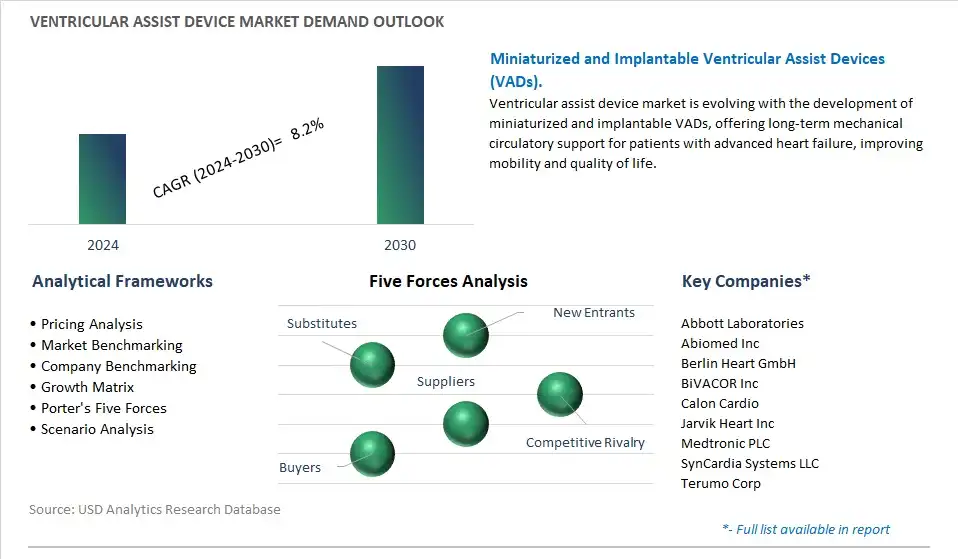
Ventricular Assist Device Market Trend: Transition towards Destination Therapy Reshapes Ventricular Assist Device Market
A significant trend in the ventricular assist device (VAD) market is the increasing adoption of destination therapy. While VADs were initially developed as a bridge to heart transplantation, there has been a notable shift towards using these devices as long-term therapy for end-stage heart failure patients who are ineligible for transplant. Destination therapy offers these patients a viable alternative to improve their quality of life and prolong survival, driving the demand for VADs. Additionally, advancements in device design, miniaturization, and implantation techniques have made destination therapy more accessible and effective, further fueling market growth in the VAD segment. This trend reflects the evolving landscape of heart failure management and the increasing acceptance of VADs as a standard of care for eligible patients.
Ventricular Assist Device Market Driver: Rising Prevalence of Heart Failure and Advancements in Cardiac Care Propel Ventricular Assist Device Market Growth
The rising prevalence of heart failure and advancements in cardiac care serve as significant drivers for the ventricular assist device market. Heart failure affects millions of individuals worldwide, contributing to high morbidity and mortality rates. As traditional treatment options such as medications and cardiac resynchronization therapy may be insufficient for end-stage heart failure patients, there is a growing need for advanced therapies like VADs. Furthermore, advancements in device technology, surgical techniques, and patient management protocols have improved VAD outcomes, making them a viable option for a broader patient population. With healthcare systems prioritizing innovative solutions for heart failure management and improving patient outcomes, the demand for ventricular assist devices continues to grow, supporting market expansion and technological advancements.
Ventricular Assist Device Market Opportunity: Expansion into Pediatric and Ambulatory Care Markets Presents Lucrative Opportunities in Ventricular Assist Device Market
The expansion into pediatric and ambulatory care markets represents a promising opportunity for growth within the ventricular assist device market. While VADs have traditionally been used in adults with end-stage heart failure, there is a growing need for pediatric-specific devices and solutions to address congenital heart defects and pediatric heart failure. Additionally, advancements in device miniaturization and implantation techniques have enabled the development of ambulatory VADs, offering patients greater mobility and quality of life. Capitalizing on this opportunity requires manufacturers to invest in pediatric-specific device development, clinical research, and regulatory approvals to meet the unique needs of pediatric patients. Moreover, targeting ambulatory care settings and expanding indications for VAD use can further enhance market penetration and revenue growth in the evolving landscape of heart failure management.
Ventricular Assist Device Market Market Segmentation
By Product
Left Ventricular Assist Device
Right Ventricular Assist Device
Bi-Ventricular Assist Device
Total Artificial Heart
By Type of Flow
Pulsatile Flow
Continuous Flow
By Application
Bridge to Transplant
Destination Therapy
Others
By Design
Implantable
Transcutaneous
Geographical Analysis
North America (United States, Canada, Mexico)
Europe (Germany, France, United Kingdom, Spain, Italy, Rest of Europe)
Asia Pacific (China, India, Japan, South Korea, Rest of Asia Pacific)
South America (Brazil, Argentina, Rest of South America)
Middle East and Africa (Saudi Arabia, UAE, Rest of Middle East, South Africa, Egypt, Rest of Africa)
Ventricular Assist Device Market Companies
Abbott Laboratories
Abiomed Inc
Berlin Heart GmbH
BiVACOR Inc
Calon Cardio
Jarvik Heart Inc
Medtronic PLC
SynCardia Systems LLC
Terumo Corp
Reasons to Buy the Ventricular Assist Device Market Study
• Deepen your industry insights and navigate uncertainties for strategy formulation, CAPEX, and Operational decisions
• Gain access to detailed insights on the Ventricular Assist Device Market, encompassing current market size, growth trends, and forecasts till 2030.
• Access detailed competitor analysis, enabling competitive advantage through a thorough understanding of market players, strategies, and potential differentiation opportunities
• Stay ahead of the curve with insights on technological advancements, innovations, and upcoming trends
• Identify lucrative investment avenues and expansion opportunities within the Ventricular Assist Device Market industry, guided by robust, data-backed analysis.
• Understand regional and global markets through country-wise analysis, regional market potential, regulatory nuances, and dynamics
• Execute strategies with confidence and speed through information, analytics, and insights on the industry value chain
• Corporate leaders, strategists, financial experts, shareholders, asset managers, and governmental representatives can make long-term planning scenarios and build an integrated and timely understanding of market dynamics
• Benefit from tailored solutions and expert consultation based on report insights, providing personalized strategies aligned with specific business needs.
TABLE OF CONTENTS
1 Introduction to 2024 Ventricular Assist Device Market
1.1 Market Overview
1.2 Quick Facts
1.3 Scope/Objective of the Study
1.4 Market Definition
1.5 Countries and Regions Analyzed
1.6 Units, Currency, and Conversions
1.7 Industry Value Chain
2 Research Methodology
2.1 Market Size Estimation
2.2 Sources and Research Methodology
2.3 Data Triangulation
2.4 Assumptions and Limitations
3 Executive Summary
3.1 Global Ventricular Assist Device Market Size Outlook, $ Million, 2021 to 2030
3.2 Ventricular Assist Device Market Outlook by Type, $ Million, 2021 to 2030
3.3 Ventricular Assist Device Market Outlook by Product, $ Million, 2021 to 2030
3.4 Ventricular Assist Device Market Outlook by Application, $ Million, 2021 to 2030
3.5 Ventricular Assist Device Market Outlook by Key Countries, $ Million, 2021 to 2030
4 Market Dynamics
4.1 Key Driving Forces of Ventricular Assist Device Industry
4.2 Key Market Trends in Ventricular Assist Device Industry
4.3 Potential Opportunities in Ventricular Assist Device Industry
4.4 Key Challenges in Ventricular Assist Device Industry
5 Market Factor Analysis
5.1 Value Chain Analysis
5.2 Competitive Landscape
5.2.1 Global Ventricular Assist Device Market Share by Company (%), 2023
5.2.2 Product Offerings by Company
5.3 Porter’s Five Forces Analysis
5.4 Pricing Analysis and Outlook
6 Growth Outlook Across Scenarios
6.1 Growth Analysis-Case Scenario Definitions
6.2 Low Growth Scenario Forecasts
6.3 Reference Growth Scenario Forecasts
6.4 High Growth Scenario Forecasts
7 Global Ventricular Assist Device Market Outlook by Segments
7.1 Ventricular Assist Device Market Outlook by Segments, $ Million, 2021- 2030
By Product
Left Ventricular Assist Device
Right Ventricular Assist Device
Bi-Ventricular Assist Device
Total Artificial Heart
By Type of Flow
Pulsatile Flow
Continuous Flow
By Application
Bridge to Transplant
Destination Therapy
Others
By Design
Implantable
Transcutaneous
8 North America Ventricular Assist Device Market Analysis and Outlook To 2030
8.1 Introduction to North America Ventricular Assist Device Markets in 2024
8.2 North America Ventricular Assist Device Market Size Outlook by Country, 2021-2030
8.2.1 United States
8.2.2 Canada
8.2.3 Mexico
8.3 North America Ventricular Assist Device Market size Outlook by Segments, 2021-2030
By Product
Left Ventricular Assist Device
Right Ventricular Assist Device
Bi-Ventricular Assist Device
Total Artificial Heart
By Type of Flow
Pulsatile Flow
Continuous Flow
By Application
Bridge to Transplant
Destination Therapy
Others
By Design
Implantable
Transcutaneous
9 Europe Ventricular Assist Device Market Analysis and Outlook To 2030
9.1 Introduction to Europe Ventricular Assist Device Markets in 2024
9.2 Europe Ventricular Assist Device Market Size Outlook by Country, 2021-2030
9.2.1 Germany
9.2.2 France
9.2.3 Spain
9.2.4 United Kingdom
9.2.4 Italy
9.2.5 Russia
9.2.6 Norway
9.2.7 Rest of Europe
9.3 Europe Ventricular Assist Device Market Size Outlook by Segments, 2021-2030
By Product
Left Ventricular Assist Device
Right Ventricular Assist Device
Bi-Ventricular Assist Device
Total Artificial Heart
By Type of Flow
Pulsatile Flow
Continuous Flow
By Application
Bridge to Transplant
Destination Therapy
Others
By Design
Implantable
Transcutaneous
10 Asia Pacific Ventricular Assist Device Market Analysis and Outlook To 2030
10.1 Introduction to Asia Pacific Ventricular Assist Device Markets in 2024
10.2 Asia Pacific Ventricular Assist Device Market Size Outlook by Country, 2021-2030
10.2.1 China
10.2.2 India
10.2.3 Japan
10.2.4 South Korea
10.2.5 Indonesia
10.2.6 Malaysia
10.2.7 Australia
10.2.8 Rest of Asia Pacific
10.3 Asia Pacific Ventricular Assist Device Market size Outlook by Segments, 2021-2030
By Product
Left Ventricular Assist Device
Right Ventricular Assist Device
Bi-Ventricular Assist Device
Total Artificial Heart
By Type of Flow
Pulsatile Flow
Continuous Flow
By Application
Bridge to Transplant
Destination Therapy
Others
By Design
Implantable
Transcutaneous
11 South America Ventricular Assist Device Market Analysis and Outlook To 2030
11.1 Introduction to South America Ventricular Assist Device Markets in 2024
11.2 South America Ventricular Assist Device Market Size Outlook by Country, 2021-2030
11.2.1 Brazil
11.2.2 Argentina
11.2.3 Rest of South America
11.3 South America Ventricular Assist Device Market size Outlook by Segments, 2021-2030
By Product
Left Ventricular Assist Device
Right Ventricular Assist Device
Bi-Ventricular Assist Device
Total Artificial Heart
By Type of Flow
Pulsatile Flow
Continuous Flow
By Application
Bridge to Transplant
Destination Therapy
Others
By Design
Implantable
Transcutaneous
12 Middle East and Africa Ventricular Assist Device Market Analysis and Outlook To 2030
12.1 Introduction to Middle East and Africa Ventricular Assist Device Markets in 2024
12.2 Middle East and Africa Ventricular Assist Device Market Size Outlook by Country, 2021-2030
12.2.1 Saudi Arabia
12.2.2 UAE
12.2.3 Oman
12.2.4 Rest of Middle East
12.2.5 Egypt
12.2.6 Nigeria
12.2.7 South Africa
12.2.8 Rest of Africa
12.3 Middle East and Africa Ventricular Assist Device Market size Outlook by Segments, 2021-2030
By Product
Left Ventricular Assist Device
Right Ventricular Assist Device
Bi-Ventricular Assist Device
Total Artificial Heart
By Type of Flow
Pulsatile Flow
Continuous Flow
By Application
Bridge to Transplant
Destination Therapy
Others
By Design
Implantable
Transcutaneous
13 Company Profiles
13.1 Company Snapshot
13.2 SWOT Profiles
13.3 Products and Services
13.4 Recent Developments
13.5 Financial Profile
List of Companies
Abbott Laboratories
Abiomed Inc
Berlin Heart GmbH
BiVACOR Inc
Calon Cardio
Jarvik Heart Inc
Medtronic PLC
SynCardia Systems LLC
Terumo Corp
14 Appendix
14.1 Customization Offerings
14.2 Subscription Services
14.3 Related Reports
14.4 Publisher Expertise
By Product
Left Ventricular Assist Device
Right Ventricular Assist Device
Bi-Ventricular Assist Device
Total Artificial Heart
By Type of Flow
Pulsatile Flow
Continuous Flow
By Application
Bridge to Transplant
Destination Therapy
Others
By Design
Implantable
Transcutaneous
