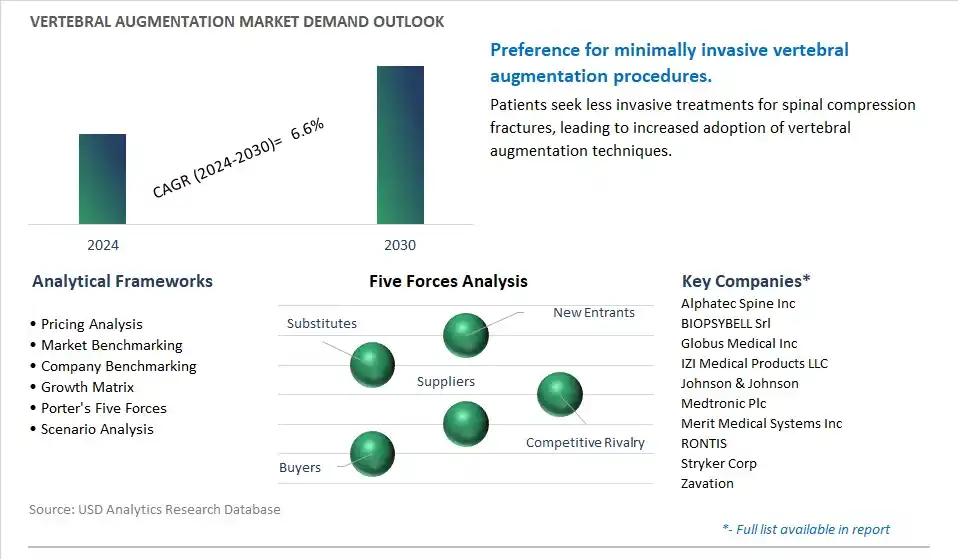
Vertebral Augmentation Market is estimated to increase at a growth rate of 6.6% CAGR over the forecast period from 2024 to 2030.
The global Vertebral Augmentation Market Study analyzes and forecasts the market size across 6 regions and 24 countries for diverse segments including By Product (Vertebroplastic Device, Kyphoplastic Device), By End-User (Hospitals, Ambulatory Surgery Centers, Others).
An Introduction to Vertebral Augmentation Market in 2024
The Vertebral Augmentation Market comprises minimally invasive spine procedures, vertebral compression fracture (VCF) treatments, and bone cement augmentation devices used in orthopedics, spine surgery, and vertebral fracture management for stabilizing vertebral fractures, reducing pain, and restoring spinal function in patients with osteoporosis, spinal tumors, or traumatic spine injuries. Vertebral augmentation procedures include vertebroplasty and kyphoplasty, utilizing bone cement injections and balloon-assisted techniques to reinforce vertebral bodies and alleviate vertebral fracture-related symptoms. Market dynamics encompass vertebral augmentation technologies, bone cement formulations, spinal implant innovations, and procedural advancements for improved vertebral fracture treatment outcomes and spine health restoration.
Vertebral Augmentation Market Competitive Landscape
The global Vertebral Augmentation Industry is highly competitive with a large number of companies focusing on niche market segments. Amidst intense competitive conditions, Vertebral Augmentation Companies are investing in new product launches and strengthening distribution channels. Key companies operating in the Vertebral Augmentation Industry include- Alphatec Spine Inc, BIOPSYBELL Srl, Globus Medical Inc, IZI Medical Products LLC, Johnson & Johnson, Medtronic Plc, Merit Medical Systems Inc, RONTIS, Stryker Corp, Zavation.
Vertebral Augmentation Market Trend: Advancements in Minimally Invasive Techniques
A notable trend in the market for Vertebral Augmentation is the continued advancements in minimally invasive techniques for the treatment of vertebral compression fractures (VCFs), driving the development of novel augmentation devices and procedural approaches to improve patient outcomes and reduce procedural morbidity. Vertebral augmentation procedures, including vertebroplasty and kyphoplasty, are minimally invasive interventions used to stabilize vertebral fractures, alleviate pain, and restore spinal alignment in patients with osteoporosis, osteolytic lesions, or traumatic injuries. Recent innovations in vertebral augmentation techniques include the use of advanced imaging modalities such as cone-beam computed tomography (CBCT) and navigation systems to enhance procedural accuracy, optimize cement placement, and minimize complications such as cement leakage and adjacent-level fractures. Additionally, the development of next-generation vertebral augmentation devices, such as expandable balloons, fenestrated screws, and biocompatible cements, offers greater procedural flexibility, precision, and clinical efficacy compared to traditional augmentation methods. As healthcare providers increasingly prioritize minimally invasive spine interventions and patient-centered care, the market for vertebral augmentation is expected to witness further innovation and adoption of advanced technologies to address the unmet needs of patients with VCFs and spinal pathologies.
Vertebral Augmentation Market Driver: Aging Population and Rising Incidence of Osteoporosis
A significant driver for the market of Vertebral Augmentation is the aging population and the associated increase in the incidence of osteoporosis-related vertebral compression fractures (VCFs), driving the demand for minimally invasive interventions to manage pain, restore mobility, and prevent vertebral deformities in elderly patients. Osteoporosis is a common age-related bone disorder characterized by reduced bone density and increased fracture risk, particularly in postmenopausal women and older adults. VCFs are a frequent complication of osteoporosis, leading to debilitating pain, functional impairment, and diminished quality of life. With the aging of the global population and the growing prevalence of osteoporosis-associated fractures, there is a rising demand for effective treatment options to address the clinical and economic burden of VCFs. Vertebral augmentation procedures offer significant benefits for elderly patients, including rapid pain relief, minimal tissue disruption, short hospital stays, and improved functional outcomes compared to conservative management or open surgical techniques. As the incidence of osteoporosis-related fractures continues to rise, driven by demographic shifts and lifestyle factors, the market for vertebral augmentation is poised for growth, with opportunities for market expansion, technological innovation, and enhanced patient care.
Vertebral Augmentation Market Opportunity: Personalized Treatment Approaches
An exciting opportunity for the market of Vertebral Augmentation lies in the development of personalized treatment approaches and patient-specific interventions tailored to the unique anatomical, biomechanical, and clinical characteristics of individual patients with vertebral compression fractures (VCFs). Personalized medicine approaches offer opportunities to optimize treatment outcomes, minimize complications, and improve patient satisfaction by tailoring vertebral augmentation procedures to patients' specific needs, preferences, and risk profiles. Advanced imaging techniques such as magnetic resonance imaging (MRI), dual-energy X-ray absorptiometry (DXA), and finite element analysis (FEA) enable clinicians to assess vertebral morphology, bone quality, and fracture biomechanics, guiding the selection of appropriate augmentation techniques, implant configurations, and cement delivery strategies. Furthermore, the integration of patient-reported outcome measures (PROMs), functional assessments, and quality-of-life metrics into clinical decision-making processes facilitates shared decision-making, treatment planning, and long-term monitoring of treatment efficacy and safety. By embracing personalized treatment approaches and multidisciplinary care models, healthcare providers can optimize clinical outcomes, reduce healthcare costs, and enhance the overall patient experience in the management of vertebral compression fractures. Manufacturers of vertebral augmentation devices can seize the opportunity to develop customizable implants, instrumentation, and procedural solutions that empower clinicians to deliver personalized care and improve patient outcomes in the evolving landscape of spine intervention.
Vertebral Augmentation Market Share Analysis: Kyphoplastic Device is the fastest growing market segment over the forecast period to 2030
Within the Vertebral Augmentation by Product segmentation, the Kyphoplastic Device emerges as a fast-growing segment. Kyphoplasty is a minimally invasive procedure used to treat vertebral compression fractures by restoring vertebral height and stability through the injection of bone cement into the fractured vertebrae. Kyphoplastic devices offer several advantages over traditional vertebroplastic devices, including enhanced control over cement placement, reduced risk of cement leakage, and improved restoration of vertebral anatomy. These devices are gaining popularity among healthcare providers due to their efficacy in providing immediate pain relief and restoring vertebral function, particularly in patients with osteoporotic fractures or spinal metastases. Additionally, the increasing prevalence of conditions such as osteoporosis and the aging population's rising demand for minimally invasive spine procedures contribute to the rapid growth of the kyphoplastic device segment. With hospitals and ambulatory surgery centers increasingly adopting kyphoplasty as a preferred treatment option for vertebral compression fractures, the market for kyphoplastic devices is poised for significant expansion, catering to the evolving needs of patients with spinal pathologies.
Vertebral Augmentation Market Segmentation
By Product
Vertebroplastic Device
Kyphoplastic Device
By End-User
Hospitals
Ambulatory Surgery Centers
Others
Geographical Analysis
North America (United States, Canada, Mexico)
Europe (Germany, France, United Kingdom, Spain, Italy, Rest of Europe)
Asia Pacific (China, India, Japan, South Korea, Rest of Asia Pacific)
South America (Brazil, Argentina, Rest of South America)
Middle East and Africa (Saudi Arabia, UAE, Rest of Middle East, South Africa, Egypt, Rest of Africa)
Vertebral Augmentation Companies
Alphatec Spine Inc
BIOPSYBELL Srl
Globus Medical Inc
IZI Medical Products LLC
Johnson & Johnson
Medtronic Plc
Merit Medical Systems Inc
RONTIS
Stryker Corp
Zavation
* List not Exhaustive
Reasons to Buy the Vertebral Augmentation Market Study
• Deepen your industry insights and navigate uncertainties for strategy formulation, CAPEX, and Operational decisions
• Gain access to detailed insights on the Vertebral Augmentation Market, encompassing current market size, growth trends, and forecasts till 2030.
• Access detailed competitor analysis, enabling competitive advantage through a thorough understanding of market players, strategies, and potential differentiation opportunities
• Stay ahead of the curve with insights on technological advancements, innovations, and upcoming trends
• Identify lucrative investment avenues and expansion opportunities within the Vertebral Augmentation Industry, guided by robust, data-backed analysis.
• Understand regional and global markets through country-wise analysis, regional market potential, regulatory nuances, and dynamics
• Execute strategies with confidence and speed through information, analytics, and insights on the industry value chain
• Corporate leaders, strategists, financial experts, shareholders, asset managers, and governmental representatives can make long-term planning scenarios and build an integrated and timely understanding of market dynamics
• Benefit from tailored solutions and expert consultation based on report insights, providing personalized strategies aligned with specific business needs.
TABLE OF CONTENTS
1 Introduction to 2024 Vertebral Augmentation Market
1.1 Market Overview
1.2 Quick Facts
1.3 Scope/Objective of the Study
1.4 Market Definition
1.5 Countries and Regions Analyzed
1.6 Units, Currency, and Conversions
1.7 Industry Value Chain
2 Research Methodology
2.1 Market Size Estimation
2.2 Sources and Research Methodology
2.3 Data Triangulation
2.4 Assumptions and Limitations
3 Executive Summary
3.1 Global Vertebral Augmentation Market Size Outlook, $ Million, 2021 to 2030
3.2 Vertebral Augmentation Market Outlook by Type, $ Million, 2021 to 2030
3.3 Vertebral Augmentation Market Outlook by Product, $ Million, 2021 to 2030
3.4 Vertebral Augmentation Market Outlook by Application, $ Million, 2021 to 2030
3.5 Vertebral Augmentation Market Outlook by Key Countries, $ Million, 2021 to 2030
4 Market Dynamics
4.1 Key Driving Forces of Vertebral Augmentation Industry
4.2 Key Market Trends in Vertebral Augmentation Industry
4.3 Potential Opportunities in Vertebral Augmentation Industry
4.4 Key Challenges in Vertebral Augmentation Industry
5 Market Factor Analysis
5.1 Value Chain Analysis
5.2 Competitive Landscape
5.2.1 Global Vertebral Augmentation Market Share by Company (%), 2023
5.2.2 Product Offerings by Company
5.3 Porter’s Five Forces Analysis
5.4 Pricing Analysis and Outlook
6 Growth Outlook Across Scenarios
6.1 Growth Analysis-Case Scenario Definitions
6.2 Low Growth Scenario Forecasts
6.3 Reference Growth Scenario Forecasts
6.4 High Growth Scenario Forecasts
7 Global Vertebral Augmentation Market Outlook by Segments
7.1 Vertebral Augmentation Market Outlook by Segments, $ Million, 2021- 2030
By Product
Vertebroplastic Device
Kyphoplastic Device
By End-User
Hospitals
Ambulatory Surgery Centers
Others
8 North America Vertebral Augmentation Market Analysis and Outlook To 2030
8.1 Introduction to North America Vertebral Augmentation Markets in 2024
8.2 North America Vertebral Augmentation Market Size Outlook by Country, 2021-2030
8.2.1 United States
8.2.2 Canada
8.2.3 Mexico
8.3 North America Vertebral Augmentation Market size Outlook by Segments, 2021-2030
By Product
Vertebroplastic Device
Kyphoplastic Device
By End-User
Hospitals
Ambulatory Surgery Centers
Others
9 Europe Vertebral Augmentation Market Analysis and Outlook To 2030
9.1 Introduction to Europe Vertebral Augmentation Markets in 2024
9.2 Europe Vertebral Augmentation Market Size Outlook by Country, 2021-2030
9.2.1 Germany
9.2.2 France
9.2.3 Spain
9.2.4 United Kingdom
9.2.4 Italy
9.2.5 Russia
9.2.6 Norway
9.2.7 Rest of Europe
9.3 Europe Vertebral Augmentation Market Size Outlook by Segments, 2021-2030
By Product
Vertebroplastic Device
Kyphoplastic Device
By End-User
Hospitals
Ambulatory Surgery Centers
Others
10 Asia Pacific Vertebral Augmentation Market Analysis and Outlook To 2030
10.1 Introduction to Asia Pacific Vertebral Augmentation Markets in 2024
10.2 Asia Pacific Vertebral Augmentation Market Size Outlook by Country, 2021-2030
10.2.1 China
10.2.2 India
10.2.3 Japan
10.2.4 South Korea
10.2.5 Indonesia
10.2.6 Malaysia
10.2.7 Australia
10.2.8 Rest of Asia Pacific
10.3 Asia Pacific Vertebral Augmentation Market size Outlook by Segments, 2021-2030
By Product
Vertebroplastic Device
Kyphoplastic Device
By End-User
Hospitals
Ambulatory Surgery Centers
Others
11 South America Vertebral Augmentation Market Analysis and Outlook To 2030
11.1 Introduction to South America Vertebral Augmentation Markets in 2024
11.2 South America Vertebral Augmentation Market Size Outlook by Country, 2021-2030
11.2.1 Brazil
11.2.2 Argentina
11.2.3 Rest of South America
11.3 South America Vertebral Augmentation Market size Outlook by Segments, 2021-2030
By Product
Vertebroplastic Device
Kyphoplastic Device
By End-User
Hospitals
Ambulatory Surgery Centers
Others
12 Middle East and Africa Vertebral Augmentation Market Analysis and Outlook To 2030
12.1 Introduction to Middle East and Africa Vertebral Augmentation Markets in 2024
12.2 Middle East and Africa Vertebral Augmentation Market Size Outlook by Country, 2021-2030
12.2.1 Saudi Arabia
12.2.2 UAE
12.2.3 Oman
12.2.4 Rest of Middle East
12.2.5 Egypt
12.2.6 Nigeria
12.2.7 South Africa
12.2.8 Rest of Africa
12.3 Middle East and Africa Vertebral Augmentation Market size Outlook by Segments, 2021-2030
By Product
Vertebroplastic Device
Kyphoplastic Device
By End-User
Hospitals
Ambulatory Surgery Centers
Others
13 Company Profiles
13.1 Company Snapshot
13.2 SWOT Profiles
13.3 Products and Services
13.4 Recent Developments
13.5 Financial Profile
List of Companies
Alphatec Spine Inc
BIOPSYBELL Srl
Globus Medical Inc
IZI Medical Products LLC
Johnson & Johnson
Medtronic Plc
Merit Medical Systems Inc
RONTIS
Stryker Corp
Zavation
14 Appendix
14.1 Customization Offerings
14.2 Subscription Services
14.3 Related Reports
14.4 Publisher Expertise
