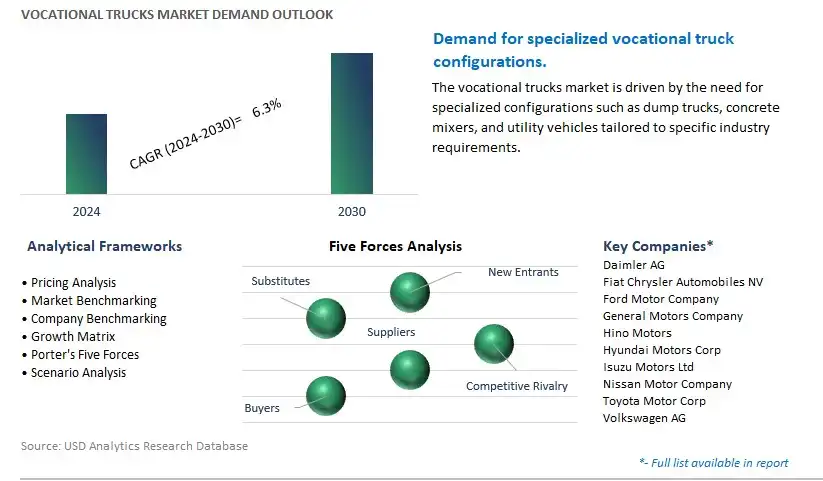
Vocational Trucks Market is estimated to increase at a growth rate of 6.3% CAGR over the forecast period from 2024 to 2030.
The global Vocational Trucks Market study analyzes and forecasts the market size across 6 regions and 24 countries for diverse segments including By Type (Light Duty Vocational Trucks, Medium Duty Vocational Trucks, Heavy Duty Vocational Trucks).
An Introduction to Global Vocational Trucks Market, 2024
The vocational trucks market in 2024 caters to industries and businesses requiring specialized vehicles for specific tasks and applications, such as construction, mining, waste management, and utility services. Vocational trucks, also known as work trucks or specialty vehicles, are designed and configured with features tailored to meet the unique needs of various vocational segments. These trucks come in a wide range of configurations, including dump trucks, concrete mixers, utility trucks, and refuse trucks, among others. With the growth of infrastructure development projects, urbanization, and industrial activities, the demand for vocational trucks remains robust. Manufacturers in this market focus on providing durable, reliable, and versatile vehicles equipped with features such as heavy-duty chassis, specialized bodies, and advanced safety technologies to enhance productivity and efficiency in vocational applications. Moreover, as industries evolve and adopt new technologies, vocational trucks integrate innovations such as electrification, autonomous operation, and telematics to improve performance, reduce emissions, and optimize fleet management. As essential components of various sectors, vocational trucks play a vital role in supporting economic growth, infrastructure development, and essential services worldwide.
Vocational Trucks Competitive Landscape
The global Vocational Trucks market is highly competitive with a large number of companies focusing on niche market segments. Amidst intense competitive conditions, Vocational Trucks Companies are investing in new product launches and strengthening distribution channels. Key companies operating in the Vocational Trucks Market Industry include- Daimler AG, Fiat Chrysler Automobiles NV, Ford Motor Company, General Motors Company, Hino Motors, Hyundai Motors Corp, Isuzu Motors Ltd, Nissan Motor Company, Toyota Motor Corp, Volkswagen AG.
Vocational Trucks Market Trend: Increased Demand for Customization and Specialization
A prominent trend in the Vocational Trucks market is the increased demand for customization and specialization among buyers. As businesses across various industries seek to optimize their operations and meet specific requirements, there's a growing need for vocational trucks that are tailored to their unique applications and workflows. This trend reflects a shift away from one-size-fits-all solutions towards customizable vocational trucks designed to handle specialized tasks such as construction, utilities, waste management, and delivery services. Manufacturers are responding by offering a wide range of customization options, including different chassis configurations, body types, payload capacities, and equipment installations, to meet the diverse needs of vocational truck customers in the market.
Vocational Trucks Market Driver: Infrastructure Development and Urbanization Projects
The primary driver propelling the growth of the Vocational Trucks market is the ongoing infrastructure development and urbanization projects worldwide. As cities expand, infrastructure networks grow, and construction activities increase, there's a rising demand for vocational trucks to support various construction, maintenance, and utility tasks. These trucks play a crucial role in transporting materials, equipment, and personnel to construction sites, as well as facilitating essential services such as road maintenance, street cleaning, and utility installations. Additionally, the implementation of large-scale infrastructure projects, such as transportation systems, utility upgrades, and renewable energy installations, drives the demand for specialized vocational trucks tailored to the unique requirements of these projects, thus fueling market growth in the vocational truck segment.
Vocational Trucks Market Opportunity: Integration of Advanced Technology and Telematics Solutions
An Market Opportunity ripe for exploration within the Vocational Trucks market is the integration of advanced technology and telematics solutions to enhance efficiency, safety, and productivity. By incorporating technologies such as GPS tracking, remote diagnostics, onboard sensors, and fleet management software, manufacturers can offer vocational trucks with enhanced capabilities for monitoring, analyzing, and optimizing performance in real time. These telematics solutions enable fleet managers to track vehicle locations, monitor fuel consumption, schedule maintenance tasks, and improve route planning, resulting in cost savings, operational efficiency, and better resource utilization. Additionally, the integration of advanced safety features such as collision avoidance systems, lane departure warning, and driver assistance technologies enhances the safety and reliability of vocational trucks, reducing the risk of accidents and improving overall productivity in various vocational applications. By embracing opportunities to integrate advanced technology and telematics solutions, stakeholders in the vocational truck market can differentiate their offerings, attract new customers, and drive market growth in the evolving landscape of vocational transportation solutions.
Vocational Trucks Market Segmentation
By Type
Light Duty Vocational Trucks
-Pickup Trucks
-Vans and Buses
Medium Duty Vocational Trucks
-Box Trucks
-Cab and Chassis Trucks
-Cars
Heavy Duty Vocational Trucks
-Dump and Wrecker Trucks
-Fire and Emergency Trucks
-Garbage and Refuse Trucks
-School and Transit BusesGeographical Analysis
North America (United States, Canada, Mexico)
Europe (Germany, France, United Kingdom, Spain, Italy, Rest of Europe)
Asia Pacific (China, India, Japan, South Korea, Rest of Asia Pacific)
South America (Brazil, Argentina, Rest of South America)
Middle East and Africa (Saudi Arabia, UAE, Rest of Middle East, South Africa, Egypt, Rest of Africa
Vocational Trucks Companies
Daimler AG
Fiat Chrysler Automobiles NV
Ford Motor Company
General Motors Company
Hino Motors
Hyundai Motors Corp
Isuzu Motors Ltd
Nissan Motor Company
Toyota Motor Corp
Volkswagen AG
*- List not Exhaustive
TABLE OF CONTENTS
1 Introduction to 2024 Vocational Trucks Market
1.1 Market Overview
1.2 Quick Facts
1.3 Scope/Objective of the Study
1.4 Market Definition
1.5 Countries and Regions Analyzed
1.6 Units, Currency, and Conversions
1.7 Industry Value Chain
2 Research Methodology
2.1 Market Size Estimation
2.2 Sources and Research Methodology
2.3 Data Triangulation
2.4 Assumptions and Limitations
3 Executive Summary
3.1 Global Vocational Trucks Market Size Outlook, $ Million, 2021 to 2030
3.2 Vocational Trucks Market Outlook by Type, $ Million, 2021 to 2030
3.3 Vocational Trucks Market Outlook by Product, $ Million, 2021 to 2030
3.4 Vocational Trucks Market Outlook by Application, $ Million, 2021 to 2030
3.5 Vocational Trucks Market Outlook by Key Countries, $ Million, 2021 to 2030
4 Market Dynamics
4.1 Key Driving Forces of Vocational Trucks Industry
4.2 Key Market Trends in Vocational Trucks Industry
4.3 Potential Opportunities in Vocational Trucks Industry
4.4 Key Challenges in Vocational Trucks Industry
5 Market Factor Analysis
5.1 Value Chain Analysis
5.2 Competitive Landscape
5.2.1 Global Vocational Trucks Market Share by Company (%), 2023
5.2.2 Product Offerings by Company
5.3 Porter’s Five Forces Analysis
5.4 Pricing Analysis and Outlook
6 Growth Outlook Across Scenarios
6.1 Growth Analysis-Case Scenario Definitions
6.2 Low Growth Scenario Forecasts
6.3 Reference Growth Scenario Forecasts
6.4 High Growth Scenario Forecasts
7 Global Vocational Trucks Market Outlook by Segments
7.1 Vocational Trucks Market Outlook by Segments, $ Million, 2021- 2030
By Type
Light Duty Vocational Trucks
-Pickup Trucks
-Vans and Buses
Medium Duty Vocational Trucks
-Box Trucks
-Cab and Chassis Trucks
-Cars
Heavy Duty Vocational Trucks
-Dump and Wrecker Trucks
-Fire and Emergency Trucks
-Garbage and Refuse Trucks
-School and Transit Buses
8 North America Vocational Trucks Market Analysis and Outlook To 2030
8.1 Introduction to North America Vocational Trucks Markets in 2024
8.2 North America Vocational Trucks Market Size Outlook by Country, 2021-2030
8.2.1 United States
8.2.2 Canada
8.2.3 Mexico
8.3 North America Vocational Trucks Market size Outlook by Segments, 2021-2030
By Type
Light Duty Vocational Trucks
-Pickup Trucks
-Vans and Buses
Medium Duty Vocational Trucks
-Box Trucks
-Cab and Chassis Trucks
-Cars
Heavy Duty Vocational Trucks
-Dump and Wrecker Trucks
-Fire and Emergency Trucks
-Garbage and Refuse Trucks
-School and Transit Buses
9 Europe Vocational Trucks Market Analysis and Outlook To 2030
9.1 Introduction to Europe Vocational Trucks Markets in 2024
9.2 Europe Vocational Trucks Market Size Outlook by Country, 2021-2030
9.2.1 Germany
9.2.2 France
9.2.3 Spain
9.2.4 United Kingdom
9.2.4 Italy
9.2.5 Russia
9.2.6 Norway
9.2.7 Rest of Europe
9.3 Europe Vocational Trucks Market Size Outlook by Segments, 2021-2030
By Type
Light Duty Vocational Trucks
-Pickup Trucks
-Vans and Buses
Medium Duty Vocational Trucks
-Box Trucks
-Cab and Chassis Trucks
-Cars
Heavy Duty Vocational Trucks
-Dump and Wrecker Trucks
-Fire and Emergency Trucks
-Garbage and Refuse Trucks
-School and Transit Buses
10 Asia Pacific Vocational Trucks Market Analysis and Outlook To 2030
10.1 Introduction to Asia Pacific Vocational Trucks Markets in 2024
10.2 Asia Pacific Vocational Trucks Market Size Outlook by Country, 2021-2030
10.2.1 China
10.2.2 India
10.2.3 Japan
10.2.4 South Korea
10.2.5 Indonesia
10.2.6 Malaysia
10.2.7 Australia
10.2.8 Rest of Asia Pacific
10.3 Asia Pacific Vocational Trucks Market size Outlook by Segments, 2021-2030
By Type
Light Duty Vocational Trucks
-Pickup Trucks
-Vans and Buses
Medium Duty Vocational Trucks
-Box Trucks
-Cab and Chassis Trucks
-Cars
Heavy Duty Vocational Trucks
-Dump and Wrecker Trucks
-Fire and Emergency Trucks
-Garbage and Refuse Trucks
-School and Transit Buses
11 South America Vocational Trucks Market Analysis and Outlook To 2030
11.1 Introduction to South America Vocational Trucks Markets in 2024
11.2 South America Vocational Trucks Market Size Outlook by Country, 2021-2030
11.2.1 Brazil
11.2.2 Argentina
11.2.3 Rest of South America
11.3 South America Vocational Trucks Market size Outlook by Segments, 2021-2030
By Type
Light Duty Vocational Trucks
-Pickup Trucks
-Vans and Buses
Medium Duty Vocational Trucks
-Box Trucks
-Cab and Chassis Trucks
-Cars
Heavy Duty Vocational Trucks
-Dump and Wrecker Trucks
-Fire and Emergency Trucks
-Garbage and Refuse Trucks
-School and Transit Buses
12 Middle East and Africa Vocational Trucks Market Analysis and Outlook To 2030
12.1 Introduction to Middle East and Africa Vocational Trucks Markets in 2024
12.2 Middle East and Africa Vocational Trucks Market Size Outlook by Country, 2021-2030
12.2.1 Saudi Arabia
12.2.2 UAE
12.2.3 Oman
12.2.4 Rest of Middle East
12.2.5 Egypt
12.2.6 Nigeria
12.2.7 South Africa
12.2.8 Rest of Africa
12.3 Middle East and Africa Vocational Trucks Market size Outlook by Segments, 2021-2030
By Type
Light Duty Vocational Trucks
-Pickup Trucks
-Vans and Buses
Medium Duty Vocational Trucks
-Box Trucks
-Cab and Chassis Trucks
-Cars
Heavy Duty Vocational Trucks
-Dump and Wrecker Trucks
-Fire and Emergency Trucks
-Garbage and Refuse Trucks
-School and Transit Buses
13 Company Profiles
13.1 Company Snapshot
13.2 SWOT Profiles
13.3 Products and Services
13.4 Recent Developments
13.5 Financial Profile
List of Companies
Daimler AG
Fiat Chrysler Automobiles NV
Ford Motor Company
General Motors Company
Hino Motors
Hyundai Motors Corp
Isuzu Motors Ltd
Nissan Motor Company
Toyota Motor Corp
Volkswagen AG
14 Appendix
14.1 Customization Offerings
14.2 Subscription Services
14.3 Related Reports
14.4 Publisher Expertise
By Type
Light Duty Vocational Trucks
-Pickup Trucks
-Vans and Buses
Medium Duty Vocational Trucks
-Box Trucks
-Cab and Chassis Trucks
-Cars
Heavy Duty Vocational Trucks
-Dump and Wrecker Trucks
-Fire and Emergency Trucks
-Garbage and Refuse Trucks
-School and Transit Buses
