Warehouse Automation and Autonomous Mobile Robots Market Overview: Fulfillment Robotics, AS/RS Systems and Warehouse Operating Economics
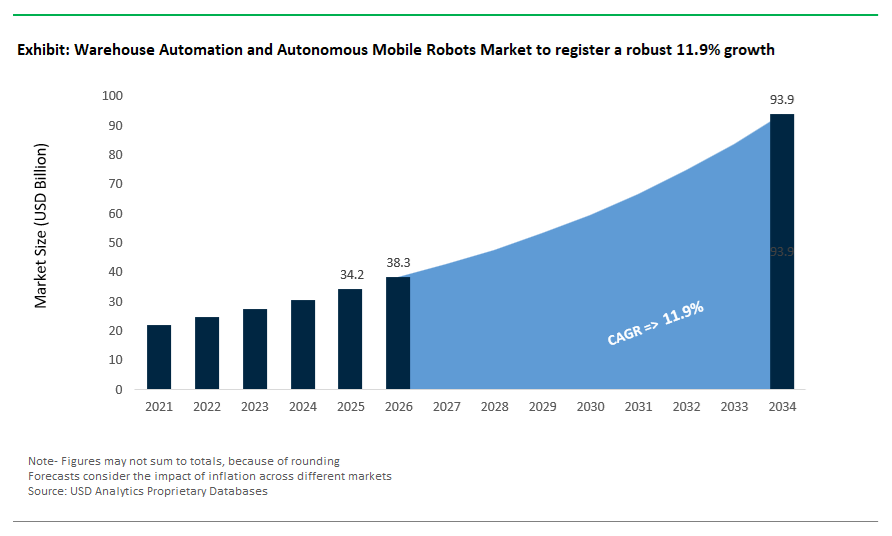
The global Warehouse Automation and Autonomous Mobile Robots Market is valued at USD 38,337.5 million in 2026 and is expected to reach USD 94,094.8 million by 2034, expanding at a CAGR of 11.9% during the forecast period. The market encompasses automated storage and retrieval systems (AS/RS), autonomous mobile robots (AMRs), goods-to-person picking systems, robotic palletizing and depalletizing equipment, automated sortation systems, conveyors, and warehouse execution software. Demand originates from e-commerce fulfillment centers, third-party logistics (3PL) providers, retail distribution networks, grocery operators, pharmaceutical distributors, and industrial warehouses managing high order volumes and increasingly complex inventory profiles. Commercial requirements are concentrated around order-processing throughput, picking accuracy, storage density, labor productivity, and reliable fulfillment across peak and off-peak operating periods.
Warehouse automation demand translates into supplier revenue through turnkey automation projects, robotic fleet purchases, system integration contracts, software licensing, and recurring maintenance agreements. Large distribution centers procure integrated automation systems combining storage infrastructure, robotic handling equipment, conveyors, and warehouse control systems, while smaller or variable-volume facilities increasingly use modular AMR fleets and Robotics-as-a-Service (RaaS) arrangements. The International Federation of Robotics reported 117,500 transport and logistics service robots sold globally in 2025, an increase of 21%, reflecting expanding commercial deployment across material movement and logistics applications. These figures cover the broader transportation and logistics robotics category, not warehouse AMRs exclusively. Revenue opportunities extend into fleet management software, warehouse execution systems (WES), robotic picking workstations, maintenance support, system upgrades, and expansion of installed automation capacity.
Commercial value in the Warehouse Automation and Autonomous Mobile Robots Market is determined by order lines processed per hour, cost per fulfilled order, storage locations per square meter, system availability, and compatibility with existing warehouse infrastructure. Buyers compare fixed automation architectures with flexible robotic systems based on throughput stability, product dimensions, SKU variability, installation requirements, and changes in order profiles. High-density AS/RS systems and robotic shuttle solutions address storage-intensive applications, while autonomous mobile robots provide configurable material transport and goods-to-person workflows across changing warehouse layouts. Integrated solutions combining AMRs, robotic arms, machine vision, and warehouse orchestration software command value through broader workflow coverage and reduced manual handling. Contract economics depend on implementation scope, facility modifications, fleet utilization, software integration, maintenance commitments, and the capacity of automation systems to accommodate seasonal throughput fluctuations.
Key Insights: Warehouse Automation and Autonomous Mobile Robots Market
- Market Size and Growth: Valued at USD 38,337.5 million in 2026, the market is projected to reach USD 94,094.8 million by 2034, growing at a CAGR of 11.9%.
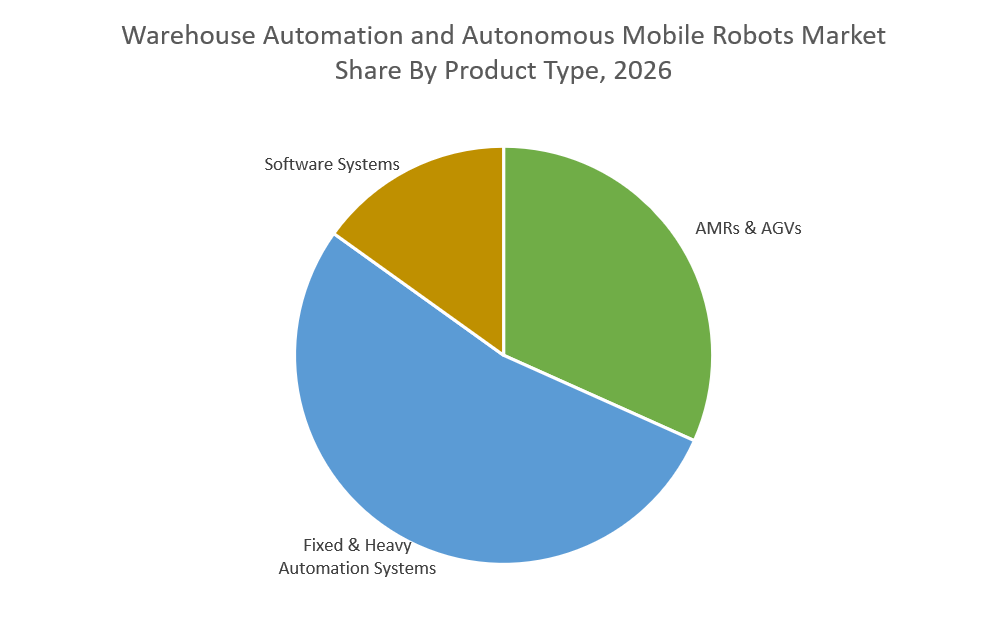
- Leading Product Segment: Fixed & Heavy Automation Systems hold the largest market share at 53.2% in 2026, supported by AS/RS, conveyor systems, and automated sortation infrastructure.
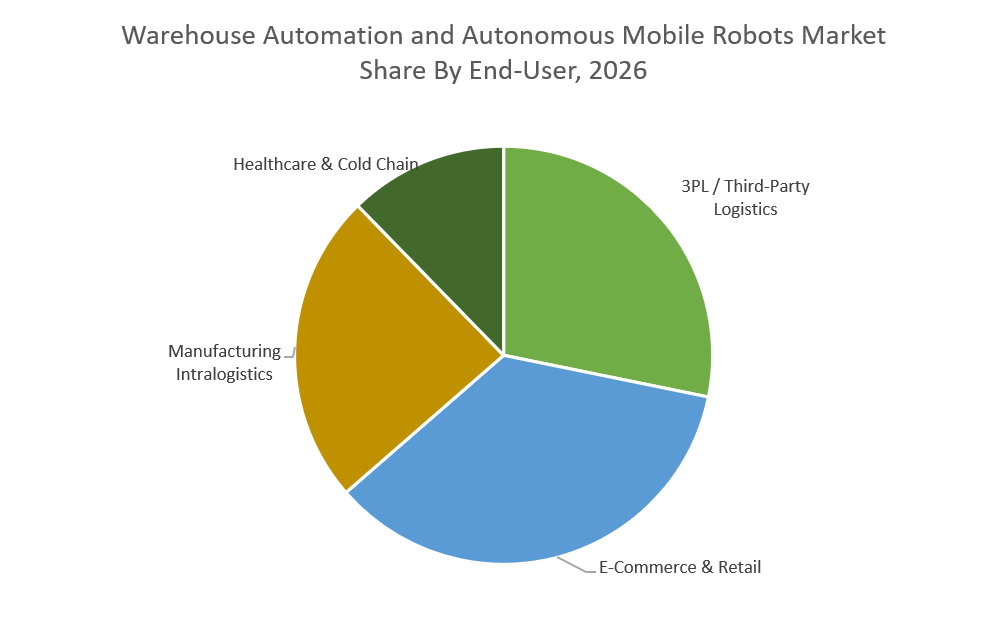
- Largest End-User: E-Commerce & Retail accounts for 35.4% of the market, driven by omnichannel fulfillment, high-volume order processing, and automated distribution.
- Key Market Dynamics: AI-powered fleet orchestration, goods-to-person robotics, warehouse labor constraints, and high-density storage systems influence automation demand.
- Emerging Opportunities: Modular warehouse retrofits, autonomous pallet handling, and Robotics-as-a-Service (RaaS) are expanding flexible automation deployment models.
Recent Developments in Warehouse Automation and AMRs: High-Density Fulfillment, Robotic Picking and Software Orchestration
Warehouse automation manufacturers are extending their product portfolios from individual robotic handling systems toward integrated fulfillment platforms combining hardware, AI-enabled software, and operational analytics. In October 2026, AutoStore announced an expanded warehouse automation portfolio that included FlexBinsPort for handling different bin sizes at one workstation, enhanced AutoCase functionality for case handling, Pio Pal robotic picking capabilities, and new CubeVerse applications for system design and maintenance visibility. The announcement builds on the CubeVerse cloud platform and AutoStore Intelligence introduced in March 2026. These developments extend cube-based automated storage technology into more fulfillment workflows, including case handling, item picking, system simulation, and maintenance management.
Commercial-scale robotic deployments are providing evidence of warehouse automation performance across high-SKU distribution environments. In September 2026, GXO Logistics and Exotec announced the deployment of an automated Skypod fulfillment system for Guess in Venlo, Netherlands. The installation comprises 127 robots, approximately 60,000 rack locations, eight goods-to-person picking stations, and 200 meters of conveyors. According to the companies, the facility processes 40,000–70,000 pieces daily and can achieve up to 2,200 order lines per hour during peak operating periods. The deployment illustrates the role of robotic storage and retrieval systems in contract logistics environments with seasonal demand, extensive product assortments, and cross-regional distribution requirements.
AMR manufacturers are simultaneously expanding throughput capabilities and robotic coordination software. In August 2026, Geekplus launched RoboShuttle Hyper, a tote-to-person climbing AMR system designed for high-density fulfillment, micro-fulfillment centers, and variable-volume e-commerce operations. The company specifies a throughput capability of up to 6,000 totes per hour per 1,000 square meters, while its accompanying Max Workstation supports continuous tote feeding. Earlier, in April 2026, Dematic announced a partnership with GreyOrange to incorporate the GreyMatter AI-powered orchestration platform into its warehouse software ecosystem. The collaboration addresses the coordination of fixed automation, autonomous mobile robots, and human-operated workflows within mixed-technology facilities, where warehouse execution performance depends on the synchronization of multiple equipment and software platforms.
Warehouse Automation and AMR Safety Regulations: ISO 3691-4, EU Machinery Regulation and Industrial Mobile Robot Standards
Warehouse automation systems are subject to machinery-safety requirements, workplace risk assessments, and technical standards governing robotic equipment and integrated material-handling operations. The international standard ISO 3691-4:2023 establishes safety requirements and verification provisions for driverless industrial trucks and their systems, including applicable autonomous mobile robots and automated guided vehicles. The standard addresses hazards associated with driverless industrial truck operation and operating-zone conditions. A revised ISO/DIS 3691-4 entered the standards-development process in 2026 but remained a draft as of October 2026, with the 2023 edition continuing as the published reference.
In the European Union, Machinery Regulation (EU) 2023/1230 becomes generally applicable on January 20, 2027, replacing the existing Machinery Directive 2006/42/EC. The regulation updates machinery safety provisions, including requirements addressing AI-enabled safety functions, the integrity of safety-related control systems, and protection against corruption of safety-related software and data. These provisions are relevant to warehouse robotics manufacturers and system integrators supplying automated equipment to European distribution and manufacturing facilities.
In North America, the ANSI/A3 R15.08 industrial mobile robot safety standards address robot design, system integration, and operational use. The 2026 publication of ANSI/A3 R15.08-3 extends the series to the use of industrial mobile robot applications in day-to-day operations, including maintaining acceptable workplace risk. OSHA separately identifies applicable workplace-safety requirements but does not maintain a robotics-specific federal safety standard. Safety engineering, fleet integration, personnel detection, and documented risk assessment remain important elements of commercial robot deployment and conformity evaluation.
Key Market Trends Reshaping Warehouse Automation and Autonomous Mobile Robots
AI-Driven AMR Fleet Orchestration and Multi-Vendor Warehouse Software Interoperability
Warehouse automation is increasingly moving toward software-coordinated operations that integrate autonomous mobile robots, automated storage and retrieval systems, conveyors, robotic picking equipment, and warehouse management systems. AI-enabled warehouse execution software supports task allocation, robotic fleet scheduling, traffic management, and the coordination of material flows across different automation technologies. The 2026 MHI and Deloitte Annual Industry Report found that 39% of surveyed supply chain leaders considered robotics and automation significantly disruptive, while AI received an even higher assessment. Interoperability is becoming a commercial differentiator as warehouses deploy equipment from multiple manufacturers and seek centralized control over robotic movements. The VDA 5050 communication interface provides a common technical foundation for connecting compatible mobile robots with fleet-control systems, although overall interoperability remains dependent on implementation and integration scope. Supplier value is increasingly associated with orchestration software, application programming interfaces (APIs), navigation intelligence, system integration, and ongoing fleet optimization services.
Adoption of High-Density AS/RS and Goods-to-Person Robotic Fulfillment Systems
High-density automated storage and retrieval systems (AS/RS) and goods-to-person (GTP) technologies are gaining commercial importance among retailers, e-commerce distributors, and third-party logistics operators managing extensive SKU portfolios and constrained warehouse footprints. Cube-based storage, robotic shuttle systems, automated bin retrieval, and integrated picking stations reduce dependence on conventional aisle-based manual retrieval while increasing inventory accessibility within available storage space. An AutoStore customer deployment for Outdoor Network demonstrates the scale of integrated fulfillment infrastructure, with 28,700 storage bins accommodating more than 80,000 SKUs and 14 goods-to-person picking ports connected to a broader automation system. These technologies generate commercial value through storage density, order-line throughput, picking accuracy, and the reduction of nonproductive worker travel. System economics are influenced by inventory turnover, bin and tote dimensions, workstation utilization, replenishment frequency, and the balance between storage capacity and retrieval speed. Demand encompasses complete AS/RS installations, robotic picking modules, material-handling integration, and warehouse control software.
Key Drivers Accelerating Warehouse Automation and Autonomous Mobile Robots Market Growth
E-Commerce and Omnichannel Fulfillment Complexity
The continued expansion of digital retail and omnichannel distribution is increasing the operational requirements placed on warehouse fulfillment infrastructure. According to the U.S. Census Bureau's second-quarter 2026 retail e-commerce data, seasonally adjusted e-commerce sales increased 12.2% year over year and represented 17.1% of total U.S. retail sales. Higher online sales activity contributes to demand for individual-item picking, order consolidation, returns processing, and flexible fulfillment capacity across distribution networks. Omnichannel warehouses must coordinate store replenishment, direct-to-consumer shipments, and returns while handling different order sizes, inventory allocation rules, and delivery commitments. These operating conditions support demand for automated sortation, goods-to-person systems, robotic picking, and autonomous mobile material transport. Automation procurement is closely connected to orders processed per hour, SKU accessibility, peak-period throughput, fulfillment accuracy, and the ability of warehouse execution systems to coordinate inventory movements across multiple sales channels.
Warehouse Labor Constraints and Rising Fulfillment Operating Costs
Warehouse workforce availability and labor-intensive fulfillment processes remain important commercial drivers of robotic material handling and distribution-center automation. Manual picking, pallet movement, replenishment, and internal transportation require substantial labor hours, particularly in facilities with high order volumes or extended operating schedules. The U.S. Bureau of Labor Statistics reported average hourly earnings of USD 26.74 for employees in the warehousing and storage industry in August 2026, while production and nonsupervisory employees earned an average USD 26.02 per hour. Labor economics vary considerably across countries and facility types, but staffing costs, employee turnover, training requirements, and workload variability remain central factors in warehouse automation purchasing decisions. AMRs and automated material-handling systems reduce the manual transport component of order fulfillment and allow workers to perform receiving, exception handling, replenishment, and picking at designated workstations. Commercial evaluation increasingly incorporates labor hours per order, cost per order line, equipment utilization, and throughput consistency across operating shifts.
Emerging Opportunities in Warehouse Automation and Autonomous Mobile Robots
Brownfield Warehouse Retrofits Using Modular AMRs and Scalable Automation
Existing distribution centers represent a substantial application opportunity for modular autonomous mobile robots and warehouse automation systems that can operate within established building layouts. Unlike greenfield automation projects, brownfield deployments must accommodate existing storage racks, floor conditions, loading docks, conveyor infrastructure, warehouse management software, and ongoing fulfillment activities. Modular AMR systems allow automation capacity to be introduced through configurable robotic fleets, charging infrastructure, workstation interfaces, and software integration without necessarily replacing the entire material-handling architecture. Applications are expanding beyond tote transportation into pallet movement, automated replenishment, mobile manipulation, and coordinated material transfer between storage and processing zones. Vision-based navigation, LiDAR sensing, simultaneous localization and mapping (SLAM), and fleet coordination software support robotic operation in environments containing workers, forklifts, and changing material flows. The commercial scope includes robotic fleet deployment, facility integration, mapping and commissioning services, software interfaces, and subsequent capacity expansion, with project economics shaped by throughput requirements, installation constraints, and operational disruption during commissioning.
Expansion of Robotics-as-a-Service and Subscription-Based Warehouse Automation
Robotics-as-a-Service (RaaS) is expanding the commercial models available to warehouse automation suppliers and logistics operators by separating robotic system access from conventional equipment ownership. Subscription-based arrangements can combine AMR hardware, fleet management software, technical support, maintenance, and equipment availability within recurring service contracts. The International Federation of Robotics' 2025 service robotics report recorded 42% growth in RaaS within its transportation and logistics service-robot category during 2024, reflecting increased adoption of rental and subscription arrangements across material transport applications. The reported figure covers a broader robotics category than warehouse AMRs alone. RaaS adoption is commercially relevant to third-party logistics providers, seasonal distribution operations, and mid-sized warehouses where robotic capacity requirements change with customer contracts or order volumes. Supplier revenue models encompass monthly fleet subscriptions, software services, preventive maintenance, fleet expansion, and contract renewals. Commercial differentiation depends on system uptime, service coverage, robot utilization, contract duration, and the allocation of maintenance and technology lifecycle costs between equipment providers and warehouse operators.
Warehouse Automation and Autonomous Mobile Robots Market Share Analysis, 2026
Fixed and Heavy Automation Systems Lead Warehouse Automation and AMR Market by Product Type
Fixed & Heavy Automation Systems accounted for the largest share of the Warehouse Automation and Autonomous Mobile Robots Market at 53.2% in 2026, supported by substantial equipment and integration expenditure associated with automated storage and retrieval systems (AS/RS), conveyor networks, sortation systems, and robotic material-handling infrastructure. Large distribution centers and fulfillment facilities rely on these systems for high-volume inventory movement, automated storage, and consistent order-processing throughput. AMRs & AGVs represent the second-largest product category, reflecting demand for flexible goods-to-person picking, autonomous pallet transport, and warehouse replenishment applications. Software Systems contribute through warehouse execution platforms, robotic fleet management, automation orchestration, and control-system integration, with recurring licensing and technical support forming part of the commercial revenue structure.
E-Commerce and Retail Dominate Warehouse Automation and AMR Market by End-User
E-Commerce & Retail accounted for the largest share of the Warehouse Automation and Autonomous Mobile Robots Market at 35.4% in 2026, reflecting extensive automation requirements across online fulfillment centers, omnichannel distribution facilities, and retail inventory networks. High SKU diversity, variable order volumes, individual-item picking, and shorter fulfillment windows support demand for robotic picking, goods-to-person systems, automated sortation, and warehouse execution software. Third-Party Logistics represents the second-largest end-user segment, supported by multi-client fulfillment operations and the need to accommodate changing contract volumes. Manufacturing Intralogistics contributes through automated production replenishment, pallet movement, and internal material transport, while Healthcare & Cold Chain applications involve pharmaceutical distribution, temperature-controlled storage, and specialized inventory-handling systems.
Competitive Landscape of Warehouse Automation Systems, AMRs and Intralogistics Robotics
The Warehouse Automation and Autonomous Mobile Robots Market comprises established material-handling system integrators, specialized robotics manufacturers, warehouse software developers, and integrated automation solution providers. Daifuku, Dematic, Vanderlande, SSI SCHAEFER, KNAPP, Swisslog, and TGW Logistics maintain broad portfolios covering automated storage, conveyor systems, sortation equipment, robotic material handling, and warehouse control technologies. These companies compete primarily in complex distribution-center projects requiring engineering design, equipment integration, installation, commissioning, and long-term operational support. Their competitive positions reflect project delivery capabilities, equipment reliability, installed system experience, and the availability of regional engineering and maintenance services.
Specialized robotics providers, including AutoStore, Exotec, Geekplus, Locus Robotics, and Hai Robotics, compete through differentiated robotic handling architectures and application-specific fulfillment systems. AutoStore's cube-storage technology occupies a distinct position within compact automated storage, while Exotec and Hai Robotics focus on robotic storage and retrieval configurations. Geekplus and Locus Robotics offer mobile robotic solutions addressing different warehouse fulfillment workflows. Competitive differentiation is influenced by robot carrying capacity, retrieval performance, storage configuration, workstation compatibility, and the flexibility of automation systems across different inventory characteristics. Distribution partnerships and certified systems integrators also influence commercial reach, particularly where robotic equipment forms part of a larger warehouse automation installation.
Symbotic and Ocado Intelligent Automation represent integrated robotics and software-driven warehouse automation businesses, with offerings spanning robotic material handling, storage infrastructure, and fulfillment execution. GreyOrange participates through robotic fulfillment solutions and warehouse orchestration software. The Symbotic integrated warehouse automation platform illustrates the combination of autonomous robotics, industrial handling equipment, and proprietary software within a coordinated material-flow system. Software capabilities represent an important element of supplier differentiation, particularly in equipment scheduling, warehouse execution, inventory synchronization, and the management of automation interfaces across existing enterprise systems.
Commercial competition extends beyond initial equipment specifications to include turnkey project pricing, installation schedules, system availability, lifecycle maintenance, and warehouse software integration. Large automation integrators typically compete for multi-year distribution infrastructure projects, while specialized robotics providers participate through direct enterprise contracts, integration partnerships, and recurring service arrangements. Dematic's warehouse software portfolio demonstrates the breadth of management, execution, and equipment-control software associated with integrated fulfillment operations. Supplier competitiveness is also influenced by global service coverage, spare-parts availability, commissioning resources, customer-specific system engineering, and the cost of adapting automation infrastructure to changing distribution requirements.
Warehouse Automation and Autonomous Mobile Robots Market Geographical Analysis: Leading Countries and Regional Industry Developments
United States Warehouse Automation and AMR Market — E-Commerce Fulfillment and Robotic Distribution Centers
The United States represents a major market for warehouse automation and autonomous mobile robots, supported by large-scale retail distribution networks, third-party logistics operations, grocery supply chains, and manufacturing warehouses. In October 2026, Walmart opened its fifth next-generation fulfillment center in Stockton, California, a facility exceeding 900,000 square feet that incorporates advanced automation and machine learning to increase storage and order-processing capacity. Amazon has separately deployed its Proteus autonomous mobile robots across 25 U.S. fulfillment centers, demonstrating operational adoption of robotic material transport in high-volume distribution environments. Domestic demand encompasses automated storage and retrieval systems (AS/RS), autonomous pallet movers, robotic picking, goods-to-person fulfillment, and warehouse execution software. Large retail and wholesale distribution networks generate substantial equipment and system integration requirements, while warehouse automation procurement is influenced by fulfillment throughput, regional delivery coverage, system availability, and the operating economics of labor-intensive distribution facilities.
China Warehouse Automation and AMR Market — High-Density Storage and Intelligent Logistics Infrastructure
China maintains an extensive warehouse automation ecosystem supported by large e-commerce platforms, integrated logistics providers, manufacturing supply chains, and domestic robotics manufacturers. JD Logistics reported that its Zhilang intelligent warehousing system entered large-scale nationwide deployment during the first half of 2025, including facilities in Beijing, Guangzhou, Chengdu, and Fuzhou. The system integrates mobile handling robots, climbing robots, three-dimensional storage racks, automated sorting workstations, and container-return equipment, utilizing warehouse clear heights of up to 12 meters for high-density inventory storage. China's warehouse automation market includes domestic suppliers such as Geekplus, Hai Robotics, and Hikrobot, alongside international material-handling technology providers. Commercial demand is concentrated around robotic goods-to-person picking, automated inventory retrieval, intelligent sorting, and high-throughput distribution infrastructure serving online retail and industrial logistics. Project economics are influenced by storage-space utilization, order-processing capacity, robotic fleet coordination, and integration with warehouse management and logistics execution systems.
Germany Warehouse Automation and AMR Market — Manufacturing Intralogistics and Automated Storage Systems
Germany's Warehouse Automation and Autonomous Mobile Robots Market is supported by established automotive, industrial machinery, electronics, pharmaceutical, and wholesale distribution operations. Manufacturing intralogistics represents an important application area, with automated systems connecting component storage, material replenishment, production workstations, and finished-goods handling. In February 2026, Siemens commissioned KNAPP to develop an AeroBot robotic warehouse system at its Karlsruhe manufacturing facility, designed to accommodate 30,000 storage locations across 27 levels and incorporate 21 autonomous storage robots. The system was scheduled for commissioning during 2026, while KNAPP's Open Shuttle AMRs were already supporting production logistics at the facility. Germany also hosts major automation technology companies and system integrators, including SSI SCHAEFER, Dematic, and Jungheinrich. Commercial demand extends across automated small-parts warehouses, shuttle-based AS/RS, autonomous mobile transport, and warehouse control software, with system compatibility, equipment reliability, maintenance coverage, and integration with enterprise resource planning platforms influencing procurement requirements.
Japan Warehouse Automation and AMR Market — Food Distribution, Robotic Picking and Cold-Chain Logistics
Japan's warehouse automation market is supported by food distribution, pharmaceuticals, retail logistics, automotive components, and industrial manufacturing supply chains. Labor availability and the operational requirements of temperature-controlled distribution facilities contribute to demand for automated picking, robotic storage, and autonomous material handling. In July 2026, Mitsubishi Shokuhin, IHI Logistics Industrial Systems, and Exotec commenced full-scale operation of an automated logistics system at the Soka Food Service Distribution Center. The ambient-temperature operation incorporates 44 Skypod robots and approximately 10,182 storage bins, while the frozen-storage area uses a separate automated case-handling system with capacity for 7,488 cases. This combination demonstrates the application of robotic goods-to-person technology alongside specialized cold-storage automation within food wholesale distribution. Japanese suppliers including Daifuku, Toyota Industries, and Murata Machinery maintain established material-handling technology portfolios. Commercial requirements encompass AS/RS installations, robotic case handling, automated pallet transport, and integrated warehouse control systems supporting continuous distribution operations.
United Kingdom Warehouse Automation and AMR Market — Retail Distribution and Robotic E-Commerce Fulfillment
The United Kingdom represents an established market for warehouse automation, particularly across e-commerce fulfillment, grocery distribution, parcel logistics, and third-party logistics facilities. Large retailers and logistics operators are expanding robotic fulfillment capacity to accommodate high SKU diversity, time-sensitive order processing, and geographically distributed customer deliveries. In 2026, Amazon opened a £500 million robotic fulfillment center in Northampton, where thousands of Hercules robots operate across three floors to retrieve inventory and transport it to employee picking stations. The facility forms part of a broader distribution infrastructure expansion in Northamptonshire. The United Kingdom also has an established automation technology ecosystem associated with Ocado's robotic fulfillment systems and specialist warehouse integration providers. Demand covers automated storage systems, goods-to-person robotics, robotic picking, conveyor sortation, and warehouse orchestration platforms, with commercial evaluation closely associated with order fulfillment capacity, installation constraints, software integration, and maintenance requirements across operational distribution centers.
India Warehouse Automation and AMR Market — E-Commerce Logistics and Automated Fulfillment Infrastructure
India's Warehouse Automation and Autonomous Mobile Robots Market is developing through e-commerce distribution, organized retail, third-party logistics, pharmaceutical supply chains, and manufacturing intralogistics. Large fulfillment operators are incorporating automated storage, robotic packaging, conveyor networks, and high-speed sortation to support increasingly complex national distribution operations. In July 2026, Flipkart reported that its Haringhata fulfillment center in West Bengal contained approximately five million cubic feet of storage capacity across six mezzanine levels. The facility integrates automated storage and retrieval systems, robotic packaging arms, cross-belt sorters, and a nine-kilometer conveyor network. India's automation supplier ecosystem includes domestic robotics companies such as Addverb and GreyOrange, alongside international material-handling and intralogistics technology providers. Commercial demand extends across automated fulfillment centers, robotic order consolidation, autonomous material transport, and warehouse execution software. Purchasing requirements vary between large greenfield distribution projects and modular automation deployments in existing warehouses, with throughput capacity, equipment integration, service availability, and total operating costs influencing system selection.
Warehouse Automation and Autonomous Mobile Robots Market Report Scope
Warehouse Automation and Autonomous Mobile Robots Market Report Scope, Segmentation and Regional Coverage, 2026–2034
|
Parameter
|
Details
|
|
Market Size (2026)
|
USD 38,337.5 Million
|
|
Market Size (2034)
|
USD 94,094.8 Million
|
|
Market Growth Rate
|
CAGR of 11.9%
|
|
Segments
|
By Product & Technology Type: Autonomous Mobile Robots (AMRs) & AGVs (Goods-to-Person AMRs, Person-to-Goods / Collaborative AMRs, Autonomous Forklifts, Tuggers & Pallet Movers, Mobile Manipulators), Fixed & Heavy Automation Systems, Software Systems. By Navigation & Perception Technology: LiDAR-Based Navigation, Vision-SLAM & AI-Based, Guidance Infrastructure. By Payload Capacity: Light Duty (Below 100 kg), Medium Duty (100–500 kg), Heavy Duty (Above 500 kg, Including 1,500+ kg). By Application Function: Inbound & Receiving, Storage & Buffering, Picking & Fulfillment, Outbound & Sortation. By End-User: 3PL / Third-Party Logistics, E-Commerce & Retail, Manufacturing Intralogistics, Healthcare & Cold Chain.
|
|
Study Period
|
Historical: 2021–2025; Base Year: 2026; Forecast: 2026–2034
|
|
Units
|
Revenue (USD Million)
|
|
Technology Coverage
|
Autonomous Mobile Robots (AMRs), Automated Guided Vehicles (AGVs), Automated Storage and Retrieval Systems (AS/RS), Goods-to-Person (G2P) Robotics, Person-to-Goods (P2G) Systems, Autonomous Forklifts, Robotic Pallet Movers, Mobile Manipulators, LiDAR Navigation, Vision-SLAM, AI-Based Navigation and Perception, Robotic Picking, Conveyor and Sortation Systems, Warehouse Management Systems (WMS), Warehouse Execution Systems (WES), Fleet Orchestration Software, Robotics-as-a-Service (RaaS)
|
|
Qualitative Analysis
|
Porter's Five Forces, SWOT Analysis, Market Share Analysis, Market Drivers, Trends and Opportunities, Industry Benchmarking, Competitive Landscape, Warehouse Automation Value Chain, Technology Adoption, Robotic Fleet Interoperability, Automation Deployment Economics, Supply-Chain Analysis, Regional and Country Market Outlook
|
|
Regulatory & Standards Coverage
|
ISO 3691-4:2023 Driverless Industrial Truck Safety, ANSI/A3 R15.08 Industrial Mobile Robot Safety Standards, EU Machinery Regulation (EU) 2023/1230, VDA 5050 Mobile Robot Communication Interface, Applicable OSHA Workplace Safety Requirements, Industrial Robot Safety Assessment and Machinery Conformity Requirements
|
|
Companies
|
Daifuku, Dematic (KION Group), Vanderlande (Toyota Industries), SSI SCHAEFER, KNAPP, Swisslog (KUKA Group), TGW Logistics, Symbotic, AutoStore, Exotec, Geekplus, Locus Robotics, Hai Robotics, GreyOrange, Ocado Intelligent Automation
|
|
Countries
|
North America: United States, Canada, Mexico. Europe: Germany, United Kingdom, France, Italy, Spain, Russia. Asia Pacific: China, India, Japan, South Korea, Australia, Singapore. South America: Brazil, Argentina. Middle East & Africa: United Arab Emirates, South Africa. Additional Rest of Region coverage. Total: 19 individually analyzed countries across five regions.
|
Warehouse Automation & Autonomous Mobile Robots (AMRs) Market Segmentation
By Product & Technology Type
- Autonomous Mobile Robots (AMRs) & AGVs:
- Goods-to-Person (G2P) AMRs
- Person-to-Goods (P2G) / Collaborative AMRs
- Autonomous Forklifts, Tuggers & Pallet Movers
- Mobile Manipulators (AMRs equipped with robotic arms)
- Fixed & Heavy Automation Systems
- Software Systems
By Navigation & Perception Technology
- LiDAR-Based Navigation
- Vision-SLAM & AI-Based
- Guidance Infrastructure
By Payload Capacity
- Light Duty (<100 kg)
- Medium Duty (100 kg to 500 kg)
- Heavy Duty (>500 kg to 1,500+ kg)
By Application Function
- Inbound & Receiving
- Storage & Buffering
- Picking & Fulfillment
- Outbound & Sortation
By End-User
- 3PL / Third-Party Logistics
- E-Commerce & Retail
- Manufacturing Intralogistics
- Healthcare & Cold Chain
Countries Analyzed
- North America (US, Canada, Mexico)
- Europe (Germany, UK, France, Spain, Italy, Russia, Rest of Europe)
- Asia Pacific (China, India, Japan, South Korea, Australia, South East Asia, Rest of Asia)
- South America (Brazil, Argentina, Rest of South America)
- Middle East and Africa (Saudi Arabia, UAE, Rest of Middle East, South Africa, Egypt, Rest of Africa)
Leading Warehouse Automation and AMR Companies
- Daifuku Co., Ltd.
- Dematic (KION Group AG)
- Vanderlande Industries B.V. (Toyota Industries Corporation)
- SSI SCHAEFER
- KNAPP AG
- Swisslog (KUKA Group)
- TGW Logistics
- Symbotic Inc.
- AutoStore
- Exotec
- Geekplus Technology Co., Ltd.
- Locus Robotics
- Hai Robotics
- GreyOrange
- Ocado Intelligent Automation (Ocado Group)
*List not Exhaustive
Warehouse Automation and Autonomous Mobile Robots Market Research Methodology
The Warehouse Automation and Autonomous Mobile Robots Market research methodology incorporates bottom-up supplier revenue assessment and top-down analysis of automation demand across logistics, retail distribution, and industrial warehousing. Secondary research covers automation manufacturer annual reports, investor disclosures, equipment portfolios, industry association publications, government logistics statistics, and documented warehouse automation projects. The analysis examines autonomous mobile robots and automated guided vehicles, fixed and heavy automation systems, and warehouse software platforms, with end-user coverage across third-party logistics, e-commerce and retail, manufacturing intralogistics, and healthcare and cold chain.
Market estimates and forecasts consider automation equipment revenue, warehouse system integration, robotic fleet deployment, software licensing, and recurring service arrangements. Demand assessment incorporates distribution-center activity, fulfillment throughput requirements, warehouse operating costs, storage density, and automation adoption across major geographical markets. Revenue allocation distinguishes mobile robotics, fixed automation infrastructure, and separately identifiable software to limit double counting within integrated fulfillment projects. The 2026 base-year valuation and 2034 forecast are analyzed alongside product-level market shares, end-user demand, competitive supplier positioning, and country-specific deployment activity.
Table of Contents: Warehouse Automation and Autonomous Mobile Robots Market
1. Executive Summary
1.1. Global Warehouse Automation and AMR Market Highlights
1.2. Market Size, Growth and Forecast Summary, 2026–2034
1.3. Key Findings by Product, Navigation Technology, Payload Capacity and Application
1.4. Regional and Country Market Share Highlights
1.5. Warehouse Automation Technology and Competitive Landscape Snapshot
1.6. Principal Industry Developments and Market Outlook
2. Warehouse Automation and Autonomous Mobile Robots Market Introduction and Research Scope
2.1. Warehouse Automation and AMR Market Definition
2.2. Global Warehousing, Intralogistics and Robotic Fulfillment Ecosystem
2.3. Automated Material Handling and Mobile Robotics Technology Classification
2.4. Warehouse Automation Revenue Structure and Value Chain
2.5. Equipment Sales, Software Licensing and Service Revenue Models
2.6. Market Scope, Inclusions and Exclusions
2.7. Market Segmentation Framework
2.8. Historical Period, Base Year and Forecast Period
3. Global Warehouse Automation and AMR Market Size and Forecast, 2026–2034
3.1. Historical Warehouse Automation Market Development, 2021–2025
3.2. Global Market Size and Revenue Analysis, 2026
3.3. Warehouse Automation and AMR Market Revenue Forecast, 2027–2034
3.4. Global Market CAGR and Year-on-Year Growth Analysis
3.5. Revenue Distribution by Product and Technology Type
3.6. AMR and AGV Demand by Navigation and Perception Technology
3.7. Mobile Robot Demand by Payload Capacity
3.8. Revenue Distribution by Warehouse Application
3.9. Revenue Distribution by End-User Industry
3.10. Regional Warehouse Automation Market Size and Share Comparison
3.11. Warehouse Automation Project Economics and Lifecycle Cost Analysis
3.12. Base-Case, High-Growth and Low-Growth Market Forecast Scenarios
4. Warehouse Automation and Autonomous Mobile Robots Market Dynamics
4.1. Key Market Trends
4.1.1. AI-Driven AMR Fleet Orchestration and Multi-Vendor Warehouse Software Interoperability
4.1.2. Adoption of High-Density AS/RS and Goods-to-Person Robotic Fulfillment Systems
4.2. Key Market Growth Drivers
4.2.1. E-Commerce and Omnichannel Fulfillment Complexity
4.2.2. Warehouse Labor Constraints and Rising Fulfillment Operating Costs
4.3. Emerging Market Opportunities
4.3.1. Brownfield Warehouse Retrofits Using Modular AMRs and Scalable Automation
4.3.2. Expansion of Robotics-as-a-Service and Subscription-Based Warehouse Automation
4.4. Market Restraints and Industry Challenges
4.4.1. Warehouse Automation Capital and Integration Costs
4.4.2. Legacy Warehouse Management and Control System Compatibility
4.4.3. Multi-Vendor Robotics Interoperability Constraints
4.4.4. Automation System Reliability and Maintenance Requirements
4.4.5. Warehouse Layout, Infrastructure and Commissioning Limitations
5. Warehouse Automation Technology Landscape and Industry Standards
5.1. Automated Storage and Retrieval Systems (AS/RS) Technology Overview
5.2. Autonomous Mobile Robots and Automated Guided Vehicle Architectures
5.3. LiDAR, Vision-SLAM and AI-Based Navigation Technologies
5.4. Robotic Picking, Manipulation and Pallet-Handling Systems
5.5. Goods-to-Person and Person-to-Goods Fulfillment Architectures
5.6. Warehouse Management Systems (WMS) and Warehouse Execution Systems (WES)
5.7. Fleet Management, Robot Orchestration and Multi-Vendor Integration
5.8. Warehouse Automation Safety and Regulatory Requirements
5.8.1. ISO 3691-4 Driverless Industrial Truck Safety Requirements
5.8.2. ANSI/A3 R15.08 Industrial Mobile Robot Safety Standards
5.8.3. European Union Machinery Regulation
5.8.4. VDA 5050 Mobile Robot Communication Interface
5.8.5. Warehouse Robotics Workplace Safety and Risk Assessment
5.9. Robotic System Testing, Certification and Performance Validation
6. Global Warehouse Automation and Autonomous Mobile Robots Market Segmentation Analysis, 2026–2034
6.1. By Product & Technology Type
6.1.1. Autonomous Mobile Robots (AMRs) & AGVs
6.1.1.1. Goods-to-Person (G2P) AMRs
6.1.1.2. Person-to-Goods (P2G) / Collaborative AMRs
6.1.1.3. Autonomous Forklifts, Tuggers & Pallet Movers
6.1.1.4. Mobile Manipulators (AMRs Equipped with Robotic Arms)
6.1.2. Fixed & Heavy Automation Systems
6.1.3. Software Systems
6.1.4. Product and Technology Revenue Forecast, 2026–2034
6.1.5. Product and Technology Market Share Analysis, 2026 and 2034
6.2. By Navigation & Perception Technology
6.2.1. LiDAR-Based Navigation
6.2.2. Vision-SLAM & AI-Based Navigation
6.2.3. Guidance Infrastructure
6.2.4. AMR and AGV Navigation Technology Adoption Analysis
6.2.5. Navigation Technology Revenue and Share Outlook Within Mobile Robotics, 2026–2034
6.3. By Payload Capacity
6.3.1. Light Duty – Below 100 kg
6.3.2. Medium Duty – 100 kg to 500 kg
6.3.3. Heavy Duty – Above 500 kg, Including 1,500+ kg Systems
6.3.4. Payload Capacity Demand by AMR and AGV Application
6.3.5. Mobile Robotics Payload Segment Revenue and Share Forecast, 2026–2034
6.4. By Application Function
6.4.1. Inbound & Receiving
6.4.2. Storage & Buffering
6.4.3. Picking & Fulfillment
6.4.4. Outbound & Sortation
6.4.5. Application Revenue Forecast, 2026–2034
6.4.6. Application Market Share Analysis, 2026 and 2034
6.5. By End-User
6.5.1. 3PL / Third-Party Logistics
6.5.2. E-Commerce & Retail
6.5.3. Manufacturing Intralogistics
6.5.4. Healthcare & Cold Chain
6.5.5. End-User Revenue Forecast, 2026–2034
6.5.6. End-User Market Share Analysis, 2026 and 2034
6.6. Cross-Segment Market Analysis
6.6.1. Product and Technology Demand by End-User
6.6.2. Warehouse Automation Applications by Product Type
6.6.3. Navigation Technologies by AMR and AGV Category
6.6.4. Mobile Robot Payload Capacity by Application
6.6.5. Warehouse Automation System Revenue and Application Benchmarking
7. Warehouse Automation and AMR Market Size and Share by Region and Country, 2026–2034
7.1. North America Warehouse Automation and AMR Market
7.1.1. North America Market Size, CAGR and Global Market Share
7.1.2. United States Market Size, Share and Forecast
7.1.3. Canada Market Size, Share and Forecast
7.1.4. Mexico Market Size, Share and Forecast
7.1.5. Rest of North America
7.1.6. North America Country Market Share Comparison
7.1.7. North America Market Outlook by Product and End-User
7.2. Europe Warehouse Automation and AMR Market
7.2.1. Europe Market Size, CAGR and Global Market Share
7.2.2. Germany Market Size, Share and Forecast
7.2.3. United Kingdom Market Size, Share and Forecast
7.2.4. France Market Size, Share and Forecast
7.2.5. Italy Market Size, Share and Forecast
7.2.6. Spain Market Size, Share and Forecast
7.2.7. Russia Market Size, Share and Forecast
7.2.8. Rest of Europe
7.2.9. Europe Country Market Share Comparison
7.2.10. Europe Market Outlook by Product and End-User
7.3. Asia Pacific Warehouse Automation and AMR Market
7.3.1. Asia Pacific Market Size, CAGR and Global Market Share
7.3.2. China Market Size, Share and Forecast
7.3.3. India Market Size, Share and Forecast
7.3.4. Japan Market Size, Share and Forecast
7.3.5. South Korea Market Size, Share and Forecast
7.3.6. Australia Market Size, Share and Forecast
7.3.7. Singapore Market Size, Share and Forecast
7.3.8. Rest of Asia Pacific
7.3.9. Asia Pacific Country Market Share Comparison
7.3.10. Asia Pacific Market Outlook by Product and End-User
7.4. South America Warehouse Automation and AMR Market
7.4.1. South America Market Size, CAGR and Global Market Share
7.4.2. Brazil Market Size, Share and Forecast
7.4.3. Argentina Market Size, Share and Forecast
7.4.4. Rest of South America
7.4.5. South America Country Market Share Comparison
7.4.6. South America Market Outlook by Product and End-User
7.5. Middle East and Africa Warehouse Automation and AMR Market
7.5.1. Middle East and Africa Market Size, CAGR and Global Market Share
7.5.2. United Arab Emirates Market Size, Share and Forecast
7.5.3. South Africa Market Size, Share and Forecast
7.5.4. Rest of Middle East
7.5.5. Rest of Africa
7.5.6. Middle East and Africa Country Market Share Comparison
7.5.7. Regional Market Outlook by Product and End-User
7.6. Global Regional Market Share Comparison
7.6.1. Market Share by Five Major Regions, 2026
7.6.2. Forecast Regional Market Share, 2034
7.6.3. Regional CAGR Comparison, 2026–2034
7.6.4. Regional Revenue Contribution to Global Market Growth
8. Comparative Analysis of 19 Warehouse Automation and AMR Country Markets
8.1. Country-Level Revenue and Global Market Share, 2026
8.2. Country-Level Market Revenue Forecasts, 2027–2034
8.3. Country-Level Market Share Outlook, 2034
8.4. Country CAGR Comparison, 2026–2034
8.5. Warehouse Automation Installed Operations and Distribution Infrastructure by Country
8.6. Autonomous Mobile Robot and AS/RS Deployment Analysis by Country
8.7. E-Commerce, 3PL and Manufacturing Intralogistics Demand by Country
8.8. Leading Warehouse Automation and AMR Suppliers by Country
8.9. Global and Regional Market Share Reconciliation
9. Warehouse Automation and Autonomous Mobile Robots Competitive Landscape
9.1. Global Warehouse Automation Competitive Structure
9.2. Turnkey Automation Integrators and Robotics Specialists
9.3. Competitive Benchmarking by Product and Technology Portfolio
9.4. AS/RS, AGV and AMR Supplier Comparison
9.5. Warehouse Software and Fleet Orchestration Provider Comparison
9.6. Automation Project Pricing and Commercial Models
9.7. System Integrator and Distribution Partner Ecosystem
9.8. Regional Supplier Presence and Competitive Positioning
9.9. Robotics-as-a-Service and Recurring Revenue Models
9.10. Company Market Presence and Ranking Analysis
9.11. Porter’s Five Forces Analysis
9.12. SWOT Analysis of the Warehouse Automation Industry
10. Warehouse Automation and AMR Recent Developments and Industry Transactions
10.1. Autonomous Mobile Robot Product Developments
10.2. AS/RS and High-Density Storage Technology Developments
10.3. Warehouse Automation Software and AI Integration
10.4. Robotic Picking and Mobile Manipulator Developments
10.5. Major Warehouse Automation Contracts and Installations
10.6. Technology Partnerships and System Integration Agreements
10.7. Robotics Company Acquisitions and Portfolio Developments
10.8. Warehouse Automation Manufacturing and Regional Capacity Expansion
10.9. Warehouse Robotics Innovation and Development Timeline, 2024–2026
11. Company Profiles of Leading Warehouse Automation and AMR Market Players
11.1. Daifuku Co., Ltd.
11.2. Dematic (KION Group AG)
11.3. Vanderlande Industries B.V. (Toyota Industries Corporation)
11.4. SSI SCHAEFER
11.5. KNAPP AG
11.6. Swisslog (KUKA Group)
11.7. TGW Logistics
11.8. Symbotic Inc.
11.9. AutoStore
11.10. Exotec
11.11. Geekplus Technology Co., Ltd.
11.12. Locus Robotics
11.13. Hai Robotics
11.14. GreyOrange
11.15. Ocado Intelligent Automation (Ocado Group)
Standard Company Profile Coverage
- Company Overview and Warehouse Automation Business
- Product, Robotics and Software Portfolio
- Warehouse Applications and Customer Industries
- Geographic Operations and Integration Partners
- Financial and Business Performance, Where Disclosed
- Competitive Positioning and Recent Company Developments
12. Warehouse Automation and AMR Market Research Methodology
12.1. Research Objectives and Market Scope
12.2. Primary Research Framework
12.3. Secondary Research Sources
12.4. Bottom-Up Market Sizing
12.5. Top-Down Market Validation
12.6. Equipment, Software and Service Revenue Attribution
12.7. AMR and AGV Technology Classification
12.8. Regional and Country Market Estimation
12.9. Market Share Calculation and Validation
12.10. Historical Market Data Assessment
12.11. Forecast Assumptions and Scenario Analysis
12.12. Market Data Triangulation and Quality Assurance
12.13. Research Limitations and Market Definitions
13. Appendix
13.1. List of Tables
13.2. List of Figures and Charts
13.3. Warehouse Automation and AMR Acronyms and Abbreviations
13.4. Market Segmentation Definitions
13.5. Navigation and Payload Classification Notes
13.6. Regional and Country Classification
13.7. Revenue Units, Exchange-Rate Conventions and Calculation Notes
13.8. Company and Robotics Technology Reference Directory
13.9. Research Data Tables and Supplementary Forecasts