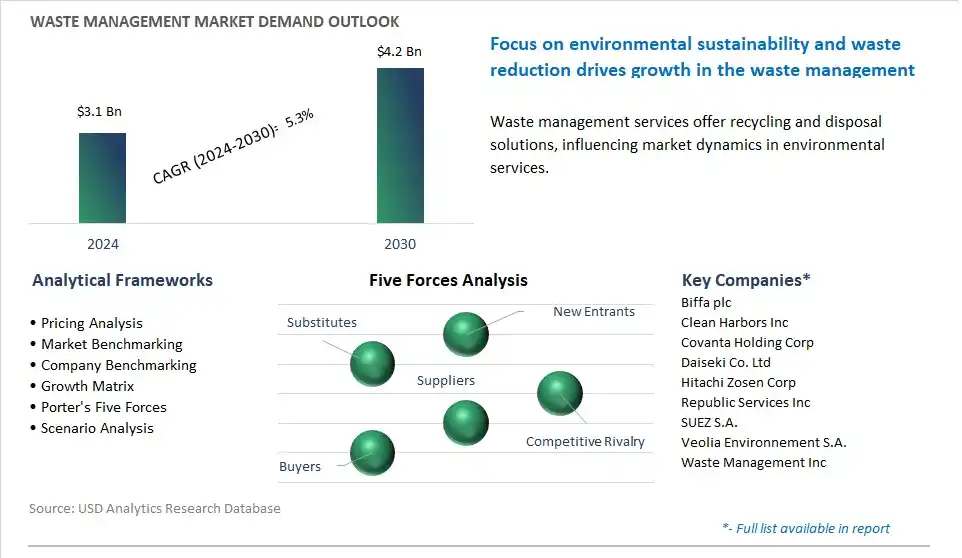
The global Waste Management Market is poised to register a 5.3% CAGR from $3.1 Billion in 2024 to $4.2 Billion in 2030.
The global Waste Management Market Study analyzes and forecasts the market size across 6 regions and 24 countries for diverse segments -By Type (Hazardous Waste, E-waste, Plastic Waste, Bio-medical Waste, Others), By Service (Open Dumping, Incineration/Combustion, Landfill, Recycling, Composting & Anaerobic Digestion), By End-User (Residential, Commercial, Industrial).
An Introduction to Global Waste Management Market in 2024
The waste management market is experiencing growth driven by increasing urbanization, industrialization, and environmental awareness, leading to greater emphasis on waste reduction, recycling, and resource recovery. Key trends shaping the future of the industry include innovations in waste collection, sorting, recycling, and disposal technologies to improve efficiency, minimize environmental impact, and maximize resource recovery. Advanced waste management solutions such as material recovery facilities (MRFs), anaerobic digestion plants, waste-to-energy (WTE) facilities, and landfill gas capture systems enable municipalities and industries to manage waste streams more effectively while reducing greenhouse gas emissions and promoting circular economy principles. Moreover, the adoption of smart waste management technologies, including IoT-enabled sensors, RFID tracking systems, and predictive analytics, enhances operational visibility, route optimization, and waste diversion efforts. Additionally, the growing emphasis on extended producer responsibility (EPR), product stewardship, and circular economy initiatives drives collaboration among stakeholders across the value chain to promote sustainable consumption and production practices. As governments enact stricter regulations and environmental targets, and businesses invest in waste reduction and recycling initiatives, the waste management market is poised for continued growth and innovation as a key player in the global transition towards a more sustainable and circular economy.
Waste Management Market Competitive Landscape
The market report analyses the leading companies in the industry including Biffa plc, Clean Harbors Inc, Covanta Holding Corp, Daiseki Co. Ltd, Hitachi Zosen Corp, Republic Services Inc, SUEZ S.A., Veolia Environnement S.A., Waste Management Inc.
Waste Management Market Dynamics
Waste Management Market Trend: Increasing Focus on Sustainable Waste Management Practices
A prominent trend in the waste management market is the increasing focus on sustainable waste management practices. As environmental concerns grow and governments implement stricter regulations on waste disposal and recycling, there is a heightened emphasis on adopting sustainable solutions for waste management. This includes initiatives such as waste reduction, recycling, composting, and energy recovery from waste. Companies operating in the waste management sector are increasingly investing in technologies and processes that minimize environmental impact, promote resource recovery, and contribute to the circular economy. This trend reflects a broader shift towards sustainability in waste management, driven by societal awareness, regulatory requirements, and corporate responsibility.
Waste Management Market Driver: Urbanization and Population Growth
A key driver for the waste management market is urbanization and population growth. As populations continue to urbanize and expand, particularly in developing regions, there is a corresponding increase in the generation of municipal solid waste (MSW) and industrial waste. Rapid urbanization leads to higher consumption rates, increased packaging waste, and greater demand for infrastructure and services to manage waste effectively. Additionally, rising living standards and economic development contribute to the production of more diverse and complex waste streams. The growing urban population creates a significant demand for waste management services, including collection, treatment, recycling, and disposal, driving the growth of the waste management industry.
Waste Management Market Opportunity: Integration of Digital Technologies and Data Analytics
An opportunity within the waste management market lies in the integration of digital technologies and data analytics. With the advancement of digitalization and the Internet of Things (IoT), there is potential to revolutionize waste management processes through real-time monitoring, predictive analytics, and optimization algorithms. By deploying sensors, smart bins, and connected devices, waste management companies can gather valuable data on waste generation, collection routes, landfill capacity, and recycling rates. This data can be analyzed to identify patterns, optimize resource allocation, minimize operational costs, and improve overall efficiency in waste management operations. Additionally, digital technologies enable better communication with customers, enhanced transparency, and the development of innovative solutions to address specific waste management challenges. By embracing digitalization, companies can unlock new opportunities for innovation, improve service quality, and stay competitive in the evolving waste management landscape.
Waste Management Market Share Analysis: Plastic Waste segment generated the highest revenue in the industry
The plastic waste segment is the largest segment in the Waste Management Market due to the significant volume of plastic waste generated globally and the growing awareness of environmental pollution caused by plastic waste accumulation. Plastics are widely used in various industries and daily consumer products due to their versatility, durability, and affordability. However, the widespread use of single-use plastics and the lack of effective recycling infrastructure have led to a substantial increase in plastic waste generation. As a result, plastic waste has become a major environmental concern, contributing to pollution of oceans, waterways, and terrestrial ecosystems. Governments, industries, and environmental organizations worldwide have intensified efforts to address the plastic waste crisis through regulatory measures, waste reduction initiatives, and recycling programs. Additionally, technological advancements in plastic recycling technologies, such as mechanical recycling, chemical recycling, and waste-to-energy processes, have enhanced the feasibility of plastic waste management and resource recovery. In addition, increasing public awareness of plastic pollution and the growing demand for sustainable packaging solutions drive investments in circular economy initiatives and innovations to reduce plastic waste generation and promote the use of recycled plastics. As the largest segment in the Waste Management Market, the plastic waste segment encompasses a wide range of waste management activities, including collection, sorting, recycling, and disposal, reflecting the critical importance of addressing the plastic waste challenge to achieve environmental sustainability and resource conservation.
Waste Management Market Share Analysis: Recycling Segment is poised to register the fastest growth rate (CAGR) over the forecast period to 2030
The recycling segment is the fastest-growing segment in the Waste Management Market due to increasing environmental awareness, regulatory mandates, and the growing recognition of the economic and environmental benefits of recycling. Recycling plays a crucial role in waste management by diverting materials from landfills and incineration facilities, conserving natural resources, and reducing energy consumption and greenhouse gas emissions associated with virgin material production. Governments, businesses, and consumers are increasingly prioritizing recycling initiatives to minimize waste generation, promote resource conservation, and mitigate environmental pollution. Additionally, advancements in recycling technologies and processes have improved the efficiency and cost-effectiveness of recycling operations, making recycling a viable and attractive option for waste management. In addition, the growing demand for recycled materials in various industries, including packaging, construction, automotive, and electronics, drives investments in recycling infrastructure and market development. Further, public awareness campaigns, education programs, and incentives encourage individuals and communities to participate in recycling programs and adopt sustainable waste management practices. As governments implement stricter waste management regulations and set ambitious recycling targets, and businesses increasingly incorporate circular economy principles into their operations, the recycling segment is expected to experience rapid growth, driving innovation and investment in the Waste Management Market.
Waste Management Market Share Analysis: Commercial Segment is poised to register the fastest growth rate (CAGR) over the forecast period to 2030
The commercial segment is the fastest-growing segment in the Waste Management Market due to diverse factors driving demand for waste management services in commercial settings. Commercial establishments, including offices, retail stores, restaurants, hotels, and healthcare facilities, generate significant quantities of waste as part of their daily operations. With increasing urbanization, population growth, and economic development, the volume of waste generated by commercial entities is expanding rapidly. Additionally, stringent waste management regulations and sustainability initiatives encourage commercial businesses to implement effective waste reduction, recycling, and disposal practices to minimize environmental impact and comply with regulatory requirements. Further, the rise of e-commerce and online retailing has led to an increase in packaging waste generated by commercial businesses, further driving demand for waste management services. In addition, growing consumer awareness of environmental issues and the preference for eco-friendly products and services prompt commercial establishments to adopt sustainable waste management solutions to enhance their corporate social responsibility (CSR) and attract environmentally conscious customers. As a result, waste management companies are increasingly focusing on providing tailored waste management solutions and value-added services to meet the specific needs of commercial clients, driving growth in the commercial segment of the Waste Management Market.
Waste Management Market Report Segmentation
By Type
Hazardous Waste
E-waste
Plastic Waste
Bio-medical Waste
Others
By Service
Open Dumping
Incineration/Combustion
Landfill
Recycling
Composting & Anaerobic Digestion
By End-User
Residential
Commercial
Industrial
Regions Included
North America (US, Canada, Mexico)
Europe (Germany, UK, France, Spain, Italy, Russia, Rest of Europe)
Asia Pacific (China, India, Japan, South Korea, Australia, South East Asia, Rest of Asia)
South America (Brazil, Argentina, Rest of South America)
Middle East and Africa (Saudi Arabia, UAE, Rest of Middle East, South Africa, Egypt, Rest of Africa)
Waste Management Companies Profiled in the Market Study
Biffa plc
Clean Harbors Inc
Covanta Holding Corp
Daiseki Co. Ltd
Hitachi Zosen Corp
Republic Services Inc
SUEZ S.A.
Veolia Environnement S.A.
Waste Management Inc
*- List Not Exhaustive
TABLE OF CONTENTS
1 Introduction to 2024 Waste Management Market
1.1 Market Overview
1.2 Quick Facts
1.3 Scope/Objective of the Study
1.4 Market Definition
1.5 Countries and Regions Covered
1.6 Units, Currency, and Conversions
1.7 Industry Value Chain
2 Research Methodology
2.1 Market Size Estimation
2.2 Sources and Research Methodology
2.3 Data Triangulation
2.4 Assumptions and Limitations
3 Executive Summary
3.1 Global Waste Management Market Size Outlook, $ Million, 2021 to 2030
3.2 Waste Management Market Outlook by Type, $ Million, 2021 to 2030
3.3 Waste Management Market Outlook by Product, $ Million, 2021 to 2030
3.4 Waste Management Market Outlook by Application, $ Million, 2021 to 2030
3.5 Waste Management Market Outlook by Key Countries, $ Million, 2021 to 2030
4 Market Dynamics
4.1 Key Driving Forces of Waste Management Industry
4.2 Key Market Trends in Waste Management Industry
4.3 Potential Opportunities in Waste Management Industry
4.4 Key Challenges in Waste Management Industry
5 Market Factor Analysis
5.1 Value Chain Analysis
5.2 Competitive Landscape
5.2.1 Global Waste Management Market Share by Company (%), 2023
5.2.2 Product Offerings by Company
5.3 Porter’s Five Forces Analysis
5.4 Pricing Analysis and Outlook
6 Growth Outlook Across Scenarios
6.1 Growth Analysis-Case Scenario Definitions
6.2 Low Growth Scenario Forecasts
6.3 Reference Growth Scenario Forecasts
6.4 High Growth Scenario Forecasts
7 Global Waste Management Market Outlook by Segments
7.1 Waste Management Market Outlook by Segments, $ Million, 2021- 2030
By Type
Hazardous Waste
E-waste
Plastic Waste
Bio-medical Waste
Others
By Service
Open Dumping
Incineration/Combustion
Landfill
Recycling
Composting & Anaerobic Digestion
By End-User
Residential
Commercial
Industrial
8 North America Waste Management Market Analysis and Outlook To 2030
8.1 Introduction to North America Waste Management Markets in 2024
8.2 North America Waste Management Market Size Outlook by Country, 2021-2030
8.2.1 United States
8.2.2 Canada
8.2.3 Mexico
8.3 North America Waste Management Market size Outlook by Segments, 2021-2030
By Type
Hazardous Waste
E-waste
Plastic Waste
Bio-medical Waste
Others
By Service
Open Dumping
Incineration/Combustion
Landfill
Recycling
Composting & Anaerobic Digestion
By End-User
Residential
Commercial
Industrial
9 Europe Waste Management Market Analysis and Outlook To 2030
9.1 Introduction to Europe Waste Management Markets in 2024
9.2 Europe Waste Management Market Size Outlook by Country, 2021-2030
9.2.1 Germany
9.2.2 France
9.2.3 Spain
9.2.4 United Kingdom
9.2.4 Italy
9.2.5 Russia
9.2.6 Norway
9.2.7 Rest of Europe
9.3 Europe Waste Management Market Size Outlook by Segments, 2021-2030
By Type
Hazardous Waste
E-waste
Plastic Waste
Bio-medical Waste
Others
By Service
Open Dumping
Incineration/Combustion
Landfill
Recycling
Composting & Anaerobic Digestion
By End-User
Residential
Commercial
Industrial
10 Asia Pacific Waste Management Market Analysis and Outlook To 2030
10.1 Introduction to Asia Pacific Waste Management Markets in 2024
10.2 Asia Pacific Waste Management Market Size Outlook by Country, 2021-2030
10.2.1 China
10.2.2 India
10.2.3 Japan
10.2.4 South Korea
10.2.5 Indonesia
10.2.6 Malaysia
10.2.7 Australia
10.2.8 Rest of Asia Pacific
10.3 Asia Pacific Waste Management Market size Outlook by Segments, 2021-2030
By Type
Hazardous Waste
E-waste
Plastic Waste
Bio-medical Waste
Others
By Service
Open Dumping
Incineration/Combustion
Landfill
Recycling
Composting & Anaerobic Digestion
By End-User
Residential
Commercial
Industrial
11 South America Waste Management Market Analysis and Outlook To 2030
11.1 Introduction to South America Waste Management Markets in 2024
11.2 South America Waste Management Market Size Outlook by Country, 2021-2030
11.2.1 Brazil
11.2.2 Argentina
11.2.3 Rest of South America
11.3 South America Waste Management Market size Outlook by Segments, 2021-2030
By Type
Hazardous Waste
E-waste
Plastic Waste
Bio-medical Waste
Others
By Service
Open Dumping
Incineration/Combustion
Landfill
Recycling
Composting & Anaerobic Digestion
By End-User
Residential
Commercial
Industrial
12 Middle East and Africa Waste Management Market Analysis and Outlook To 2030
12.1 Introduction to Middle East and Africa Waste Management Markets in 2024
12.2 Middle East and Africa Waste Management Market Size Outlook by Country, 2021-2030
12.2.1 Saudi Arabia
12.2.2 UAE
12.2.3 Oman
12.2.4 Rest of Middle East
12.2.5 Egypt
12.2.6 Nigeria
12.2.7 South Africa
12.2.8 Rest of Africa
12.3 Middle East and Africa Waste Management Market size Outlook by Segments, 2021-2030
By Type
Hazardous Waste
E-waste
Plastic Waste
Bio-medical Waste
Others
By Service
Open Dumping
Incineration/Combustion
Landfill
Recycling
Composting & Anaerobic Digestion
By End-User
Residential
Commercial
Industrial
13 Company Profiles
13.1 Company Snapshot
13.2 SWOT Profiles
13.3 Products and Services
13.4 Recent Developments
13.5 Financial Profile
Biffa plc
Clean Harbors Inc
Covanta Holding Corp
Daiseki Co. Ltd
Hitachi Zosen Corp
Republic Services Inc
SUEZ S.A.
Veolia Environnement S.A.
Waste Management Inc
14 Appendix
14.1 Customization Offerings
14.2 Subscription Services
14.3 Related Reports
14.4 Publisher Expertise
By Type
Hazardous Waste
E-waste
Plastic Waste
Bio-medical Waste
Others
By Service
Open Dumping
Incineration/Combustion
Landfill
Recycling
Composting & Anaerobic Digestion
By End-User
Residential
Commercial
Industrial
Countries Analyzed
North America (US, Canada, Mexico)
Europe (Germany, UK, France, Spain, Italy, Russia, Rest of Europe)
Asia Pacific (China, India, Japan, South Korea, Australia, South East Asia, Rest of Asia)
South America (Brazil, Argentina, Rest of South America)
Middle East and Africa (Saudi Arabia, UAE, Rest of Middle East, South Africa, Egypt, Rest of Africa)
