Wearable Brain Devices Market is estimated to increase at a growth rate of 10.1% CAGR over the forecast period from 2024 to 2030.
The global Wearable Brain Devices Marketstudy analyzes and forecasts the market size across 6 regions and 24 countries for diverse segments including By Channel Type (32-Channel Type, 12-Channel Type, 14-Channels, 5-Channel Type, Multichannels, Others), By Application (Medical Setting, AR/VR Gaming Settings, Others), By End-user (Hospitals & Clinics, Neurology Centers, Ambulatory Surgery Centers, Diagnostic Centers, Transportation and Construction, Research and Academics, Homecare Settings, Intensive Care Units, Assisted Living Facilities, Athletes and Military Personnel, Others).
An introduction to Wearable Brain Devices Market in 2024
The wearable brain devices market is experiencing notable growth in 2024, driven by advancements in neurotechnology, brain-computer interfaces (BCIs), and the integration of wearable sensors and AI algorithms for brain monitoring, neurofeedback, and cognitive enhancement applications. Wearable brain devices encompass EEG headsets, neurosensing wearables, and brain stimulation devices designed to measure brain activity, monitor cognitive function, and modulate neural circuits for various neurological conditions, mental health disorders, and performance optimization goals. With the growing interest in brain health, cognitive enhancement, and digital therapeutics, wearable brain devices offer individuals, researchers, and clinicians innovative tools for brain monitoring, neurorehabilitation, and brain-computer interaction. With ongoing developments in sensor technology, signal processing algorithms, and brain-machine interfaces, the wearable brain devices market is witnessing rapid expansion and adoption, offering new opportunities for brain health monitoring, brain-computer interfacing, and neuromodulation therapies, driving advancements in wearable neurotechnology and neuroengineering innovations.
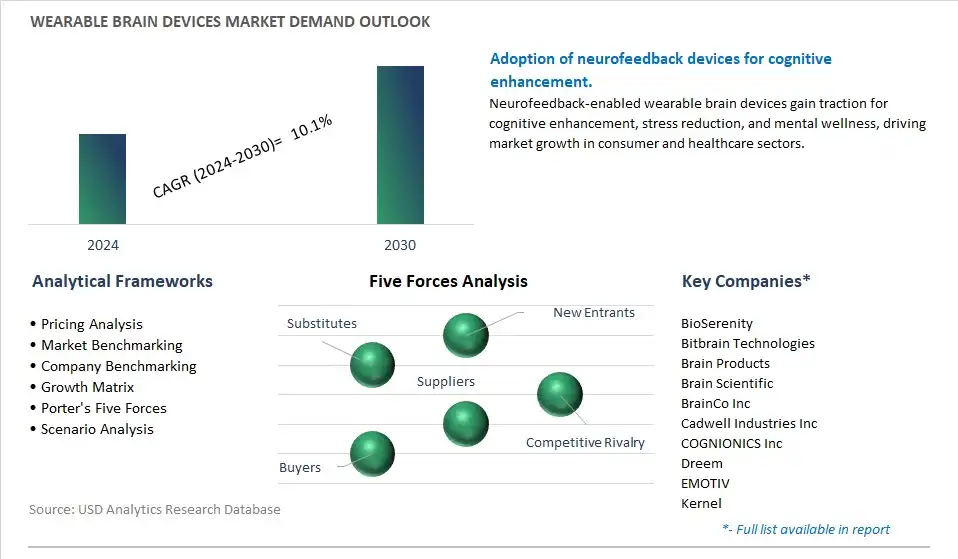
Wearable Brain Devices Market Trend: Integration of Brain-Computer Interface Technology Reshapes Wearable Brain Devices Market
A significant trend in the wearable brain devices market is the integration of brain-computer interface (BCI) technology into wearable devices. BCI technology enables direct communication between the brain and external devices, allowing users to control and interact with technology using neural signals. Wearable brain devices equipped with BCI technology offer various applications, including brain-controlled prosthetics, neurofeedback training, cognitive enhancement, and mental health monitoring. Advancements in signal processing algorithms, neural decoding techniques, and wearable sensor technologies have led to the development of more user-friendly, accurate, and accessible BCI-enabled wearables. As researchers and developers explore new applications and potential benefits of BCI technology, the trend towards integrating BCI into wearable brain devices continues to drive market growth and innovation in neurotechnology.
Wearable Brain Devices Market Driver: Rising Demand for Non-Invasive Brain Monitoring Solutions Drives Wearable Brain Devices Market Growth
The rising demand for non-invasive brain monitoring solutions serves as a significant driver for the wearable brain devices market. Non-invasive brain monitoring technologies, such as electroencephalography (EEG), functional near-infrared spectroscopy (fNIRS), and magnetoencephalography (MEG), play a crucial role in diagnosing neurological disorders, studying brain function, and monitoring cognitive performance. Wearable brain devices offer a portable and convenient means of collecting real-time brain activity data outside of traditional clinical settings, enabling continuous monitoring and personalized interventions. Moreover, increasing awareness of brain health, mental wellness, and the importance of early detection and intervention in neurological conditions drive the adoption of wearable brain devices among consumers, healthcare providers, and researchers. As the demand for non-invasive brain monitoring solutions continues to grow, the market for wearable brain devices expands, supporting technological advancements and market penetration in the neurotechnology sector.
Wearable Brain Devices Market Opportunity: Expansion into Neurorehabilitation and Brain-Computer Interface Applications Presents Lucrative Opportunities in Wearable Brain Devices Market
The expansion into neurorehabilitation and brain-computer interface (BCI) applications represents a promising opportunity for growth within the wearable brain devices market. Neurorehabilitation aims to restore or enhance neural function and motor abilities in individuals with neurological injuries or disorders, such as stroke, traumatic brain injury (TBI), and spinal cord injury (SCI). Wearable brain devices offer innovative solutions for neurorehabilitation by providing real-time feedback, personalized therapy programs, and brain-controlled assistive devices. Moreover, BCI applications enable individuals with severe motor disabilities to communicate, interact with their environment, and regain independence through brain-controlled prosthetics, communication aids, and mobility devices. By expanding into neurorehabilitation and BCI applications, wearable brain device manufacturers can address unmet needs in rehabilitation medicine, enhance patient outcomes, and improve quality of life for individuals with neurological conditions. Additionally, strategic partnerships with rehabilitation centers, neuroscientists, and technology developers can facilitate market entry and adoption of wearable brain devices in neurorehabilitation and BCI therapy settings, driving revenue growth and market expansion in the evolving landscape of neurotechnology and rehabilitation medicine.
Wearable Brain Devices Market Market Segmentation
By Channel Type
32-Channel Type
12-Channel Type
14-Channels
5-Channel Type
Multichannels
Others
By Application
Medical Setting
-Epilepsy
-Sleep Disorders
-Parkinson’s Disease
-Traumatic Brain Injury (TBI)
-Alzheimer’s
-Other
AR/VR Gaming Settings
Others
By End-User
Hospitals & Clinics
Neurology Centers
Ambulatory Surgery Centers (ASCs)
Diagnostic Centers
Transportation and Construction
Research and Academics
Homecare Settings
Intensive Care Units
Assisted Living Facilities
Athletes and Military Personnel
Others
Geographical Analysis
North America (United States, Canada, Mexico)
Europe (Germany, France, United Kingdom, Spain, Italy, Rest of Europe)
Asia Pacific (China, India, Japan, South Korea, Rest of Asia Pacific)
South America (Brazil, Argentina, Rest of South America)
Middle East and Africa (Saudi Arabia, UAE, Rest of Middle East, South Africa, Egypt, Rest of Africa)
Wearable Brain Devices Market Companies
BioSerenity
Bitbrain Technologies
Brain Products
Brain Scientific
BrainCo Inc
Cadwell Industries Inc
COGNIONICS Inc
Dreem
EMOTIV
Kernel
mBrainTrain
Neuroelectrics
Neurolief
NextMind
Reasons to Buy the Wearable Brain Devices Market Study
• Deepen your industry insights and navigate uncertainties for strategy formulation, CAPEX, and Operational decisions
• Gain access to detailed insights on the Wearable Brain Devices Market, encompassing current market size, growth trends, and forecasts till 2030.
• Access detailed competitor analysis, enabling competitive advantage through a thorough understanding of market players, strategies, and potential differentiation opportunities
• Stay ahead of the curve with insights on technological advancements, innovations, and upcoming trends
• Identify lucrative investment avenues and expansion opportunities within the Wearable Brain Devices Market industry, guided by robust, data-backed analysis.
• Understand regional and global markets through country-wise analysis, regional market potential, regulatory nuances, and dynamics
• Execute strategies with confidence and speed through information, analytics, and insights on the industry value chain
• Corporate leaders, strategists, financial experts, shareholders, asset managers, and governmental representatives can make long-term planning scenarios and build an integrated and timely understanding of market dynamics
• Benefit from tailored solutions and expert consultation based on report insights, providing personalized strategies aligned with specific business needs.
TABLE OF CONTENTS
1 Introduction to 2024 Wearable Brain Devices Market
1.1 Market Overview
1.2 Quick Facts
1.3 Scope/Objective of the Study
1.4 Market Definition
1.5 Countries and Regions Analyzed
1.6 Units, Currency, and Conversions
1.7 Industry Value Chain
2 Research Methodology
2.1 Market Size Estimation
2.2 Sources and Research Methodology
2.3 Data Triangulation
2.4 Assumptions and Limitations
3 Executive Summary
3.1 Global Wearable Brain Devices Market Size Outlook, $ Million, 2021 to 2030
3.2 Wearable Brain Devices Market Outlook by Type, $ Million, 2021 to 2030
3.3 Wearable Brain Devices Market Outlook by Product, $ Million, 2021 to 2030
3.4 Wearable Brain Devices Market Outlook by Application, $ Million, 2021 to 2030
3.5 Wearable Brain Devices Market Outlook by Key Countries, $ Million, 2021 to 2030
4 Market Dynamics
4.1 Key Driving Forces of Wearable Brain Devices Industry
4.2 Key Market Trends in Wearable Brain Devices Industry
4.3 Potential Opportunities in Wearable Brain Devices Industry
4.4 Key Challenges in Wearable Brain Devices Industry
5 Market Factor Analysis
5.1 Value Chain Analysis
5.2 Competitive Landscape
5.2.1 Global Wearable Brain Devices Market Share by Company (%), 2023
5.2.2 Product Offerings by Company
5.3 Porter’s Five Forces Analysis
5.4 Pricing Analysis and Outlook
6 Growth Outlook Across Scenarios
6.1 Growth Analysis-Case Scenario Definitions
6.2 Low Growth Scenario Forecasts
6.3 Reference Growth Scenario Forecasts
6.4 High Growth Scenario Forecasts
7 Global Wearable Brain Devices Market Outlook by Segments
7.1 Wearable Brain Devices Market Outlook by Segments, $ Million, 2021- 2030
By Channel Type
32-Channel Type
12-Channel Type
14-Channels
5-Channel Type
Multichannels
Others
By Application
Medical Setting
-Epilepsy
-Sleep Disorders
-Parkinson’s Disease
-Traumatic Brain Injury (TBI)
-Alzheimer’s
-Other
AR/VR Gaming Settings
Others
By End-User
Hospitals & Clinics
Neurology Centers
Ambulatory Surgery Centers (ASCs)
Diagnostic Centers
Transportation and Construction
Research and Academics
Homecare Settings
Intensive Care Units
Assisted Living Facilities
Athletes and Military Personnel
Others
8 North America Wearable Brain Devices Market Analysis and Outlook To 2030
8.1 Introduction to North America Wearable Brain Devices Markets in 2024
8.2 North America Wearable Brain Devices Market Size Outlook by Country, 2021-2030
8.2.1 United States
8.2.2 Canada
8.2.3 Mexico
8.3 North America Wearable Brain Devices Market size Outlook by Segments, 2021-2030
By Channel Type
32-Channel Type
12-Channel Type
14-Channels
5-Channel Type
Multichannels
Others
By Application
Medical Setting
-Epilepsy
-Sleep Disorders
-Parkinson’s Disease
-Traumatic Brain Injury (TBI)
-Alzheimer’s
-Other
AR/VR Gaming Settings
Others
By End-User
Hospitals & Clinics
Neurology Centers
Ambulatory Surgery Centers (ASCs)
Diagnostic Centers
Transportation and Construction
Research and Academics
Homecare Settings
Intensive Care Units
Assisted Living Facilities
Athletes and Military Personnel
Others
9 Europe Wearable Brain Devices Market Analysis and Outlook To 2030
9.1 Introduction to Europe Wearable Brain Devices Markets in 2024
9.2 Europe Wearable Brain Devices Market Size Outlook by Country, 2021-2030
9.2.1 Germany
9.2.2 France
9.2.3 Spain
9.2.4 United Kingdom
9.2.4 Italy
9.2.5 Russia
9.2.6 Norway
9.2.7 Rest of Europe
9.3 Europe Wearable Brain Devices Market Size Outlook by Segments, 2021-2030
By Channel Type
32-Channel Type
12-Channel Type
14-Channels
5-Channel Type
Multichannels
Others
By Application
Medical Setting
-Epilepsy
-Sleep Disorders
-Parkinson’s Disease
-Traumatic Brain Injury (TBI)
-Alzheimer’s
-Other
AR/VR Gaming Settings
Others
By End-User
Hospitals & Clinics
Neurology Centers
Ambulatory Surgery Centers (ASCs)
Diagnostic Centers
Transportation and Construction
Research and Academics
Homecare Settings
Intensive Care Units
Assisted Living Facilities
Athletes and Military Personnel
Others
10 Asia Pacific Wearable Brain Devices Market Analysis and Outlook To 2030
10.1 Introduction to Asia Pacific Wearable Brain Devices Markets in 2024
10.2 Asia Pacific Wearable Brain Devices Market Size Outlook by Country, 2021-2030
10.2.1 China
10.2.2 India
10.2.3 Japan
10.2.4 South Korea
10.2.5 Indonesia
10.2.6 Malaysia
10.2.7 Australia
10.2.8 Rest of Asia Pacific
10.3 Asia Pacific Wearable Brain Devices Market size Outlook by Segments, 2021-2030
By Channel Type
32-Channel Type
12-Channel Type
14-Channels
5-Channel Type
Multichannels
Others
By Application
Medical Setting
-Epilepsy
-Sleep Disorders
-Parkinson’s Disease
-Traumatic Brain Injury (TBI)
-Alzheimer’s
-Other
AR/VR Gaming Settings
Others
By End-User
Hospitals & Clinics
Neurology Centers
Ambulatory Surgery Centers (ASCs)
Diagnostic Centers
Transportation and Construction
Research and Academics
Homecare Settings
Intensive Care Units
Assisted Living Facilities
Athletes and Military Personnel
Others
11 South America Wearable Brain Devices Market Analysis and Outlook To 2030
11.1 Introduction to South America Wearable Brain Devices Markets in 2024
11.2 South America Wearable Brain Devices Market Size Outlook by Country, 2021-2030
11.2.1 Brazil
11.2.2 Argentina
11.2.3 Rest of South America
11.3 South America Wearable Brain Devices Market size Outlook by Segments, 2021-2030
By Channel Type
32-Channel Type
12-Channel Type
14-Channels
5-Channel Type
Multichannels
Others
By Application
Medical Setting
-Epilepsy
-Sleep Disorders
-Parkinson’s Disease
-Traumatic Brain Injury (TBI)
-Alzheimer’s
-Other
AR/VR Gaming Settings
Others
By End-User
Hospitals & Clinics
Neurology Centers
Ambulatory Surgery Centers (ASCs)
Diagnostic Centers
Transportation and Construction
Research and Academics
Homecare Settings
Intensive Care Units
Assisted Living Facilities
Athletes and Military Personnel
Others
12 Middle East and Africa Wearable Brain Devices Market Analysis and Outlook To 2030
12.1 Introduction to Middle East and Africa Wearable Brain Devices Markets in 2024
12.2 Middle East and Africa Wearable Brain Devices Market Size Outlook by Country, 2021-2030
12.2.1 Saudi Arabia
12.2.2 UAE
12.2.3 Oman
12.2.4 Rest of Middle East
12.2.5 Egypt
12.2.6 Nigeria
12.2.7 South Africa
12.2.8 Rest of Africa
12.3 Middle East and Africa Wearable Brain Devices Market size Outlook by Segments, 2021-2030
By Channel Type
32-Channel Type
12-Channel Type
14-Channels
5-Channel Type
Multichannels
Others
By Application
Medical Setting
-Epilepsy
-Sleep Disorders
-Parkinson’s Disease
-Traumatic Brain Injury (TBI)
-Alzheimer’s
-Other
AR/VR Gaming Settings
Others
By End-User
Hospitals & Clinics
Neurology Centers
Ambulatory Surgery Centers (ASCs)
Diagnostic Centers
Transportation and Construction
Research and Academics
Homecare Settings
Intensive Care Units
Assisted Living Facilities
Athletes and Military Personnel
Others
13 Company Profiles
13.1 Company Snapshot
13.2 SWOT Profiles
13.3 Products and Services
13.4 Recent Developments
13.5 Financial Profile
List of Companies
BioSerenity
Bitbrain Technologies
Brain Products
Brain Scientific
BrainCo Inc
Cadwell Industries Inc
COGNIONICS Inc
Dreem
EMOTIV
Kernel
mBrainTrain
Neuroelectrics
Neurolief
NextMind
14 Appendix
14.1 Customization Offerings
14.2 Subscription Services
14.3 Related Reports
14.4 Publisher Expertise
