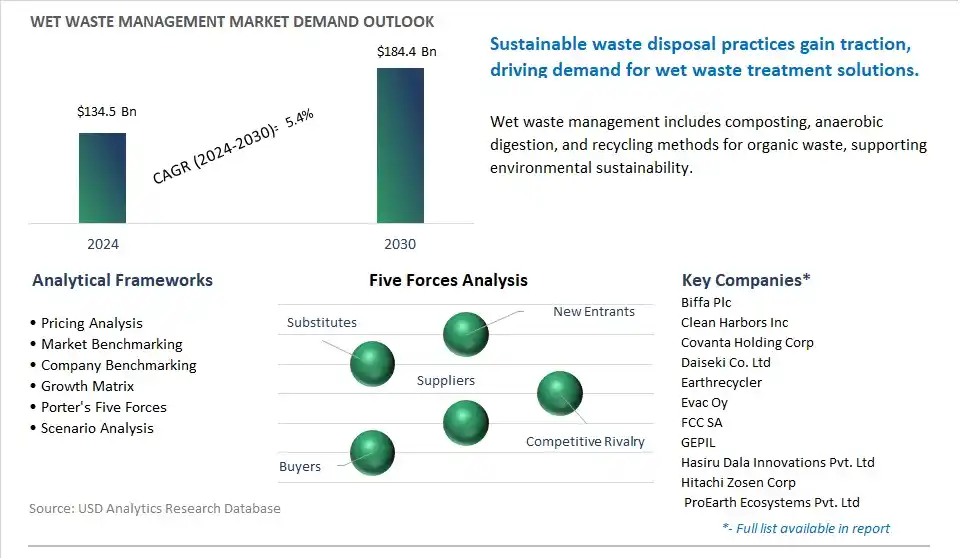
The global Wet Waste Management Market is poised to register a 5.4% CAGR from $134.5 Billion in 2024 to $184.4 Billion in 2030.
The global Wet Waste Management Market Study analyzes and forecasts the market size across 6 regions and 24 countries for diverse segments -By Service (Collection & transportation, Storage, Sorting, Processing, Disposal & landfill), By Source (Industrial, Municipal, Commercial, Healthcare & medical, Others), By Waste type (Food scrap, Meat & bones, Agricultural waste, Medical waste, Shredded paper, Others), By Method (Landfill, Recycling, Incineration).
An Introduction to Global Wet Waste Management Market in 2024
The wet waste management market is witnessing steady growth driven by urbanization, population growth, and increasing awareness about environmental conservation and resource recovery. Wet waste, also known as organic waste, includes biodegradable materials such as food scraps, yard waste, and sewage sludge, which can be converted into valuable resources through composting, anaerobic digestion, and other treatment processes. Key trends shaping the future of wet waste management include the adoption of decentralized and community-based waste management solutions to reduce transportation costs and carbon emissions, integration of smart waste management technologies for efficient collection, sorting, and processing of organic waste streams, and the promotion of circular economy initiatives to maximize resource recovery and minimize landfilling. Moreover, with the rise of sustainable packaging and food waste reduction strategies, there is a growing emphasis on waste prevention and source separation to divert organic waste from landfills and mitigate environmental pollution.
Wet Waste Management Market Competitive Landscape
The market report analyses the leading companies in the industry including Biffa Plc, Clean Harbors Inc, Covanta Holding Corp, Daiseki Co. Ltd, Earthrecycler, Evac Oy, FCC SA, GEPIL, Hasiru Dala Innovations Pvt. Ltd, Hitachi Zosen Corp, ProEarth Ecosystems Pvt. Ltd, Republic Services Inc, RETHMANN SE and Co. KG, SAAHAS WASTE MANAGEMENT Pvt. Ltd, Stericycle Inc, SUEZ SA, Valicor Inc, Veolia Environnement SA, Waste Management Inc.
Wet Waste Management Market Dynamics
Wet Waste Management Market Trend: Increasing Emphasis on Sustainable Waste Management Practices
A prominent trend in the wet waste management market is the increasing emphasis on sustainable waste management practices. With growing concerns over environmental degradation, resource depletion, and climate change, there is a heightened focus on reducing, recycling, and treating wet waste in an environmentally responsible manner. Governments, businesses, and communities are adopting strategies such as composting, anaerobic digestion, and wastewater treatment to manage wet waste effectively while minimizing environmental impact. This trend is driving the demand for innovative wet waste management solutions that prioritize sustainability, circular economy principles, and resource recovery, stimulating the development and adoption of advanced technologies and practices in the wet waste management industry.
Wet Waste Management Market Driver: Regulatory Compliance and Environmental Protection
The primary driver for the wet waste management market is regulatory compliance and environmental protection. Governments worldwide are enacting stringent regulations and standards to mitigate the adverse impacts of wet waste on public health, ecosystems, and natural resources. Regulations governing wastewater discharge, landfilling, and organic waste management require businesses, municipalities, and industries to implement effective wet waste management strategies and technologies to ensure compliance and protect the environment. The imperative to meet regulatory requirements, avoid fines, and mitigate liability drives the demand for wet waste management solutions that enable organizations to manage wet waste streams safely, efficiently, and sustainably.
Wet Waste Management Market Opportunity: Integration of Digital Technologies and Data Analytics
An opportunity for market advancement in the wet waste management segment lies in the integration of digital technologies and data analytics. With the rise of the Internet of Things (IoT), artificial intelligence (AI), and big data analytics, there is potential to optimize wet waste management processes, improve operational efficiency, and enhance decision-making capabilities. By deploying IoT sensors, smart meters, and monitoring systems, waste management companies can collect real-time data on wet waste generation, composition, and treatment performance. Leveraging AI algorithms and predictive analytics, organizations can optimize waste collection routes, treatment processes, and resource allocation, leading to cost savings, resource efficiency, and environmental benefits. Collaboration with technology providers, data scientists, and waste management professionals can facilitate the development and implementation of digital solutions that drive innovation and value creation in the wet waste management industry, unlocking new opportunities for growth and market leadership.
Wet Waste Management Market Share Analysis: Collection & transportation generated the highest revenue in 2024
The largest segment in the Wet Waste Management Market is Collection & transportation. This is primarily because collection and transportation form the initial and most fundamental stages of the waste management process. Without effective collection and transportation services, waste cannot be efficiently managed, sorted, processed, or disposed of. Collection involves the gathering of wet waste from various sources such as households, commercial establishments, and industrial facilities, while transportation involves the movement of this waste to designated treatment or disposal facilities. Given the ubiquitous nature of wet waste generation, especially from households and food-related businesses, the demand for collection and transportation services remains consistently high. Additionally, stringent environmental regulations and growing awareness about the importance of proper waste management further drive the need for efficient collection and transportation services to ensure the proper handling and disposal of wet waste materials. Therefore, the collection and transportation segment stands as the largest in the Wet Waste Management Market due to its critical role in initiating the waste management process and addressing the primary need of waste removal from source locations.
Wet Waste Management Market Share Analysis: Healthcare & Medical segment is poised to register the fastest growth rate (CAGR) over the forecast period to 2030
The fastest-growing segment in the Wet Waste Management Market is the Healthcare & Medical sector. This is because healthcare facilities, including hospitals, clinics, and laboratories, generate a significant amount of wet waste, such as biological waste, pathological waste, and infectious materials, due to their nature of operation. With the increasing emphasis on healthcare services and advancements in medical technology, the volume of waste generated by healthcare facilities is continuously growing. Further, stringent regulations and guidelines govern the handling, treatment, and disposal of medical waste to prevent the spread of infections and protect public health and the environment. Accordingly, there is a growing demand for specialized wet waste management services tailored to the unique requirements of healthcare facilities. These services include the collection, transportation, treatment, and disposal of medical waste in compliance with regulatory standards. Additionally, the COVID-19 pandemic has further underscored the importance of effective medical waste management, driving the need for innovative solutions and technologies to handle infectious waste safely. Therefore, the Healthcare & Medical sector is experiencing the fastest growth in the Wet Waste Management Market due to the increasing volume of medical waste generated and the stringent regulations governing its management.
Wet Waste Management Market Share Analysis: Food Scrap segment is poised to register the fastest growth rate (CAGR) over the forecast period to 2030
The fastest-growing segment in the Wet Waste Management Market is the Food Scrap category. This is because food scraps represent a substantial portion of the waste generated globally, particularly in urban areas and food-related industries such as restaurants, hotels, and catering services. With increasing urbanization and changes in dietary habits, the volume of food waste generated continues to rise. Additionally, there is growing awareness about the environmental and economic impacts of food waste, leading to increased efforts to reduce, reuse, and recycle food scraps. Governments and municipalities are implementing regulations and initiatives to encourage composting and organic waste diversion programs, driving the demand for wet waste management services tailored to food scraps. Further, advancements in technology have made it easier and more cost-effective to process and convert food waste into valuable resources such as compost and biogas through anaerobic digestion. Therefore, the Food Scrap segment is experiencing rapid growth in the Wet Waste Management Market due to the increasing volume of food waste generated and the growing emphasis on sustainable waste management practices.
Wet Waste Management Market Report Segmentation
By Service
Collection & transportation
Storage
Sorting
Processing
Disposal & landfill
By Source
Industrial
Municipal
Commercial
Healthcare & medical
Others
By Waste type
Food scrap
Meat & bones
Agricultural waste
Medical waste
Shredded paper
Others
By Method
Landfill
Recycling
Incineration
Regions Included
North America (US, Canada, Mexico)
Europe (Germany, UK, France, Spain, Italy, Russia, Rest of Europe)
Asia Pacific (China, India, Japan, South Korea, Australia, South East Asia, Rest of Asia)
South America (Brazil, Argentina, Rest of South America)
Middle East and Africa (Saudi Arabia, UAE, Rest of Middle East, South Africa, Egypt, Rest of Africa)
Wet Waste Management Companies Profiled in the Market Study
Biffa Plc
Clean Harbors Inc
Covanta Holding Corp
Daiseki Co. Ltd
Earthrecycler
Evac Oy
FCC SA
GEPIL
Hasiru Dala Innovations Pvt. Ltd
Hitachi Zosen Corp
ProEarth Ecosystems Pvt. Ltd
Republic Services Inc
RETHMANN SE and Co. KG
SAAHAS WASTE MANAGEMENT Pvt. Ltd
Stericycle Inc
SUEZ SA
Valicor Inc
Veolia Environnement SA
Waste Management Inc
*- List Not Exhaustive
TABLE OF CONTENTS
1 Introduction to 2024 Wet Waste Management Market
1.1 Market Overview
1.2 Quick Facts
1.3 Scope/Objective of the Study
1.4 Market Definition
1.5 Countries and Regions Covered
1.6 Units, Currency, and Conversions
1.7 Industry Value Chain
2 Research Methodology
2.1 Market Size Estimation
2.2 Sources and Research Methodology
2.3 Data Triangulation
2.4 Assumptions and Limitations
3 Executive Summary
3.1 Global Wet Waste Management Market Size Outlook, $ Million, 2021 to 2030
3.2 Wet Waste Management Market Outlook by Type, $ Million, 2021 to 2030
3.3 Wet Waste Management Market Outlook by Product, $ Million, 2021 to 2030
3.4 Wet Waste Management Market Outlook by Application, $ Million, 2021 to 2030
3.5 Wet Waste Management Market Outlook by Key Countries, $ Million, 2021 to 2030
4 Market Dynamics
4.1 Key Driving Forces of Wet Waste Management Industry
4.2 Key Market Trends in Wet Waste Management Industry
4.3 Potential Opportunities in Wet Waste Management Industry
4.4 Key Challenges in Wet Waste Management Industry
5 Market Factor Analysis
5.1 Value Chain Analysis
5.2 Competitive Landscape
5.2.1 Global Wet Waste Management Market Share by Company (%), 2023
5.2.2 Product Offerings by Company
5.3 Porter’s Five Forces Analysis
5.4 Pricing Analysis and Outlook
6 Growth Outlook Across Scenarios
6.1 Growth Analysis-Case Scenario Definitions
6.2 Low Growth Scenario Forecasts
6.3 Reference Growth Scenario Forecasts
6.4 High Growth Scenario Forecasts
7 Global Wet Waste Management Market Outlook by Segments
7.1 Wet Waste Management Market Outlook by Segments, $ Million, 2021- 2030
By Service
Collection & transportation
Storage
Sorting
Processing
Disposal & landfill
By Source
Industrial
Municipal
Commercial
Healthcare & medical
Others
By Waste type
Food scrap
Meat & bones
Agricultural waste
Medical waste
Shredded paper
Others
By Method
Landfill
Recycling
Incineration
8 North America Wet Waste Management Market Analysis and Outlook To 2030
8.1 Introduction to North America Wet Waste Management Markets in 2024
8.2 North America Wet Waste Management Market Size Outlook by Country, 2021-2030
8.2.1 United States
8.2.2 Canada
8.2.3 Mexico
8.3 North America Wet Waste Management Market size Outlook by Segments, 2021-2030
By Service
Collection & transportation
Storage
Sorting
Processing
Disposal & landfill
By Source
Industrial
Municipal
Commercial
Healthcare & medical
Others
By Waste type
Food scrap
Meat & bones
Agricultural waste
Medical waste
Shredded paper
Others
By Method
Landfill
Recycling
Incineration
9 Europe Wet Waste Management Market Analysis and Outlook To 2030
9.1 Introduction to Europe Wet Waste Management Markets in 2024
9.2 Europe Wet Waste Management Market Size Outlook by Country, 2021-2030
9.2.1 Germany
9.2.2 France
9.2.3 Spain
9.2.4 United Kingdom
9.2.4 Italy
9.2.5 Russia
9.2.6 Norway
9.2.7 Rest of Europe
9.3 Europe Wet Waste Management Market Size Outlook by Segments, 2021-2030
By Service
Collection & transportation
Storage
Sorting
Processing
Disposal & landfill
By Source
Industrial
Municipal
Commercial
Healthcare & medical
Others
By Waste type
Food scrap
Meat & bones
Agricultural waste
Medical waste
Shredded paper
Others
By Method
Landfill
Recycling
Incineration
10 Asia Pacific Wet Waste Management Market Analysis and Outlook To 2030
10.1 Introduction to Asia Pacific Wet Waste Management Markets in 2024
10.2 Asia Pacific Wet Waste Management Market Size Outlook by Country, 2021-2030
10.2.1 China
10.2.2 India
10.2.3 Japan
10.2.4 South Korea
10.2.5 Indonesia
10.2.6 Malaysia
10.2.7 Australia
10.2.8 Rest of Asia Pacific
10.3 Asia Pacific Wet Waste Management Market size Outlook by Segments, 2021-2030
By Service
Collection & transportation
Storage
Sorting
Processing
Disposal & landfill
By Source
Industrial
Municipal
Commercial
Healthcare & medical
Others
By Waste type
Food scrap
Meat & bones
Agricultural waste
Medical waste
Shredded paper
Others
By Method
Landfill
Recycling
Incineration
11 South America Wet Waste Management Market Analysis and Outlook To 2030
11.1 Introduction to South America Wet Waste Management Markets in 2024
11.2 South America Wet Waste Management Market Size Outlook by Country, 2021-2030
11.2.1 Brazil
11.2.2 Argentina
11.2.3 Rest of South America
11.3 South America Wet Waste Management Market size Outlook by Segments, 2021-2030
By Service
Collection & transportation
Storage
Sorting
Processing
Disposal & landfill
By Source
Industrial
Municipal
Commercial
Healthcare & medical
Others
By Waste type
Food scrap
Meat & bones
Agricultural waste
Medical waste
Shredded paper
Others
By Method
Landfill
Recycling
Incineration
12 Middle East and Africa Wet Waste Management Market Analysis and Outlook To 2030
12.1 Introduction to Middle East and Africa Wet Waste Management Markets in 2024
12.2 Middle East and Africa Wet Waste Management Market Size Outlook by Country, 2021-2030
12.2.1 Saudi Arabia
12.2.2 UAE
12.2.3 Oman
12.2.4 Rest of Middle East
12.2.5 Egypt
12.2.6 Nigeria
12.2.7 South Africa
12.2.8 Rest of Africa
12.3 Middle East and Africa Wet Waste Management Market size Outlook by Segments, 2021-2030
By Service
Collection & transportation
Storage
Sorting
Processing
Disposal & landfill
By Source
Industrial
Municipal
Commercial
Healthcare & medical
Others
By Waste type
Food scrap
Meat & bones
Agricultural waste
Medical waste
Shredded paper
Others
By Method
Landfill
Recycling
Incineration
13 Company Profiles
13.1 Company Snapshot
13.2 SWOT Profiles
13.3 Products and Services
13.4 Recent Developments
13.5 Financial Profile
Biffa Plc
Clean Harbors Inc
Covanta Holding Corp
Daiseki Co. Ltd
Earthrecycler
Evac Oy
FCC SA
GEPIL
Hasiru Dala Innovations Pvt. Ltd
Hitachi Zosen Corp
ProEarth Ecosystems Pvt. Ltd
Republic Services Inc
RETHMANN SE and Co. KG
SAAHAS WASTE MANAGEMENT Pvt. Ltd
Stericycle Inc
SUEZ SA
Valicor Inc
Veolia Environnement SA
Waste Management Inc
14 Appendix
14.1 Customization Offerings
14.2 Subscription Services
14.3 Related Reports
14.4 Publisher Expertise
By Service
Collection & transportation
Storage
Sorting
Processing
Disposal & landfill
By Source
Industrial
Municipal
Commercial
Healthcare & medical
Others
By Waste type
Food scrap
Meat & bones
Agricultural waste
Medical waste
Shredded paper
Others
By Method
Landfill
Recycling
Incineration
Countries Analyzed
North America (US, Canada, Mexico)
Europe (Germany, UK, France, Spain, Italy, Russia, Rest of Europe)
Asia Pacific (China, India, Japan, South Korea, Australia, South East Asia, Rest of Asia)
South America (Brazil, Argentina, Rest of South America)
Middle East and Africa (Saudi Arabia, UAE, Rest of Middle East, South Africa, Egypt, Rest of Africa)
