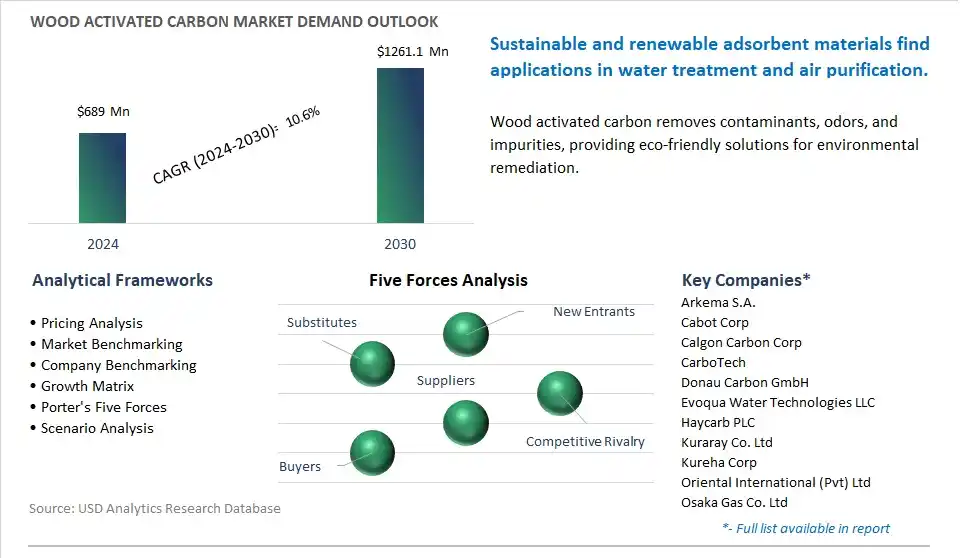
The global Wood Activated Carbon Market is poised to register a 10.6% CAGR from $689 Million in 2024 to $1261.1 Million in 2030.
The global Wood Activated Carbon Market Study analyzes and forecasts the market size across 6 regions and 24 countries for diverse segments -By Product (Powdered, Granular), By Application (Fluid Adsorption, Decolorization, Purification), By Phase (Liquid, Gaseous), By End-User (Water Treatment, Food and Beverage Processing, Pharmaceutical and Medical, Automotive, Air Purification, Others).
An Introduction to Global Wood Activated Carbon Market in 2024
The wood activated carbon market is witnessing steady growth driven by the increasing demand for water and air purification solutions, environmental regulations, and the growing awareness of health hazards associated with pollutants. Wood activated carbon, derived from various wood sources such as coconut shells, hardwoods, and softwoods, is known for its high porosity and surface area, making it an effective adsorbent for removing contaminants from liquids and gases. Key trends shaping the future of the wood activated carbon industry include the development of specialized activated carbon products tailored for specific applications such as water treatment, air filtration, and gas purification. Moreover, with the rise of sustainable manufacturing practices, there is a growing emphasis on the use of renewable and eco-friendly wood sources, as well as the implementation of carbonization processes that minimize energy consumption and waste generation. Additionally, advancements in activation techniques and post-treatment processes are leading to the production of activated carbons with enhanced pore structure, surface chemistry, and adsorption capacity, driving innovation and performance improvement in wood activated carbon applications.
Wood Activated Carbon Market Competitive Landscape
The market report analyses the leading companies in the industry including Arkema S.A., Cabot Corp, Calgon Carbon Corp, CarboTech, Donau Carbon GmbH, Evoqua Water Technologies LLC, Haycarb PLC, Kuraray Co. Ltd, Kureha Corp, Oriental International (Pvt) Ltd, Osaka Gas Co. Ltd, Puragen Activated Carbons, Silcarbon Aktivkohle GmbH, Veolia Environnement S.A., Zhengzhou Zhulin Activated Carbon Development Co. Ltd.
Wood Activated Carbon Market Dynamics
Wood Activated Carbon Market Trend: Increased Demand for Environmental Remediation Solutions
A prominent trend in the wood activated carbon market is the increased demand for environmental remediation solutions. With growing concerns over water and air pollution, as well as the need for sustainable waste management practices, there is a rising demand for wood activated carbon as an effective adsorbent material for environmental remediation applications. Wood activated carbon is widely used in water and air purification processes to remove contaminants such as organic pollutants, heavy metals, and volatile organic compounds (VOCs). This trend is driven by regulatory requirements, industrial sustainability goals, and public awareness of environmental issues, stimulating the adoption of wood activated carbon in various industries, including municipal water treatment, wastewater treatment, air filtration, and soil remediation.
Wood Activated Carbon Market Driver: Stringent Environmental Regulations and Compliance Requirements
The primary driver for the wood activated carbon market is stringent environmental regulations and compliance requirements. Governments worldwide are enacting strict regulations to address water and air pollution, as well as to ensure safe drinking water and clean air for communities. Industries, municipalities, and commercial entities are obligated to comply with these regulations, driving the demand for effective pollution control solutions such as wood activated carbon. Additionally, the implementation of corporate sustainability initiatives and environmental stewardship programs further amplifies the demand for wood activated carbon as a sustainable and eco-friendly alternative for environmental remediation. The need to meet regulatory standards, avoid fines, and maintain public trust drives investment in wood activated carbon products and solutions.
Wood Activated Carbon Market Opportunity: Expansion into Emerging Markets and Applications
An opportunity for market growth in the wood activated carbon segment lies in the expansion into emerging markets and applications. While wood activated carbon is traditionally used in water and air purification applications, there is potential to explore new markets and applications where its adsorption properties can be leveraged. For example, wood activated carbon can be used in niche applications such as gas storage, catalyst support, and pharmaceutical purification. Additionally, there is an opportunity to penetrate emerging markets in developing countries where environmental concerns are on the rise, and infrastructure investments are driving demand for pollution control solutions. By diversifying product offerings and exploring new market opportunities, manufacturers of wood activated carbon can expand their customer base and revenue streams, positioning themselves for long-term growth and sustainability in the environmental remediation industry.
Wood Activated Carbon Market Share Analysis: Granular generated the highest revenue in 2024
The largest segment in the Wood Activated Carbon Market is the Granular category. Granular activated carbon (GAC) is widely used in various industries for water and air purification due to its highly porous structure and large surface area, which allow for effective adsorption of contaminants. Compared to powdered activated carbon (PAC), granular activated carbon offers potential advantages. GAC has a larger particle size, which results in slower flow rates and longer contact times with contaminants, leading to more thorough adsorption. This makes GAC particularly suitable for applications where extended contact time is required, such as in water treatment filters and packed bed adsorption systems. Additionally, GAC is more durable and less prone to dusting compared to PAC, making it easier to handle and less to cause clogging or fouling issues in filtration systems. Further, the larger particle size of GAC allows for easier regeneration and reactivation, extending the lifespan of the activated carbon and reducing overall operating costs. These factors contribute to the widespread use of granular activated carbon in industries such as municipal water treatment, wastewater treatment, food and beverage processing, and air purification. Therefore, the Granular segment is the largest in the Wood Activated Carbon Market due to its versatility, effectiveness, and wide range of applications.
Wood Activated Carbon Market Share Analysis: Fluid Adsorption segment is poised to register the fastest growth rate (CAGR) over the forecast period to 2030
The fastest-growing segment in the Wood Activated Carbon Market is the Fluid Adsorption category. Fluid adsorption, also known as liquid-phase adsorption, involves the removal of contaminants from liquids such as water, beverages, and industrial effluents through adsorption onto activated carbon particles. Diverse factors contribute to the rapid growth of fluid adsorption applications compared to decolorization and purification. There is a growing global concern over water quality and the need for effective water treatment solutions to address issues such as contamination from industrial pollutants, chemicals, and emerging contaminants like pharmaceuticals and microplastics. Activated carbon, derived from wood sources, offers an efficient and cost-effective solution for removing a wide range of organic and inorganic contaminants from water due to its high surface area and porosity. Additionally, the increasing demand for clean and safe drinking water, particularly in developing regions facing water scarcity and pollution challenges, drives the adoption of activated carbon-based water treatment systems. Further, fluid adsorption applications extend beyond water treatment to include purification of beverages such as alcoholic spirits, juices, and syrups, where activated carbon is used to remove impurities and off-flavors, improving taste and quality. As industries and municipalities invest in water treatment infrastructure and regulations become more stringent, the demand for wood activated carbon in fluid adsorption applications is expected to grow rapidly, making it the fastest-growing segment in the Wood Activated Carbon Market.
Wood Activated Carbon Market Share Analysis: Liquid Phase segment is poised to register the fastest growth rate (CAGR) over the forecast period to 2030
The fastest-growing segment in the Wood Activated Carbon Market is the Liquid Phase category. Diverse factors contribute to the rapid growth of liquid-phase applications compared to gaseous-phase applications. There is a growing global concern over water quality and the need for effective water treatment solutions to address issues such as contamination from industrial pollutants, chemicals, and emerging contaminants like pharmaceuticals and microplastics. Activated carbon, derived from wood sources, offers an efficient and cost-effective solution for removing a wide range of organic and inorganic contaminants from water due to its high surface area and porosity. Additionally, the increasing demand for clean and safe drinking water, particularly in developing regions facing water scarcity and pollution challenges, drives the adoption of activated carbon-based water treatment systems. Further, liquid-phase applications extend beyond water treatment to include purification of beverages such as alcoholic spirits, juices, and syrups, where activated carbon is used to remove impurities and off-flavors, improving taste and quality. As industries and municipalities invest in water treatment infrastructure and regulations become more stringent, the demand for wood activated carbon in liquid-phase applications is expected to grow rapidly, making it the fastest-growing segment in the Wood Activated Carbon Market.
Wood Activated Carbon Market Report Segmentation
By Product
Powdered
Granular
By Application
Fluid Adsorption
Decolorization
Purification
By Phase
Liquid
Gaseous
By End-User
Water Treatment
Food and Beverage Processing
Pharmaceutical and Medical
Automotive
Air Purification
Others
Regions Included
North America (US, Canada, Mexico)
Europe (Germany, UK, France, Spain, Italy, Russia, Rest of Europe)
Asia Pacific (China, India, Japan, South Korea, Australia, South East Asia, Rest of Asia)
South America (Brazil, Argentina, Rest of South America)
Middle East and Africa (Saudi Arabia, UAE, Rest of Middle East, South Africa, Egypt, Rest of Africa)
Wood Activated Carbon Companies Profiled in the Market Study
Arkema S.A.
Cabot Corp
Calgon Carbon Corp
CarboTech
Donau Carbon GmbH
Evoqua Water Technologies LLC
Haycarb PLC
Kuraray Co. Ltd
Kureha Corp
Oriental International (Pvt) Ltd
Osaka Gas Co. Ltd
Puragen Activated Carbons
Silcarbon Aktivkohle GmbH
Veolia Environnement S.A.
Zhengzhou Zhulin Activated Carbon Development Co. Ltd
*- List Not Exhaustive
TABLE OF CONTENTS
1 Introduction to 2024 Wood Activated Carbon Market
1.1 Market Overview
1.2 Quick Facts
1.3 Scope/Objective of the Study
1.4 Market Definition
1.5 Countries and Regions Covered
1.6 Units, Currency, and Conversions
1.7 Industry Value Chain
2 Research Methodology
2.1 Market Size Estimation
2.2 Sources and Research Methodology
2.3 Data Triangulation
2.4 Assumptions and Limitations
3 Executive Summary
3.1 Global Wood Activated Carbon Market Size Outlook, $ Million, 2021 to 2030
3.2 Wood Activated Carbon Market Outlook by Type, $ Million, 2021 to 2030
3.3 Wood Activated Carbon Market Outlook by Product, $ Million, 2021 to 2030
3.4 Wood Activated Carbon Market Outlook by Application, $ Million, 2021 to 2030
3.5 Wood Activated Carbon Market Outlook by Key Countries, $ Million, 2021 to 2030
4 Market Dynamics
4.1 Key Driving Forces of Wood Activated Carbon Industry
4.2 Key Market Trends in Wood Activated Carbon Industry
4.3 Potential Opportunities in Wood Activated Carbon Industry
4.4 Key Challenges in Wood Activated Carbon Industry
5 Market Factor Analysis
5.1 Value Chain Analysis
5.2 Competitive Landscape
5.2.1 Global Wood Activated Carbon Market Share by Company (%), 2023
5.2.2 Product Offerings by Company
5.3 Porter’s Five Forces Analysis
5.4 Pricing Analysis and Outlook
6 Growth Outlook Across Scenarios
6.1 Growth Analysis-Case Scenario Definitions
6.2 Low Growth Scenario Forecasts
6.3 Reference Growth Scenario Forecasts
6.4 High Growth Scenario Forecasts
7 Global Wood Activated Carbon Market Outlook by Segments
7.1 Wood Activated Carbon Market Outlook by Segments, $ Million, 2021- 2030
By Product
Powdered
Granular
By Application
Fluid Adsorption
Decolorization
Purification
By Phase
Liquid
Gaseous
By End-User
Water Treatment
Food and Beverage Processing
Pharmaceutical and Medical
Automotive
Air Purification
Others
8 North America Wood Activated Carbon Market Analysis and Outlook To 2030
8.1 Introduction to North America Wood Activated Carbon Markets in 2024
8.2 North America Wood Activated Carbon Market Size Outlook by Country, 2021-2030
8.2.1 United States
8.2.2 Canada
8.2.3 Mexico
8.3 North America Wood Activated Carbon Market size Outlook by Segments, 2021-2030
By Product
Powdered
Granular
By Application
Fluid Adsorption
Decolorization
Purification
By Phase
Liquid
Gaseous
By End-User
Water Treatment
Food and Beverage Processing
Pharmaceutical and Medical
Automotive
Air Purification
Others
9 Europe Wood Activated Carbon Market Analysis and Outlook To 2030
9.1 Introduction to Europe Wood Activated Carbon Markets in 2024
9.2 Europe Wood Activated Carbon Market Size Outlook by Country, 2021-2030
9.2.1 Germany
9.2.2 France
9.2.3 Spain
9.2.4 United Kingdom
9.2.4 Italy
9.2.5 Russia
9.2.6 Norway
9.2.7 Rest of Europe
9.3 Europe Wood Activated Carbon Market Size Outlook by Segments, 2021-2030
By Product
Powdered
Granular
By Application
Fluid Adsorption
Decolorization
Purification
By Phase
Liquid
Gaseous
By End-User
Water Treatment
Food and Beverage Processing
Pharmaceutical and Medical
Automotive
Air Purification
Others
10 Asia Pacific Wood Activated Carbon Market Analysis and Outlook To 2030
10.1 Introduction to Asia Pacific Wood Activated Carbon Markets in 2024
10.2 Asia Pacific Wood Activated Carbon Market Size Outlook by Country, 2021-2030
10.2.1 China
10.2.2 India
10.2.3 Japan
10.2.4 South Korea
10.2.5 Indonesia
10.2.6 Malaysia
10.2.7 Australia
10.2.8 Rest of Asia Pacific
10.3 Asia Pacific Wood Activated Carbon Market size Outlook by Segments, 2021-2030
By Product
Powdered
Granular
By Application
Fluid Adsorption
Decolorization
Purification
By Phase
Liquid
Gaseous
By End-User
Water Treatment
Food and Beverage Processing
Pharmaceutical and Medical
Automotive
Air Purification
Others
11 South America Wood Activated Carbon Market Analysis and Outlook To 2030
11.1 Introduction to South America Wood Activated Carbon Markets in 2024
11.2 South America Wood Activated Carbon Market Size Outlook by Country, 2021-2030
11.2.1 Brazil
11.2.2 Argentina
11.2.3 Rest of South America
11.3 South America Wood Activated Carbon Market size Outlook by Segments, 2021-2030
By Product
Powdered
Granular
By Application
Fluid Adsorption
Decolorization
Purification
By Phase
Liquid
Gaseous
By End-User
Water Treatment
Food and Beverage Processing
Pharmaceutical and Medical
Automotive
Air Purification
Others
12 Middle East and Africa Wood Activated Carbon Market Analysis and Outlook To 2030
12.1 Introduction to Middle East and Africa Wood Activated Carbon Markets in 2024
12.2 Middle East and Africa Wood Activated Carbon Market Size Outlook by Country, 2021-2030
12.2.1 Saudi Arabia
12.2.2 UAE
12.2.3 Oman
12.2.4 Rest of Middle East
12.2.5 Egypt
12.2.6 Nigeria
12.2.7 South Africa
12.2.8 Rest of Africa
12.3 Middle East and Africa Wood Activated Carbon Market size Outlook by Segments, 2021-2030
By Product
Powdered
Granular
By Application
Fluid Adsorption
Decolorization
Purification
By Phase
Liquid
Gaseous
By End-User
Water Treatment
Food and Beverage Processing
Pharmaceutical and Medical
Automotive
Air Purification
Others
13 Company Profiles
13.1 Company Snapshot
13.2 SWOT Profiles
13.3 Products and Services
13.4 Recent Developments
13.5 Financial Profile
Arkema S.A.
Cabot Corp
Calgon Carbon Corp
CarboTech
Donau Carbon GmbH
Evoqua Water Technologies LLC
Haycarb PLC
Kuraray Co. Ltd
Kureha Corp
Oriental International (Pvt) Ltd
Osaka Gas Co. Ltd
Puragen Activated Carbons
Silcarbon Aktivkohle GmbH
Veolia Environnement S.A.
Zhengzhou Zhulin Activated Carbon Development Co. Ltd
14 Appendix
14.1 Customization Offerings
14.2 Subscription Services
14.3 Related Reports
14.4 Publisher Expertise
By Product
Powdered
Granular
By Application
Fluid Adsorption
Decolorization
Purification
By Phase
Liquid
Gaseous
By End-User
Water Treatment
Food and Beverage Processing
Pharmaceutical and Medical
Automotive
Air Purification
Others
Countries Analyzed
North America (US, Canada, Mexico)
Europe (Germany, UK, France, Spain, Italy, Russia, Rest of Europe)
Asia Pacific (China, India, Japan, South Korea, Australia, South East Asia, Rest of Asia)
South America (Brazil, Argentina, Rest of South America)
Middle East and Africa (Saudi Arabia, UAE, Rest of Middle East, South Africa, Egypt, Rest of Africa)
