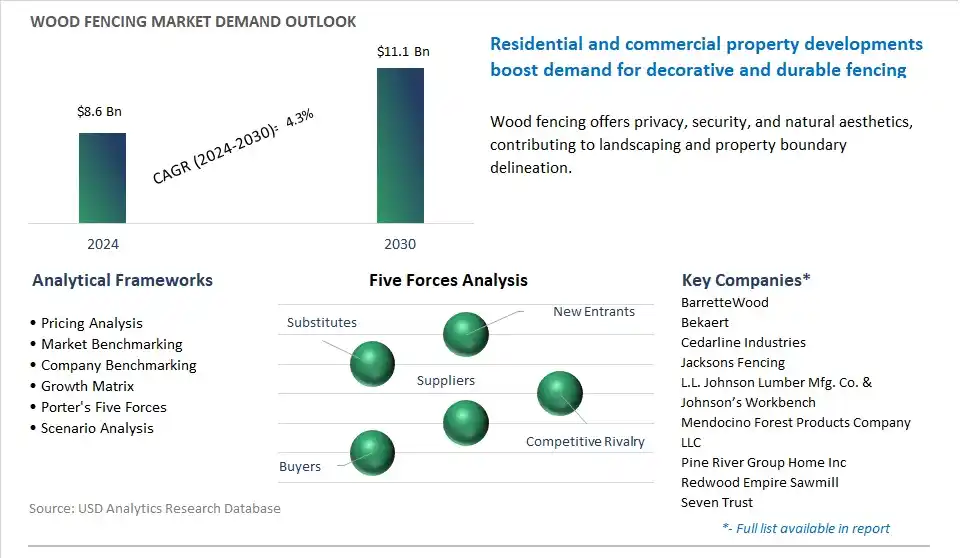
The global Wood Fencing Market is poised to register a 4.3% CAGR from $8.6 Billion in 2024 to $11.1 Billion in 2030.
The global Wood Fencing Market Study analyzes and forecasts the market size across 6 regions and 24 countries for diverse segments -By Product (Picket, Rail & Post, Vertical Board, Others), By Species (Cedar, Douglas fir, Redwood, Whitewood, Others), By Installation (Contractor & Installer, Do-It-Yourself), By Coatings (Stained, Non-Stained), By Application (Residential, Agricultural, Others).
An Introduction to Global Wood Fencing Market in 2024
The wood fencing market is experiencing steady growth driven by residential and commercial construction activities, landscaping projects, and the increasing demand for privacy and security solutions. Wood fences, prized for their natural beauty, versatility, and durability, remain a popular choice among homeowners, property developers, and landscape designers. Key trends shaping the future of the wood fencing industry include the adoption of sustainable forestry practices and eco-friendly wood treatments to enhance the longevity and performance of wood fence products. Moreover, with advancements in wood preservatives and surface coatings, there is a trend towards the development of pressure-treated and factory-finished wood fencing materials with improved resistance to decay, rot, and insect damage, ensuring long-term durability and low maintenance requirements. Additionally, innovations in fence design and construction techniques are enabling the creation of custom and prefabricated fencing systems that offer ease of installation, adaptability to varied terrain, and aesthetic appeal. Furthermore, with the growing emphasis on outdoor living spaces and landscaping aesthetics, there is a rising demand for decorative and ornamental wood fencing designs that complement architectural styles and enhance curb appeal, driving market growth and product innovation.
Wood Fencing Market Competitive Landscape
The market report analyses the leading companies in the industry including BarretteWood, Bekaert, Cedarline Industries, Jacksons Fencing, L.L. Johnson Lumber Mfg. Co. & Johnson’s Workbench, Mendocino Forest Products Company LLC, Pine River Group Home Inc, Redwood Empire Sawmill, Seven Trust, Sierra Pacific Industries, SPEC Wood Inc, Travis Perkins, Treeway Fencing Ltd, Wilfirs.
Wood Fencing Market Dynamics
Wood Fencing Market Trend: Preference for Natural and Sustainable Building Materials
A prominent trend in the wood fencing market is the preference for natural and sustainable building materials. With increasing awareness of environmental sustainability and a desire for more eco-friendly construction practices, there is a growing demand for wood fencing as a renewable and biodegradable alternative to synthetic materials. Consumers and contractors are choosing wood fencing for its natural aesthetic appeal, versatility, and environmental benefits. This trend is driven by the desire to reduce the carbon footprint of construction projects, promote sustainable forestry practices, and create visually appealing outdoor spaces that blend harmoniously with the natural surroundings.
Wood Fencing Market Driver: Residential and Commercial Development Projects
The primary driver for the wood fencing market is residential and commercial development projects. As populations grow and urbanization continues, there is a continuous demand for new housing developments, commercial properties, and infrastructure projects that require fencing solutions for security, privacy, and boundary delineation. Wood fencing, known for its durability, affordability, and ease of installation, remains a popular choice among homeowners, developers, and contractors for both residential and commercial applications. Factors such as new construction, renovation activities, and landscaping projects drive the need for wood fencing products, stimulating growth in the market.
Wood Fencing Market Opportunity: Offering Customized Design and Installation Services
An opportunity for market advancement in the wood fencing segment lies in offering customized design and installation services. Beyond providing standard fencing products, manufacturers and contractors can differentiate themselves by offering personalized solutions tailored to the specific needs and preferences of customers. This can include custom-designed fencing styles, sizes, and finishes, as well as professional installation services that ensure proper alignment, stability, and longevity of the fence. By collaborating closely with customers, architects, and landscape designers, companies can create unique fencing designs that enhance the aesthetic appeal of properties and provide functional benefits such as noise reduction, wind protection, and wildlife deterrence. By leveraging technology such as 3D modeling and visualization tools, and offering turnkey solutions from design to installation, companies can unlock new opportunities for revenue growth and market differentiation in the wood fencing industry.
Wood Fencing Market Share Analysis: Vertical Board generated the highest revenue in 2024
The largest segment in the Wood Fencing Market is the Vertical Board category. Vertical board fencing, also known as panel or privacy fencing, is widely used for its versatility, durability, and aesthetic appeal. Vertical board fences consist of overlapping or closely spaced vertical boards that provide privacy, security, and sound insulation while enhancing the appearance of outdoor spaces. This type of fencing is commonly used in residential settings to enclose yards, gardens, and property boundaries, providing a sense of seclusion and creating a private outdoor oasis. Additionally, vertical board fencing is available in various wood species, grades, and finishes, allowing homeowners to choose options that complement their home's architecture and landscaping. Further, vertical board fencing can be customized with decorative elements such as lattice tops, scalloped edges, and post caps to add visual interest and curb appeal. Furthermore, vertical board fencing is relatively easy to install and maintain, making it a popular choice for homeowners looking for durable and low-maintenance fencing solutions. The combination of privacy, versatility, and aesthetic appeal makes vertical board fencing the largest segment in the Wood Fencing Market.
Wood Fencing Market Share Analysis: Cedar segment is poised to register the fastest growth rate (CAGR) over the forecast period to 2030
The fastest-growing segment in the Wood Fencing Market is the Cedar category. Diverse factors contribute to the rapid growth of cedar fencing compared to other wood species. cedar is renowned for its natural durability, decay resistance, and insect repellent properties, making it an ideal choice for outdoor applications such as fencing. Cedar contains natural oils and extracts that protect it from rot, decay, and insect damage, allowing it to withstand exposure to moisture, humidity, and harsh weather conditions without deteriorating. Additionally, cedar's distinctive aroma and warm coloration add to its aesthetic appeal, enhancing the overall appearance of outdoor spaces. Further, cedar is lightweight and easy to work with, making it suitable for various fencing styles and installation methods. Furthermore, cedar fencing is considered environmentally friendly and sustainable, as cedar trees are abundant in North America and can be harvested responsibly from managed forests. Additionally, the growing trend towards outdoor living spaces, privacy, and property delineation drives the demand for cedar fencing among homeowners, builders, and landscape designers. As consumers increasingly prioritize quality, aesthetics, and sustainability in their fencing materials, the demand for cedar fencing in the Wood Fencing Market is expected to continue growing rapidly, making it the fastest-growing segment.
Wood Fencing Market Share Analysis: Do-It-Yourself segment is poised to register the fastest growth rate (CAGR) over the forecast period to 2030
The fastest-growing segment in the Wood Fencing Market is the Do-It-Yourself (DIY) category. Diverse factors contribute to the rapid growth of DIY installations compared to contractor and installer services. There is a growing trend towards DIY home improvement projects driven by factors such as cost savings, convenience, and personalization. DIY enthusiasts are increasingly opting to tackle home improvement projects themselves, including fence installations, to save on labor costs and have greater control over the design and execution of their projects. Additionally, the availability of easy-to-install fencing kits and pre-assembled panels makes DIY fence installations accessible to homeowners of varying skill levels. These kits come with detailed instructions and all the necessary hardware, allowing homeowners to complete their fencing projects efficiently and without the need for specialized tools or expertise. Further, the rise of online resources, tutorials, and instructional videos provides DIYers with valuable guidance and support throughout the installation process, empowering them to take on more complex projects with confidence. Furthermore, the COVID-19 pandemic has further accelerated the DIY trend, as homeowners spent more time at home and sought ways to enhance their outdoor living spaces and increase privacy and security. Accordingly, the demand for wood fencing materials for DIY installations has surged, driving the growth of the DIY segment in the Wood Fencing Market.
Wood Fencing Market Report Segmentation
By Product
Picket
Rail & Post
Vertical Board
Others
By Species
Cedar
Douglas fir
Redwood
Whitewood
Others
By Installation
Contractor & Installer
Do-It-Yourself
By Coatings
Stained
Non-Stained
By Application
Residential
Agricultural
Others
Regions Included
North America (US, Canada, Mexico)
Europe (Germany, UK, France, Spain, Italy, Russia, Rest of Europe)
Asia Pacific (China, India, Japan, South Korea, Australia, South East Asia, Rest of Asia)
South America (Brazil, Argentina, Rest of South America)
Middle East and Africa (Saudi Arabia, UAE, Rest of Middle East, South Africa, Egypt, Rest of Africa)
Wood Fencing Companies Profiled in the Market Study
BarretteWood
Bekaert
Cedarline Industries
Jacksons Fencing
L.L. Johnson Lumber Mfg. Co. & Johnson’s Workbench
Mendocino Forest Products Company LLC
Pine River Group Home Inc
Redwood Empire Sawmill
Seven Trust
Sierra Pacific Industries
SPEC Wood Inc
Travis Perkins
Treeway Fencing Ltd
Wilfirs
*- List Not Exhaustive
TABLE OF CONTENTS
1 Introduction to 2024 Wood Fencing Market
1.1 Market Overview
1.2 Quick Facts
1.3 Scope/Objective of the Study
1.4 Market Definition
1.5 Countries and Regions Covered
1.6 Units, Currency, and Conversions
1.7 Industry Value Chain
2 Research Methodology
2.1 Market Size Estimation
2.2 Sources and Research Methodology
2.3 Data Triangulation
2.4 Assumptions and Limitations
3 Executive Summary
3.1 Global Wood Fencing Market Size Outlook, $ Million, 2021 to 2030
3.2 Wood Fencing Market Outlook by Type, $ Million, 2021 to 2030
3.3 Wood Fencing Market Outlook by Product, $ Million, 2021 to 2030
3.4 Wood Fencing Market Outlook by Application, $ Million, 2021 to 2030
3.5 Wood Fencing Market Outlook by Key Countries, $ Million, 2021 to 2030
4 Market Dynamics
4.1 Key Driving Forces of Wood Fencing Industry
4.2 Key Market Trends in Wood Fencing Industry
4.3 Potential Opportunities in Wood Fencing Industry
4.4 Key Challenges in Wood Fencing Industry
5 Market Factor Analysis
5.1 Value Chain Analysis
5.2 Competitive Landscape
5.2.1 Global Wood Fencing Market Share by Company (%), 2023
5.2.2 Product Offerings by Company
5.3 Porter’s Five Forces Analysis
5.4 Pricing Analysis and Outlook
6 Growth Outlook Across Scenarios
6.1 Growth Analysis-Case Scenario Definitions
6.2 Low Growth Scenario Forecasts
6.3 Reference Growth Scenario Forecasts
6.4 High Growth Scenario Forecasts
7 Global Wood Fencing Market Outlook by Segments
7.1 Wood Fencing Market Outlook by Segments, $ Million, 2021- 2030
By Product
Picket
Rail & Post
Vertical Board
Others
By Species
Cedar
Douglas fir
Redwood
Whitewood
Others
By Installation
Contractor & Installer
Do-It-Yourself
By Coatings
Stained
Non-Stained
By Application
Residential
Agricultural
Others
8 North America Wood Fencing Market Analysis and Outlook To 2030
8.1 Introduction to North America Wood Fencing Markets in 2024
8.2 North America Wood Fencing Market Size Outlook by Country, 2021-2030
8.2.1 United States
8.2.2 Canada
8.2.3 Mexico
8.3 North America Wood Fencing Market size Outlook by Segments, 2021-2030
By Product
Picket
Rail & Post
Vertical Board
Others
By Species
Cedar
Douglas fir
Redwood
Whitewood
Others
By Installation
Contractor & Installer
Do-It-Yourself
By Coatings
Stained
Non-Stained
By Application
Residential
Agricultural
Others
9 Europe Wood Fencing Market Analysis and Outlook To 2030
9.1 Introduction to Europe Wood Fencing Markets in 2024
9.2 Europe Wood Fencing Market Size Outlook by Country, 2021-2030
9.2.1 Germany
9.2.2 France
9.2.3 Spain
9.2.4 United Kingdom
9.2.4 Italy
9.2.5 Russia
9.2.6 Norway
9.2.7 Rest of Europe
9.3 Europe Wood Fencing Market Size Outlook by Segments, 2021-2030
By Product
Picket
Rail & Post
Vertical Board
Others
By Species
Cedar
Douglas fir
Redwood
Whitewood
Others
By Installation
Contractor & Installer
Do-It-Yourself
By Coatings
Stained
Non-Stained
By Application
Residential
Agricultural
Others
10 Asia Pacific Wood Fencing Market Analysis and Outlook To 2030
10.1 Introduction to Asia Pacific Wood Fencing Markets in 2024
10.2 Asia Pacific Wood Fencing Market Size Outlook by Country, 2021-2030
10.2.1 China
10.2.2 India
10.2.3 Japan
10.2.4 South Korea
10.2.5 Indonesia
10.2.6 Malaysia
10.2.7 Australia
10.2.8 Rest of Asia Pacific
10.3 Asia Pacific Wood Fencing Market size Outlook by Segments, 2021-2030
By Product
Picket
Rail & Post
Vertical Board
Others
By Species
Cedar
Douglas fir
Redwood
Whitewood
Others
By Installation
Contractor & Installer
Do-It-Yourself
By Coatings
Stained
Non-Stained
By Application
Residential
Agricultural
Others
11 South America Wood Fencing Market Analysis and Outlook To 2030
11.1 Introduction to South America Wood Fencing Markets in 2024
11.2 South America Wood Fencing Market Size Outlook by Country, 2021-2030
11.2.1 Brazil
11.2.2 Argentina
11.2.3 Rest of South America
11.3 South America Wood Fencing Market size Outlook by Segments, 2021-2030
By Product
Picket
Rail & Post
Vertical Board
Others
By Species
Cedar
Douglas fir
Redwood
Whitewood
Others
By Installation
Contractor & Installer
Do-It-Yourself
By Coatings
Stained
Non-Stained
By Application
Residential
Agricultural
Others
12 Middle East and Africa Wood Fencing Market Analysis and Outlook To 2030
12.1 Introduction to Middle East and Africa Wood Fencing Markets in 2024
12.2 Middle East and Africa Wood Fencing Market Size Outlook by Country, 2021-2030
12.2.1 Saudi Arabia
12.2.2 UAE
12.2.3 Oman
12.2.4 Rest of Middle East
12.2.5 Egypt
12.2.6 Nigeria
12.2.7 South Africa
12.2.8 Rest of Africa
12.3 Middle East and Africa Wood Fencing Market size Outlook by Segments, 2021-2030
By Product
Picket
Rail & Post
Vertical Board
Others
By Species
Cedar
Douglas fir
Redwood
Whitewood
Others
By Installation
Contractor & Installer
Do-It-Yourself
By Coatings
Stained
Non-Stained
By Application
Residential
Agricultural
Others
13 Company Profiles
13.1 Company Snapshot
13.2 SWOT Profiles
13.3 Products and Services
13.4 Recent Developments
13.5 Financial Profile
BarretteWood
Bekaert
Cedarline Industries
Jacksons Fencing
L.L. Johnson Lumber Mfg. Co. & Johnson’s Workbench
Mendocino Forest Products Company LLC
Pine River Group Home Inc
Redwood Empire Sawmill
Seven Trust
Sierra Pacific Industries
SPEC Wood Inc
Travis Perkins
Treeway Fencing Ltd
Wilfirs
14 Appendix
14.1 Customization Offerings
14.2 Subscription Services
14.3 Related Reports
14.4 Publisher Expertise
By Product
Picket
Rail & Post
Vertical Board
Others
By Species
Cedar
Douglas fir
Redwood
Whitewood
Others
By Installation
Contractor & Installer
Do-It-Yourself
By Coatings
Stained
Non-Stained
By Application
Residential
Agricultural
Others
Countries Analyzed
North America (US, Canada, Mexico)
Europe (Germany, UK, France, Spain, Italy, Russia, Rest of Europe)
Asia Pacific (China, India, Japan, South Korea, Australia, South East Asia, Rest of Asia)
South America (Brazil, Argentina, Rest of South America)
Middle East and Africa (Saudi Arabia, UAE, Rest of Middle East, South Africa, Egypt, Rest of Africa)
