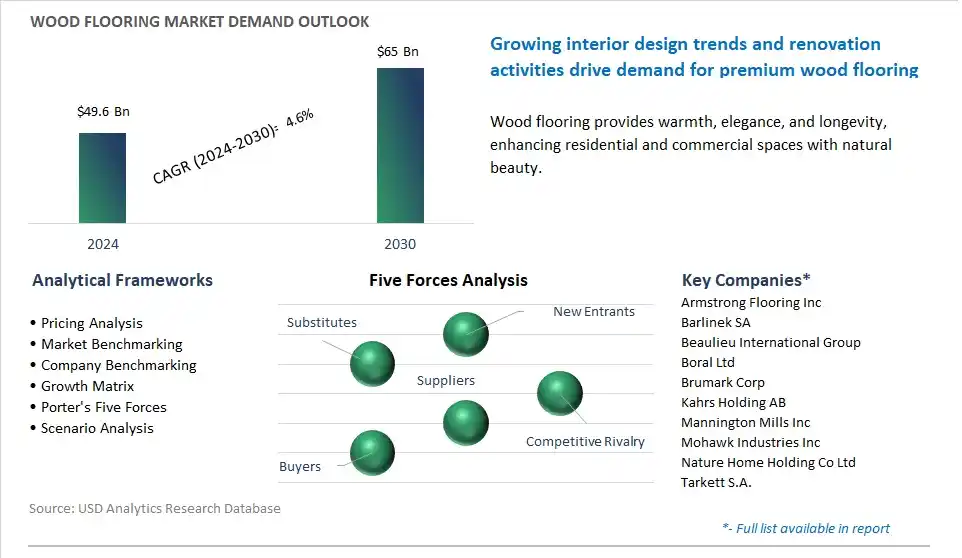
The global Wood Flooring Market is poised to register a 4.6% CAGR from $49.6 Billion in 2024 to $65 Billion in 2030.
The global Wood Flooring Market Study analyzes and forecasts the market size across 6 regions and 24 countries for diverse segments -By Product (Solid Wood, Engineered Wood), By Distribution Channel (Home Centers, Flagship Stores, Specialty Stores, Online, Others), By End-User (Residential, Commercial).
An Introduction to Global Wood Flooring Market in 2024
The wood flooring market continues to evolve with changing consumer preferences, technological advancements, and sustainability considerations. Wood flooring, appreciated for its natural beauty, durability, and timeless appeal, remains a popular choice for residential, commercial, and hospitality spaces. Key trends shaping the future of the wood flooring industry include the development of engineered wood flooring with enhanced stability and moisture resistance, making it suitable for installation in areas prone to fluctuations in temperature and humidity. Moreover, with the rising demand for sustainable and eco-friendly flooring options, there is a growing emphasis on certified wood sources, responsible forestry practices, and eco-friendly finishing materials in wood flooring production. Additionally, advancements in digital printing technology are enabling the replication of realistic wood grain patterns and textures on laminate and luxury vinyl plank flooring, offering cost-effective alternatives to solid wood flooring without compromising on aesthetics or performance. Furthermore, with the increasing focus on indoor air quality and occupant health, there is a trend towards the use of low-VOC finishes and adhesives in wood flooring installations, ensuring a healthier indoor environment for building occupants.
Wood Flooring Market Competitive Landscape
The market report analyses the leading companies in the industry including Armstrong Flooring Inc, Barlinek SA, Beaulieu International Group, Boral Ltd, Brumark Corp, Kahrs Holding AB, Mannington Mills Inc, Mohawk Industries Inc, Nature Home Holding Co Ltd, Tarkett S.A..
Wood Flooring Market Dynamics
Wood Flooring Market Trend: Growing Preference for Engineered Wood Flooring
A prominent trend in the wood flooring market is the growing preference for engineered wood flooring. Engineered wood flooring offers several advantages over solid wood flooring, including enhanced stability, resistance to moisture and humidity, and wider availability of species and finishes. With advancements in manufacturing technology, engineered wood flooring has become increasingly popular among homeowners, designers, and contractors seeking durable and versatile flooring solutions. This trend is driven by the desire for flooring materials that offer superior performance, durability, and aesthetics while addressing concerns about environmental sustainability and moisture-related issues commonly associated with solid wood flooring.
Wood Flooring Market Driver: Increase in Residential and Commercial Construction Activity
The primary driver for the wood flooring market is the increase in residential and commercial construction activity. As populations grow, urbanization continues, and disposable incomes rise, there is a rising demand for new homes, office spaces, retail stores, and hospitality establishments, all of which require high-quality flooring solutions. Wood flooring, renowned for its timeless appeal, warmth, and durability, remains a popular choice for both residential and commercial applications. Factors such as renovation projects, interior design trends, and the desire for customizable and aesthetically pleasing spaces drive the demand for wood flooring products, stimulating market growth.
Wood Flooring Market Opportunity: Expansion into Green Building and Sustainable Construction
An opportunity for market advancement in the wood flooring segment lies in expansion into green building and sustainable construction projects. With increasing awareness of environmental issues and the adoption of green building standards, there is a growing demand for flooring materials that meet stringent sustainability criteria. Wood flooring, especially products certified by recognized eco-labels such as Forest Stewardship Council (FSC) or Leadership in Energy and Environmental Design (LEED), can appeal to environmentally conscious consumers and developers. By offering sustainable wood flooring options, promoting responsible forestry practices, and participating in green building initiatives, manufacturers can capitalize on the growing market for eco-friendly flooring materials and contribute to the advancement of sustainable construction practices.
Wood Flooring Market Share Analysis: Engineered Wood generated the highest revenue in 2024
The largest segment in the Wood Flooring Market is the Engineered Wood category. Engineered wood flooring has gained significant popularity and market share. engineered wood flooring offers a more affordable alternative to solid wood flooring while providing comparable aesthetics and performance. Engineered wood consists of multiple layers of wood veneer or plywood bonded together with adhesive under high pressure and heat. This construction method enhances the stability and durability of the flooring, making it less susceptible to warping, shrinking, and expansion due to fluctuations in temperature and humidity compared to solid wood flooring. Additionally, engineered wood flooring is available in a wide range of wood species, finishes, and styles, allowing consumers to achieve the desired look and feel for their spaces. Further, engineered wood flooring is suitable for installation in various environments, including below-grade areas such as basements, where solid wood flooring are prone to moisture-related issues. Furthermore, advancements in manufacturing technology have led to improvements in the quality and performance of engineered wood flooring, making it an attractive option for homeowners, builders, and designers. Additionally, engineered wood flooring is more environmentally friendly than solid wood flooring, as it utilizes less raw material and often includes recycled wood components. These factors contribute to the widespread adoption of engineered wood flooring as the largest segment in the Wood Flooring Market.
Wood Flooring Market Share Analysis: Online channel segment is poised to register the fastest growth rate (CAGR) over the forecast period to 2030
The fastest-growing segment in the Wood Flooring Market is the Online distribution channel. Diverse factors contribute to the rapid growth of online sales compared to traditional brick-and-mortar distribution channels. The convenience and accessibility of online shopping have led to a significant shift in consumer behavior, with more people opting to purchase goods and services online. This trend has been further accelerated by the COVID-19 pandemic, which has prompted consumers to embrace e-commerce for safety reasons and out of necessity due to lockdowns and social distancing measures. Additionally, the wide availability of wood flooring products from various brands and manufacturers on online platforms allows consumers to compare prices, browse product specifications, and read reviews from other buyers, making it easier to find the perfect flooring for their needs. Further, online retailers often offer competitive pricing, discounts, and promotions, attracting budget-conscious consumers and incentivizing them to make purchases online. Furthermore, the convenience of doorstep delivery and flexible return policies offered by online retailers eliminates the need for consumers to visit physical stores, saving them time and effort. Additionally, online retailers can reach a broader audience geographically, including customers in rural areas or regions with limited access to brick-and-mortar stores. As a result of these factors, the online distribution channel has experienced rapid growth in the Wood Flooring Market, capturing market share from traditional retail channels and becoming the fastest-growing segment.
Wood Flooring Market Share Analysis: Commercial end-user segment is poised to register the fastest growth rate (CAGR) over the forecast period to 2030
The fastest-growing segment in the Wood Flooring Market is the Commercial end-user category. Diverse factors contribute to the rapid growth of wood flooring in commercial applications compared to residential use. There has been an increasing trend towards creating aesthetically pleasing and inviting commercial spaces, such as offices, retail stores, restaurants, hotels, and healthcare facilities. Wood flooring adds warmth, sophistication, and a touch of luxury to these environments, enhancing the overall ambiance and customer experience. Additionally, wood flooring offers versatility in design, with various wood species, finishes, and installation patterns available to suit different commercial aesthetics and branding requirements. Further, advancements in wood flooring technology, such as engineered wood flooring with enhanced durability and performance characteristics, make it suitable for high-traffic areas in commercial settings. Furthermore, wood flooring is perceived as a sustainable and eco-friendly choice compared to other flooring materials, aligning with the growing demand for green building practices and LEED (Leadership in Energy and Environmental Design) certification in commercial construction projects. Additionally, the COVID-19 pandemic has heightened awareness of hygiene and cleanliness in commercial spaces, leading to increased demand for wood flooring, which is easy to clean and maintain. As businesses invest in renovating and upgrading their commercial spaces to attract customers, improve employee productivity, and create a positive brand image, the demand for wood flooring in the commercial sector is expected to continue growing rapidly, making it the fastest-growing segment in the Wood Flooring Market.
Wood Flooring Market Report Segmentation
By Product
Solid Wood
Engineered Wood
By Distribution Channel
Home Centers
Flagship Stores
Specialty Stores
Online
Others
By End-User
Residential
Commercial
Regions Included
North America (US, Canada, Mexico)
Europe (Germany, UK, France, Spain, Italy, Russia, Rest of Europe)
Asia Pacific (China, India, Japan, South Korea, Australia, South East Asia, Rest of Asia)
South America (Brazil, Argentina, Rest of South America)
Middle East and Africa (Saudi Arabia, UAE, Rest of Middle East, South Africa, Egypt, Rest of Africa)
Wood Flooring Companies Profiled in the Market Study
Armstrong Flooring Inc
Barlinek SA
Beaulieu International Group
Boral Ltd
Brumark Corp
Kahrs Holding AB
Mannington Mills Inc
Mohawk Industries Inc
Nature Home Holding Co Ltd
Tarkett S.A.
*- List Not Exhaustive
TABLE OF CONTENTS
1 Introduction to 2024 Wood Flooring Market
1.1 Market Overview
1.2 Quick Facts
1.3 Scope/Objective of the Study
1.4 Market Definition
1.5 Countries and Regions Covered
1.6 Units, Currency, and Conversions
1.7 Industry Value Chain
2 Research Methodology
2.1 Market Size Estimation
2.2 Sources and Research Methodology
2.3 Data Triangulation
2.4 Assumptions and Limitations
3 Executive Summary
3.1 Global Wood Flooring Market Size Outlook, $ Million, 2021 to 2030
3.2 Wood Flooring Market Outlook by Type, $ Million, 2021 to 2030
3.3 Wood Flooring Market Outlook by Product, $ Million, 2021 to 2030
3.4 Wood Flooring Market Outlook by Application, $ Million, 2021 to 2030
3.5 Wood Flooring Market Outlook by Key Countries, $ Million, 2021 to 2030
4 Market Dynamics
4.1 Key Driving Forces of Wood Flooring Industry
4.2 Key Market Trends in Wood Flooring Industry
4.3 Potential Opportunities in Wood Flooring Industry
4.4 Key Challenges in Wood Flooring Industry
5 Market Factor Analysis
5.1 Value Chain Analysis
5.2 Competitive Landscape
5.2.1 Global Wood Flooring Market Share by Company (%), 2023
5.2.2 Product Offerings by Company
5.3 Porter’s Five Forces Analysis
5.4 Pricing Analysis and Outlook
6 Growth Outlook Across Scenarios
6.1 Growth Analysis-Case Scenario Definitions
6.2 Low Growth Scenario Forecasts
6.3 Reference Growth Scenario Forecasts
6.4 High Growth Scenario Forecasts
7 Global Wood Flooring Market Outlook by Segments
7.1 Wood Flooring Market Outlook by Segments, $ Million, 2021- 2030
By Product
Solid Wood
Engineered Wood
By Distribution Channel
Home Centers
Flagship Stores
Specialty Stores
Online
Others
By End-User
Residential
Commercial
8 North America Wood Flooring Market Analysis and Outlook To 2030
8.1 Introduction to North America Wood Flooring Markets in 2024
8.2 North America Wood Flooring Market Size Outlook by Country, 2021-2030
8.2.1 United States
8.2.2 Canada
8.2.3 Mexico
8.3 North America Wood Flooring Market size Outlook by Segments, 2021-2030
By Product
Solid Wood
Engineered Wood
By Distribution Channel
Home Centers
Flagship Stores
Specialty Stores
Online
Others
By End-User
Residential
Commercial
9 Europe Wood Flooring Market Analysis and Outlook To 2030
9.1 Introduction to Europe Wood Flooring Markets in 2024
9.2 Europe Wood Flooring Market Size Outlook by Country, 2021-2030
9.2.1 Germany
9.2.2 France
9.2.3 Spain
9.2.4 United Kingdom
9.2.4 Italy
9.2.5 Russia
9.2.6 Norway
9.2.7 Rest of Europe
9.3 Europe Wood Flooring Market Size Outlook by Segments, 2021-2030
By Product
Solid Wood
Engineered Wood
By Distribution Channel
Home Centers
Flagship Stores
Specialty Stores
Online
Others
By End-User
Residential
Commercial
10 Asia Pacific Wood Flooring Market Analysis and Outlook To 2030
10.1 Introduction to Asia Pacific Wood Flooring Markets in 2024
10.2 Asia Pacific Wood Flooring Market Size Outlook by Country, 2021-2030
10.2.1 China
10.2.2 India
10.2.3 Japan
10.2.4 South Korea
10.2.5 Indonesia
10.2.6 Malaysia
10.2.7 Australia
10.2.8 Rest of Asia Pacific
10.3 Asia Pacific Wood Flooring Market size Outlook by Segments, 2021-2030
By Product
Solid Wood
Engineered Wood
By Distribution Channel
Home Centers
Flagship Stores
Specialty Stores
Online
Others
By End-User
Residential
Commercial
11 South America Wood Flooring Market Analysis and Outlook To 2030
11.1 Introduction to South America Wood Flooring Markets in 2024
11.2 South America Wood Flooring Market Size Outlook by Country, 2021-2030
11.2.1 Brazil
11.2.2 Argentina
11.2.3 Rest of South America
11.3 South America Wood Flooring Market size Outlook by Segments, 2021-2030
By Product
Solid Wood
Engineered Wood
By Distribution Channel
Home Centers
Flagship Stores
Specialty Stores
Online
Others
By End-User
Residential
Commercial
12 Middle East and Africa Wood Flooring Market Analysis and Outlook To 2030
12.1 Introduction to Middle East and Africa Wood Flooring Markets in 2024
12.2 Middle East and Africa Wood Flooring Market Size Outlook by Country, 2021-2030
12.2.1 Saudi Arabia
12.2.2 UAE
12.2.3 Oman
12.2.4 Rest of Middle East
12.2.5 Egypt
12.2.6 Nigeria
12.2.7 South Africa
12.2.8 Rest of Africa
12.3 Middle East and Africa Wood Flooring Market size Outlook by Segments, 2021-2030
By Product
Solid Wood
Engineered Wood
By Distribution Channel
Home Centers
Flagship Stores
Specialty Stores
Online
Others
By End-User
Residential
Commercial
13 Company Profiles
13.1 Company Snapshot
13.2 SWOT Profiles
13.3 Products and Services
13.4 Recent Developments
13.5 Financial Profile
Armstrong Flooring Inc
Barlinek SA
Beaulieu International Group
Boral Ltd
Brumark Corp
Kahrs Holding AB
Mannington Mills Inc
Mohawk Industries Inc
Nature Home Holding Co Ltd
Tarkett S.A.
14 Appendix
14.1 Customization Offerings
14.2 Subscription Services
14.3 Related Reports
14.4 Publisher Expertise
By Product
Solid Wood
Engineered Wood
By Distribution Channel
Home Centers
Flagship Stores
Specialty Stores
Online
Others
By End-User
Residential
Commercial
Countries Analyzed
North America (US, Canada, Mexico)
Europe (Germany, UK, France, Spain, Italy, Russia, Rest of Europe)
Asia Pacific (China, India, Japan, South Korea, Australia, South East Asia, Rest of Asia)
South America (Brazil, Argentina, Rest of South America)
Middle East and Africa (Saudi Arabia, UAE, Rest of Middle East, South Africa, Egypt, Rest of Africa)
