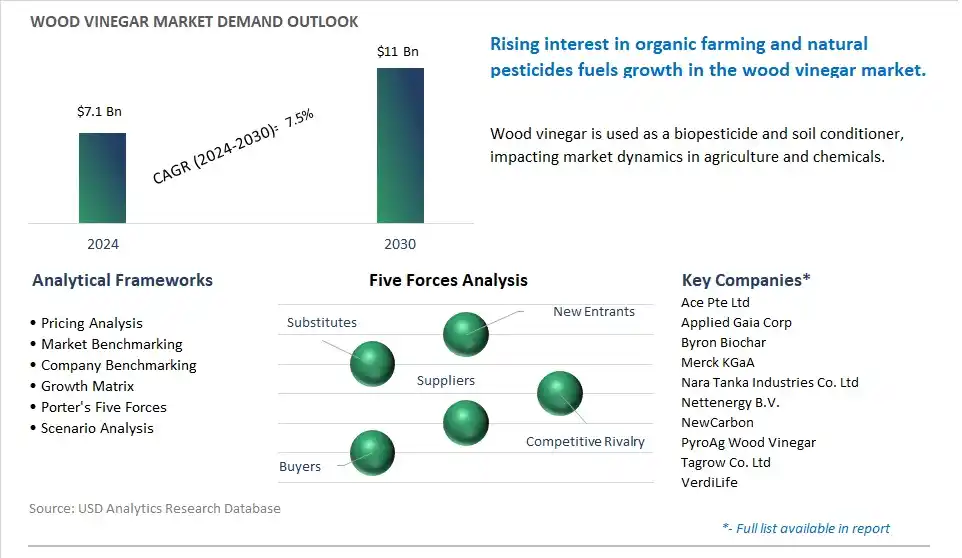
The global Wood Vinegar Market is poised to register a 7.5% CAGR from $7.1 Billion in 2024 to $11 Billion in 2030.
The global Wood Vinegar Market Study analyzes and forecasts the market size across 6 regions and 24 countries for diverse segments -By Method (Slow pyrolysis, Fast pyrolysis, Intermediate pyrolysis), By Application (Agriculture Food & Beverage Animal Feed, Others).
An Introduction to Global Wood Vinegar Market in 2024
The wood vinegar market is experiencing growth driven by the increasing adoption of bio-based agricultural inputs, organic fertilizers, and natural pest control solutions in sustainable farming practices. Key trends shaping the future of the industry include innovations in wood vinegar production technologies, extraction methods, and formulation processes to enhance product quality, efficacy, and application convenience. Advanced wood vinegar products offer multifunctional benefits such as plant growth promotion, soil conditioning, pest repellence, and disease suppression, supporting integrated pest management (IPM) and regenerative agriculture approaches. Moreover, the growing demand for organic and non-toxic alternatives to synthetic agrochemicals drives market growth, as wood vinegar serves as a safe and environmentally friendly solution for crop protection and soil health improvement. Additionally, the integration of wood vinegar into livestock feed additives, animal health products, and pet care formulations offers natural solutions for odor control, digestive health, and parasite management. As farmers and growers increasingly prioritize sustainability, soil health, and food safety, the wood vinegar market is poised for sustained growth and innovation as a key player in the global transition towards more environmentally friendly and socially responsible agriculture practices.
Wood Vinegar Market Competitive Landscape
The market report analyses the leading companies in the industry including Ace Pte Ltd, Applied Gaia Corp, Byron Biochar, Merck KGaA, Nara Tanka Industries Co. Ltd, Nettenergy B.V., NewCarbon, PyroAg Wood Vinegar, Tagrow Co. Ltd, VerdiLife.
Wood Vinegar Market Dynamics
Wood Vinegar Market Trend: Increasing Demand for Organic and Natural Agricultural Inputs
A prominent trend in the wood vinegar market is the increasing demand for organic and natural agricultural inputs. Wood vinegar, also known as pyroligneous acid, is a byproduct of the pyrolysis process of wood, commonly derived from biomass sources such as hardwood and bamboo. It contains various organic compounds such as acetic acid, phenols, and methanol, which have been found to have beneficial effects on plant growth, soil health, and pest control. As consumers and farmers alike prioritize organic and sustainable farming practices, there is a growing interest in using wood vinegar as a natural alternative to synthetic fertilizers, pesticides, and soil conditioners. This trend reflects a broader shift towards eco-friendly and sustainable agriculture, driven by concerns about chemical residues, soil degradation, and environmental impact.
Wood Vinegar Market Driver: Rising Awareness of Sustainable Agriculture and Crop Yield Enhancement
A key driver for the wood vinegar market is the rising awareness of sustainable agriculture and crop yield enhancement. Farmers are increasingly seeking environmentally friendly solutions to improve soil fertility, enhance crop productivity, and mitigate the negative impacts of conventional agricultural practices. Wood vinegar offers a natural and biodegradable option for addressing these challenges, as it can improve soil structure, stimulate plant growth, and suppress pests and diseases. With the growing demand for high-quality and nutritious food, as well as the need to optimize agricultural productivity to feed a growing global population, there is a significant opportunity for wood vinegar to play a role in sustainable agriculture as a cost-effective and environmentally friendly agricultural input.
Wood Vinegar Market Opportunity: Expansion into New Applications and Markets
An opportunity within the wood vinegar market lies in the expansion into new applications and markets. While wood vinegar is primarily used in agriculture as a soil conditioner, fertilizer enhancer, and pest repellent, there are potential opportunities to explore its use in other industries and sectors. For example, wood vinegar can be utilized in animal husbandry for odor control, livestock health promotion, and feed supplementation. It can also find applications in environmental remediation projects for soil and water treatment, as well as in the production of bio-based chemicals, fuels, and pharmaceuticals. By diversifying into new applications and markets, wood vinegar manufacturers can leverage its versatile properties and capitalize on emerging opportunities for growth and innovation in the bio-based products sector.
Wood Vinegar Market Share Analysis: Slow Pyrolysis segment generated the highest revenue in the industry
The slow pyrolysis method is the largest segment in the Wood Vinegar Market due to its established technology, favorable production yields, and superior quality of wood vinegar obtained through this process. Slow pyrolysis involves heating biomass, such as wood, in the absence of oxygen at relatively low temperatures (300-500°C) for an extended period, diverse hours to days. This gradual heating process allows for the controlled decomposition of biomass into biochar, syngas, and wood vinegar, among other products. Wood vinegar produced through slow pyrolysis is characterized by its high concentration of organic compounds, including acetic acid, phenols, and carboxylic acids, as well as beneficial plant-derived substances such as organic acids, antioxidants, and growth-promoting phytochemicals. In addition, slow pyrolysis technology is well-established and widely used in the wood vinegar industry, with numerous commercial-scale production facilities and established supply chains. Additionally, slow pyrolysis offers flexibility in feedstock selection and process optimization, enabling producers to obtain wood vinegar with desired characteristics and meet specific market requirements. Further, the growing demand for natural and sustainable alternatives in agriculture, forestry, animal husbandry, and environmental remediation drives the utilization of wood vinegar produced through slow pyrolysis as a bio-based and eco-friendly solution.
Wood Vinegar Market Share Analysis: Agriculture Segment is poised to register the fastest growth rate (CAGR) over the forecast period to 2030
Wood vinegar's application in agriculture is experiencing rapid growth due to its numerous benefits in enhancing soil fertility, plant growth, and disease resistance. As farmers increasingly seek sustainable and organic alternatives to conventional chemical fertilizers and pesticides, wood vinegar has emerged as a promising solution. It contains valuable nutrients and organic acids that improve soil structure, promote microbial activity, and increase nutrient uptake by plants. Additionally, its natural insect-repelling properties help reduce the need for synthetic pesticides, aligning with the growing demand for eco-friendly agricultural practices. Further, the rise of organic farming and the emphasis on food safety and environmental sustainability have contributed to the expansion of the wood vinegar market in agriculture. With its multifaceted benefits and compatibility with various crops, wood vinegar is poised to witness continuous growth in the agricultural sector.
Wood Vinegar Market Report Segmentation
By Method
Slow pyrolysis
Fast pyrolysis
Intermediate pyrolysis
By Application
Agriculture
-Crop Nutrition
-Crop Protection
Food & Beverage
-Canned Food
-Sauces
-Dairy Products
-Others
Animal Feed
Others
Regions Included
North America (US, Canada, Mexico)
Europe (Germany, UK, France, Spain, Italy, Russia, Rest of Europe)
Asia Pacific (China, India, Japan, South Korea, Australia, South East Asia, Rest of Asia)
South America (Brazil, Argentina, Rest of South America)
Middle East and Africa (Saudi Arabia, UAE, Rest of Middle East, South Africa, Egypt, Rest of Africa)
Wood Vinegar Companies Profiled in the Market Study
Ace Pte Ltd
Applied Gaia Corp
Byron Biochar
Merck KGaA
Nara Tanka Industries Co. Ltd
Nettenergy B.V.
NewCarbon
PyroAg Wood Vinegar
Tagrow Co. Ltd
VerdiLife
*- List Not Exhaustive
TABLE OF CONTENTS
1 Introduction to 2024 Wood Vinegar Market
1.1 Market Overview
1.2 Quick Facts
1.3 Scope/Objective of the Study
1.4 Market Definition
1.5 Countries and Regions Covered
1.6 Units, Currency, and Conversions
1.7 Industry Value Chain
2 Research Methodology
2.1 Market Size Estimation
2.2 Sources and Research Methodology
2.3 Data Triangulation
2.4 Assumptions and Limitations
3 Executive Summary
3.1 Global Wood Vinegar Market Size Outlook, $ Million, 2021 to 2030
3.2 Wood Vinegar Market Outlook by Type, $ Million, 2021 to 2030
3.3 Wood Vinegar Market Outlook by Product, $ Million, 2021 to 2030
3.4 Wood Vinegar Market Outlook by Application, $ Million, 2021 to 2030
3.5 Wood Vinegar Market Outlook by Key Countries, $ Million, 2021 to 2030
4 Market Dynamics
4.1 Key Driving Forces of Wood Vinegar Industry
4.2 Key Market Trends in Wood Vinegar Industry
4.3 Potential Opportunities in Wood Vinegar Industry
4.4 Key Challenges in Wood Vinegar Industry
5 Market Factor Analysis
5.1 Value Chain Analysis
5.2 Competitive Landscape
5.2.1 Global Wood Vinegar Market Share by Company (%), 2023
5.2.2 Product Offerings by Company
5.3 Porter’s Five Forces Analysis
5.4 Pricing Analysis and Outlook
6 Growth Outlook Across Scenarios
6.1 Growth Analysis-Case Scenario Definitions
6.2 Low Growth Scenario Forecasts
6.3 Reference Growth Scenario Forecasts
6.4 High Growth Scenario Forecasts
7 Global Wood Vinegar Market Outlook by Segments
7.1 Wood Vinegar Market Outlook by Segments, $ Million, 2021- 2030
By Method
Slow pyrolysis
Fast pyrolysis
Intermediate pyrolysis
By Application
Agriculture
-Crop Nutrition
-Crop Protection
Food & Beverage
-Canned Food
-Sauces
-Dairy Products
-Others
Animal Feed
Others
8 North America Wood Vinegar Market Analysis and Outlook To 2030
8.1 Introduction to North America Wood Vinegar Markets in 2024
8.2 North America Wood Vinegar Market Size Outlook by Country, 2021-2030
8.2.1 United States
8.2.2 Canada
8.2.3 Mexico
8.3 North America Wood Vinegar Market size Outlook by Segments, 2021-2030
By Method
Slow pyrolysis
Fast pyrolysis
Intermediate pyrolysis
By Application
Agriculture
-Crop Nutrition
-Crop Protection
Food & Beverage
-Canned Food
-Sauces
-Dairy Products
-Others
Animal Feed
Others
9 Europe Wood Vinegar Market Analysis and Outlook To 2030
9.1 Introduction to Europe Wood Vinegar Markets in 2024
9.2 Europe Wood Vinegar Market Size Outlook by Country, 2021-2030
9.2.1 Germany
9.2.2 France
9.2.3 Spain
9.2.4 United Kingdom
9.2.4 Italy
9.2.5 Russia
9.2.6 Norway
9.2.7 Rest of Europe
9.3 Europe Wood Vinegar Market Size Outlook by Segments, 2021-2030
By Method
Slow pyrolysis
Fast pyrolysis
Intermediate pyrolysis
By Application
Agriculture
-Crop Nutrition
-Crop Protection
Food & Beverage
-Canned Food
-Sauces
-Dairy Products
-Others
Animal Feed
Others
10 Asia Pacific Wood Vinegar Market Analysis and Outlook To 2030
10.1 Introduction to Asia Pacific Wood Vinegar Markets in 2024
10.2 Asia Pacific Wood Vinegar Market Size Outlook by Country, 2021-2030
10.2.1 China
10.2.2 India
10.2.3 Japan
10.2.4 South Korea
10.2.5 Indonesia
10.2.6 Malaysia
10.2.7 Australia
10.2.8 Rest of Asia Pacific
10.3 Asia Pacific Wood Vinegar Market size Outlook by Segments, 2021-2030
By Method
Slow pyrolysis
Fast pyrolysis
Intermediate pyrolysis
By Application
Agriculture
-Crop Nutrition
-Crop Protection
Food & Beverage
-Canned Food
-Sauces
-Dairy Products
-Others
Animal Feed
Others
11 South America Wood Vinegar Market Analysis and Outlook To 2030
11.1 Introduction to South America Wood Vinegar Markets in 2024
11.2 South America Wood Vinegar Market Size Outlook by Country, 2021-2030
11.2.1 Brazil
11.2.2 Argentina
11.2.3 Rest of South America
11.3 South America Wood Vinegar Market size Outlook by Segments, 2021-2030
By Method
Slow pyrolysis
Fast pyrolysis
Intermediate pyrolysis
By Application
Agriculture
-Crop Nutrition
-Crop Protection
Food & Beverage
-Canned Food
-Sauces
-Dairy Products
-Others
Animal Feed
Others
12 Middle East and Africa Wood Vinegar Market Analysis and Outlook To 2030
12.1 Introduction to Middle East and Africa Wood Vinegar Markets in 2024
12.2 Middle East and Africa Wood Vinegar Market Size Outlook by Country, 2021-2030
12.2.1 Saudi Arabia
12.2.2 UAE
12.2.3 Oman
12.2.4 Rest of Middle East
12.2.5 Egypt
12.2.6 Nigeria
12.2.7 South Africa
12.2.8 Rest of Africa
12.3 Middle East and Africa Wood Vinegar Market size Outlook by Segments, 2021-2030
By Method
Slow pyrolysis
Fast pyrolysis
Intermediate pyrolysis
By Application
Agriculture
-Crop Nutrition
-Crop Protection
Food & Beverage
-Canned Food
-Sauces
-Dairy Products
-Others
Animal Feed
Others
13 Company Profiles
13.1 Company Snapshot
13.2 SWOT Profiles
13.3 Products and Services
13.4 Recent Developments
13.5 Financial Profile
Ace Pte Ltd
Applied Gaia Corp
Byron Biochar
Merck KGaA
Nara Tanka Industries Co. Ltd
Nettenergy B.V.
NewCarbon
PyroAg Wood Vinegar
Tagrow Co. Ltd
VerdiLife
14 Appendix
14.1 Customization Offerings
14.2 Subscription Services
14.3 Related Reports
14.4 Publisher Expertise
By Method
Slow pyrolysis
Fast pyrolysis
Intermediate pyrolysis
By Application
Agriculture
-Crop Nutrition
-Crop Protection
Food & Beverage
-Canned Food
-Sauces
-Dairy Products
-Others
Animal Feed
Others
Countries Analyzed
North America (US, Canada, Mexico)
Europe (Germany, UK, France, Spain, Italy, Russia, Rest of Europe)
Asia Pacific (China, India, Japan, South Korea, Australia, South East Asia, Rest of Asia)
South America (Brazil, Argentina, Rest of South America)
Middle East and Africa (Saudi Arabia, UAE, Rest of Middle East, South Africa, Egypt, Rest of Africa)
