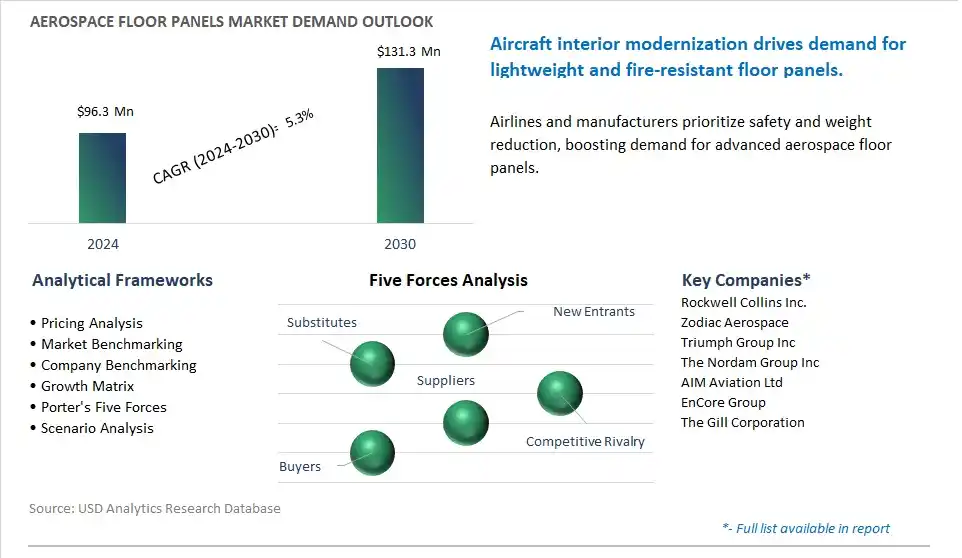
The global Aerospace Floor Panels Market is poised to register a 5.3% CAGR from $96.3 Million in 2024 to $131.3 Million in 2030.
The global Aerospace Floor Panels Market Study analyzes and forecasts the market size across 6 regions and 24 countries for diverse segments -By Raw Material (Nomex honeycomb, Aluminum honeycomb, Others), By Aircraft Type (Narrow body aircraft, Wide body aircraft, Very Large Aircraft(VLA)), By End-User (Commercial aviation, Military aircrafts, Business jets).
An Introduction to Global Aerospace Floor Panels Market in 2024
The aerospace floor panels market is experiencing notable growth driven by increasing demand for lightweight, durable flooring solutions in commercial and military aircraft. Key trends shaping the future of the industry include the growing adoption of advanced materials such as composite honeycomb panels, thermoplastic composites, and aluminum alloys for their high strength-to-weight ratio, fire resistance, and fatigue performance. Moreover, there's a rising emphasis on design innovation and customization to meet specific aircraft requirements, including noise reduction, vibration damping, and modular installation. Additionally, advancements in manufacturing processes such as automated layup, resin infusion, and 3D printing are driving innovation and market expansion, enabling floor panel manufacturers to offer lightweight, cost-effective, and environmentally friendly solutions for cabin interiors and cargo compartments in the global aerospace floor panels market.
Aerospace Floor Panels Market Competitive Landscape
The market report analyses the leading companies in the industry including Rockwell Collins Inc., Zodiac Aerospace, Triumph Group Inc, The Nordam Group Inc, AIM Aviation Ltd, EnCore Group, The Gill Corporation.
Aerospace Floor Panels Market Dynamics
Aerospace Floor Panels Market Trend: Adoption of Lightweight and High-Strength Materials
A prominent market trend for aerospace floor panels is the increasing adoption of lightweight and high-strength materials. With aircraft manufacturers striving to reduce weight and improve fuel efficiency, there's a growing demand for floor panels made from advanced composite materials such as carbon fiber reinforced polymers (CFRP), fiberglass-reinforced plastics (FRP), and honeycomb sandwich structures. These materials offer excellent strength-to-weight ratios, durability, and resistance to corrosion and fatigue, making them ideal for aerospace applications. The trend towards lightweight materials in floor panel construction reflects the industry's continuous efforts to enhance aircraft performance, increase payload capacity, and reduce operating costs.
Aerospace Floor Panels Market Driver: Demand for Enhanced Passenger Comfort and Cabin Design Flexibility
A significant driver for the aerospace floor panels market is the demand for enhanced passenger comfort and cabin design flexibility. Airlines and aircraft manufacturers are increasingly focusing on improving the passenger experience and offering innovative cabin interiors that provide comfort, space, and customization options. Floor panels play a crucial role in cabin design, contributing to the overall aesthetics, functionality, and comfort of the aircraft interior. As airlines compete to attract passengers and differentiate their services, there's a growing need for floor panels that offer noise reduction, vibration damping, and customizable features such as integrated lighting, in-seat power outlets, and modular configurations.
Aerospace Floor Panels Market Opportunity: Integration of Advanced Technologies and Smart Features
An opportunity for the aerospace floor panels market lies in the integration of advanced technologies and smart features. With the rise of connected aircraft and smart cabin systems, there's potential to develop floor panels equipped with sensors, actuators, and connectivity capabilities. Smart floor panels can provide real-time data on cabin conditions, passenger movements, and cargo loading, enabling airlines to optimize cabin layout, improve operational efficiency, and enhance passenger safety and comfort. Additionally, the integration of augmented reality (AR) and virtual reality (VR) technologies into floor panels can offer interactive entertainment, wayfinding, and in-flight services, providing a unique and immersive passenger experience. By embracing innovation and investing in smart floor panel solutions, manufacturers can differentiate their products, meet the evolving needs of airlines and passengers, and seize new market opportunities in the aerospace industry.
Aerospace Floor Panels Market Share Analysis: Aluminum honeycomb raw material segment generated the highest revenue in the industry
The largest segment in the Aerospace Floor Panels Market is the Aluminum honeycomb raw material segment. This dominance can be attributed to diverse factors. The aluminum honeycomb panels offer a combination of lightweight construction, high strength-to-weight ratio, and durability, making them well-suited for aerospace applications where weight reduction and structural integrity are critical considerations. Aerospace floor panels made from aluminum honeycomb provide excellent load-bearing capabilities while minimizing Over the forecast period aircraft weight, thereby contributing to fuel efficiency and operational performance. Additionally, aluminum honeycomb panels exhibit superior resistance to corrosion, fatigue, and impact damage compared to other materials, ensuring long-term reliability and safety in demanding aerospace environments. In addition, aluminum honeycomb panels offer versatility in design and fabrication, allowing for customization to meet specific requirements such as size, shape, and performance characteristics. Further, advancements in manufacturing technologies and processes have led to improved cost-effectiveness and production efficiency for aluminum honeycomb panels, further driving their widespread adoption in the aerospace industry. With their proven performance, lightweight construction, and versatility, the Aluminum honeycomb raw material segment remains the largest in the Aerospace Floor Panels Market.
Aerospace Floor Panels Market Share Analysis: Narrow body aircraft Segment is poised to register the fastest growth rate (CAGR) over the forecast period to 2030
The fastest-growing segment in the Aerospace Floor Panels Market is the Narrow body aircraft category. The rapid growth is driven by there is a significant increase in demand for narrow body aircraft worldwide, driven by factors such as rising air travel demand, the emergence of low-cost carriers, and the need for fuel-efficient and versatile aircraft models for short to medium-haul routes. Narrow body aircraft, such as single-aisle jets, are well-suited for regional and domestic operations, making them popular choices for airlines seeking to expand their fleets and meet growing passenger demand. Additionally, narrow body aircraft offer economic advantages such as lower acquisition costs, reduced operational expenses, and higher fleet utilization rates compared to larger aircraft types like wide body and very large aircraft (VLA). In addition, advancements in aerospace technology, including improved engine efficiency, aerodynamics, and materials, have led to the development of next-generation narrow body aircraft models with enhanced performance, range, and passenger comfort features. Further, the ongoing modernization and replacement cycles in the global aviation industry drive the demand for aerospace floor panels for retrofitting existing narrow body aircraft and outfitting new aircraft deliveries. With the increasing market demand for narrow body aircraft and the continuous advancements in aircraft technology, the Narrow body aircraft segment is the fastest-growing segment in the Aerospace Floor Panels Market.
Aerospace Floor Panels Market Share Analysis: Commercial aviation end-user Segment is poised to register the fastest growth rate (CAGR) over the forecast period to 2030
The fastest-growing segment in the Aerospace Floor Panels Market is the Commercial aviation end-user category. Diverse factors contribute to this growth. The the commercial aviation sector has been experiencing significant expansion, driven by increasing passenger demand, expanding airline fleets, and the opening of new routes in emerging markets. As airlines strive to modernize their fleets and enhance passenger experience, there is a growing need for lightweight, durable, and efficient aerospace floor panels to outfit new aircraft deliveries and retrofit existing fleets. Additionally, commercial airlines are increasingly focused on fuel efficiency and operational cost savings, which can be achieved through the use of lightweight materials like composite floor panels. Further, the ongoing trend towards the development of next-generation aircraft models, such as narrow-body and regional jets, further fuels the demand for aerospace floor panels in the commercial aviation sector. These modern aircraft designs require innovative flooring solutions that offer superior performance, aesthetics, and passenger comfort features. In addition, the commercial aviation sector is characterized by stringent safety and regulatory requirements, driving the adoption of high-quality aerospace floor panels that meet industry standards and certifications. With the continuous growth and modernization of the commercial aviation sector, driven by factors like rising air travel demand, fleet expansion, and technological advancements, the Commercial aviation end-user segment is the fastest-growing segment in the Aerospace Floor Panels Market.
Aerospace Floor Panels Market Report Segmentation
By Raw Material
Nomex honeycomb
Aluminum honeycomb
Others
By Aircraft Type
Narrow body aircraft
Wide body aircraft
Very Large Aircraft(VLA)
By End-user
Commercial aviation
Military aircrafts
Business jets
Regions Included
North America (US, Canada, Mexico)
Europe (Germany, UK, France, Spain, Italy, Russia, Rest of Europe)
Asia Pacific (China, India, Japan, South Korea, Australia, South East Asia, Rest of Asia)
South America (Brazil, Argentina, Rest of South America)
Middle East and Africa (Saudi Arabia, UAE, Rest of Middle East, South Africa, Egypt, Rest of Africa)
Aerospace Floor Panels Companies Profiled in the Market Study
Rockwell Collins Inc.
Zodiac Aerospace
Triumph Group Inc
The Nordam Group Inc
AIM Aviation Ltd
EnCore Group
The Gill Corporation
*- List Not Exhaustive
TABLE OF CONTENTS
1 Introduction to 2024 Aerospace Floor Panels Market
1.1 Market Overview
1.2 Quick Facts
1.3 Scope/Objective of the Study
1.4 Market Definition
1.5 Countries and Regions Covered
1.6 Units, Currency, and Conversions
1.7 Industry Value Chain
2 Research Methodology
2.1 Market Size Estimation
2.2 Sources and Research Methodology
2.3 Data Triangulation
2.4 Assumptions and Limitations
3 Executive Summary
3.1 Global Aerospace Floor Panels Market Size Outlook, $ Million, 2021 to 2030
3.2 Aerospace Floor Panels Market Outlook by Type, $ Million, 2021 to 2030
3.3 Aerospace Floor Panels Market Outlook by Product, $ Million, 2021 to 2030
3.4 Aerospace Floor Panels Market Outlook by Application, $ Million, 2021 to 2030
3.5 Aerospace Floor Panels Market Outlook by Key Countries, $ Million, 2021 to 2030
4 Market Dynamics
4.1 Key Driving Forces of Aerospace Floor Panels Industry
4.2 Key Market Trends in Aerospace Floor Panels Industry
4.3 Potential Opportunities in Aerospace Floor Panels Industry
4.4 Key Challenges in Aerospace Floor Panels Industry
5 Market Factor Analysis
5.1 Value Chain Analysis
5.2 Competitive Landscape
5.2.1 Global Aerospace Floor Panels Market Share by Company (%), 2023
5.2.2 Product Offerings by Company
5.3 Porter’s Five Forces Analysis
5.4 Pricing Analysis and Outlook
6 Growth Outlook Across Scenarios
6.1 Growth Analysis-Case Scenario Definitions
6.2 Low Growth Scenario Forecasts
6.3 Reference Growth Scenario Forecasts
6.4 High Growth Scenario Forecasts
7 Global Aerospace Floor Panels Market Outlook by Segments
7.1 Aerospace Floor Panels Market Outlook by Segments, $ Million, 2021- 2030
By Raw Material
Nomex honeycomb
Aluminum honeycomb
Others
By Aircraft Type
Narrow body aircraft
Wide body aircraft
Very Large Aircraft(VLA)
By End-user
Commercial aviation
Military aircrafts
Business jets
8 North America Aerospace Floor Panels Market Analysis and Outlook To 2030
8.1 Introduction to North America Aerospace Floor Panels Markets in 2024
8.2 North America Aerospace Floor Panels Market Size Outlook by Country, 2021-2030
8.2.1 United States
8.2.2 Canada
8.2.3 Mexico
8.3 North America Aerospace Floor Panels Market size Outlook by Segments, 2021-2030
By Raw Material
Nomex honeycomb
Aluminum honeycomb
Others
By Aircraft Type
Narrow body aircraft
Wide body aircraft
Very Large Aircraft(VLA)
By End-user
Commercial aviation
Military aircrafts
Business jets
9 Europe Aerospace Floor Panels Market Analysis and Outlook To 2030
9.1 Introduction to Europe Aerospace Floor Panels Markets in 2024
9.2 Europe Aerospace Floor Panels Market Size Outlook by Country, 2021-2030
9.2.1 Germany
9.2.2 France
9.2.3 Spain
9.2.4 United Kingdom
9.2.4 Italy
9.2.5 Russia
9.2.6 Norway
9.2.7 Rest of Europe
9.3 Europe Aerospace Floor Panels Market Size Outlook by Segments, 2021-2030
By Raw Material
Nomex honeycomb
Aluminum honeycomb
Others
By Aircraft Type
Narrow body aircraft
Wide body aircraft
Very Large Aircraft(VLA)
By End-user
Commercial aviation
Military aircrafts
Business jets
10 Asia Pacific Aerospace Floor Panels Market Analysis and Outlook To 2030
10.1 Introduction to Asia Pacific Aerospace Floor Panels Markets in 2024
10.2 Asia Pacific Aerospace Floor Panels Market Size Outlook by Country, 2021-2030
10.2.1 China
10.2.2 India
10.2.3 Japan
10.2.4 South Korea
10.2.5 Indonesia
10.2.6 Malaysia
10.2.7 Australia
10.2.8 Rest of Asia Pacific
10.3 Asia Pacific Aerospace Floor Panels Market size Outlook by Segments, 2021-2030
By Raw Material
Nomex honeycomb
Aluminum honeycomb
Others
By Aircraft Type
Narrow body aircraft
Wide body aircraft
Very Large Aircraft(VLA)
By End-user
Commercial aviation
Military aircrafts
Business jets
11 South America Aerospace Floor Panels Market Analysis and Outlook To 2030
11.1 Introduction to South America Aerospace Floor Panels Markets in 2024
11.2 South America Aerospace Floor Panels Market Size Outlook by Country, 2021-2030
11.2.1 Brazil
11.2.2 Argentina
11.2.3 Rest of South America
11.3 South America Aerospace Floor Panels Market size Outlook by Segments, 2021-2030
By Raw Material
Nomex honeycomb
Aluminum honeycomb
Others
By Aircraft Type
Narrow body aircraft
Wide body aircraft
Very Large Aircraft(VLA)
By End-user
Commercial aviation
Military aircrafts
Business jets
12 Middle East and Africa Aerospace Floor Panels Market Analysis and Outlook To 2030
12.1 Introduction to Middle East and Africa Aerospace Floor Panels Markets in 2024
12.2 Middle East and Africa Aerospace Floor Panels Market Size Outlook by Country, 2021-2030
12.2.1 Saudi Arabia
12.2.2 UAE
12.2.3 Oman
12.2.4 Rest of Middle East
12.2.5 Egypt
12.2.6 Nigeria
12.2.7 South Africa
12.2.8 Rest of Africa
12.3 Middle East and Africa Aerospace Floor Panels Market size Outlook by Segments, 2021-2030
By Raw Material
Nomex honeycomb
Aluminum honeycomb
Others
By Aircraft Type
Narrow body aircraft
Wide body aircraft
Very Large Aircraft(VLA)
By End-user
Commercial aviation
Military aircrafts
Business jets
13 Company Profiles
13.1 Company Snapshot
13.2 SWOT Profiles
13.3 Products and Services
13.4 Recent Developments
13.5 Financial Profile
Rockwell Collins Inc.
Zodiac Aerospace
Triumph Group Inc
The Nordam Group Inc
AIM Aviation Ltd
EnCore Group
The Gill Corporation
14 Appendix
14.1 Customization Offerings
14.2 Subscription Services
14.3 Related Reports
14.4 Publisher Expertise
By Raw Material
Nomex honeycomb
Aluminum honeycomb
Others
By Aircraft Type
Narrow body aircraft
Wide body aircraft
Very Large Aircraft(VLA)
By End-user
Commercial aviation
Military aircrafts
Business jets
Countries Analyzed
North America (US, Canada, Mexico)
Europe (Germany, UK, France, Spain, Italy, Russia, Rest of Europe)
Asia Pacific (China, India, Japan, South Korea, Australia, South East Asia, Rest of Asia)
South America (Brazil, Argentina, Rest of South America)
Middle East and Africa (Saudi Arabia, UAE, Rest of Middle East, South Africa, Egypt, Rest of Africa)
