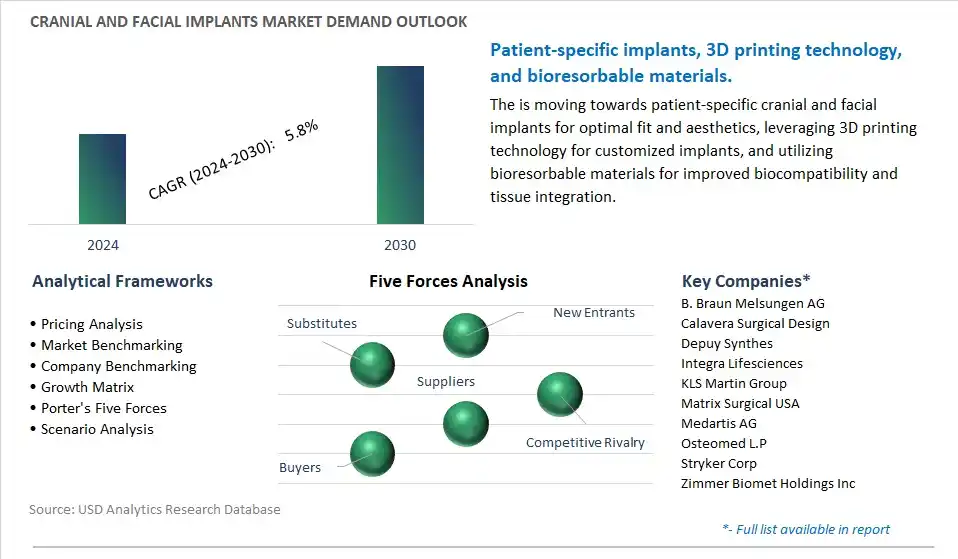
Cranial and Facial Implants Market is estimated to increase at a Compounded Annual Growth Rate of 5.8% CAGR over the forecast period from 2024 to 2030
The Cranial and Facial Implants Market study analyzes and forecasts the market size across 6 regions and 24 countries for diverse segments- By Type (Cranial Implants, Facial Implants), By Material (Polymethyl Methacrylate, Porous Polyethylene, Titanium, Others), By End-User (Hospitals, Specialty Clinics, Ambulatory Surgical Centers).
An Introduction to Cranial and Facial Implants Market in 2024
In 2024, the market for cranial and facial implants addresses the reconstructive and aesthetic needs of patients undergoing craniofacial surgery, trauma reconstruction, and cosmetic facial augmentation, offering a variety of implantable devices, biomaterials, and customized solutions for restoring cranial and facial anatomy, improving facial symmetry, and enhancing patient outcomes. Cranial and facial implants are used to reconstruct defects resulting from trauma, congenital anomalies, tumor resection, or aesthetic concerns, providing structural support, contouring, and volume augmentation to the craniofacial region. Implantable materials include polymethyl methacrylate (PMMA), silicone, porous polyethylene, titanium, and bioresorbable polymers, each offering specific advantages in terms of biocompatibility, durability, and aesthetic outcomes. With a focus on patient-specific treatment planning, 3D imaging, and computer-aided design (CAD) techniques, cranial and facial implant procedures are tailored to individual patient anatomy, facial proportions, and surgical goals to achieve optimal aesthetic and functional results. Moreover, with advancements in implant materials, implant manufacturing technologies, and surgical techniques, the cranial and facial implants market supports innovation and customization in craniofacial reconstruction, facial rejuvenation, and aesthetic facial contouring, offering patients personalized solutions for enhancing facial appearance and restoring self-confidence.
Market Trend: Growing Demand for Customized Implants
A significant trend in the Cranial and Facial Implants market is the growing demand for customized implants. As medical technology advances, there's a shift towards personalized healthcare solutions tailored to individual patient anatomy and needs. Customized cranial and facial implants are designed using advanced imaging techniques, such as computed tomography (CT) scans and 3D printing technology, to precisely match the patient's unique craniofacial structure. These implants offer several advantages over traditional off-the-shelf implants, including improved fit, reduced risk of complications, and enhanced aesthetic outcomes. With increasing awareness among surgeons and patients about the benefits of customized implants, there's a rising demand for personalized solutions in cranial and facial reconstruction procedures, driving market growth and innovation in the Cranial and Facial Implants market.
Market Driver: Rising Incidence of Traumatic Injuries and Craniofacial Deformities
An important driver fueling the Cranial and Facial Implants market is the rising incidence of traumatic injuries and craniofacial deformities. Trauma, accidents, congenital anomalies, and medical conditions such as cancer can result in craniofacial defects that require surgical intervention and reconstruction. Cranial and facial implants play a crucial role in restoring form and function to the skull and facial bones, helping patients regain normal appearance, protect underlying structures, and improve quality of life. With an increasing global population, urbanization, and industrialization, the incidence of traumatic injuries and craniofacial deformities is expected to rise, driving the demand for cranial and facial implants as essential components of reconstructive surgery. Additionally, advancements in surgical techniques, such as minimally invasive procedures and computer-assisted navigation, are expanding the indications for cranial and facial implants, further fueling market growth in the Cranial and Facial Implants segment.
Market Opportunity: Expansion of Bioresorbable Implants and Biomaterials
A significant opportunity within the Cranial and Facial Implants market lies in the expansion of bioresorbable implants and biomaterials. Bioresorbable implants, composed of biocompatible materials that gradually degrade and are absorbed by the body over time, offer several advantages over traditional permanent implants, including reduced risk of infection, avoidance of implant removal surgeries, and promotion of natural tissue regeneration. Opportunities exist for manufacturers to develop innovative biomaterials and bioresorbable implants with improved mechanical properties, biodegradation kinetics, and tissue integration capabilities, catering to the specific needs of craniofacial reconstruction and augmentation procedures. Additionally, the integration of growth factors, stem cells, and tissue engineering approaches holds promise for enhancing the regenerative capacity of biomaterials and promoting more seamless integration with surrounding tissues. By investing in research and development initiatives focused on bioresorbable implants and biomaterials, stakeholders in the Cranial and Facial Implants market can capitalize on the opportunity to advance patient care, improve surgical outcomes, and drive innovation in craniofacial reconstruction technologies.
Cranial and Facial Implants Market Share Analysis: Facial Implants
Among the various segments in the cranial and facial implants market, facial implants are experiencing the fastest growth. Facial implants are utilized in aesthetic and reconstructive procedures to enhance or restore facial contours, symmetry, and volume. The rapid growth of facial implants in the market can be attributed to several factors. Firstly, there is a growing demand for facial augmentation procedures driven by increasing aesthetic consciousness and the desire for facial rejuvenation and enhancement. Facial implants offer effective solutions for addressing volume loss, asymmetry, and structural deficiencies in various facial regions, including the cheeks, chin, and jawline, thereby improving overall facial aesthetics and self-confidence. Secondly, advancements in implant materials and design have led to the development of innovative facial implants with improved biocompatibility, durability, and aesthetic outcomes. Modern facial implants are available in a variety of materials, including porous polyethylene, polymethyl methacrylate (PMMA), titanium, and others, allowing for customization and patient-specific treatment approaches. Additionally, the expanding applications of facial implants in both cosmetic and reconstructive surgery contribute to market growth. Facial implants are utilized in aesthetic procedures such as cheek augmentation, chin augmentation, and lip enhancement, as well as in reconstructive surgeries following trauma, congenital anomalies, or facial asymmetry. Furthermore, the increasing adoption of minimally invasive techniques and outpatient procedures in facial implant surgery enhances patient accessibility and satisfaction, driving demand for facial implant procedures across different healthcare settings.
Cranial and Facial Implants Competitive Analysis
The market research study provides in-depth insights into leading companies including the SWOT analyses, product profile, financial details, and recent developments acrossB. Braun Melsungen AG, Calavera Surgical Design, Depuy Synthes, Integra Lifesciences, KLS Martin Group, Matrix Surgical USA, Medartis AG, Osteomed L.P, Stryker Corp, Zimmer Biomet Holdings Inc
Cranial and Facial Implants Market Segmentation
By Type
Cranial Implants
Facial Implants
By Material
Polymethyl Methacrylate
Porous Polyethylene
Titanium
Others
By End-User
Hospitals
Specialty Clinics
Ambulatory Surgical Centers
Geographical Analysis
North America (United States, Canada, Mexico)
Europe (Germany, France, United Kingdom, Spain, Italy, Rest of Europe)
Asia Pacific (China, India, Japan, South Korea, Rest of Asia Pacific)
South America (Brazil, Argentina, Rest of South America)
Middle East and Africa (Saudi Arabia, UAE, Rest of Middle East, South Africa, Egypt, Rest of Africa)
Cranial and Facial Implants Market Companies
B. Braun Melsungen AG
Calavera Surgical Design
Depuy Synthes
Integra Lifesciences
KLS Martin Group
Matrix Surgical USA
Medartis AG
Osteomed L.P
Stryker Corp
Zimmer Biomet Holdings Inc
Reasons to Buy the Cranial and Facial Implants Market Study
• Deepen your industry insights and navigate uncertainties for strategy formulation, CAPEX, and Operational decisions
• Gain access to detailed insights on the Cranial and Facial Implants Market, encompassing current market size, growth trends, and forecasts till 2030.
• Access detailed competitor analysis, enabling competitive advantage through a thorough understanding of market players, strategies, and potential differentiation opportunities
• Stay ahead of the curve with insights on technological advancements, innovations, and upcoming trends
• Identify lucrative investment avenues and expansion opportunities within the Cranial and Facial Implants Market industry, guided by robust, data-backed analysis.
• Understand regional and global markets through country-wise analysis, regional market potential, regulatory nuances, and dynamics
• Execute strategies with confidence and speed through information, analytics, and insights on the industry value chain
• Corporate leaders, strategists, financial experts, shareholders, asset managers, and governmental representatives can make long-term planning scenarios and build an integrated and timely understanding of market dynamics
• Benefit from tailored solutions and expert consultation based on report insights, providing personalized strategies aligned with specific business needs.
TABLE OF CONTENTS
1 Introduction to 2024 Cranial and Facial Implants Market
1.1 Market Overview
1.2 Quick Facts
1.3 Scope/Objective of the Study
1.4 Market Definition
1.5 Countries and Regions Covered
1.6 Units, Currency, and Conversions
1.7 Industry Value Chain
2 Research Methodology
2.1 Market Size Estimation
2.2 Sources and Research Methodology
2.3 Data Triangulation
2.4 Assumptions and Limitations
3 Executive Summary
3.1 Global Cranial and Facial Implants Market Size Outlook, $ Million, 2021 to 2030
3.2 Cranial and Facial Implants Market Outlook by Type, $ Million, 2021 to 2030
3.3 Cranial and Facial Implants Market Outlook by Product, $ Million, 2021 to 2030
3.4 Cranial and Facial Implants Market Outlook by Application, $ Million, 2021 to 2030
3.5 Cranial and Facial Implants Market Outlook by Key Countries, $ Million, 2021 to 2030
4 Market Dynamics
4.1 Key Driving Forces of Cranial and Facial Implants Industry
4.2 Key Market Trends in Cranial and Facial Implants Industry
4.3 Potential Opportunities in Cranial and Facial Implants Industry
4.4 Key Challenges in Cranial and Facial Implants Industry
5 Market Factor Analysis
5.1 Value Chain Analysis
5.2 Competitive Landscape
5.2.1 Global Cranial and Facial Implants Market Share by Company (%), 2023
5.2.2 Product Offerings by Company
5.3 Porter’s Five Forces Analysis
5.4 Pricing Analysis and Outlook
6 Growth Outlook Across Scenarios
6.1 Growth Analysis-Case Scenario Definitions
6.2 Low Growth Scenario Forecasts
6.3 Reference Growth Scenario Forecasts
6.4 High Growth Scenario Forecasts
7 Global Cranial and Facial Implants Market Outlook by Segments
7.1 Cranial and Facial Implants Market Outlook by Segments, $ Million, 2021- 2030
By Type
Cranial Implants
Facial Implants
By Material
Polymethyl Methacrylate
Porous Polyethylene
Titanium
Others
By End-User
Hospitals
Specialty Clinics
Ambulatory Surgical Centers
8 North America Cranial and Facial Implants Market Analysis and Outlook To 2030
8.1 Introduction to North America Cranial and Facial Implants Markets in 2024
8.2 North America Cranial and Facial Implants Market Size Outlook by Country, 2021-2030
8.2.1 United States
8.2.2 Canada
8.2.3 Mexico
8.3 North America Cranial and Facial Implants Market size Outlook by Segments, 2021-2030
By Type
Cranial Implants
Facial Implants
By Material
Polymethyl Methacrylate
Porous Polyethylene
Titanium
Others
By End-User
Hospitals
Specialty Clinics
Ambulatory Surgical Centers
9 Europe Cranial and Facial Implants Market Analysis and Outlook To 2030
9.1 Introduction to Europe Cranial and Facial Implants Markets in 2024
9.2 Europe Cranial and Facial Implants Market Size Outlook by Country, 2021-2030
9.2.1 Germany
9.2.2 France
9.2.3 Spain
9.2.4 United Kingdom
9.2.4 Italy
9.2.5 Russia
9.2.6 Norway
9.2.7 Rest of Europe
9.3 Europe Cranial and Facial Implants Market Size Outlook by Segments, 2021-2030
By Type
Cranial Implants
Facial Implants
By Material
Polymethyl Methacrylate
Porous Polyethylene
Titanium
Others
By End-User
Hospitals
Specialty Clinics
Ambulatory Surgical Centers
10 Asia Pacific Cranial and Facial Implants Market Analysis and Outlook To 2030
10.1 Introduction to Asia Pacific Cranial and Facial Implants Markets in 2024
10.2 Asia Pacific Cranial and Facial Implants Market Size Outlook by Country, 2021-2030
10.2.1 China
10.2.2 India
10.2.3 Japan
10.2.4 South Korea
10.2.5 Indonesia
10.2.6 Malaysia
10.2.7 Australia
10.2.8 Rest of Asia Pacific
10.3 Asia Pacific Cranial and Facial Implants Market size Outlook by Segments, 2021-2030
By Type
Cranial Implants
Facial Implants
By Material
Polymethyl Methacrylate
Porous Polyethylene
Titanium
Others
By End-User
Hospitals
Specialty Clinics
Ambulatory Surgical Centers
11 South America Cranial and Facial Implants Market Analysis and Outlook To 2030
11.1 Introduction to South America Cranial and Facial Implants Markets in 2024
11.2 South America Cranial and Facial Implants Market Size Outlook by Country, 2021-2030
11.2.1 Brazil
11.2.2 Argentina
11.2.3 Rest of South America
11.3 South America Cranial and Facial Implants Market size Outlook by Segments, 2021-2030
By Type
Cranial Implants
Facial Implants
By Material
Polymethyl Methacrylate
Porous Polyethylene
Titanium
Others
By End-User
Hospitals
Specialty Clinics
Ambulatory Surgical Centers
12 Middle East and Africa Cranial and Facial Implants Market Analysis and Outlook To 2030
12.1 Introduction to Middle East and Africa Cranial and Facial Implants Markets in 2024
12.2 Middle East and Africa Cranial and Facial Implants Market Size Outlook by Country, 2021-2030
12.2.1 Saudi Arabia
12.2.2 UAE
12.2.3 Oman
12.2.4 Rest of Middle East
12.2.5 Egypt
12.2.6 Nigeria
12.2.7 South Africa
12.2.8 Rest of Africa
12.3 Middle East and Africa Cranial and Facial Implants Market size Outlook by Segments, 2021-2030
By Type
Cranial Implants
Facial Implants
By Material
Polymethyl Methacrylate
Porous Polyethylene
Titanium
Others
By End-User
Hospitals
Specialty Clinics
Ambulatory Surgical Centers
13 Company Profiles
13.1 Company Snapshot
13.2 SWOT Profiles
13.3 Products and Services
13.4 Recent Developments
13.5 Financial Profile
List of Companies
B. Braun Melsungen AG
Calavera Surgical Design
Depuy Synthes
Integra Lifesciences
KLS Martin Group
Matrix Surgical USA
Medartis AG
Osteomed L.P
Stryker Corp
Zimmer Biomet Holdings Inc
14 Appendix
14.1 Customization Offerings
14.2 Subscription Services
14.3 Related Reports
14.4 Publisher Expertise
By Type
Cranial Implants
Facial Implants
By Material
Polymethyl Methacrylate
Porous Polyethylene
Titanium
Others
By End-User
Hospitals
Specialty Clinics
Ambulatory Surgical Centers
Countries Analyzed
North America (United States, Canada, Mexico)
Europe (Germany, France, United Kingdom, Spain, Italy, Rest of Europe)
Asia Pacific (China, India, Japan, South Korea, Rest of Asia Pacific)
South America (Brazil, Argentina, Rest of South America)
Middle East and Africa (Saudi Arabia, UAE, Rest of Middle East, South Africa, Egypt, Rest of Africa)
