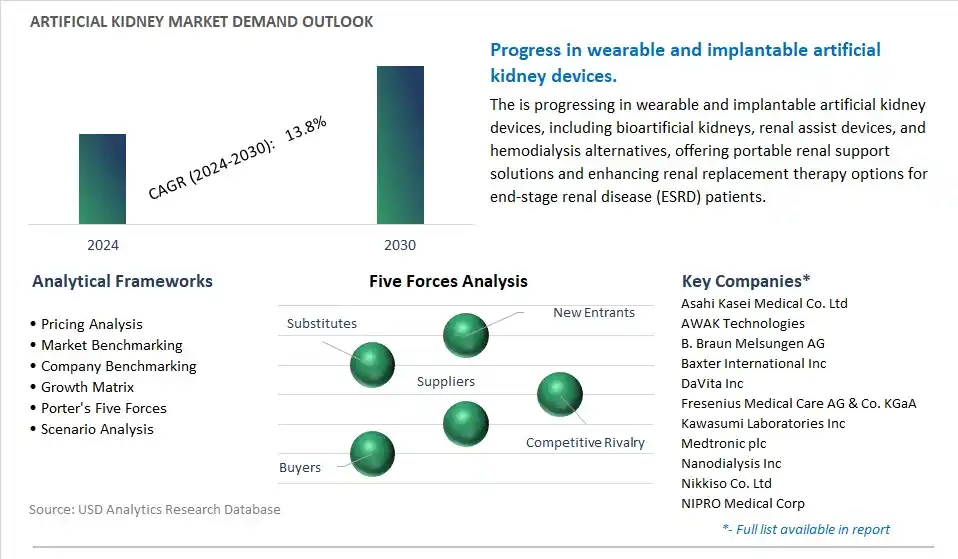
Artificial Kidney Market is estimated to increase at a Compounded Annual Growth Rate of 13.8% CAGR over the forecast period from 2024 to 2030
The Artificial Kidney Market study analyzes and forecasts the market size across 6 regions and 24 countries for diverse segments- By Device (Wearable Artificial Kidney, Implantable Artificial Kidney), By End-User (Hospitals, Specialty Clinics, Ambulatory Surgical Centers).
An Introduction to Artificial Kidney Market in 2024
In 2024, the market for artificial kidneys, also known as renal assist devices or wearable artificial kidneys, addresses the unmet need for renal replacement therapies in patients with end-stage renal disease (ESRD) and acute kidney injury (AKI), offering portable, implantable, or wearable solutions for continuous or intermittent dialysis outside of traditional hemodialysis centers. Artificial kidneys mimic the physiological functions of the native kidney, removing metabolic waste products, regulating electrolyte balance, and maintaining fluid homeostasis through filtration and dialysis processes. With a focus on patient mobility, treatment flexibility, and quality of life improvement, artificial kidney technology encompasses various dialysis modalities, including hemodialysis, peritoneal dialysis, and wearable dialysis devices, tailored to individual patient needs and treatment goals. Moreover, with advancements in miniaturization, biocompatibility, and hemofiltration techniques, the artificial kidney market offers promising avenues for improving renal replacement therapy outcomes, enhancing patient autonomy, and revolutionizing the management of kidney failure.
Market Trend: Advancements in Renal Replacement Therapy Technologies
A significant trend in the artificial kidney market is the ongoing advancements in renal replacement therapy (RRT) technologies aimed at improving the treatment outcomes and quality of life for patients with end-stage renal disease (ESRD). These advancements encompass various modalities, including hemodialysis, peritoneal dialysis, and renal transplantation, as well as emerging technologies such as wearable artificial kidneys and bioartificial kidneys. These innovations aim to address the limitations of conventional dialysis methods, such as the need for frequent clinic visits, fluid and dietary restrictions, and long-term complications, by providing more efficient, portable, and patient-friendly solutions for renal replacement therapy. The trend toward advancements in RRT technologies underscores the continuous pursuit of innovative approaches to meet the growing demand for effective and accessible treatments for ESRD patients.
Market Driver: Rising Prevalence of End-stage Renal Disease
A key driver for the artificial kidney market is the rising prevalence of end-stage renal disease (ESRD) worldwide, driven by factors such as aging populations, increasing incidence of chronic kidney disease (CKD), and the rising prevalence of risk factors such as diabetes, hypertension, and obesity. ESRD represents the final stage of CKD, where kidney function is severely impaired, necessitating renal replacement therapy to sustain life. With the global burden of CKD and ESRD continuing to escalate, there is a growing demand for effective and accessible treatment options, including artificial kidneys, to provide renal support and improve outcomes for ESRD patients. The increasing prevalence of ESRD underscores the urgent need for innovative solutions to address the challenges of managing this complex and debilitating condition, driving market growth in the artificial kidney segment.
Market Opportunity: Development of Bioartificial Kidney Technologies
An opportunity in the artificial kidney market lies in the development of bioartificial kidney technologies that combine the benefits of renal replacement therapy with the physiological functions of natural kidneys. Bioartificial kidneys aim to replicate the complex filtration, reabsorption, and excretion processes of the native kidney using a combination of cellular components, biomaterials, and microfluidic systems. These innovative devices hold promise for providing more efficient and physiologically relevant renal support compared to conventional dialysis methods, potentially reducing the burden of ESRD treatment, improving patient outcomes, and enhancing quality of life for ESRD patients. By investing in the development of bioartificial kidney technologies, companies can address unmet clinical needs, differentiate their product offerings, and capitalize on opportunities for market expansion in the evolving landscape of renal replacement therapy and regenerative medicine.
Artificial Kidney Market Share Analysis: Wearable Artificial Kidney
The Wearable Artificial Kidney segment within the Artificial Kidney Market is witnessing rapid growth. Wearable artificial kidneys are innovative medical devices designed to provide continuous renal replacement therapy (CRRT) to patients with end-stage renal disease (ESRD) or acute kidney injury (AKI) outside the hospital setting. These portable devices aim to offer greater mobility and freedom to patients by enabling them to undergo dialysis treatment while performing their daily activities, such as working, traveling, or sleeping, without being confined to a dialysis center. As a result, wearable artificial kidneys have garnered significant interest from patients, healthcare providers, and researchers seeking to improve the quality of life and treatment outcomes for individuals requiring long-term dialysis therapy. Additionally, advancements in miniaturization, biocompatibility, and dialysis technology have led to the development of wearable artificial kidneys that are more compact, efficient, and user-friendly. With the growing prevalence of chronic kidney disease (CKD) and ESRD worldwide and the increasing demand for more flexible and convenient dialysis options, the Wearable Artificial Kidney segment of the Artificial Kidney Market is poised for substantial expansion.
Artificial Kidney Competitive Analysis
The market research study provides in-depth insights into leading companies including the SWOT analyses, product profile, financial details, and recent developments acrossAsahi Kasei Medical Co. Ltd, AWAK Technologies, B. Braun Melsungen AG, Baxter International Inc, DaVita Inc, Fresenius Medical Care AG & Co. KGaA, Kawasumi Laboratories Inc, Medtronic plc, Nanodialysis Inc, Nikkiso Co. Ltd, NIPRO Medical Corp
Artificial Kidney Market Segmentation
By Device
Wearable Artificial Kidney
Implantable Artificial Kidney
By End-User
Hospitals
Specialty Clinics
Ambulatory Surgical Centers
Geographical Analysis
North America (United States, Canada, Mexico)
Europe (Germany, France, United Kingdom, Spain, Italy, Rest of Europe)
Asia Pacific (China, India, Japan, South Korea, Rest of Asia Pacific)
South America (Brazil, Argentina, Rest of South America)
Middle East and Africa (Saudi Arabia, UAE, Rest of Middle East, South Africa, Egypt, Rest of Africa)
Artificial Kidney Market Companies
Asahi Kasei Medical Co. Ltd
AWAK Technologies
B. Braun Melsungen AG
Baxter International Inc
DaVita Inc
Fresenius Medical Care AG & Co. KGaA
Kawasumi Laboratories Inc
Medtronic plc
Nanodialysis Inc
Nikkiso Co. Ltd
NIPRO Medical Corp
Reasons to Buy the Artificial Kidney Market Study
• Deepen your industry insights and navigate uncertainties for strategy formulation, CAPEX, and Operational decisions
• Gain access to detailed insights on the Artificial Kidney Market, encompassing current market size, growth trends, and forecasts till 2030.
• Access detailed competitor analysis, enabling competitive advantage through a thorough understanding of market players, strategies, and potential differentiation opportunities
• Stay ahead of the curve with insights on technological advancements, innovations, and upcoming trends
• Identify lucrative investment avenues and expansion opportunities within the Artificial Kidney Market industry, guided by robust, data-backed analysis.
• Understand regional and global markets through country-wise analysis, regional market potential, regulatory nuances, and dynamics
• Execute strategies with confidence and speed through information, analytics, and insights on the industry value chain
• Corporate leaders, strategists, financial experts, shareholders, asset managers, and governmental representatives can make long-term planning scenarios and build an integrated and timely understanding of market dynamics
• Benefit from tailored solutions and expert consultation based on report insights, providing personalized strategies aligned with specific business needs.
TABLE OF CONTENTS
1 Introduction to 2024 Artificial Kidney Market
1.1 Market Overview
1.2 Quick Facts
1.3 Scope/Objective of the Study
1.4 Market Definition
1.5 Countries and Regions Covered
1.6 Units, Currency, and Conversions
1.7 Industry Value Chain
2 Research Methodology
2.1 Market Size Estimation
2.2 Sources and Research Methodology
2.3 Data Triangulation
2.4 Assumptions and Limitations
3 Executive Summary
3.1 Global Artificial Kidney Market Size Outlook, $ Million, 2021 to 2030
3.2 Artificial Kidney Market Outlook by Type, $ Million, 2021 to 2030
3.3 Artificial Kidney Market Outlook by Product, $ Million, 2021 to 2030
3.4 Artificial Kidney Market Outlook by Application, $ Million, 2021 to 2030
3.5 Artificial Kidney Market Outlook by Key Countries, $ Million, 2021 to 2030
4 Market Dynamics
4.1 Key Driving Forces of Artificial Kidney Industry
4.2 Key Market Trends in Artificial Kidney Industry
4.3 Potential Opportunities in Artificial Kidney Industry
4.4 Key Challenges in Artificial Kidney Industry
5 Market Factor Analysis
5.1 Value Chain Analysis
5.2 Competitive Landscape
5.2.1 Global Artificial Kidney Market Share by Company (%), 2023
5.2.2 Product Offerings by Company
5.3 Porter’s Five Forces Analysis
5.4 Pricing Analysis and Outlook
6 Growth Outlook Across Scenarios
6.1 Growth Analysis-Case Scenario Definitions
6.2 Low Growth Scenario Forecasts
6.3 Reference Growth Scenario Forecasts
6.4 High Growth Scenario Forecasts
7 Global Artificial Kidney Market Outlook by Segments
7.1 Artificial Kidney Market Outlook by Segments, $ Million, 2021- 2030
By Device
Wearable Artificial Kidney
Implantable Artificial Kidney
By End-User
Hospitals
Specialty Clinics
Ambulatory Surgical Centers
8 North America Artificial Kidney Market Analysis and Outlook To 2030
8.1 Introduction to North America Artificial Kidney Markets in 2024
8.2 North America Artificial Kidney Market Size Outlook by Country, 2021-2030
8.2.1 United States
8.2.2 Canada
8.2.3 Mexico
8.3 North America Artificial Kidney Market size Outlook by Segments, 2021-2030
By Device
Wearable Artificial Kidney
Implantable Artificial Kidney
By End-User
Hospitals
Specialty Clinics
Ambulatory Surgical Centers
9 Europe Artificial Kidney Market Analysis and Outlook To 2030
9.1 Introduction to Europe Artificial Kidney Markets in 2024
9.2 Europe Artificial Kidney Market Size Outlook by Country, 2021-2030
9.2.1 Germany
9.2.2 France
9.2.3 Spain
9.2.4 United Kingdom
9.2.4 Italy
9.2.5 Russia
9.2.6 Norway
9.2.7 Rest of Europe
9.3 Europe Artificial Kidney Market Size Outlook by Segments, 2021-2030
By Device
Wearable Artificial Kidney
Implantable Artificial Kidney
By End-User
Hospitals
Specialty Clinics
Ambulatory Surgical Centers
10 Asia Pacific Artificial Kidney Market Analysis and Outlook To 2030
10.1 Introduction to Asia Pacific Artificial Kidney Markets in 2024
10.2 Asia Pacific Artificial Kidney Market Size Outlook by Country, 2021-2030
10.2.1 China
10.2.2 India
10.2.3 Japan
10.2.4 South Korea
10.2.5 Indonesia
10.2.6 Malaysia
10.2.7 Australia
10.2.8 Rest of Asia Pacific
10.3 Asia Pacific Artificial Kidney Market size Outlook by Segments, 2021-2030
By Device
Wearable Artificial Kidney
Implantable Artificial Kidney
By End-User
Hospitals
Specialty Clinics
Ambulatory Surgical Centers
11 South America Artificial Kidney Market Analysis and Outlook To 2030
11.1 Introduction to South America Artificial Kidney Markets in 2024
11.2 South America Artificial Kidney Market Size Outlook by Country, 2021-2030
11.2.1 Brazil
11.2.2 Argentina
11.2.3 Rest of South America
11.3 South America Artificial Kidney Market size Outlook by Segments, 2021-2030
By Device
Wearable Artificial Kidney
Implantable Artificial Kidney
By End-User
Hospitals
Specialty Clinics
Ambulatory Surgical Centers
12 Middle East and Africa Artificial Kidney Market Analysis and Outlook To 2030
12.1 Introduction to Middle East and Africa Artificial Kidney Markets in 2024
12.2 Middle East and Africa Artificial Kidney Market Size Outlook by Country, 2021-2030
12.2.1 Saudi Arabia
12.2.2 UAE
12.2.3 Oman
12.2.4 Rest of Middle East
12.2.5 Egypt
12.2.6 Nigeria
12.2.7 South Africa
12.2.8 Rest of Africa
12.3 Middle East and Africa Artificial Kidney Market size Outlook by Segments, 2021-2030
By Device
Wearable Artificial Kidney
Implantable Artificial Kidney
By End-User
Hospitals
Specialty Clinics
Ambulatory Surgical Centers
13 Company Profiles
13.1 Company Snapshot
13.2 SWOT Profiles
13.3 Products and Services
13.4 Recent Developments
13.5 Financial Profile
List of Companies
Asahi Kasei Medical Co. Ltd
AWAK Technologies
B. Braun Melsungen AG
Baxter International Inc
DaVita Inc
Fresenius Medical Care AG & Co. KGaA
Kawasumi Laboratories Inc
Medtronic plc
Nanodialysis Inc
Nikkiso Co. Ltd
NIPRO Medical Corp
14 Appendix
14.1 Customization Offerings
14.2 Subscription Services
14.3 Related Reports
14.4 Publisher Expertise
By Device
Wearable Artificial Kidney
Implantable Artificial Kidney
By End-User
Hospitals
Specialty Clinics
Ambulatory Surgical Centers
Countries Analyzed
North America (United States, Canada, Mexico)
Europe (Germany, France, United Kingdom, Spain, Italy, Rest of Europe)
Asia Pacific (China, India, Japan, South Korea, Rest of Asia Pacific)
South America (Brazil, Argentina, Rest of South America)
Middle East and Africa (Saudi Arabia, UAE, Rest of Middle East, South Africa, Egypt, Rest of Africa)
