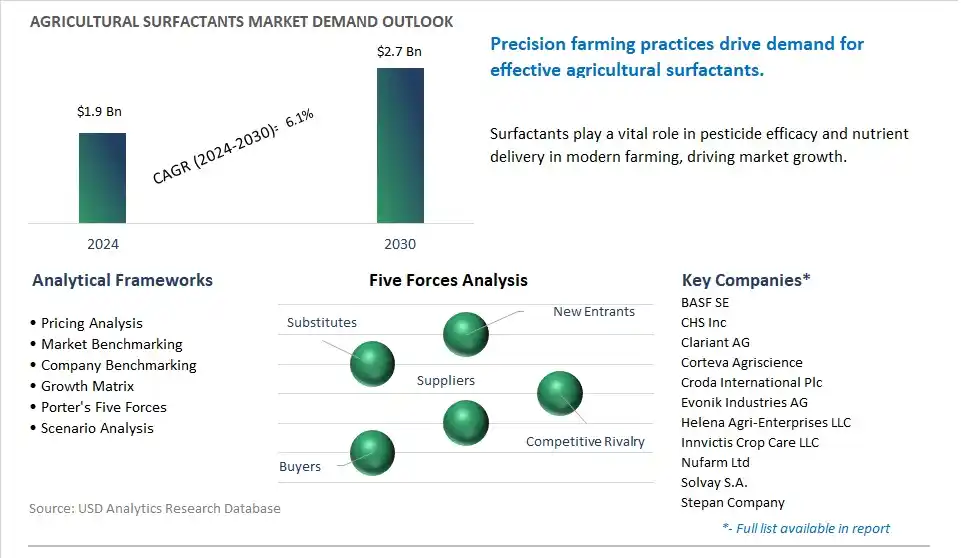
The global Agricultural Surfactants Market is poised to register a 6.1% CAGR from $1.9 Billion in 2024 to $2.7 Billion in 2030.
The global Agricultural Surfactants Market Study analyzes and forecasts the market size across 6 regions and 24 countries for diverse segments -By Type (Non-Ionic, Anionic, Cationic, Amphoteric), By Substrate (Synthetic, Bio-Based), By Application (Herbicides, Fungicides, Insecticides, Others), By Crop (Cereals & Grains, Pulses & Oilseeds, Fruits & Vegetables, Others).
An Introduction to Global Agricultural Surfactants Market in 2024
The agricultural surfactants market is witnessing significant growth driven by the increasing adoption of agrochemicals and bio-based crop protection products. Key trends shaping the future of the industry include the growing demand for surfactants in pesticide formulations to enhance spreading, wetting, and absorption on plant surfaces, thereby improving efficacy and reducing environmental impact. Moreover, there's a rising emphasis on sustainable surfactant solutions derived from renewable resources such as plant oils and sugar derivatives, in response to regulatory restrictions and consumer preferences for eco-friendly agricultural practices. Additionally, advancements in surfactant chemistry, formulation technology, and application methods are driving innovation and market expansion, enabling surfactant manufacturers to offer versatile and effective solutions for pest management, herbicide adjuvants, and crop enhancement in the global agricultural surfactants market.
Agricultural Surfactants Market Competitive Landscape
The market report analyses the leading companies in the industry including BASF SE, CHS Inc, Clariant AG, Corteva Agriscience, Croda International Plc, Evonik Industries AG, Helena Agri-Enterprises LLC, Innvictis Crop Care LLC, Nufarm Ltd, Solvay S.A., Stepan Company.
Agricultural Surfactants Market Dynamics
Agricultural Surfactants Market Trend: Increasing Adoption of Precision Agriculture Techniques
A prominent market trend for agricultural surfactants is the increasing adoption of precision agriculture techniques. With advancements in technology and data analytics, farmers are adopting precision agriculture practices to optimize inputs, improve crop yields, and minimize environmental impact. Agricultural surfactants play a crucial role in precision agriculture by enhancing the effectiveness of agrochemicals such as herbicides, insecticides, and fungicides. Surfactants help reduce surface tension and improve the spreadability and penetration of agrochemicals on plant surfaces, ensuring uniform coverage and maximizing their efficacy. The trend towards precision agriculture drives the demand for specialized surfactant formulations tailored to meet the requirements of modern farming practices and support sustainable crop production.
Agricultural Surfactants Market Driver: Need for Enhanced Agrochemical Performance and Efficiency
A significant driver for the agricultural surfactants market is the need for enhanced agrochemical performance and efficiency. As farmers face challenges such as weed resistance, pest infestations, and disease outbreaks, there's a growing demand for surfactants that improve the performance and effectiveness of agrochemicals in controlling pests and diseases. Surfactants act as adjuvants, facilitating the dispersion, adhesion, and absorption of agrochemicals on plant surfaces, thereby increasing their bioavailability and efficacy. Additionally, surfactants can help overcome environmental factors such as water stress, temperature extremes, and soil conditions that may affect the performance of agrochemicals. The imperative to maximize crop protection and optimize agrochemical inputs drives market demand for agricultural surfactants, supporting innovation and product development in the industry.
Agricultural Surfactants Market Opportunity: Development of Environmentally Friendly and Biodegradable Surfactants
An opportunity for the agricultural surfactants market lies in the development of environmentally friendly and biodegradable surfactants. With increasing regulatory scrutiny and consumer demand for sustainable agricultural practices, there's a growing interest in surfactant formulations that are safe for the environment and human health. Manufacturers have the opportunity to innovate and develop surfactants derived from renewable resources, such as plant oils, sugars, and amino acids, that offer effective performance while minimizing environmental impact. Additionally, there's potential to develop surfactants with enhanced biodegradability and eco-toxicity profiles, ensuring their compatibility with organic farming practices and ecological sustainability. By offering eco-friendly surfactant solutions, agricultural surfactant manufacturers can address market demands for sustainable agriculture inputs, differentiate their products, and capture new market opportunities in the agrochemical sector.
Agricultural Surfactants Market Share Analysis: Non-Ionic surfactants segment generated the highest revenue in the industry
The largest segment in the Agricultural Surfactants Market is Non-Ionic surfactants, and this predominance is driven by non-ionic surfactants offer versatile compatibility with a wide range of agrochemical formulations, including herbicides, insecticides, fungicides, and plant growth regulators. This versatility makes them indispensable in modern agricultural practices, where multiple types of agrochemicals are often used in combination for integrated pest management and crop protection. Additionally, non-ionic surfactants are known for their excellent wetting, spreading, and dispersing properties, which enhance the efficacy of agrochemicals by ensuring uniform coverage and absorption on plant surfaces. In addition, non-ionic surfactants exhibit superior performance under various environmental conditions, including hard water and low temperatures, making them reliable and effective across diverse agricultural settings. Further, non-ionic surfactants are generally less prone to pH sensitivity and compatibility issues compared to other types, minimizing the risk of formulation instability and crop damage. Over the forecast period, the widespread adoption of non-ionic surfactants in agricultural applications is driven by their versatility, compatibility, efficacy, and reliability, solidifying their position as the largest segment in the Agricultural Surfactants Market.
Agricultural Surfactants Market Share Analysis: Bio-Based category Segment is poised to register the fastest growth rate (CAGR) over the forecast period to 2030
The fastest-growing segment in the Agricultural Surfactants Market is the Bio-Based category, and the rapid growth is driven by there is a growing global trend towards sustainability and environmental consciousness, driving the demand for agricultural inputs derived from renewable sources. Bio-based surfactants, often derived from natural oils, fats, or sugars, offer a sustainable alternative to traditional synthetic surfactants, which are derived from petrochemicals. This aligns with the preferences of environmentally-conscious consumers and regulatory mandates promoting eco-friendly agricultural practices. Additionally, bio-based surfactants are perceived to have lower environmental impact and greater biodegradability compared to their synthetic counterparts, reducing the risk of pollution and ecological harm. In addition, advancements in biotechnology and green chemistry have led to the development of bio-based surfactants with improved performance and functionality, closing the gap with synthetic options in terms of efficacy and cost-effectiveness. Further, as consumers become more aware of the potential health risks associated with chemical residues in food and the environment, there is a growing demand for agricultural products treated with bio-based surfactants perceived as safer and more natural. Over the forecast period, the rapid growth of the Bio-Based segment in the Agricultural Surfactants Market is driven by sustainability concerns, regulatory pressures, technological advancements, and shifting consumer preferences towards eco-friendly and safer agricultural solutions.
Agricultural Surfactants Market Share Analysis: Herbicides application Segment is poised to register the fastest growth rate (CAGR) over the forecast period to 2030
The fastest-growing segment in the Agricultural Surfactants Market is the Herbicides application segment, and the rapid growth is driven by herbicides play a critical role in weed control, which is a persistent challenge for farmers worldwide. With the increasing prevalence of herbicide-resistant weeds, there is a growing need for more effective herbicide formulations that can improve weed control outcomes. Surfactants enhance the performance of herbicides by reducing surface tension and improving wetting and spreading on plant surfaces, ensuring better herbicide coverage and absorption by target weeds. Additionally, herbicide formulations often require surfactants to overcome issues such as hydrophobicity and adhesion to waxy leaf surfaces, particularly in challenging weather conditions. Further, advancements in herbicide technology, such as the development of new active ingredients and modes of action, have created opportunities for synergistic combinations with surfactants to enhance herbicide efficacy and combat weed resistance. In addition, the adoption of precision agriculture practices, including targeted herbicide applications and integrated weed management strategies, has increased the demand for surfactants that can optimize herbicide performance while minimizing environmental impact and off-target effects. Over the forecast period, the rapid growth of the Herbicides application segment in the Agricultural Surfactants Market is driven by the ongoing need for effective weed control solutions, advancements in herbicide technology, and the critical role of surfactants in maximizing herbicide efficacy and sustainability in modern agriculture.
Agricultural Surfactants Market Report Segmentation
By Type
Non-Ionic
Anionic
Cationic
Amphoteric
By Substrate
Synthetic
Bio-Based
By Application
Herbicides
Fungicides
Insecticides
Others
By Crop
Cereals & Grains
Pulses & Oilseeds
Fruits & Vegetables
Others
Regions Included
North America (US, Canada, Mexico)
Europe (Germany, UK, France, Spain, Italy, Russia, Rest of Europe)
Asia Pacific (China, India, Japan, South Korea, Australia, South East Asia, Rest of Asia)
South America (Brazil, Argentina, Rest of South America)
Middle East and Africa (Saudi Arabia, UAE, Rest of Middle East, South Africa, Egypt, Rest of Africa)
Agricultural Surfactants Companies Profiled in the Market Study
BASF SE
CHS Inc
Clariant AG
Corteva Agriscience
Croda International Plc
Evonik Industries AG
Helena Agri-Enterprises LLC
Innvictis Crop Care LLC
Nufarm Ltd
Solvay S.A.
Stepan Company
*- List Not Exhaustive
TABLE OF CONTENTS
1 Introduction to 2024 Agricultural Surfactants Market
1.1 Market Overview
1.2 Quick Facts
1.3 Scope/Objective of the Study
1.4 Market Definition
1.5 Countries and Regions Covered
1.6 Units, Currency, and Conversions
1.7 Industry Value Chain
2 Research Methodology
2.1 Market Size Estimation
2.2 Sources and Research Methodology
2.3 Data Triangulation
2.4 Assumptions and Limitations
3 Executive Summary
3.1 Global Agricultural Surfactants Market Size Outlook, $ Million, 2021 to 2030
3.2 Agricultural Surfactants Market Outlook by Type, $ Million, 2021 to 2030
3.3 Agricultural Surfactants Market Outlook by Product, $ Million, 2021 to 2030
3.4 Agricultural Surfactants Market Outlook by Application, $ Million, 2021 to 2030
3.5 Agricultural Surfactants Market Outlook by Key Countries, $ Million, 2021 to 2030
4 Market Dynamics
4.1 Key Driving Forces of Agricultural Surfactants Industry
4.2 Key Market Trends in Agricultural Surfactants Industry
4.3 Potential Opportunities in Agricultural Surfactants Industry
4.4 Key Challenges in Agricultural Surfactants Industry
5 Market Factor Analysis
5.1 Value Chain Analysis
5.2 Competitive Landscape
5.2.1 Global Agricultural Surfactants Market Share by Company (%), 2023
5.2.2 Product Offerings by Company
5.3 Porter’s Five Forces Analysis
5.4 Pricing Analysis and Outlook
6 Growth Outlook Across Scenarios
6.1 Growth Analysis-Case Scenario Definitions
6.2 Low Growth Scenario Forecasts
6.3 Reference Growth Scenario Forecasts
6.4 High Growth Scenario Forecasts
7 Global Agricultural Surfactants Market Outlook by Segments
7.1 Agricultural Surfactants Market Outlook by Segments, $ Million, 2021- 2030
By Type
Non-Ionic
Anionic
Cationic
Amphoteric
By Substrate
Synthetic
Bio-Based
By Application
Herbicides
Fungicides
Insecticides
Others
By Crop
Cereals & Grains
Pulses & Oilseeds
Fruits & Vegetables
Others
8 North America Agricultural Surfactants Market Analysis and Outlook To 2030
8.1 Introduction to North America Agricultural Surfactants Markets in 2024
8.2 North America Agricultural Surfactants Market Size Outlook by Country, 2021-2030
8.2.1 United States
8.2.2 Canada
8.2.3 Mexico
8.3 North America Agricultural Surfactants Market size Outlook by Segments, 2021-2030
By Type
Non-Ionic
Anionic
Cationic
Amphoteric
By Substrate
Synthetic
Bio-Based
By Application
Herbicides
Fungicides
Insecticides
Others
By Crop
Cereals & Grains
Pulses & Oilseeds
Fruits & Vegetables
Others
9 Europe Agricultural Surfactants Market Analysis and Outlook To 2030
9.1 Introduction to Europe Agricultural Surfactants Markets in 2024
9.2 Europe Agricultural Surfactants Market Size Outlook by Country, 2021-2030
9.2.1 Germany
9.2.2 France
9.2.3 Spain
9.2.4 United Kingdom
9.2.4 Italy
9.2.5 Russia
9.2.6 Norway
9.2.7 Rest of Europe
9.3 Europe Agricultural Surfactants Market Size Outlook by Segments, 2021-2030
By Type
Non-Ionic
Anionic
Cationic
Amphoteric
By Substrate
Synthetic
Bio-Based
By Application
Herbicides
Fungicides
Insecticides
Others
By Crop
Cereals & Grains
Pulses & Oilseeds
Fruits & Vegetables
Others
10 Asia Pacific Agricultural Surfactants Market Analysis and Outlook To 2030
10.1 Introduction to Asia Pacific Agricultural Surfactants Markets in 2024
10.2 Asia Pacific Agricultural Surfactants Market Size Outlook by Country, 2021-2030
10.2.1 China
10.2.2 India
10.2.3 Japan
10.2.4 South Korea
10.2.5 Indonesia
10.2.6 Malaysia
10.2.7 Australia
10.2.8 Rest of Asia Pacific
10.3 Asia Pacific Agricultural Surfactants Market size Outlook by Segments, 2021-2030
By Type
Non-Ionic
Anionic
Cationic
Amphoteric
By Substrate
Synthetic
Bio-Based
By Application
Herbicides
Fungicides
Insecticides
Others
By Crop
Cereals & Grains
Pulses & Oilseeds
Fruits & Vegetables
Others
11 South America Agricultural Surfactants Market Analysis and Outlook To 2030
11.1 Introduction to South America Agricultural Surfactants Markets in 2024
11.2 South America Agricultural Surfactants Market Size Outlook by Country, 2021-2030
11.2.1 Brazil
11.2.2 Argentina
11.2.3 Rest of South America
11.3 South America Agricultural Surfactants Market size Outlook by Segments, 2021-2030
By Type
Non-Ionic
Anionic
Cationic
Amphoteric
By Substrate
Synthetic
Bio-Based
By Application
Herbicides
Fungicides
Insecticides
Others
By Crop
Cereals & Grains
Pulses & Oilseeds
Fruits & Vegetables
Others
12 Middle East and Africa Agricultural Surfactants Market Analysis and Outlook To 2030
12.1 Introduction to Middle East and Africa Agricultural Surfactants Markets in 2024
12.2 Middle East and Africa Agricultural Surfactants Market Size Outlook by Country, 2021-2030
12.2.1 Saudi Arabia
12.2.2 UAE
12.2.3 Oman
12.2.4 Rest of Middle East
12.2.5 Egypt
12.2.6 Nigeria
12.2.7 South Africa
12.2.8 Rest of Africa
12.3 Middle East and Africa Agricultural Surfactants Market size Outlook by Segments, 2021-2030
By Type
Non-Ionic
Anionic
Cationic
Amphoteric
By Substrate
Synthetic
Bio-Based
By Application
Herbicides
Fungicides
Insecticides
Others
By Crop
Cereals & Grains
Pulses & Oilseeds
Fruits & Vegetables
Others
13 Company Profiles
13.1 Company Snapshot
13.2 SWOT Profiles
13.3 Products and Services
13.4 Recent Developments
13.5 Financial Profile
BASF SE
CHS Inc
Clariant AG
Corteva Agriscience
Croda International Plc
Evonik Industries AG
Helena Agri-Enterprises LLC
Innvictis Crop Care LLC
Nufarm Ltd
Solvay S.A.
Stepan Company
14 Appendix
14.1 Customization Offerings
14.2 Subscription Services
14.3 Related Reports
14.4 Publisher Expertise
By Type
Non-Ionic
Anionic
Cationic
Amphoteric
By Substrate
Synthetic
Bio-Based
By Application
Herbicides
Fungicides
Insecticides
Others
By Crop
Cereals & Grains
Pulses & Oilseeds
Fruits & Vegetables
Others
Countries Analyzed
North America (US, Canada, Mexico)
Europe (Germany, UK, France, Spain, Italy, Russia, Rest of Europe)
Asia Pacific (China, India, Japan, South Korea, Australia, South East Asia, Rest of Asia)
South America (Brazil, Argentina, Rest of South America)
Middle East and Africa (Saudi Arabia, UAE, Rest of Middle East, South Africa, Egypt, Rest of Africa)
