
The Cartilage Repair Regeneration Market study analyzes and forecasts the market size across 6 regions and 24 countries for diverse segments- By Type (Fibrocartilage, Hyaline Cartilage, Others), By Modality (Cell-based, Non-Cell-based), By Treatment (Palliative, Intrinsic Repair Stimulus), By Application (Knee, Spine, Ankle, Hip, Others).
In 2024, the market for cartilage repair and regeneration addresses the therapeutic challenges of articular cartilage injuries and osteoarthritis, offering innovative biologic implants, cell-based therapies, and tissue engineering approaches for promoting cartilage healing, restoring joint function, and delaying the progression of degenerative joint diseases. Cartilage repair and regeneration therapies aim to stimulate chondrogenesis, extracellular matrix synthesis, and tissue integration processes within damaged cartilage lesions, providing biological scaffolds, growth factors, or autologous chondrocyte grafts to enhance tissue repair mechanisms and restore biomechanical properties of articular surfaces. With a focus on joint preservation, symptom relief, and functional restoration, cartilage repair and regeneration techniques offer minimally invasive procedures, arthroscopic interventions, and biocompatible implant materials tailored to patient age, lesion size, and joint biomechanics. Moreover, with advancements in tissue engineering, regenerative medicine, and stem cell biology, the cartilage repair and regeneration market continues to innovate, offering personalized treatment strategies and regenerative solutions for improving long-term joint health and quality of life in patients with cartilage defects and osteoarthritis worldwide.
A significant trend in the Cartilage Repair Regeneration market is the continuous advancements in regenerative medicine technologies. With a growing understanding of cartilage biology and tissue engineering principles, there has been notable progress in developing innovative approaches for repairing and regenerating damaged cartilage. Techniques such as autologous chondrocyte implantation (ACI), matrix-induced autologous chondrocyte implantation (MACI), and mesenchymal stem cell (MSC) therapies are gaining prominence for their ability to promote cartilage regeneration and functional restoration. Additionally, advancements in biomaterials, scaffolds, growth factors, and biologics are contributing to the development of more effective and durable cartilage repair solutions. This trend reflects a shift towards regenerative therapies that aim to restore native tissue structure and function, offering promising prospects for patients with cartilage injuries and degenerative joint diseases.
An important driver fueling the Cartilage Repair Regeneration market is the growing incidence of cartilage injuries and osteoarthritis. Cartilage injuries, whether due to trauma, sports-related activities, or degenerative processes such as osteoarthritis, can result in significant pain, functional impairment, and reduced quality of life. As the global population ages and lifestyles become more sedentary, there's a parallel increase in the prevalence of cartilage-related disorders, driving the demand for effective treatment options. Cartilage repair and regeneration therapies offer a promising approach to address the underlying pathology of cartilage injuries and osteoarthritis, providing patients with the potential for long-term pain relief, improved joint function, and preservation of joint integrity. As healthcare providers prioritize conservative management strategies and minimally invasive interventions for cartilage-related disorders, there's a growing market for regenerative therapies that promote tissue healing and functional restoration.
A significant opportunity within the Cartilage Repair Regeneration market lies in the expansion into personalized medicine and biomarker development. While current cartilage repair and regeneration therapies offer promising outcomes for many patients, there's variability in treatment responses and outcomes due to factors such as patient demographics, injury characteristics, and biological variability. Opportunities exist for leveraging personalized medicine approaches, including genetic profiling, biomarker analysis, and imaging techniques, to tailor treatment strategies to individual patient needs and optimize treatment outcomes. Additionally, there's potential for identifying novel biomarkers that can predict treatment responses, monitor disease progression, and guide treatment decision-making in cartilage repair and regeneration. By investing in research and development efforts to advance personalized medicine and biomarker discovery in the field of cartilage repair and regeneration, stakeholders can unlock new market opportunities, improve patient care, and drive innovation in regenerative orthopedic therapies.
Among the various types of cartilage repair/regeneration, the hyaline cartilage segment is experiencing significant growth. Hyaline cartilage is the smooth, elastic tissue that covers the ends of bones in joints, providing cushioning and enabling smooth movement. The rapid growth of hyaline cartilage repair/regeneration can be attributed to several factors. Firstly, hyaline cartilage injuries, such as those occurring in the knee due to sports injuries or degenerative conditions like osteoarthritis, are common and can lead to significant pain and functional impairment. As a result, there is a growing demand for effective treatments to repair or regenerate hyaline cartilage and restore joint function. Secondly, advancements in regenerative medicine technologies, including cell-based therapies and tissue engineering approaches, have led to the development of innovative strategies for hyaline cartilage repair and regeneration. These therapies aim to stimulate the intrinsic repair mechanisms of the body and promote the formation of new hyaline cartilage tissue. Additionally, the expanding applications of hyaline cartilage repair/regeneration across various joints, including the knee, spine, ankle, hip, and others, further drive market growth. Furthermore, the increasing adoption of minimally invasive procedures and the growing awareness about the importance of preserving joint function and mobility contribute to the rising demand for hyaline cartilage repair/regeneration therapies. As a result, the hyaline cartilage segment is expected to continue experiencing rapid growth in the cartilage repair/regeneration market, offering significant opportunities for manufacturers, healthcare providers, and researchers involved in musculoskeletal medicine.
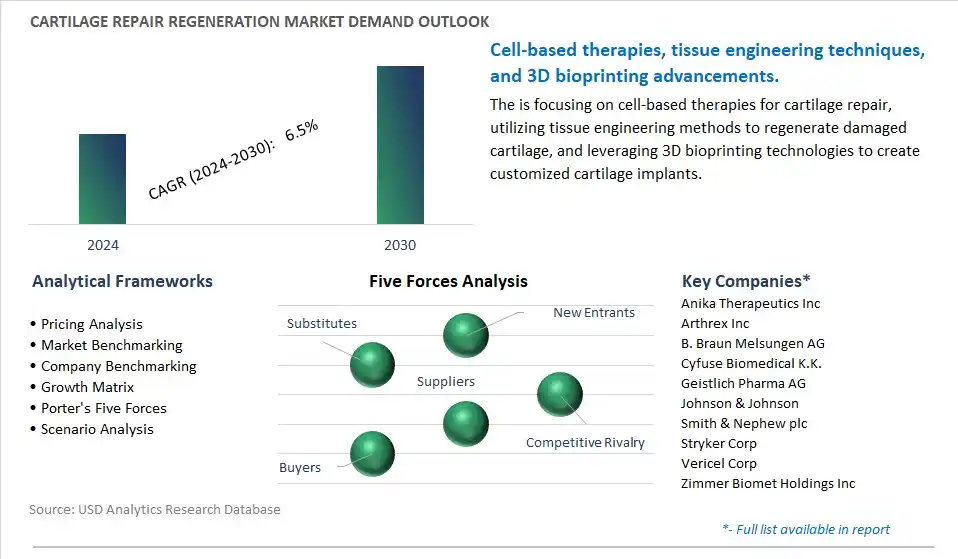
The market research study provides in-depth insights into leading companies including the SWOT analyses, product profile, financial details, and recent developments acrossAnika Therapeutics Inc, Arthrex Inc, B. Braun Melsungen AG, Cyfuse Biomedical K.K., Geistlich Pharma AG, Johnson & Johnson, Smith & Nephew plc, Stryker Corp, Vericel Corp, Zimmer Biomet Holdings Inc
By Type
Fibrocartilage
Hyaline Cartilage
Others
By Modality
Cell-based
Non-Cell-based
By Treatment
Palliative
Intrinsic Repair Stimulus
By Application
Knee
Spine
Ankle
Hip
Others
Geographical Analysis
North America (United States, Canada, Mexico)
Europe (Germany, France, United Kingdom, Spain, Italy, Rest of Europe)
Asia Pacific (China, India, Japan, South Korea, Rest of Asia Pacific)
South America (Brazil, Argentina, Rest of South America)
Middle East and Africa (Saudi Arabia, UAE, Rest of Middle East, South Africa, Egypt, Rest of Africa)
Anika Therapeutics Inc
Arthrex Inc
B. Braun Melsungen AG
Cyfuse Biomedical K.K.
Geistlich Pharma AG
Johnson & Johnson
Smith & Nephew plc
Stryker Corp
Vericel Corp
Zimmer Biomet Holdings Inc
• Deepen your industry insights and navigate uncertainties for strategy formulation, CAPEX, and Operational decisions
• Gain access to detailed insights on the Cartilage Repair Regeneration Market, encompassing current market size, growth trends, and forecasts till 2030.
• Access detailed competitor analysis, enabling competitive advantage through a thorough understanding of market players, strategies, and potential differentiation opportunities
• Stay ahead of the curve with insights on technological advancements, innovations, and upcoming trends
• Identify lucrative investment avenues and expansion opportunities within the Cartilage Repair Regeneration Market industry, guided by robust, data-backed analysis.
• Understand regional and global markets through country-wise analysis, regional market potential, regulatory nuances, and dynamics
• Execute strategies with confidence and speed through information, analytics, and insights on the industry value chain
• Corporate leaders, strategists, financial experts, shareholders, asset managers, and governmental representatives can make long-term planning scenarios and build an integrated and timely understanding of market dynamics
• Benefit from tailored solutions and expert consultation based on report insights, providing personalized strategies aligned with specific business needs.
TABLE OF CONTENTS
1 Introduction to 2024 Cartilage Repair Regeneration Market
1.1 Market Overview
1.2 Quick Facts
1.3 Scope/Objective of the Study
1.4 Market Definition
1.5 Countries and Regions Covered
1.6 Units, Currency, and Conversions
1.7 Industry Value Chain
2 Research Methodology
2.1 Market Size Estimation
2.2 Sources and Research Methodology
2.3 Data Triangulation
2.4 Assumptions and Limitations
3 Executive Summary
3.1 Global Cartilage Repair Regeneration Market Size Outlook, $ Million, 2021 to 2030
3.2 Cartilage Repair Regeneration Market Outlook by Type, $ Million, 2021 to 2030
3.3 Cartilage Repair Regeneration Market Outlook by Product, $ Million, 2021 to 2030
3.4 Cartilage Repair Regeneration Market Outlook by Application, $ Million, 2021 to 2030
3.5 Cartilage Repair Regeneration Market Outlook by Key Countries, $ Million, 2021 to 2030
4 Market Dynamics
4.1 Key Driving Forces of Cartilage Repair Regeneration Industry
4.2 Key Market Trends in Cartilage Repair Regeneration Industry
4.3 Potential Opportunities in Cartilage Repair Regeneration Industry
4.4 Key Challenges in Cartilage Repair Regeneration Industry
5 Market Factor Analysis
5.1 Value Chain Analysis
5.2 Competitive Landscape
5.2.1 Global Cartilage Repair Regeneration Market Share by Company (%), 2023
5.2.2 Product Offerings by Company
5.3 Porter’s Five Forces Analysis
5.4 Pricing Analysis and Outlook
6 Growth Outlook Across Scenarios
6.1 Growth Analysis-Case Scenario Definitions
6.2 Low Growth Scenario Forecasts
6.3 Reference Growth Scenario Forecasts
6.4 High Growth Scenario Forecasts
7 Global Cartilage Repair Regeneration Market Outlook by Segments
7.1 Cartilage Repair Regeneration Market Outlook by Segments, $ Million, 2021- 2030
By Type
Fibrocartilage
Hyaline Cartilage
Others
By Modality
Cell-based
Non-Cell-based
By Treatment
Palliative
Intrinsic Repair Stimulus
By Application
Knee
Spine
Ankle
Hip
Others
8 North America Cartilage Repair Regeneration Market Analysis and Outlook To 2030
8.1 Introduction to North America Cartilage Repair Regeneration Markets in 2024
8.2 North America Cartilage Repair Regeneration Market Size Outlook by Country, 2021-2030
8.2.1 United States
8.2.2 Canada
8.2.3 Mexico
8.3 North America Cartilage Repair Regeneration Market size Outlook by Segments, 2021-2030
By Type
Fibrocartilage
Hyaline Cartilage
Others
By Modality
Cell-based
Non-Cell-based
By Treatment
Palliative
Intrinsic Repair Stimulus
By Application
Knee
Spine
Ankle
Hip
Others
9 Europe Cartilage Repair Regeneration Market Analysis and Outlook To 2030
9.1 Introduction to Europe Cartilage Repair Regeneration Markets in 2024
9.2 Europe Cartilage Repair Regeneration Market Size Outlook by Country, 2021-2030
9.2.1 Germany
9.2.2 France
9.2.3 Spain
9.2.4 United Kingdom
9.2.4 Italy
9.2.5 Russia
9.2.6 Norway
9.2.7 Rest of Europe
9.3 Europe Cartilage Repair Regeneration Market Size Outlook by Segments, 2021-2030
By Type
Fibrocartilage
Hyaline Cartilage
Others
By Modality
Cell-based
Non-Cell-based
By Treatment
Palliative
Intrinsic Repair Stimulus
By Application
Knee
Spine
Ankle
Hip
Others
10 Asia Pacific Cartilage Repair Regeneration Market Analysis and Outlook To 2030
10.1 Introduction to Asia Pacific Cartilage Repair Regeneration Markets in 2024
10.2 Asia Pacific Cartilage Repair Regeneration Market Size Outlook by Country, 2021-2030
10.2.1 China
10.2.2 India
10.2.3 Japan
10.2.4 South Korea
10.2.5 Indonesia
10.2.6 Malaysia
10.2.7 Australia
10.2.8 Rest of Asia Pacific
10.3 Asia Pacific Cartilage Repair Regeneration Market size Outlook by Segments, 2021-2030
By Type
Fibrocartilage
Hyaline Cartilage
Others
By Modality
Cell-based
Non-Cell-based
By Treatment
Palliative
Intrinsic Repair Stimulus
By Application
Knee
Spine
Ankle
Hip
Others
11 South America Cartilage Repair Regeneration Market Analysis and Outlook To 2030
11.1 Introduction to South America Cartilage Repair Regeneration Markets in 2024
11.2 South America Cartilage Repair Regeneration Market Size Outlook by Country, 2021-2030
11.2.1 Brazil
11.2.2 Argentina
11.2.3 Rest of South America
11.3 South America Cartilage Repair Regeneration Market size Outlook by Segments, 2021-2030
By Type
Fibrocartilage
Hyaline Cartilage
Others
By Modality
Cell-based
Non-Cell-based
By Treatment
Palliative
Intrinsic Repair Stimulus
By Application
Knee
Spine
Ankle
Hip
Others
12 Middle East and Africa Cartilage Repair Regeneration Market Analysis and Outlook To 2030
12.1 Introduction to Middle East and Africa Cartilage Repair Regeneration Markets in 2024
12.2 Middle East and Africa Cartilage Repair Regeneration Market Size Outlook by Country, 2021-2030
12.2.1 Saudi Arabia
12.2.2 UAE
12.2.3 Oman
12.2.4 Rest of Middle East
12.2.5 Egypt
12.2.6 Nigeria
12.2.7 South Africa
12.2.8 Rest of Africa
12.3 Middle East and Africa Cartilage Repair Regeneration Market size Outlook by Segments, 2021-2030
By Type
Fibrocartilage
Hyaline Cartilage
Others
By Modality
Cell-based
Non-Cell-based
By Treatment
Palliative
Intrinsic Repair Stimulus
By Application
Knee
Spine
Ankle
Hip
Others
13 Company Profiles
13.1 Company Snapshot
13.2 SWOT Profiles
13.3 Products and Services
13.4 Recent Developments
13.5 Financial Profile
List of Companies
Anika Therapeutics Inc
Arthrex Inc
B. Braun Melsungen AG
Cyfuse Biomedical K.K.
Geistlich Pharma AG
Johnson & Johnson
Smith & Nephew plc
Stryker Corp
Vericel Corp
Zimmer Biomet Holdings Inc
14 Appendix
14.1 Customization Offerings
14.2 Subscription Services
14.3 Related Reports
14.4 Publisher Expertise
By Type
Fibrocartilage
Hyaline Cartilage
Others
By Modality
Cell-based
Non-Cell-based
By Treatment
Palliative
Intrinsic Repair Stimulus
By Application
Knee
Spine
Ankle
Hip
Others
Countries Analyzed
North America (United States, Canada, Mexico)
Europe (Germany, France, United Kingdom, Spain, Italy, Rest of Europe)
Asia Pacific (China, India, Japan, South Korea, Rest of Asia Pacific)
South America (Brazil, Argentina, Rest of South America)
Middle East and Africa (Saudi Arabia, UAE, Rest of Middle East, South Africa, Egypt, Rest of Africa)
The global Cartilage Repair Regeneration Market is one of the lucrative growth markets, poised to register a 6.5% growth (CAGR) between 2024 and 2030.
Emerging Markets across Asia Pacific, Europe, and Americas present robust growth prospects.
Anika Therapeutics Inc, Arthrex Inc, B. Braun Melsungen AG, Cyfuse Biomedical K.K., Geistlich Pharma AG, Johnson & Johnson, Smith & Nephew plc, Stryker Corp, Vericel Corp, Zimmer Biomet Holdings Inc
Base Year- 2023; Estimated Year- 2024; Historic Period- 2018-2023; Forecast period- 2024 to 2030; Currency: USD; Volume