
The Autologous Matrix induced Chondrogenesis Market study analyzes and forecasts the market size across 6 regions and 24 countries for diverse segments- By Material (Hyaluronic Acid, Collagen, Polyethylene Glycol (PEG), Poly Lactic-c-glycolic Acid (PLGA), Others), By Application (Knee Cartilage, Elbow Cartilage, Others).
In 2024, the market for autologous matrix-induced chondrogenesis (AMIC) addresses the growing demand for biological solutions in the treatment of articular cartilage defects and osteochondral lesions, offering regenerative therapies for cartilage repair and joint preservation. Autologous matrix-induced chondrogenesis combines microfracture techniques with biocompatible scaffolds or matrices to create a conducive environment for cartilage regeneration and tissue integration, promoting the formation of hyaline-like cartilage and restoring joint function. With a focus on patient-specific treatment strategies, tissue engineering principles, and minimally invasive surgical approaches, AMIC technology offers personalized solutions for addressing cartilage injuries, osteoarthritis, and sports-related joint pathology, improving pain relief, joint stability, and functional outcomes in orthopedic surgery and sports medicine.
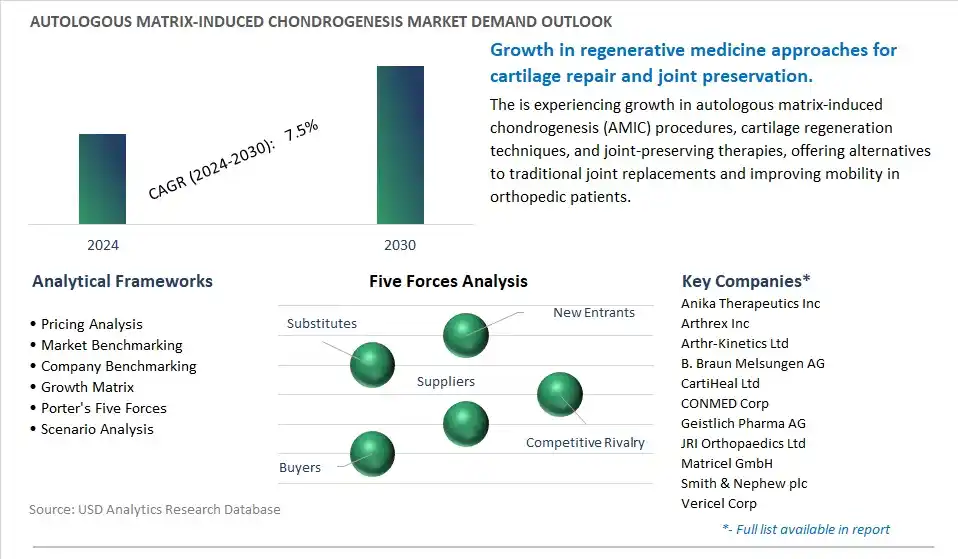
A significant trend in the autologous matrix-induced chondrogenesis (AMIC) market is the overall growth in regenerative medicine technologies, driven by advancements in tissue engineering, cell therapy, and biomaterial science. AMIC is a regenerative treatment approach that combines microfracture surgery with the implantation of a collagen matrix to stimulate cartilage repair and regeneration in damaged joint surfaces. The trend towards regenerative medicine reflects the increasing focus on harnessing the body's natural healing processes to promote tissue regeneration and repair, offering potential alternatives to traditional surgical interventions and pharmacological therapies. As regenerative medicine continues to gain traction, AMIC procedures are poised to become increasingly prevalent in orthopedic practice, driving market growth in the AMIC segment.
A key driver for the autologous matrix-induced chondrogenesis market is the rising prevalence of joint injuries and osteoarthritis, particularly among aging populations and individuals engaged in sports and physical activities. Joint injuries, such as meniscal tears, ligament injuries, and articular cartilage defects, are common orthopedic conditions that can predispose individuals to the development of osteoarthritis, a degenerative joint disease characterized by progressive cartilage loss and joint pain. Traditional treatment options for joint injuries and osteoarthritis, such as arthroscopic debridement, microfracture surgery, and joint replacement, have limitations in terms of long-term efficacy and potential risks. Autologous matrix-induced chondrogenesis offers a promising alternative for promoting cartilage repair and preserving joint function, addressing the unmet clinical needs of patients with focal cartilage defects and early-stage osteoarthritis.
An opportunity in the autologous matrix-induced chondrogenesis market lies in the expansion into sports medicine and orthopedic rehabilitation settings, where there is a growing demand for innovative treatment modalities to address joint injuries and cartilage defects in athletes and active individuals. Sports-related injuries, such as anterior cruciate ligament (ACL) tears, meniscal injuries, and chondral defects, are common among athletes and can significantly impact athletic performance and career longevity. By offering AMIC procedures as part of comprehensive sports medicine and orthopedic rehabilitation programs, healthcare providers can optimize outcomes for athletes and facilitate a faster return to play following injury. Additionally, there is opportunity to integrate AMIC with other regenerative therapies, such as platelet-rich plasma (PRP) therapy and mesenchymal stem cell (MSC) therapy, to further enhance tissue healing and regeneration in orthopedic patients. By expanding into sports medicine and orthopedic rehabilitation, companies can tap into new market segments, differentiate their offerings, and capitalize on opportunities for growth in the dynamic field of sports medicine and orthopedics.
The Hyaluronic Acid segment within the Autologous Matrix-induced Chondrogenesis Market is witnessing rapid growth. Autologous matrix-induced chondrogenesis (AMIC) is a regenerative medicine technique used for the treatment of cartilage defects, particularly in joints such as the knee and elbow. In AMIC procedures, a biocompatible scaffold, often composed of hyaluronic acid, collagen, or other materials, is combined with autologous chondrocytes or mesenchymal stem cells (MSCs) harvested from the patient's own body. The scaffold provides a supportive matrix for cell proliferation and differentiation, facilitating the repair and regeneration of damaged cartilage tissue. Hyaluronic acid-based scaffolds offer several advantages in AMIC procedures, including their biocompatibility, ability to retain moisture and promote cell adhesion, and potential to modulate inflammatory responses and enhance tissue healing. As a result, healthcare providers and patients are increasingly turning to hyaluronic acid-based materials for AMIC procedures due to their favorable biological properties and clinical outcomes. Additionally, ongoing research and development efforts aimed at optimizing hyaluronic acid-based scaffolds for cartilage repair applications are expected to further drive market growth. With a growing emphasis on regenerative therapies for cartilage defects and joint injuries, the Hyaluronic Acid segment of the Autologous Matrix-induced Chondrogenesis Market is poised for significant expansion.
The market research study provides in-depth insights into leading companies including the SWOT analyses, product profile, financial details, and recent developments acrossAnika Therapeutics Inc, Arthrex Inc, Arthr-Kinetics Ltd, B. Braun Melsungen AG, CartiHeal Ltd, CONMED Corp, Geistlich Pharma AG, JRI Orthopaedics Ltd, Matricel GmbH, Smith & Nephew plc, Vericel Corp, Zimmer Biomet Holdings Inc
By Material
Hyaluronic Acid
Collagen
Polyethylene Glycol (PEG)
Poly Lactic-c-glycolic Acid (PLGA)
Others
By Application
Knee Cartilage
Elbow Cartilage
Others
Geographical Analysis
North America (United States, Canada, Mexico)
Europe (Germany, France, United Kingdom, Spain, Italy, Rest of Europe)
Asia Pacific (China, India, Japan, South Korea, Rest of Asia Pacific)
South America (Brazil, Argentina, Rest of South America)
Middle East and Africa (Saudi Arabia, UAE, Rest of Middle East, South Africa, Egypt, Rest of Africa)
Anika Therapeutics Inc
Arthrex Inc
Arthr-Kinetics Ltd
B. Braun Melsungen AG
CartiHeal Ltd
CONMED Corp
Geistlich Pharma AG
JRI Orthopaedics Ltd
Matricel GmbH
Smith & Nephew plc
Vericel Corp
Zimmer Biomet Holdings Inc
• Deepen your industry insights and navigate uncertainties for strategy formulation, CAPEX, and Operational decisions
• Gain access to detailed insights on the Autologous Matrix induced Chondrogenesis Market, encompassing current market size, growth trends, and forecasts till 2030.
• Access detailed competitor analysis, enabling competitive advantage through a thorough understanding of market players, strategies, and potential differentiation opportunities
• Stay ahead of the curve with insights on technological advancements, innovations, and upcoming trends
• Identify lucrative investment avenues and expansion opportunities within the Autologous Matrix induced Chondrogenesis Market industry, guided by robust, data-backed analysis.
• Understand regional and global markets through country-wise analysis, regional market potential, regulatory nuances, and dynamics
• Execute strategies with confidence and speed through information, analytics, and insights on the industry value chain
• Corporate leaders, strategists, financial experts, shareholders, asset managers, and governmental representatives can make long-term planning scenarios and build an integrated and timely understanding of market dynamics
• Benefit from tailored solutions and expert consultation based on report insights, providing personalized strategies aligned with specific business needs.
TABLE OF CONTENTS
1 Introduction to 2024 Autologous Matrix induced Chondrogenesis Market
1.1 Market Overview
1.2 Quick Facts
1.3 Scope/Objective of the Study
1.4 Market Definition
1.5 Countries and Regions Covered
1.6 Units, Currency, and Conversions
1.7 Industry Value Chain
2 Research Methodology
2.1 Market Size Estimation
2.2 Sources and Research Methodology
2.3 Data Triangulation
2.4 Assumptions and Limitations
3 Executive Summary
3.1 Global Autologous Matrix induced Chondrogenesis Market Size Outlook, $ Million, 2021 to 2030
3.2 Autologous Matrix induced Chondrogenesis Market Outlook by Type, $ Million, 2021 to 2030
3.3 Autologous Matrix induced Chondrogenesis Market Outlook by Product, $ Million, 2021 to 2030
3.4 Autologous Matrix induced Chondrogenesis Market Outlook by Application, $ Million, 2021 to 2030
3.5 Autologous Matrix induced Chondrogenesis Market Outlook by Key Countries, $ Million, 2021 to 2030
4 Market Dynamics
4.1 Key Driving Forces of Autologous Matrix induced Chondrogenesis Industry
4.2 Key Market Trends in Autologous Matrix induced Chondrogenesis Industry
4.3 Potential Opportunities in Autologous Matrix induced Chondrogenesis Industry
4.4 Key Challenges in Autologous Matrix induced Chondrogenesis Industry
5 Market Factor Analysis
5.1 Value Chain Analysis
5.2 Competitive Landscape
5.2.1 Global Autologous Matrix induced Chondrogenesis Market Share by Company (%), 2023
5.2.2 Product Offerings by Company
5.3 Porter’s Five Forces Analysis
5.4 Pricing Analysis and Outlook
6 Growth Outlook Across Scenarios
6.1 Growth Analysis-Case Scenario Definitions
6.2 Low Growth Scenario Forecasts
6.3 Reference Growth Scenario Forecasts
6.4 High Growth Scenario Forecasts
7 Global Autologous Matrix induced Chondrogenesis Market Outlook by Segments
7.1 Autologous Matrix induced Chondrogenesis Market Outlook by Segments, $ Million, 2021- 2030
By Material
Hyaluronic Acid
Collagen
Polyethylene Glycol (PEG)
Poly Lactic-c-glycolic Acid (PLGA)
Others
By Application
Knee Cartilage
Elbow Cartilage
Others
8 North America Autologous Matrix induced Chondrogenesis Market Analysis and Outlook To 2030
8.1 Introduction to North America Autologous Matrix induced Chondrogenesis Markets in 2024
8.2 North America Autologous Matrix induced Chondrogenesis Market Size Outlook by Country, 2021-2030
8.2.1 United States
8.2.2 Canada
8.2.3 Mexico
8.3 North America Autologous Matrix induced Chondrogenesis Market size Outlook by Segments, 2021-2030
By Material
Hyaluronic Acid
Collagen
Polyethylene Glycol (PEG)
Poly Lactic-c-glycolic Acid (PLGA)
Others
By Application
Knee Cartilage
Elbow Cartilage
Others
9 Europe Autologous Matrix induced Chondrogenesis Market Analysis and Outlook To 2030
9.1 Introduction to Europe Autologous Matrix induced Chondrogenesis Markets in 2024
9.2 Europe Autologous Matrix induced Chondrogenesis Market Size Outlook by Country, 2021-2030
9.2.1 Germany
9.2.2 France
9.2.3 Spain
9.2.4 United Kingdom
9.2.4 Italy
9.2.5 Russia
9.2.6 Norway
9.2.7 Rest of Europe
9.3 Europe Autologous Matrix induced Chondrogenesis Market Size Outlook by Segments, 2021-2030
By Material
Hyaluronic Acid
Collagen
Polyethylene Glycol (PEG)
Poly Lactic-c-glycolic Acid (PLGA)
Others
By Application
Knee Cartilage
Elbow Cartilage
Others
10 Asia Pacific Autologous Matrix induced Chondrogenesis Market Analysis and Outlook To 2030
10.1 Introduction to Asia Pacific Autologous Matrix induced Chondrogenesis Markets in 2024
10.2 Asia Pacific Autologous Matrix induced Chondrogenesis Market Size Outlook by Country, 2021-2030
10.2.1 China
10.2.2 India
10.2.3 Japan
10.2.4 South Korea
10.2.5 Indonesia
10.2.6 Malaysia
10.2.7 Australia
10.2.8 Rest of Asia Pacific
10.3 Asia Pacific Autologous Matrix induced Chondrogenesis Market size Outlook by Segments, 2021-2030
By Material
Hyaluronic Acid
Collagen
Polyethylene Glycol (PEG)
Poly Lactic-c-glycolic Acid (PLGA)
Others
By Application
Knee Cartilage
Elbow Cartilage
Others
11 South America Autologous Matrix induced Chondrogenesis Market Analysis and Outlook To 2030
11.1 Introduction to South America Autologous Matrix induced Chondrogenesis Markets in 2024
11.2 South America Autologous Matrix induced Chondrogenesis Market Size Outlook by Country, 2021-2030
11.2.1 Brazil
11.2.2 Argentina
11.2.3 Rest of South America
11.3 South America Autologous Matrix induced Chondrogenesis Market size Outlook by Segments, 2021-2030
By Material
Hyaluronic Acid
Collagen
Polyethylene Glycol (PEG)
Poly Lactic-c-glycolic Acid (PLGA)
Others
By Application
Knee Cartilage
Elbow Cartilage
Others
12 Middle East and Africa Autologous Matrix induced Chondrogenesis Market Analysis and Outlook To 2030
12.1 Introduction to Middle East and Africa Autologous Matrix induced Chondrogenesis Markets in 2024
12.2 Middle East and Africa Autologous Matrix induced Chondrogenesis Market Size Outlook by Country, 2021-2030
12.2.1 Saudi Arabia
12.2.2 UAE
12.2.3 Oman
12.2.4 Rest of Middle East
12.2.5 Egypt
12.2.6 Nigeria
12.2.7 South Africa
12.2.8 Rest of Africa
12.3 Middle East and Africa Autologous Matrix induced Chondrogenesis Market size Outlook by Segments, 2021-2030
By Material
Hyaluronic Acid
Collagen
Polyethylene Glycol (PEG)
Poly Lactic-c-glycolic Acid (PLGA)
Others
By Application
Knee Cartilage
Elbow Cartilage
Others
13 Company Profiles
13.1 Company Snapshot
13.2 SWOT Profiles
13.3 Products and Services
13.4 Recent Developments
13.5 Financial Profile
List of Companies
Anika Therapeutics Inc
Arthrex Inc
Arthr-Kinetics Ltd
B. Braun Melsungen AG
CartiHeal Ltd
CONMED Corp
Geistlich Pharma AG
JRI Orthopaedics Ltd
Matricel GmbH
Smith & Nephew plc
Vericel Corp
Zimmer Biomet Holdings Inc
14 Appendix
14.1 Customization Offerings
14.2 Subscription Services
14.3 Related Reports
14.4 Publisher Expertise
By Material
Hyaluronic Acid
Collagen
Polyethylene Glycol (PEG)
Poly Lactic-c-glycolic Acid (PLGA)
Others
By Application
Knee Cartilage
Elbow Cartilage
Others
Countries Analyzed
North America (United States, Canada, Mexico)
Europe (Germany, France, United Kingdom, Spain, Italy, Rest of Europe)
Asia Pacific (China, India, Japan, South Korea, Rest of Asia Pacific)
South America (Brazil, Argentina, Rest of South America)
Middle East and Africa (Saudi Arabia, UAE, Rest of Middle East, South Africa, Egypt, Rest of Africa)
The global Autologous Matrix induced Chondrogenesis Market is one of the lucrative growth markets, poised to register a 7.5% growth (CAGR) between 2024 and 2030.
Emerging Markets across Asia Pacific, Europe, and Americas present robust growth prospects.
Anika Therapeutics Inc, Arthrex Inc, Arthr-Kinetics Ltd, B. Braun Melsungen AG, CartiHeal Ltd, CONMED Corp, Geistlich Pharma AG, JRI Orthopaedics Ltd, Matricel GmbH, Smith & Nephew plc, Vericel Corp, Zimmer Biomet Holdings Inc
Base Year- 2023; Estimated Year- 2024; Historic Period- 2018-2023; Forecast period- 2024 to 2030; Currency: USD; Volume