Market Overview: Alpha Lipoic Acid Market to Reach $1.9 Billion by 2034 as Clinical Expansion, High-Purity Innovations, and Regulatory Scrutiny Reshape the Sector
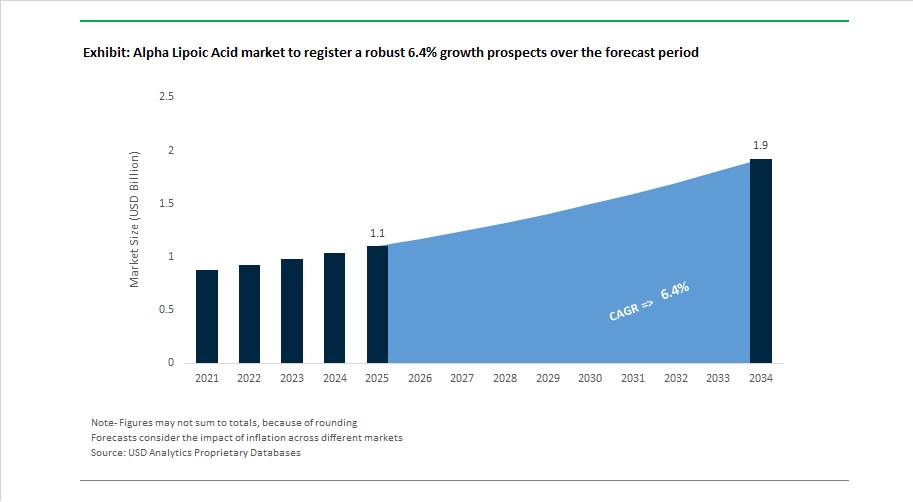
The global alpha lipoic acid market is projected to grow from $1.1 billion in 2025 to $1.9 billion by 2034, registering a 6.4% CAGR driven by rising use in dietary supplements, metabolic health formulations, neuropathy therapeutics, anti-aging skincare, and functional beverages. Alpha lipoic acid (ALA) is valued as a potent antioxidant, mitochondrial cofactor, and metabolic regulator, supporting glucose metabolism, nerve function, and oxidative stress management. Market development is influenced by growing demand for R-isomer ALA, stabilized formulations, nano-encapsulation technologies, and pharmaceutical-grade purity, particularly in geriatric nutrition and chronic disease management. Supply is concentrated in Asia-Pacific manufacturing hubs, while innovation focuses on stability enhancement and targeted delivery systems.
Product and formulation innovation strengthened in February 2025 when Kyowa Hakko Bio introduced ALA-ST, a stabilized format tailored for ready-to-drink functional beverages. Demand for higher-bioavailability forms increased in June 2025 as R-Alpha Lipoic Acid captured a record market share due to superior plasma exposure in neuropathy treatments. Cosmetic integration advanced in May 2025 as brands adopted nano-encapsulated ALA for improved dermal penetration and oxidative protection in anti-aging skincare. Pharmaceutical-grade production capacity expanded in July 2025 when AlzChem Group highlighted scaling of high-purity ALA for geriatric and pharmaceutical use. Ingredient purity innovation followed in September 2025 as Indena launched plant-derived ALA Pure to meet clean label demands.
Clinical and regulatory developments intensified in October 2025 with positive results from a sepsis trial investigating injectable ALA, signaling entry into critical care applications. Regional supply dominance was confirmed in December 2025 as Asia-Pacific producers supplied the majority of global ALA raw materials. Research momentum grew in January 2026 when the NIH included ALA within its Healthy Lifespan and Resilience priorities, while leadership changes at Veramaris indicated broader adoption of fermentation platforms for antioxidant production. In January 2026, major clinical research examined ALA as an adjuvant therapy for PCOS, with results expected mid-2026. Regulatory risk emerged in February 2026 as the European Commission evaluated potential restrictions on ALA in supplements, creating uncertainty for the European nutraceutical segment. These developments position alpha lipoic acid as a clinically expanding but regulation-sensitive antioxidant ingredient with increasing pharmaceutical relevance.
Trends and Opportunities Reshaping the Alpha Lipoic Acid (ALA) Market
The Global Alpha Lipoic Acid (ALA) Market is undergoing structural transformation as clinical science increasingly favors bioactive R-ALA, while regulators tighten oversight of nutraceutical purity, labeling, and therapeutic claims. These shifts are redefining sourcing strategies, pharmaceutical-grade production investments, and clinical validation pathways across dietary supplements, metabolic health formulations, and antioxidant therapeutics. Demand is accelerating for R-(+)-Alpha Lipoic Acid, high-purity ALA, stabilized R-ALA sodium salt, and clinically validated antioxidant ingredients, positioning premium manufacturers ahead of commodity racemic suppliers.
Scientific Migration Toward R-ALA Drives Premiumization of the Alpha Lipoic Acid Market
A decisive scientific shift is underway toward R-(+)-Alpha Lipoic Acid (R-ALA), the naturally occurring enantiomer, as comparative pharmacokinetic data confirms its superiority over synthetic racemic ALA mixtures. Studies updated in 2025 and published via MDPI and ResearchGate show R-ALA achieving nearly 50% higher plasma concentration than the S-enantiomer following oral administration, with stabilized liquid R-ALA formulations demonstrating ~38% absorption versus ~28% for S-ALA.
Peer-reviewed reviews in the Journal of Biological Chemistry (2024/25) further validate that only the R-enantiomer binds covalently to lysine residues, functioning as a critical mitochondrial cofactor. This molecular “lock-and-key” specificity is accelerating the phase-out of 50/50 racemic blends among premium nutraceutical brands in favor of pure R-ALA supplements and natural alpha lipoic acid extracts. According to Global Growth Insights (2025), synthetic ALA still represents roughly 74% of total market volume due to lower manufacturing costs, but 26% of demand has already shifted toward clean-label R-ALA, signaling a long-term transition toward higher-margin, bioidentical formulations.
Regulatory Crackdowns on Nutraceutical Claims Reshape ALA Manufacturing Economics
Global regulatory scrutiny is intensifying across the alpha lipoic acid supply chain, particularly around unregistered supplements and unsupported “medical-grade” antioxidant claims. In Europe, both the European Food Safety Authority and the European Commission are reviewing ALA under Article 8 of Regulation (EC) No 1925/2006, with industry updates from April 2025 indicating potential dosage restrictions and mandatory safety labeling by year-end.
In North America, the U.S. Food and Drug Administration escalated enforcement in February 2026 through Advisory No. 2025-1209, warning consumers against unregistered ALA supplements and reinforcing post-marketing surveillance on unauthorized antioxidant “scavenger” claims. Manufacturing audits conducted in 2025 reveal that approximately 39% of ALA producers experienced product launch delays due to tighter purity thresholds, batch traceability requirements, and expanded toxicology documentation. These compliance pressures are rapidly consolidating the market around GMP-certified suppliers with validated analytical capabilities.
Pharmaceutical-Grade R-ALA Production Emerges as a High-Value Growth Engine
As the boundary between dietary supplements and pharmaceuticals continues to blur, pharmaceutical-grade R-ALA is becoming a strategic focal point for manufacturers targeting clinical and adjunctive therapies. Historically constrained by thermal instability, R-ALA has recently benefited from patented stabilization technologies introduced in 2024 to 2025, particularly R-ALA sodium salt (Na-R-ALA), which significantly improves heat tolerance and shelf life. This innovation enables broader application across tablets, injectables, and advanced delivery systems beyond traditional capsules.
Clinical adoption is accelerating in parallel. Surveys conducted in 2025 indicate that 33% of endocrinologists now routinely recommend ALA for nerve health support, contributing to a 42% surge in pharmaceutical-grade demand in the U.S. market alone. Leading producers such as Fushilai Pharmaceutical and Shyndec, together holding approximately 17% market share in 2025, are expanding high-purity production lines to serve a $1.1 billion global ALA market, with a strong emphasis on Dietary Supplement Health and Education Act (DSHEA)-compliant exports and clinical-grade specifications.
Clinical Validation for Metabolic Health Unlocks New ALA Revenue Pathways
Beyond diabetic neuropathy, emerging clinical evidence is opening substantial opportunities for ALA in broader metabolic health indications. A 2025 study in the World Journal of Hepatology demonstrated that combining ALA with a Mediterranean-style diet significantly reduced visceral fat (p = 0.045) while improving liver enzyme markers (GGT) in patients with metabolic dysfunction, highlighting ALA’s potential role in managing Metabolic Dysfunction–Associated Steatosis (MASLD).
Additional mid-2025 trials published via MDPI confirmed for the first time in humans that ALA therapy meaningfully reduces Advanced Glycation End products (AGEs) in Type 2 Diabetes patients, directly enhancing endothelial function and lowering oxidative stress biomarkers. With approximately 72% of current ALA consumption tied to diabetic neuropathy, the next major growth frontier lies in funding double-blind, placebo-controlled trials targeting obesity management, insulin sensitivity, and cardiometabolic risk. Companies that invest early in “gold standard” clinical validation are positioned to capture premium pricing and physician-driven adoption across non-neuropathic metabolic applications.
Alpha Lipoic Acid (ALA) Market Share and Segmentation Insights
Market Share by Product Type: Racemic ALA Leads Volume While R-ALA Drives Premium Growth
Racemic alpha lipoic acid accounts for approximately 58% of global ALA demand in 2025, remaining the standard commercial grade for dietary supplements and functional foods due to lower chemical synthesis costs and broad acceptance for general antioxidant support at 200 to 600 mg dosages. R-alpha lipoic acid represents the fastest-growing segment, driven by its higher mitochondrial uptake and superior bioavailability, commanding a 3 to 5x price premium. Adoption is accelerating in sports nutrition, diabetic neuropathy management, and premium anti-aging cosmeceuticals, although supply remains constrained by enantioselective manufacturing. S-alpha lipoic acid holds a small, stable-to-declining share, largely as a co-product of racemic synthesis, with limited therapeutic relevance. Dihydrolipoic acid remains the smallest segment due to oxidative instability, confined to research-grade and specialized topical applications where enhanced reducing power is required.
Market Share by Application: Dietary Supplements Dominate While Cosmeceuticals Accelerate
Dietary supplements represent roughly 54% of ALA consumption in 2025, anchored by antioxidant wellness, blood sugar support, neuropathy relief, weight management, and anti-aging positioning, with aging demographics and rising metabolic syndrome prevalence providing structural tailwinds. The migration toward R-ALA is most visible here among high-income, informed consumers. Pharmaceuticals rank second and deliver the highest value per kilogram, with prescription-grade ALA used for diabetic polyneuropathy in select markets, supported by tightly controlled R-ALA or racemic specifications and premium IV formulations. Cosmetics and personal care are the fastest-growing application, as ALA is integrated into anti-aging serums, skin brightening systems, and photo-protection adjuncts, aided by encapsulation technologies that improve aqueous stability. Animal nutrition shows modest growth through companion pet supplementation, while functional foods and beverages remain the smallest segment due to taste and heat sensitivity, despite gradual uptake via microencapsulation.
Competitive Landscape: Pharmaceutical-Grade Purity and Advanced Delivery Systems Shaping the Alpha Lipoic Acid Market
The Alpha Lipoic Acid Market is moving decisively toward pharmaceutical-grade purity, stabilized formulations, and bioavailability-enhanced delivery systems as demand rises across metabolic health, healthy aging, sports nutrition, and nutricosmetics. Competitive differentiation increasingly centers on vertical integration, GMP-certified API production, patented stabilization technologies, and premium sensory profiles for functional foods and beverages. Leading manufacturers are investing in automation, fermentation science, and regulatory infrastructure while transitioning from bulk ALA supply to value-added, application-specific solutions for Western pharma and global wellness brands.
Alzchem Group AG anchors premium ALA supply with European manufacturing independence
Alzchem Group AG has positioned itself as the leading non-Asian producer of high-purity alpha lipoic acid, offering a de-risked supply chain for Western pharmaceutical and sports nutrition brands. In late 2025, the company approved a €120 million investment program focused on Health and Aging, including extensive automation to reinforce quality leadership. Alzchem expanded ALA into mainstream functional foods through a 2025 partnership with Ehrmann, moving ingredients from supplements into refrigerated retail formats. Its strategy centers on Healthy Aging, supplying pharmaceutical-grade ALA that supports mitochondrial function and metabolic longevity through fully integrated European production.
Sabinsa Corporation drives innovation with stabilized ALA and synergistic bioactive blends
Sabinsa Corporation operates as the R&D engine of the alpha lipoic acid industry, emphasizing patented delivery systems and combination formulations. The company supplies high-purity ALA and R-ALA variants standardized for clean beauty and cosmeceutical compliance. Recent innovations include lipid-coated, hydrophilic-stabilized ALA compositions that prevent polymerization above 30°C, addressing a major formulation challenge. Sabinsa’s soil-to-shelf platform spans more than 120 botanical extracts, enabling ALA-Plus blends enhanced with BioPerine® for improved absorption. Its research-driven model deploys over 60 scientists globally, generating more than 25 patents annually in metabolic and cognitive health.
Suzhou Fushilai Pharmaceutical Co., Ltd. scales global ALA APIs through GMP-certified manufacturing
Suzhou Fushilai Pharmaceutical is one of the world’s largest volume producers of alpha lipoic acid APIs, underpinning global supply across regulated markets. Its ALA ecosystem includes granular ALA, R-ALA, sodium R-lipoate, and key intermediates such as 6,8-dichlorooctanoic acid ethyl ester. Following its public listing, Fushilai expanded CDMO services to support customized lipoic-acid-based drug development for diabetic neuropathy. With large-scale GMP-certified facilities, the company exports extensively to Europe and North America while upgrading from bulk supply toward high-tech healthcare raw materials targeting anti-aging and neuroprotection.
Indena S.p.A. elevates ALA for nutricosmetics through ultra-purification technologies
Indena S.p.A. brings botanical and fermentation expertise to the alpha lipoic acid market, focusing on bioavailability and sensory quality. The company recently scaled ALA Pure, a sunflower-derived, ultra-purified ALA developed for premium nutricosmetic applications, eliminating the harsh odors associated with lower-grade synthetics. Indena emphasizes rapid absorption across aqueous and lipid environments using proprietary purification techniques. Its ALA is widely adopted in dermatological serums and beauty-from-within capsules where taste, smell, and skin-repair efficacy are critical. The company is also strengthening green chemistry credentials through solvent-free processes for upcoming product lines.
Olon S.p.A. integrates ALA into a global pharmaceutical development platform
Olon S.p.A., following integration of Infa Group assets in 2025, operates a consolidated Global API platform supplying alpha lipoic acid alongside vitamins and metabolic actives. Olon provides end-to-end services from molecular synthesis to finished dosage forms, making it a strategic CDMO partner for pharmaceutical clients. Its regulatory-first strategy is anchored by an extensive Drug Master File portfolio supporting worldwide registrations. The company offers high-stability thioctic acid grades tailored to Europe’s medical drug segment, which accounts for a substantial share of regional ALA demand.
Kyowa Hakko Bio pioneers stabilized ALA for functional recovery and beverages
Kyowa Hakko Bio applies advanced fermentation and metabolic chemistry to develop next-generation ALA formats for sports and wellness. Its ALA-ST formulation significantly improves resistance to moisture and light, enabling incorporation into functional beverages where traditional ALA powders degrade. The company’s Science-Backed Wellness strategy prioritizes clinical validation of ALA for blood sugar control and mitochondrial energy, particularly for Japan’s aging population. Leveraging deep amino acid expertise, Kyowa Hakko also produces ALA-amino acid conjugates for elite sports recovery, supporting high-end liquid shots and metabolic health drinks.
China Alpha Lipoic Acid Market: API Scale Leadership and Process-Level Purity Upgrades
China remains the central production engine for alpha lipoic acid APIs, anchoring a substantial share of global manufacturing capacity with annual output capabilities exceeding 720 metric tons as of late 2024. To defend export competitiveness against premium European suppliers, Chinese regulators implemented updated GB/T manufacturing standards in 2025, mandating 99.8% purity for pharmaceutical-grade thioctic acid. This regulatory shift has directly influenced capital deployment into refining infrastructure across Suzhou and Shandong, where producers invested in advanced crystallization and centrifugation technologies to reduce residual solvent levels below 50 ppm.
Supply chain robustness has also improved through vertical integration. Leading Chinese manufacturers completed internal sourcing projects for dihydrolipoic acid during 2025, insulating ALA output from upstream raw material price volatility. Export activity accelerated across 2024 and 2025, particularly toward the United States and India, with strong demand for synthetic ALA in industrial food preservation. Sustainability is emerging as a differentiator, as the 2025 Green Chemical Initiative drove enzyme-catalyzed synthesis adoption in multiple facilities, reducing hazardous waste intensity relative to legacy chemical routes.
India Alpha Lipoic Acid Market: API Expansion and Nutraceutical-Led Formulation Innovation
India has consolidated its role as a secondary global manufacturing hub for alpha lipoic acid, supported by cumulative capital expenditures of $65 million across the Hyderabad and Gujarat chemical corridors. Domestic output expansion has been paired with downstream innovation, particularly in nutraceutical formulations. Companies such as Vestige Marketing introduced targeted health capsules in 2025 that combine ALA with chromium picolinate, addressing the growing pre-diabetic and metabolic wellness segments.
Product positioning in India uniquely bridges modern antioxidant science with traditional wellness narratives, helping ALA gain acceptance as a compatible adjunct to Ayurvedic-oriented consumption. This approach contributed to a notable increase in domestic nutraceutical uptake during 2025. On the regulatory front, the Ministry of Chemicals streamlined import-export procedures for thioctic acid in November 2025, cutting administrative lead times for international CMOs. Technologically, Indian R&D centers achieved stabilization of micronized ALA particles at a 5 micrometer scale, significantly improving dissolution rates for oral solid dosage forms.
Germany’s alpha lipoic acid ecosystem is shaped by regulatory oversight and high-value specialization. In May 2025, the European Commission, supported by German safety assessments, proposed the inclusion of ALA in Annex III Part C as a substance under surveillance. This designation reinforces enhanced monitoring and labeling requirements without restricting usage, effectively raising compliance thresholds for lower-grade imports.
Within this framework, AlzChem Group AG continues to lead European production of high-purity R-enantiomer ALA. Demand for R-ALA strengthened during 2025 due to its superior bioavailability profile in medical-grade supplements. Environmental performance is also gaining prominence, as German production sites reported double-digit reductions in Scope 1 emissions through hydrogen-powered steam generation. Clinically, German-led trials underpinning the International Diabetes Federation 2025 updates reaffirmed ALA’s role in managing distal symmetric polyneuropathy, reinforcing physician confidence in regulated applications.
United States Alpha Lipoic Acid Market: Enforcement Tightening and Application Broadening
The United States alpha lipoic acid market is being reshaped by stricter enforcement and expanding end-use diversity. In early 2025, the U.S. Food and Drug Administration issued multiple public health warnings against unregistered ALA supplements, emphasizing compliance with Certificate of Product Registration requirements. This enforcement push has elevated sourcing scrutiny among brand owners and distributors.
At the same time, application innovation is widening. A landmark development occurred in late 2024 when Hill's Pet Nutrition received an FDA no-questions letter approving ALA as a nutritive antioxidant in dog food within defined limits, opening a new veterinary nutrition pathway. Cosmeceutical adoption also accelerated in 2025, with U.S. skincare brands launching nanostructured lipid carrier systems incorporating ALA to enhance dermal penetration. Research momentum remains strong, as U.S. institutions lead a growing body of peer-reviewed clinical trials exploring ALA’s role in oxidative stress and neurodegenerative conditions.
Japan Alpha Lipoic Acid Market: Regulatory Clarity and Metabolic Health Positioning
Japan offers a highly structured regulatory environment that supports controlled innovation in alpha lipoic acid applications. Amendments to the Pharmaceuticals and Medical Devices Act enacted in 2024 and fully operational in 2025 streamlined approval pathways for new ALA-based pharmaceutical combinations, particularly in metabolic health. This regulatory clarity is encouraging domestic developers to pursue combination therapies with defined clinical endpoints.
Japan also maintains a distinct quasi-drug classification for ALA in anti-aging topical products, allowing more explicit functional claims than conventional cosmetics while remaining within a regulated framework. Infrastructure support has expanded internationally, with the Pharmaceuticals and Medical Devices Agency opening a Washington D.C. office in late 2024 to facilitate cross-border collaboration on diabetic neuropathy treatments involving thioctic acid. This positioning reinforces Japan’s role as a bridge between clinical rigor and commercial application.
Country-Level Strategic Positioning in the Alpha Lipoic Acid Industry
Alpha Lipoic Acid (ALA) Market County Level Snapshot
Country
Strategic Emphasis
Industry Implication
China
API scale and purity enforcement
Cost-efficient supply with rising quality benchmarks
India
Capacity expansion and nutraceutical innovation
Formulation-led growth and export-ready APIs
Germany
Surveillance compliance and R-ALA specialization
Premium positioning under strict regulatory oversight
United States
Enforcement tightening and application diversity
Higher compliance costs with expanding pet and cosmetic uses
Japan
Regulatory clarity and quasi-drug pathways
Accelerated development of metabolic and topical products
Alpha Lipoic Acid (ALA) Market Report Scope
Alpha Lipoic Acid market
Parameter
Details
Market Size (2025)
$1.1 Billion
Market Size (2034)
$1.9 Billion
Market Growth Rate
6.4%
Segments
By Product Type (R Alpha Lipoic Acid, S Alpha Lipoic Acid, Racemic Alpha Lipoic Acid, Dihydrolipoic Acid), By Grade (Pharmaceutical Grade, Food and Dietary Grade, Cosmetic Grade), By Form (Powder, Liquid, Encapsulated), By Application (Dietary Supplements, Pharmaceuticals, Cosmetics and Personal Care, Functional Foods and Beverages, Animal Nutrition)
Study Period
2019- 2025 and 2026-2034
Units
Revenue (USD)
Qualitative Analysis
Porter’s Five Forces, SWOT Profile, Market Share, Scenario Forecasts, Market Ecosystem, Company Ranking, Market Dynamics, Industry Benchmarking
Companies
AlzChem Group AG, Suzhou Fushilai Pharmaceutical, Shandong Luning Pharmaceutical, Olon, GeroNova Research, Shanghai Shyndec Pharmaceutical, Prinova Group, Source Naturals, Doctor's Best, K W Pfannenschmidt, Infa Group, Jiangsu Maidesen, Taike Biological Engineering, Minsheng Group, Bio Actives Japan
Countries
US, Canada, Mexico, Germany, France, Spain, Italy, UK, Russia, China, India, Japan, South Korea, Australia, South East Asia, Brazil, Argentina, Middle East, Africa
Alpha Lipoic Acid Market Segmentation
By Product Type
R Alpha Lipoic Acid
S Alpha Lipoic Acid
Racemic Alpha Lipoic Acid
Dihydrolipoic Acid
By Grade
Pharmaceutical Grade
Food and Dietary Grade
Cosmetic Grade
By Form
Powder
Liquid
Encapsulated
By Application
Dietary Supplements
Pharmaceuticals
Cosmetics and Personal Care
Functional Foods and Beverages
Animal Nutrition
By Region
North America (United States, Canada, Mexico)
Europe (Germany, France, United Kingdom, Spain, Italy, Rest of Europe)
Asia Pacific (China, India, Japan, South Korea, Australia, Rest of APAC)
South and Central America (Brazil, Argentina, Rest of SCA)
Middle East and Africa (Saudi Arabia, UAE, South Africa, Rest of Middle East, Rest of Africa)
2. Alpha Lipoic Acid Market Landscape & Outlook (2025–2034)
2.1. Introduction to Alpha Lipoic Acid Market
2.2. Market Valuation and Growth Projections (2025–2034)
2.3. Key Growth Drivers: Metabolic Health, Neuropathy Therapy, and Anti-Aging Nutrition
2.4. Regulatory Environment: Supplement Surveillance, Pharmaceutical Standards, and Regional Restrictions
2.5. Technology Developments: Stabilized ALA, Nano-Encapsulation, and Targeted Delivery Systems
2.6. Supply Chain Dynamics: Asia-Pacific API Dominance and Western Pharmaceutical Integration
3. Strategic Market Trends and High-Value Opportunities
3.1. Shift Toward R-Alpha Lipoic Acid and High-Bioavailability Formats
3.2. Expansion of Pharmaceutical-Grade ALA in Neuropathy and Geriatric Care
3.3. Growth of Nano-Encapsulated ALA in Cosmeceuticals and Dermatology
3.4. Functional Beverages and Sports Nutrition Using Stabilized ALA Formats
3.5. Clinical Pipeline Development in Sepsis, PCOS, and Metabolic Disorders
4. Competitive Landscape and Strategic Developments
4.1. Pharmaceutical-Grade Purity and Advanced Delivery Systems
4.2. Capacity Expansion, Automation, and GMP Infrastructure Investments
4.3. Product Innovation: Stabilized ALA, R-ALA, and Combination Formulations
4.4. Strategic Partnerships, Clinical Collaborations, and Patent Activity
5. Alpha Lipoic Acid Market Share and Segmentation Insights
5.1. By Product Type
5.1.1. R Alpha Lipoic Acid
5.1.2. S Alpha Lipoic Acid
5.1.3. Racemic Alpha Lipoic Acid
5.1.4. Dihydrolipoic Acid
5.2. By Grade
5.2.1. Pharmaceutical Grade
5.2.2. Food and Dietary Grade
5.2.3. Cosmetic Grade
5.3. By Form
5.3.1. Powder
5.3.2. Liquid
5.3.3. Encapsulated
5.4. By Application
5.4.1. Dietary Supplements
5.4.2. Pharmaceuticals
5.4.3. Cosmetics and Personal Care
5.4.4. Functional Foods and Beverages
5.4.5. Animal Nutrition
6. Country Analysis and Outlook
6.1. United States
6.2. Canada
6.3. Mexico
6.4. Germany
6.5. France
6.6. United Kingdom
6.7. Spain
6.8. Italy
6.9. China
6.10. India
6.11. Japan
6.12. South Korea
6.13. Australia
6.14. Brazil
6.15. Argentina
6.16. Saudi Arabia
6.17. United Arab Emirates
6.18. South Africa
6.19. Rest of World
7. Alpha Lipoic Acid Market Size Outlook by Region (2025–2034)
7.1. North America Market Size Outlook
7.1.1. By Product Type
7.1.2. By Grade
7.1.3. By Application
7.1.4. By Form
7.2. Europe Market Size Outlook
7.2.1. By Product Type
7.2.2. By Grade
7.2.3. By Application
7.2.4. By Form
7.3. Asia Pacific Market Size Outlook
7.3.1. By Product Type
7.3.2. By Grade
7.3.3. By Application
7.3.4. By Form
7.4. South and Central America Market Size Outlook
7.4.1. By Product Type
7.4.2. By Grade
7.4.3. By Application
7.4.4. By Form
7.5. Middle East and Africa Market Size Outlook
7.5.1. By Product Type
7.5.2. By Grade
7.5.3. By Application
7.5.4. By Form
8. Company Profiles
8.1. AlzChem Group AG
8.2. Suzhou Fushilai Pharmaceutical
8.3. Shandong Luning Pharmaceutical
8.4. Olon S.p.A.
8.5. GeroNova Research
8.6. Shanghai Shyndec Pharmaceutical
8.7. Prinova Group
8.8. Source Naturals
8.9. Doctor’s Best
8.10. K.W. Pfannenschmidt
8.11. Infa Group
8.12. Jiangsu Maidesen
8.13. Taike Biological Engineering
8.14. Minsheng Group
8.15. Bio Actives Japan
9. Methodology
9.1. Research Scope
9.2. Market Research Approach
9.3. Market Sizing and Forecasting Model
9.4. Research Coverage
9.5. Data Horizon
9.6. Deliverables
10. Appendix
10.1. Acronyms and Abbreviations
10.2. List of Tables
10.3. List of Figures
Alpha Lipoic Acid Market Segmentation
By Product Type
R Alpha Lipoic Acid
S Alpha Lipoic Acid
Racemic Alpha Lipoic Acid
Dihydrolipoic Acid
By Grade
Pharmaceutical Grade
Food and Dietary Grade
Cosmetic Grade
By Form
Powder
Liquid
Encapsulated
By Application
Dietary Supplements
Pharmaceuticals
Cosmetics and Personal Care
Functional Foods and Beverages
Animal Nutrition
By Region
North America (United States, Canada, Mexico)
Europe (Germany, France, United Kingdom, Spain, Italy, Rest of Europe)
Asia Pacific (China, India, Japan, South Korea, Australia, Rest of APAC)
South and Central America (Brazil, Argentina, Rest of SCA)
Middle East and Africa (Saudi Arabia, UAE, South Africa, Rest of Middle East, Rest of Africa)
The global Alpha Lipoic Acid Market was valued at $1.1 billion in 2025 and is projected to reach $1.9 billion by 2034, expanding at a 6.4% CAGR. Growth is supported by rising demand in dietary supplements, diabetic neuropathy therapeutics, anti-aging skincare, and metabolic health formulations, alongside increasing adoption of high-purity and R-isomer ALA formats.
Racemic ALA still accounts for about 58% of total volume in 2025 due to lower synthesis costs and widespread supplement use. However, R-Alpha Lipoic Acid is the fastest-growing segment, driven by superior mitochondrial uptake and bioavailability. R-ALA commands a 3 to 5 times price premium, particularly in neuropathy management, sports nutrition, and premium anti-aging products.
Dietary supplements dominate with approximately 54% share in 2025, anchored in blood sugar support, antioxidant defense, and aging wellness. Pharmaceuticals deliver the highest value per kilogram, particularly IV and prescription-grade ALA for diabetic polyneuropathy. Cosmetics and personal care represent the fastest-growing segment, due to nano-encapsulation technologies improving dermal penetration and oxidative protection.
Regulatory scrutiny intensified in early 2026 as the European Commission evaluated potential supplement restrictions, increasing compliance and labeling requirements for nutraceutical brands. In the United States, FDA enforcement actions in 2025 targeted unregistered ALA products, raising sourcing standards and documentation expectations. These developments are shifting demand toward pharmaceutical-grade, GMP-certified suppliers with validated purity above 99.8%.
Market leadership includes AlzChem Group AG, Suzhou Fushilai Pharmaceutical Co., Ltd., Indena S.p.A., Olon S.p.A., and Kyowa Hakko Bio. These companies are differentiating through GMP-certified API platforms, R-enantiomer specialization, stabilized beverage-grade ALA formats, nano-encapsulation technologies, and integrated CDMO capabilities supporting global pharmaceutical and nutraceutical clients.
More Nutraceutical and Functional Ingredients Reports

 Market Share By Application, 2025.png)