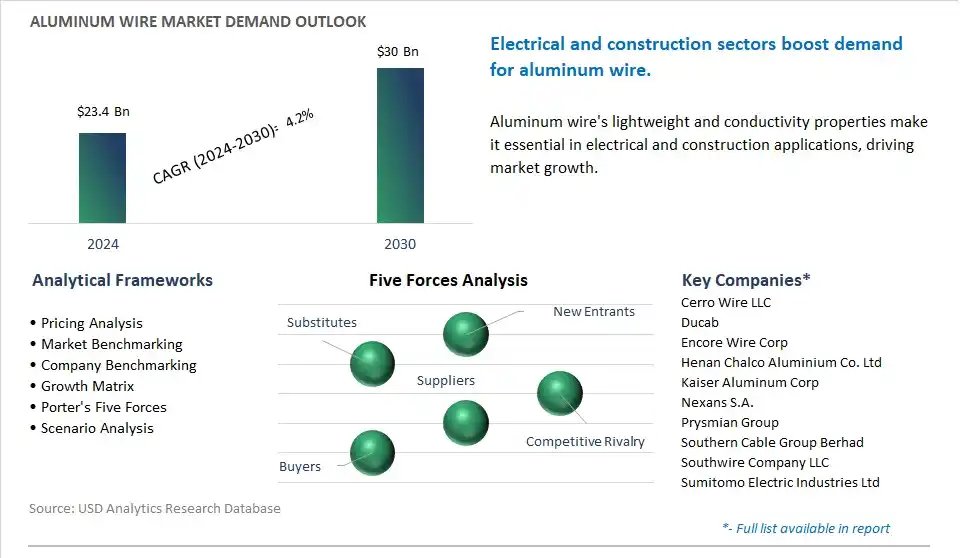
The global Aluminum Wire Market is poised to register a 4.2% CAGR from $23.4 Billion in 2024 to $30 Billion in 2030.
The global Aluminum Wire Market Study analyzes and forecasts the market size across 6 regions and 24 countries for diverse segments -By Grade (Electrical, Mechanical, Others), By Application (Building & Construction, Automotive & Transportation, Electrical & Electronics, Telecommunication, Power & Energy, Others).
An Introduction to Global Aluminum Wire Market in 2024
The aluminum wire market is experiencing steady growth driven by increasing demand in electrical transmission and distribution, automotive, and aerospace industries for lightweight and conductive materials. Key trends shaping the future of the industry include the growing adoption of aluminum wire as a cost-effective and energy-efficient alternative to copper wire in power distribution networks, motor winding applications, and automotive wiring harnesses. Moreover, there's a rising emphasis on sustainability and resource conservation, leading to innovations in aluminum wire alloys, coatings, and insulation materials to improve performance and reliability while reducing environmental impact. Additionally, advancements in wire drawing technology, alloy development, and surface treatment methods are driving innovation and market expansion, enabling wire manufacturers to offer high-quality and customizable solutions for diverse applications in the global aluminum wire market.
Aluminum Wire Market Competitive Landscape
The market report analyses the leading companies in the industry including Cerro Wire LLC, Ducab, Encore Wire Corp, Henan Chalco Aluminium Co. Ltd, Kaiser Aluminum Corp, Nexans S.A., Prysmian Group, Southern Cable Group Berhad, Southwire Company LLC, Sumitomo Electric Industries Ltd.
Aluminum Wire Market Dynamics
Aluminum Wire Market Trend: Shift Towards Lightweight and High-Conductivity Materials in Electrical Applications
A prominent market trend for aluminum wire is the shift towards lightweight and high-conductivity materials in electrical applications. With increasing demand for energy efficiency, renewable energy integration, and electrification of various sectors, there's a growing need for materials that offer superior electrical conductivity while reducing weight and cost. Aluminum wire, known for its lightweight nature and high electrical conductivity relative to its weight, is gaining traction as a viable alternative to copper wire in electrical wiring and transmission applications. The trend towards lightweight and high-conductivity materials drives market demand for aluminum wire as manufacturers and end-users seek to optimize performance, minimize energy losses, and meet sustainability goals in electrical systems and infrastructure.
Aluminum Wire Market Driver: Growth in Renewable Energy Generation and Grid Modernization Projects
A significant driver for the aluminum wire market is the growth in renewable energy generation and grid modernization projects. As countries worldwide prioritize the transition towards clean and renewable energy sources such as wind, solar, and hydroelectric power, there's an increasing need for efficient electrical transmission and distribution systems to accommodate fluctuating energy production and meet growing demand. Aluminum wire offers advantages such as lower weight, lower cost, and comparable electrical conductivity to copper wire, making it well-suited for use in renewable energy infrastructure including wind turbine generators, solar panel installations, and high-voltage transmission lines. The growth in renewable energy generation and grid modernization initiatives drives market demand for aluminum wire as a key component in modern electrical systems and renewable energy infrastructure projects.
Aluminum Wire Market Opportunity: Expansion into Automotive and Aerospace Electrical Systems
An opportunity for the aluminum wire market lies in the expansion into automotive and aerospace electrical systems. With the increasing electrification of vehicles and the development of electric and hybrid propulsion technologies, there's a growing demand for lightweight and high-performance electrical components in automotive applications. Aluminum wire, with its lightweight and high conductivity properties, presents an opportunity for use in vehicle wiring harnesses, powertrain systems, and electrical propulsion systems, offering weight savings and improved efficiency compared to traditional copper wiring. Similarly, in the aerospace industry, where weight reduction is critical for fuel efficiency and performance, aluminum wire can find applications in aircraft electrical systems, avionics, and onboard electronics. By expanding into automotive and aerospace electrical systems, aluminum wire manufacturers can tap into new market segments, capitalize on the trend towards electrification, and contribute to the advancement of sustainable transportation technologies.
Aluminum Wire Market Share Analysis: Electrical Grade segment generated the highest revenue in the industry
The largest segment in the Aluminum Wire Market is Electrical Grade, and this dominance is driven by Electrical grade aluminum wire is specifically designed and manufactured for use in electrical transmission and distribution systems, including power grids, electrical substations, transformers, motors, and electrical wiring in buildings and infrastructure. Electrical grade aluminum wire offers excellent conductivity, lightweight, corrosion resistance, and cost-effectiveness compared to traditional copper wire. In addition, aluminum wire is approximately one-third the weight of copper wire, making it easier to handle, transport, and install, reducing labor and material costs. Additionally, aluminum wire is non-magnetic and does not require additional insulation, unlike copper wire, making it suitable for high-voltage and overhead power transmission lines. Further, advancements in aluminum alloy development, wire manufacturing processes, and electrical insulation technologies have further enhanced the performance, reliability, and efficiency of electrical grade aluminum wire, driving its widespread adoption in electrical engineering and construction projects worldwide. Over the forecast period, the Electrical Grade segment dominates the Aluminum Wire Market due to its suitability for electrical applications, cost-effectiveness, lightweight, and technological advancements in aluminum wire manufacturing.
Aluminum Wire Market Share Analysis: Power & Energy Segment is poised to register the fastest growth rate (CAGR) over the forecast period to 2030
The fastest-growing segment in the Aluminum Wire Market is the Power & Energy application, and this growth is driven by diverse key factors. With the increasing global demand for renewable energy sources and the transition towards a sustainable energy future, there is a growing need for efficient and reliable power transmission and distribution infrastructure. Aluminum wire is particularly well-suited for use in power transmission and distribution systems due to its excellent conductivity, lightweight, and cost-effectiveness compared to traditional copper wire. Additionally, aluminum wire offers advantages such as corrosion resistance and ease of installation, making it ideal for overhead power lines, electrical substations, and renewable energy projects such as wind farms and solar power plants. In addition, advancements in aluminum alloy development, wire manufacturing processes, and insulation technologies have further enhanced the performance and reliability of aluminum wire in power and energy applications, driving its increased adoption in the sector. Further, government initiatives and investments in upgrading and expanding power grids, along with the growing demand for electricity in emerging economies, contribute to the growth of the Power & Energy segment in the Aluminum Wire Market. Over the forecast period, the rapid growth of the Power & Energy application segment is fueled by the increasing demand for efficient and sustainable power transmission and distribution solutions to meet the needs of a growing global population and the transition towards renewable energy sources.
Aluminum Wire Market Report Segmentation
By Grade
Electrical
Mechanical
Others
By Application
Building & Construction
Automotive & Transportation
Electrical & Electronics
Telecommunication
Power & Energy
Others
Regions Included
North America (US, Canada, Mexico)
Europe (Germany, UK, France, Spain, Italy, Russia, Rest of Europe)
Asia Pacific (China, India, Japan, South Korea, Australia, South East Asia, Rest of Asia)
South America (Brazil, Argentina, Rest of South America)
Middle East and Africa (Saudi Arabia, UAE, Rest of Middle East, South Africa, Egypt, Rest of Africa)
Aluminum Wire Companies Profiled in the Market Study
Cerro Wire LLC
Ducab
Encore Wire Corp
Henan Chalco Aluminium Co. Ltd
Kaiser Aluminum Corp
Nexans S.A.
Prysmian Group
Southern Cable Group Berhad
Southwire Company LLC
Sumitomo Electric Industries Ltd
*- List Not Exhaustive
TABLE OF CONTENTS
1 Introduction to 2024 Aluminum Wire Market
1.1 Market Overview
1.2 Quick Facts
1.3 Scope/Objective of the Study
1.4 Market Definition
1.5 Countries and Regions Covered
1.6 Units, Currency, and Conversions
1.7 Industry Value Chain
2 Research Methodology
2.1 Market Size Estimation
2.2 Sources and Research Methodology
2.3 Data Triangulation
2.4 Assumptions and Limitations
3 Executive Summary
3.1 Global Aluminum Wire Market Size Outlook, $ Million, 2021 to 2030
3.2 Aluminum Wire Market Outlook by Type, $ Million, 2021 to 2030
3.3 Aluminum Wire Market Outlook by Product, $ Million, 2021 to 2030
3.4 Aluminum Wire Market Outlook by Application, $ Million, 2021 to 2030
3.5 Aluminum Wire Market Outlook by Key Countries, $ Million, 2021 to 2030
4 Market Dynamics
4.1 Key Driving Forces of Aluminum Wire Industry
4.2 Key Market Trends in Aluminum Wire Industry
4.3 Potential Opportunities in Aluminum Wire Industry
4.4 Key Challenges in Aluminum Wire Industry
5 Market Factor Analysis
5.1 Value Chain Analysis
5.2 Competitive Landscape
5.2.1 Global Aluminum Wire Market Share by Company (%), 2023
5.2.2 Product Offerings by Company
5.3 Porter’s Five Forces Analysis
5.4 Pricing Analysis and Outlook
6 Growth Outlook Across Scenarios
6.1 Growth Analysis-Case Scenario Definitions
6.2 Low Growth Scenario Forecasts
6.3 Reference Growth Scenario Forecasts
6.4 High Growth Scenario Forecasts
7 Global Aluminum Wire Market Outlook by Segments
7.1 Aluminum Wire Market Outlook by Segments, $ Million, 2021- 2030
By Grade
Electrical
Mechanical
Others
By Application
Building & Construction
Automotive & Transportation
Electrical & Electronics
Telecommunication
Power & Energy
Others
8 North America Aluminum Wire Market Analysis and Outlook To 2030
8.1 Introduction to North America Aluminum Wire Markets in 2024
8.2 North America Aluminum Wire Market Size Outlook by Country, 2021-2030
8.2.1 United States
8.2.2 Canada
8.2.3 Mexico
8.3 North America Aluminum Wire Market size Outlook by Segments, 2021-2030
By Grade
Electrical
Mechanical
Others
By Application
Building & Construction
Automotive & Transportation
Electrical & Electronics
Telecommunication
Power & Energy
Others
9 Europe Aluminum Wire Market Analysis and Outlook To 2030
9.1 Introduction to Europe Aluminum Wire Markets in 2024
9.2 Europe Aluminum Wire Market Size Outlook by Country, 2021-2030
9.2.1 Germany
9.2.2 France
9.2.3 Spain
9.2.4 United Kingdom
9.2.4 Italy
9.2.5 Russia
9.2.6 Norway
9.2.7 Rest of Europe
9.3 Europe Aluminum Wire Market Size Outlook by Segments, 2021-2030
By Grade
Electrical
Mechanical
Others
By Application
Building & Construction
Automotive & Transportation
Electrical & Electronics
Telecommunication
Power & Energy
Others
10 Asia Pacific Aluminum Wire Market Analysis and Outlook To 2030
10.1 Introduction to Asia Pacific Aluminum Wire Markets in 2024
10.2 Asia Pacific Aluminum Wire Market Size Outlook by Country, 2021-2030
10.2.1 China
10.2.2 India
10.2.3 Japan
10.2.4 South Korea
10.2.5 Indonesia
10.2.6 Malaysia
10.2.7 Australia
10.2.8 Rest of Asia Pacific
10.3 Asia Pacific Aluminum Wire Market size Outlook by Segments, 2021-2030
By Grade
Electrical
Mechanical
Others
By Application
Building & Construction
Automotive & Transportation
Electrical & Electronics
Telecommunication
Power & Energy
Others
11 South America Aluminum Wire Market Analysis and Outlook To 2030
11.1 Introduction to South America Aluminum Wire Markets in 2024
11.2 South America Aluminum Wire Market Size Outlook by Country, 2021-2030
11.2.1 Brazil
11.2.2 Argentina
11.2.3 Rest of South America
11.3 South America Aluminum Wire Market size Outlook by Segments, 2021-2030
By Grade
Electrical
Mechanical
Others
By Application
Building & Construction
Automotive & Transportation
Electrical & Electronics
Telecommunication
Power & Energy
Others
12 Middle East and Africa Aluminum Wire Market Analysis and Outlook To 2030
12.1 Introduction to Middle East and Africa Aluminum Wire Markets in 2024
12.2 Middle East and Africa Aluminum Wire Market Size Outlook by Country, 2021-2030
12.2.1 Saudi Arabia
12.2.2 UAE
12.2.3 Oman
12.2.4 Rest of Middle East
12.2.5 Egypt
12.2.6 Nigeria
12.2.7 South Africa
12.2.8 Rest of Africa
12.3 Middle East and Africa Aluminum Wire Market size Outlook by Segments, 2021-2030
By Grade
Electrical
Mechanical
Others
By Application
Building & Construction
Automotive & Transportation
Electrical & Electronics
Telecommunication
Power & Energy
Others
13 Company Profiles
13.1 Company Snapshot
13.2 SWOT Profiles
13.3 Products and Services
13.4 Recent Developments
13.5 Financial Profile
Cerro Wire LLC
Ducab
Encore Wire Corp
Henan Chalco Aluminium Co. Ltd
Kaiser Aluminum Corp
Nexans S.A.
Prysmian Group
Southern Cable Group Berhad
Southwire Company LLC
Sumitomo Electric Industries Ltd
14 Appendix
14.1 Customization Offerings
14.2 Subscription Services
14.3 Related Reports
14.4 Publisher Expertise
By Grade
Electrical
Mechanical
Others
By Application
Building & Construction
Automotive & Transportation
Electrical & Electronics
Telecommunication
Power & Energy
Others
Countries Analyzed
North America (US, Canada, Mexico)
Europe (Germany, UK, France, Spain, Italy, Russia, Rest of Europe)
Asia Pacific (China, India, Japan, South Korea, Australia, South East Asia, Rest of Asia)
South America (Brazil, Argentina, Rest of South America)
Middle East and Africa (Saudi Arabia, UAE, Rest of Middle East, South Africa, Egypt, Rest of Africa)
