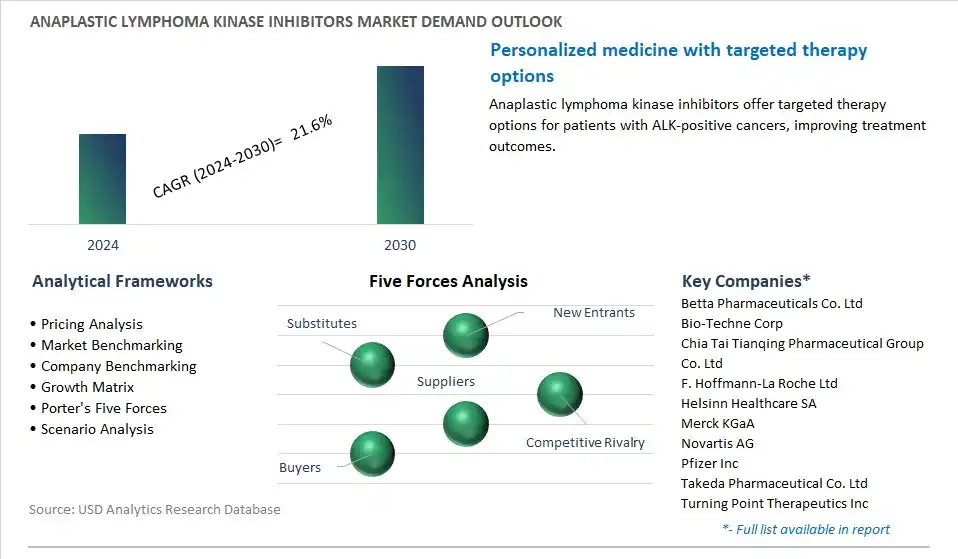
Anaplastic Lymphoma Kinase (ALK) Inhibitors Market is estimated to increase at a growth rate of 21.6% CAGR over the forecast period from 2024 to 2030.
The global Anaplastic Lymphoma Kinase (ALK) Inhibitors Market Study analyzes and forecasts the market size across 6 regions and 24 countries for diverse segments including By Type (Second-Generation ALK Inhibitors, First-Generation ALK Inhibitors, Third-Generation ALK Inhibitors).
An Introduction to Anaplastic Lymphoma Kinase (ALK) Inhibitors Market in 2024
The Anaplastic Lymphoma Kinase (ALK) Inhibitors Market in 2024 focuses on targeted therapies for cancer treatment, specifically addressing ALK-positive tumors such as non-small cell lung cancer (NSCLC) and lymphomas. ALK inhibitors, precision oncology drugs, target abnormal ALK gene alterations, inhibit cancer cell growth, and improve survival outcomes for patients with ALK-driven cancers. With advancements in molecular diagnostics, patient stratification, and combination therapies, ALK inhibitors continue to shape personalized cancer care, therapeutic efficacy, and oncology research.
Anaplastic Lymphoma Kinase (ALK) Inhibitors Market Competitive Landscape
The global Anaplastic Lymphoma Kinase (ALK) Inhibitors Industry is highly competitive with a large number of companies focusing on niche market segments. Amidst intense competitive conditions, Anaplastic Lymphoma Kinase (ALK) Inhibitors Companies are investing in new product launches and strengthening distribution channels. Key companies operating in the Anaplastic Lymphoma Kinase (ALK) Inhibitors Industry include- Betta Pharmaceuticals Co. Ltd, Bio-Techne Corp, Chia Tai Tianqing Pharmaceutical Group Co. Ltd, F. Hoffmann-La Roche Ltd, Helsinn Healthcare SA, Merck KGaA, Novartis AG, Pfizer Inc, Takeda Pharmaceutical Co. Ltd, Turning Point Therapeutics Inc.
Anaplastic Lymphoma Kinase Inhibitors Market Trend: Increasing Focus on Targeted Therapies for Cancer Treatment
In the Anaplastic Lymphoma Kinase Inhibitors market, a significant trend is the increasing focus on targeted therapies for cancer treatment. With advancements in molecular biology and cancer genomics, there's a growing understanding of the role of specific genetic alterations, such as ALK gene mutations, in driving cancer growth and progression. As a result, there's a shift towards developing ALK inhibitors and other targeted therapies that can selectively inhibit cancer cell proliferation, offering improved efficacy and reduced toxicity compared to traditional chemotherapy.
Anaplastic Lymphoma Kinase Inhibitors Market Driver: Rising Incidence of ALK-Positive Cancers
A key driver for the Anaplastic Lymphoma Kinase Inhibitors market is the rising incidence of ALK-positive cancers, particularly non-small cell lung cancer (NSCLC) and certain types of lymphomas. With ALK gene rearrangements being identified as driver mutations in a subset of cancer patients, there's an increasing demand for effective targeted therapies that can specifically target and inhibit ALK activity, offering personalized treatment options and improved clinical outcomes for patients with ALK-positive tumors.
Anaplastic Lymphoma Kinase Inhibitors Market Opportunity: Expansion into Precision Oncology and Companion Diagnostics
An opportunity exists in expanding into precision oncology and companion diagnostics for ALK inhibitors. By integrating ALK mutation testing into routine cancer diagnostics and treatment decision-making processes, there's potential to identify eligible patients for ALK inhibitor therapy, optimize treatment selection, and monitor treatment response over time. Additionally, there's an opportunity to develop companion diagnostic tests that can predict patient response to ALK inhibitors and guide treatment strategies, thus enhancing patient care and driving market growth for ALK inhibitor products.
Market Share Analysis: Third-Generation ALK Inhibitors is the fastest growing segment in the Anaplastic Lymphoma Kinase Inhibitors industry
Within the segmentation of Anaplastic Lymphoma Kinase (ALK) Inhibitors, the segment of Third-Generation ALK Inhibitors emerges as the fastest-growing. This growth is propelled by several significant factors. Third-generation ALK inhibitors represent the latest advancement in targeted therapy for ALK-positive cancers, including non-small cell lung cancer (NSCLC) and other malignancies harboring ALK gene alterations. These inhibitors are designed to overcome resistance mechanisms that develop in response to first- and second-generation ALK inhibitors, such as mutations in the ALK gene or activation of alternative signaling pathways. Third-generation ALK inhibitors demonstrate potent and selective inhibition of ALK activity, effectively suppressing tumor growth and improving patient outcomes, even in cases where resistance to earlier generations of inhibitors has developed. Additionally, third-generation ALK inhibitors offer the potential for improved safety profiles and reduced adverse effects compared to earlier generations, enhancing their suitability for long-term treatment. Furthermore, ongoing clinical trials and research efforts are expanding the therapeutic landscape of third-generation ALK inhibitors, exploring their efficacy in various patient populations and combination therapies. As a result, the segment of Third-Generation ALK Inhibitors experiences rapid growth, driven by the pressing clinical need for effective treatments for ALK-positive cancers and the promising therapeutic potential of these advanced inhibitors in overcoming resistance and improving patient outcomes.
Anaplastic Lymphoma Kinase (ALK) Inhibitors Market Segmentation
By Type
Second-Generation ALK Inhibitors
First-Generation ALK Inhibitors
Third-Generation ALK Inhibitors
Geographical Analysis
North America (United States, Canada, Mexico)
Europe (Germany, France, United Kingdom, Spain, Italy, Rest of Europe)
Asia Pacific (China, India, Japan, South Korea, Rest of Asia Pacific)
South America (Brazil, Argentina, Rest of South America)
Middle East and Africa (Saudi Arabia, UAE, Rest of Middle East, South Africa, Egypt, Rest of Africa)
Anaplastic Lymphoma Kinase (ALK) Inhibitors Companies
Betta Pharmaceuticals Co. Ltd
Bio-Techne Corp
Chia Tai Tianqing Pharmaceutical Group Co. Ltd
F. Hoffmann-La Roche Ltd
Helsinn Healthcare SA
Merck KGaA
Novartis AG
Pfizer Inc
Takeda Pharmaceutical Co. Ltd
Turning Point Therapeutics Inc
* List not Exhaustive
Reasons to Buy the Anaplastic Lymphoma Kinase (ALK) Inhibitors Market Study
• Deepen your industry insights and navigate uncertainties for strategy formulation, CAPEX, and Operational decisions
• Gain access to detailed insights on the Anaplastic Lymphoma Kinase (ALK) Inhibitors Market, encompassing current market size, growth trends, and forecasts till 2030.
• Access detailed competitor analysis, enabling competitive advantage through a thorough understanding of market players, strategies, and potential differentiation opportunities
• Stay ahead of the curve with insights on technological advancements, innovations, and upcoming trends
• Identify lucrative investment avenues and expansion opportunities within the Anaplastic Lymphoma Kinase (ALK) Inhibitors Industry, guided by robust, data-backed analysis.
• Understand regional and global markets through country-wise analysis, regional market potential, regulatory nuances, and dynamics
• Execute strategies with confidence and speed through information, analytics, and insights on the industry value chain
• Corporate leaders, strategists, financial experts, shareholders, asset managers, and governmental representatives can make long-term planning scenarios and build an integrated and timely understanding of market dynamics
• Benefit from tailored solutions and expert consultation based on report insights, providing personalized strategies aligned with specific business needs.
TABLE OF CONTENTS
1 Introduction to 2024 Anaplastic Lymphoma Kinase (ALK) Inhibitors Market
1.1 Market Overview
1.2 Quick Facts
1.3 Scope/Objective of the Study
1.4 Market Definition
1.5 Countries and Regions Analyzed
1.6 Units, Currency, and Conversions
1.7 Industry Value Chain
2 Research Methodology
2.1 Market Size Estimation
2.2 Sources and Research Methodology
2.3 Data Triangulation
2.4 Assumptions and Limitations
3 Executive Summary
3.1 Global Anaplastic Lymphoma Kinase (ALK) Inhibitors Market Size Outlook, $ Million, 2021 to 2030
3.2 Anaplastic Lymphoma Kinase (ALK) Inhibitors Market Outlook by Type, $ Million, 2021 to 2030
3.3 Anaplastic Lymphoma Kinase (ALK) Inhibitors Market Outlook by Product, $ Million, 2021 to 2030
3.4 Anaplastic Lymphoma Kinase (ALK) Inhibitors Market Outlook by Application, $ Million, 2021 to 2030
3.5 Anaplastic Lymphoma Kinase (ALK) Inhibitors Market Outlook by Key Countries, $ Million, 2021 to 2030
4 Market Dynamics
4.1 Key Driving Forces of Anaplastic Lymphoma Kinase (ALK) Inhibitors Industry
4.2 Key Market Trends in Anaplastic Lymphoma Kinase (ALK) Inhibitors Industry
4.3 Potential Opportunities in Anaplastic Lymphoma Kinase (ALK) Inhibitors Industry
4.4 Key Challenges in Anaplastic Lymphoma Kinase (ALK) Inhibitors Industry
5 Market Factor Analysis
5.1 Value Chain Analysis
5.2 Competitive Landscape
5.2.1 Global Anaplastic Lymphoma Kinase (ALK) Inhibitors Market Share by Company (%), 2023
5.2.2 Product Offerings by Company
5.3 Porter’s Five Forces Analysis
5.4 Pricing Analysis and Outlook
6 Growth Outlook Across Scenarios
6.1 Growth Analysis-Case Scenario Definitions
6.2 Low Growth Scenario Forecasts
6.3 Reference Growth Scenario Forecasts
6.4 High Growth Scenario Forecasts
7 Global Anaplastic Lymphoma Kinase (ALK) Inhibitors Market Outlook by Segments
7.1 Anaplastic Lymphoma Kinase (ALK) Inhibitors Market Outlook by Segments, $ Million, 2021- 2030
By Type
Second-Generation ALK Inhibitors
First-Generation ALK Inhibitors
Third-Generation ALK Inhibitors
8 North America Anaplastic Lymphoma Kinase (ALK) Inhibitors Market Analysis and Outlook To 2030
8.1 Introduction to North America Anaplastic Lymphoma Kinase (ALK) Inhibitors Markets in 2024
8.2 North America Anaplastic Lymphoma Kinase (ALK) Inhibitors Market Size Outlook by Country, 2021-2030
8.2.1 United States
8.2.2 Canada
8.2.3 Mexico
8.3 North America Anaplastic Lymphoma Kinase (ALK) Inhibitors Market size Outlook by Segments, 2021-2030
By Type
Second-Generation ALK Inhibitors
First-Generation ALK Inhibitors
Third-Generation ALK Inhibitors
9 Europe Anaplastic Lymphoma Kinase (ALK) Inhibitors Market Analysis and Outlook To 2030
9.1 Introduction to Europe Anaplastic Lymphoma Kinase (ALK) Inhibitors Markets in 2024
9.2 Europe Anaplastic Lymphoma Kinase (ALK) Inhibitors Market Size Outlook by Country, 2021-2030
9.2.1 Germany
9.2.2 France
9.2.3 Spain
9.2.4 United Kingdom
9.2.4 Italy
9.2.5 Russia
9.2.6 Norway
9.2.7 Rest of Europe
9.3 Europe Anaplastic Lymphoma Kinase (ALK) Inhibitors Market Size Outlook by Segments, 2021-2030
By Type
Second-Generation ALK Inhibitors
First-Generation ALK Inhibitors
Third-Generation ALK Inhibitors
10 Asia Pacific Anaplastic Lymphoma Kinase (ALK) Inhibitors Market Analysis and Outlook To 2030
10.1 Introduction to Asia Pacific Anaplastic Lymphoma Kinase (ALK) Inhibitors Markets in 2024
10.2 Asia Pacific Anaplastic Lymphoma Kinase (ALK) Inhibitors Market Size Outlook by Country, 2021-2030
10.2.1 China
10.2.2 India
10.2.3 Japan
10.2.4 South Korea
10.2.5 Indonesia
10.2.6 Malaysia
10.2.7 Australia
10.2.8 Rest of Asia Pacific
10.3 Asia Pacific Anaplastic Lymphoma Kinase (ALK) Inhibitors Market size Outlook by Segments, 2021-2030
By Type
Second-Generation ALK Inhibitors
First-Generation ALK Inhibitors
Third-Generation ALK Inhibitors
11 South America Anaplastic Lymphoma Kinase (ALK) Inhibitors Market Analysis and Outlook To 2030
11.1 Introduction to South America Anaplastic Lymphoma Kinase (ALK) Inhibitors Markets in 2024
11.2 South America Anaplastic Lymphoma Kinase (ALK) Inhibitors Market Size Outlook by Country, 2021-2030
11.2.1 Brazil
11.2.2 Argentina
11.2.3 Rest of South America
11.3 South America Anaplastic Lymphoma Kinase (ALK) Inhibitors Market size Outlook by Segments, 2021-2030
By Type
Second-Generation ALK Inhibitors
First-Generation ALK Inhibitors
Third-Generation ALK Inhibitors
12 Middle East and Africa Anaplastic Lymphoma Kinase (ALK) Inhibitors Market Analysis and Outlook To 2030
12.1 Introduction to Middle East and Africa Anaplastic Lymphoma Kinase (ALK) Inhibitors Markets in 2024
12.2 Middle East and Africa Anaplastic Lymphoma Kinase (ALK) Inhibitors Market Size Outlook by Country, 2021-2030
12.2.1 Saudi Arabia
12.2.2 UAE
12.2.3 Oman
12.2.4 Rest of Middle East
12.2.5 Egypt
12.2.6 Nigeria
12.2.7 South Africa
12.2.8 Rest of Africa
12.3 Middle East and Africa Anaplastic Lymphoma Kinase (ALK) Inhibitors Market size Outlook by Segments, 2021-2030
By Type
Second-Generation ALK Inhibitors
First-Generation ALK Inhibitors
Third-Generation ALK Inhibitors
13 Company Profiles
13.1 Company Snapshot
13.2 SWOT Profiles
13.3 Products and Services
13.4 Recent Developments
13.5 Financial Profile
List of Companies
Betta Pharmaceuticals Co. Ltd
Bio-Techne Corp
Chia Tai Tianqing Pharmaceutical Group Co. Ltd
F. Hoffmann-La Roche Ltd
Helsinn Healthcare SA
Merck KGaA
Novartis AG
Pfizer Inc
Takeda Pharmaceutical Co. Ltd
Turning Point Therapeutics Inc
14 Appendix
14.1 Customization Offerings
14.2 Subscription Services
14.3 Related Reports
14.4 Publisher Expertise
