Antibody Drug Conjugates Contract Manufacturing Market Overview: Specialized CDMO Services, Bioconjugation Economics and Commercial Manufacturing Demand
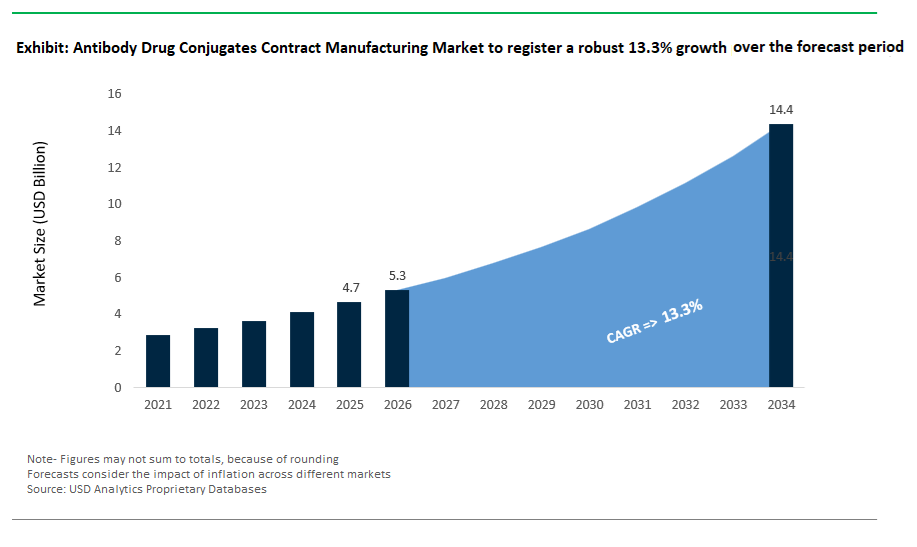
The global Antibody Drug Conjugates (ADC) Contract Manufacturing Market is valued at USD 5,381.2 million in 2026 and is projected to reach USD 14,589.1 million by 2034, growing at a CAGR of 13.3% during 2026–2034. The market comprises outsourced development and manufacturing services supporting antibody-linked therapeutic compounds, principally used in oncology. Unlike conventional monoclonal antibody manufacturing, ADC production involves coordinated biological and chemical manufacturing operations, including monoclonal antibody intermediate production, cytotoxic payload synthesis, linker preparation, bioconjugation, purification and sterile drug-product processing. Contract development and manufacturing organizations participate through specialized service modules or integrated manufacturing networks, with different providers supplying distinct stages of ADC production. Market revenue is attributable to contracted manufacturing, process development and analytical services rather than the commercial selling value of finished ADC medicines. Its business structure reflects the specialized capabilities required to combine biological intermediates with highly potent chemical components while maintaining defined drug-substance quality characteristics.
Demand for ADC contract manufacturing services converts into revenue through development programs, GMP production batches, specialized chemical manufacturing, bioconjugation campaigns and recurring commercial drug-substance or drug-product supply agreements. Preclinical and early clinical programs generate revenue from process development, manufacturing feasibility, analytical characterization and relatively small production batches. Later-stage programs involve increased manufacturing quantities, process qualification and production transfer, while established commercial products can support repeated manufacturing campaigns under longer-term supply arrangements. Service value differs considerably across monoclonal antibody production, payload-linker synthesis, conjugation, purification and sterile filling because each operation involves different equipment, personnel expertise and manufacturing requirements. Batch recovery, material utilization and process cycle duration influence production economics, particularly where expensive antibody intermediates and specialized cytotoxic compounds are consumed during manufacturing. Integrated service contracts may encompass several operations, with their commercial value determined by the actual manufacturing responsibilities and technical services delivered.
The competitive value of ADC CDMOs is closely associated with process reproducibility, technical specialization and the ability to maintain consistent drug-substance quality across development and commercial manufacturing stages. Antibody quality, payload characteristics and conjugation chemistry affect downstream purification, analytical testing and finished-product stability, creating strong dependencies between different manufacturing service modules. Manufacturing variability can influence drug-to-antibody ratio distribution, impurity levels, aggregation and product recovery, with corresponding consequences for batch acceptance and processing costs. Facilities handling highly potent compounds also have specialized containment, cleaning and materials transfer requirements that affect operational capacity and manufacturing expenses. Differences in conjugation technology, analytical expertise and manufacturing scale create barriers to switching between qualified service providers. Commercial relationships may extend across successive clinical phases and approved-product supply, with additional service revenue associated with analytical method development, stability studies, technology transfer and manufacturing comparability activities.
Key Insights
- ADC manufacturing combines biological production and specialized chemical processing, creating differentiated contract services across antibody, payload, linker and bioconjugation operations.
- Revenue spans clinical development and recurring commercial supply, with manufacturing batch scale and service complexity influencing contract values.
- Bioconjugation yield and product quality are major commercial differentiators, particularly through drug-loading consistency, impurity control and purification recovery.
- High-potency containment and analytical expertise create specialized manufacturing barriers, supporting demand for qualified ADC contract manufacturers.
- Integrated ADC manufacturing networks connect upstream intermediates, conjugation, sterile fill-finish and analytical services through coordinated production arrangements.
Antibody Drug Conjugates Contract Manufacturing Market Recent Developments: GMP Bioconjugation Capacity, Payload-Linker Manufacturing and Integrated ADC CDMO Services
Recent developments in the Antibody Drug Conjugates (ADC) Contract Manufacturing Market reflect expansion of specialized GMP manufacturing capacity, commercialization of additional bioconjugation platforms and increasing geographical diversification of ADC contract development and manufacturing services. On September 21, 2026, WuXi XDC announced the GMP release of its Singapore manufacturing site at Tuas Biomedical Park. The approximately 25,000-square-meter facility incorporates antibody intermediate manufacturing, ADC drug-substance production and sterile drug-product operations. Its BCM3 dual-function manufacturing line supports antibody intermediate batch volumes ranging from 200 to 2,000 liters, alongside conjugated drug-substance manufacturing capacity of up to 2,000 liters per batch. The DP4 facility is designed for annual production of up to 8 million vials of liquid or lyophilized bioconjugates, with sterile isolator filling and automated in-line weight verification. The September milestone followed GMP release of the relevant manufacturing facilities in August 2026.
Commercial ADC manufacturing capacity is also expanding across specialized European CDMO networks. In June 2026, Lonza announced additional highly potent active pharmaceutical ingredient (HPAPI) and payload-linker manufacturing capacity at its Visp, Switzerland, facility. The payload-linker manufacturing expansion includes specialized production and purification capabilities supported by analytical and process development laboratories, with the new capacity expected to become operational in 2028. In July 2026, Lonza separately announced plans for another commercial-scale aseptic ADC drug-product filling line at Stein, Switzerland, supported by a long-term customer agreement and targeted for operation in 2030. These projects distinguish payload-linker synthesis, bioconjugation and final drug-product manufacturing as separate but commercially connected capacity requirements within integrated ADC production networks.
Technology portfolio developments are extending beyond conventional antibody conjugation and single-payload ADC configurations. In February 2026, Lonza expanded its Advanced Synthesis offering through further integration of the Synaffix-derived GlycoConnect, HydraSpace and toxSYN technology platforms. The company also described expanded capabilities in dual-payload ADC development and early-stage bioconjugation at its Oss, Netherlands, facility. In June 2026, Lonza and Antharis Therapeutics entered a target-specific licensing agreement involving dual-payload ADC technology for gastrointestinal cancer programs. The arrangement illustrates commercialization of specialized conjugation intellectual property alongside conventional fee-for-service manufacturing capabilities, with associated requirements for molecule-specific analytical characterization and process development.
Additional CDMO providers have expanded specialized ADC manufacturing portfolios. Samsung Biologics began offering ADC services through its dedicated manufacturing facility in early 2025 and extended its collaboration with LigaChem Biosciences in January of that year to support multiple ADC development programs. The company's ADC development and manufacturing collaboration covers manufacturing activities associated with antibody-drug conjugate development. In October 2025, Simtra BioPharma Solutions reported the addition of a conjugation and purification suite at its Halle/Westfalen facility in Germany, alongside sterile drug-product manufacturing capabilities. These developments broaden the range of available ADC manufacturing configurations across specialized conjugation providers, integrated biologics CDMOs and sterile injectable manufacturers.
Antibody Drug Conjugates Contract Manufacturing Market Regulatory Compliance, GMP Bioconjugation and High-Potency Manufacturing Standards
The Antibody Drug Conjugates Contract Manufacturing Market operates within pharmaceutical GMP requirements governing biologic drug substances, highly potent chemical intermediates and sterile drug-product manufacturing. In April 2026, the FDA issued an updated biological product manufacturing inspection compliance program containing specific inspection coverage for antibody-drug conjugates. The program addresses antibody intermediate identity, linker-payload storage conditions, conjugation reaction parameters and purification controls for residual unconjugated payload. It recognizes conventional and site-specific bioconjugation approaches, including enzyme-mediated methods, with inspection coverage linked to the manufacturing process described in the applicable regulatory submission. The compliance program guides FDA inspection activities rather than establishing a separate universal ADC manufacturing regulation.
Product characterization and process comparability are addressed through the ICH quality guidelines for biotechnology products, particularly ICH Q5E and Q6B. ICH Q5E provides principles for evaluating manufacturing changes affecting biotechnology products, including applicable protein conjugates, while ICH Q6B addresses the establishment of specifications for biologically derived products. ADC quality assessment incorporates antibody identity, drug-to-antibody ratio (DAR), conjugation heterogeneity, aggregation, residual free payload and product potency. Analytical requirements vary according to the antibody structure, linker chemistry, payload characteristics and manufacturing process.
High-potency manufacturing also involves occupational containment and cross-contamination controls. The European Medicines Agency's health-based exposure limit guideline establishes a scientific framework for evaluating cross-contamination risks in shared pharmaceutical manufacturing facilities. Occupational exposure limits and containment classifications are compound-specific and should not be interpreted as a single threshold applicable to all ADC payloads.
ADC drug-product filling is additionally subject to sterile manufacturing requirements, including EU GMP Annex 1. Contract manufacturing quality assessment covers aseptic process qualification, cleaning validation, equipment containment, material traceability, analytical method performance and manufacturing documentation across antibody production, conjugation, purification and final drug-product operations.
Key Market Trends Shaping Antibody Drug Conjugates Contract Manufacturing
Site-Specific Bioconjugation and Advanced Linker-Payload Technologies Reshape ADC Contract Manufacturing
The Antibody Drug Conjugates Contract Manufacturing Market is experiencing increasing technical differentiation as ADC developers explore more controlled conjugation methods, specialized linker chemistries and novel cytotoxic payload architectures. Conventional lysine- and cysteine-based conjugation methods can generate heterogeneous distributions of drug loading and attachment sites, while site-specific approaches use engineered amino acids, modified cysteine residues or enzyme-mediated reactions to control selected conjugation characteristics. Drug-to-antibody ratio (DAR), conjugation-site distribution, linker stability and molecular aggregation influence the physicochemical properties and manufacturing consistency of ADC drug substances. Emerging dual-payload and other differentiated bioconjugate architectures introduce additional complexity in reaction control, purification and analytical characterization. The commercial significance of these technologies lies in the manufacturing expertise required to translate laboratory conjugation methods into reproducible GMP processes. Contract development and manufacturing organizations (CDMOs) compete through conjugation chemistry capabilities, reaction yield, product quality control and the compatibility of their manufacturing platforms with different antibody and linker-payload combinations.
Integrated Antibody-to-Drug-Product Manufacturing Expands End-to-End ADC CDMO Service Models
Integrated manufacturing models are becoming an important competitive characteristic of the Antibody Drug Conjugates Contract Manufacturing Market because ADC production combines biological manufacturing, specialized chemical synthesis and high-potency drug-product processing. The manufacturing sequence can involve monoclonal antibody expression and purification, cytotoxic payload synthesis, linker preparation, controlled bioconjugation, ADC purification and final sterile drug-product manufacturing. These operations require different technical capabilities, equipment configurations and quality-control procedures, creating logistical and operational interfaces when manufacturing responsibilities are distributed among multiple suppliers. Integrated ADC CDMOs provide combinations of upstream biological production, payload-linker chemistry, conjugation and fill-finish services under coordinated manufacturing arrangements, although complete production under one physical roof is not necessary for integrated service delivery. Commercial differentiation reflects technology transfer requirements, intermediate storage conditions, material accountability, manufacturing scheduling and the consistency of analytical information between production stages. Contract structures range from specialized standalone service agreements to broader drug-substance and drug-product manufacturing arrangements.
Key Growth Drivers of the Antibody Drug Conjugates Contract Manufacturing Market
Expanding ADC Oncology Indications and Commercial Treatment Volumes Accelerate Contract Manufacturing Demand
Expansion of antibody drug conjugate development across oncology indications and treatment settings is increasing demand for specialized contract manufacturing services. ADC development programs encompass clinical-stage candidates and established commercial products targeting different tumor-associated antigens, with manufacturing requirements varying according to molecule structure, treatment population and expected drug consumption. Movement of selected ADC therapies into earlier treatment settings can increase commercial batch requirements because eligible patient populations and treatment durations may differ from later-line applications. However, the relationship between clinical approvals and manufacturing demand depends on dose intensity, treatment uptake, competing therapies and the capacity requirements of individual products. For ADC CDMOs, manufacturing revenue encompasses clinical drug substance supply, process development, commercial bioconjugation and related finished-product services. Recurring commercial programs require consistent availability of antibody intermediates, linker-payload materials and qualified production capacity, while pipeline progression influences the number of manufacturing campaigns and the scale of contracted services.
High-Potency Payload Containment and Complex ADC Manufacturing Requirements Drive Specialized CDMO Outsourcing
Specialized manufacturing requirements for highly potent cytotoxic payloads and antibody conjugation processes are an important driver of outsourcing within the Antibody Drug Conjugates Contract Manufacturing Market. ADC production combines the biological processing characteristics of monoclonal antibodies with the chemical handling requirements of highly potent small-molecule compounds. Payload synthesis, conjugation and purification can involve materials requiring stringent occupational containment, controlled transfers, specialized cleaning procedures and management of hazardous manufacturing residues. Containment requirements vary according to the compound-specific occupational exposure limit, potency characteristics and manufacturing operation, rather than a universal threshold applicable to all ADC payloads. Bioconjugation manufacturing also requires control of reaction conditions, residual unconjugated payload, product aggregation and drug loading distributions that can influence drug-substance quality and manufacturing yield. Dedicated ADC CDMOs provide specialized chemical processing infrastructure, bioconjugation equipment and analytical capabilities, with service differentiation influenced by containment capacity, operational experience, batch recovery and manufacturing process reproducibility.
Emerging Opportunities in the Antibody Drug Conjugates Contract Manufacturing Market
Clinical-to-Commercial ADC Manufacturing Scale-Up Expands GMP Bioconjugation Capacity Opportunities
Progression of antibody drug conjugate candidates from early clinical development toward commercial manufacturing creates demand for scalable GMP bioconjugation services and associated process engineering capabilities. Early manufacturing campaigns typically involve relatively small production quantities and substantial process development activity, while later-stage programs require more reproducible reaction performance, established purification procedures and manufacturing processes capable of supporting recurring supply. Scaling bioconjugation operations introduces technical challenges involving mixing characteristics, reaction kinetics, antibody concentration, linker-payload addition and the removal of unconjugated process materials. Manufacturing yield can vary with process scale and purification configuration, creating differences between laboratory process performance and commercial production economics. CDMO service opportunities encompass process characterization, technology transfer, batch-scale expansion, production qualification and commercial manufacturing campaigns. Contract values are influenced by required drug-substance quantities, process complexity, manufacturing batch frequency and the extent of development activities necessary to establish consistent product quality across production scales.
High-Potency Sterile Fill-Finish and Lyophilized ADC Formulations Expand Drug Product Manufacturing Opportunities
Sterile drug-product manufacturing represents a specialized growth area within ADC contract manufacturing because finished antibody drug conjugates combine protein formulation sensitivity with the handling requirements of cytotoxic payload-containing materials. ADC formulation development involves control of aggregation, molecular stability, drug-product concentration and compatibility with processing equipment and primary containers. Liquid formulations require management of storage stability and potential degradation mechanisms, while lyophilized presentations introduce requirements for controlled freezing, drying, reconstitution performance and cake quality. Sterile filling operations must accommodate the containment characteristics of the ADC while preserving aseptic processing conditions, creating specialized requirements for product transfer, filling equipment and closed handling systems. High-value ADC drug substances also make manufacturing losses during formulation preparation, filtration, filling and lyophilization commercially significant. CDMO differentiation reflects formulation development expertise, aseptic containment capabilities, drug-product recovery, vial filling accuracy and the ability to support both clinical and commercial ADC supply.
Advanced ADC Analytical Characterization and Stability Testing Expand Specialized CDMO Service Opportunities
Increasing molecular complexity in antibody drug conjugates is expanding demand for specialized analytical development, characterization and stability testing services across the ADC manufacturing lifecycle. Unlike conventional monoclonal antibodies, ADC products require characterization of the antibody component, cytotoxic payload, chemical linker and conjugated molecular species, including variability in drug loading and conjugation sites. Analytical platforms such as liquid chromatography–mass spectrometry (LC-MS), hydrophobic interaction chromatography (HIC), size-exclusion chromatography and ligand-binding assays provide complementary information on DAR distribution, molecular heterogeneity, aggregation and biological activity. Testing of residual free payload, product-related impurities and degradation products is particularly important because these attributes can influence product stability and quality. Manufacturing changes and process scale-up can also affect analytical comparability, increasing requirements for consistent methods across development and commercial production. Specialized CDMO revenue is associated with analytical method development, method qualification and validation, stability studies, batch-release testing and product characterization supporting multiple manufacturing stages.
Antibody Drug Conjugates Contract Manufacturing Market Share Analysis, 2026
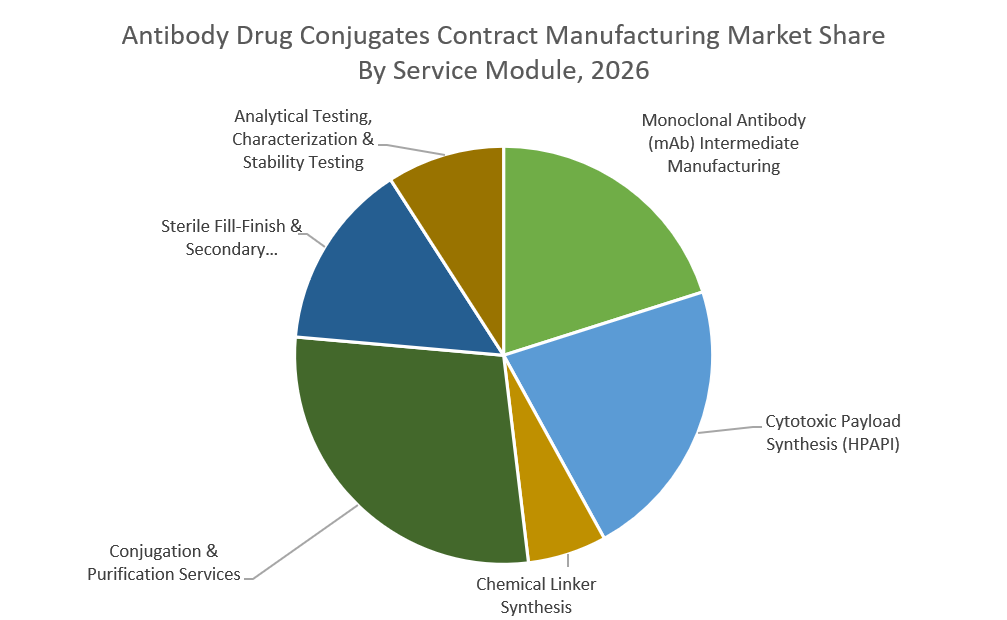
Antibody Drug Conjugates Contract Manufacturing Market Share by Service Module: Conjugation and Purification Services Lead
Conjugation and Purification Services represent the largest service module in the global Antibody Drug Conjugates Contract Manufacturing Market, accounting for an estimated 28.3% of total revenue in 2026, reflecting the specialized manufacturing capabilities required to combine monoclonal antibodies, chemical linkers and highly potent cytotoxic payloads into controlled antibody drug conjugate (ADC) drug substances. Bioconjugation processes require precise control of drug-to-antibody ratio (DAR), conjugation-site distribution, aggregation, residual impurities and drug substance stability, creating substantial technical differentiation among ADC contract development and manufacturing organizations (CDMOs). Cytotoxic payload synthesis represents another important service category, involving complex high-potency active pharmaceutical ingredient (HPAPI) manufacturing and specialized containment infrastructure. Monoclonal antibody intermediate manufacturing supports upstream biological production, while chemical linker synthesis involves application-specific organic chemistry and molecular stability requirements. Sterile fill-finish and secondary packaging services provide downstream drug-product manufacturing, whereas analytical testing, characterization and stability studies support process qualification, GMP batch release and lifecycle quality control. Service competition reflects manufacturing yield, high-potency containment capabilities, analytical expertise and the integration of biological and chemical manufacturing processes.
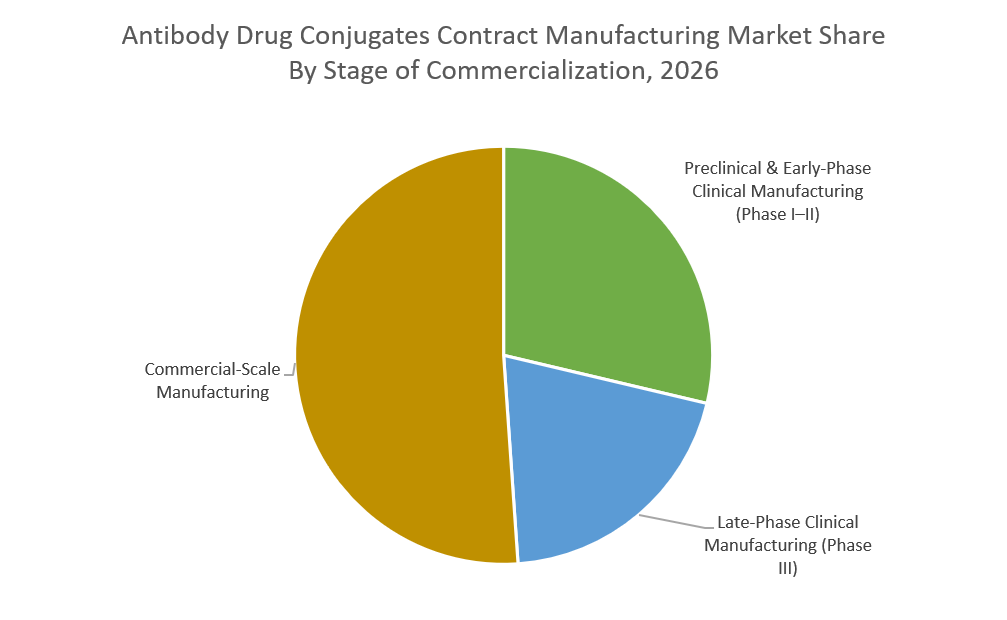
Antibody Drug Conjugates Contract Manufacturing Market Share by Stage of Commercialization: Commercial-Scale Manufacturing Dominates CDMO Revenue
Commercial-Scale Manufacturing accounts for the largest stage of commercialization segment in the global Antibody Drug Conjugates Contract Manufacturing Market, representing an estimated 51.1% of total revenue in 2026, supported by recurring GMP production requirements for approved ADC therapies and established pharmaceutical supply contracts. Commercial manufacturing involves validated antibody conjugation, high-potency material handling, drug substance purification and consistent product quality across repeated manufacturing campaigns. Production economics are influenced by batch yield, facility utilization, manufacturing campaign scheduling and the operational complexity of handling cytotoxic compounds alongside biological intermediates. Preclinical and early-phase clinical manufacturing remains important for process development, initial GMP batches and analytical method establishment, while late-phase clinical manufacturing involves process characterization, scale-up activities and preparation for commercial production. CDMO participation across these stages varies according to available production capacity, containment infrastructure, regulatory inspection history and technical specialization. Contract revenue is influenced by manufacturing scale, process transfer requirements, batch release testing and the continuity of supply for approved ADC products.
Antibody Drug Conjugates Contract Manufacturing Market Competitive Landscape
The global Antibody Drug Conjugates Contract Manufacturing Market is characterized by competition between integrated biopharmaceutical CDMOs and specialist manufacturers operating across different stages of the ADC production value chain. Lonza, WuXi XDC, Piramal Pharma Solutions and Samsung Biologics participate in integrated or multi-stage ADC manufacturing services, while Sterling Pharma Solutions, Axplora and CARBOGEN AMCIS maintain specialized capabilities in high-potency chemistry, payload-linker manufacturing and bioconjugation. Competitive positioning varies according to manufacturing service coverage, technical expertise, available production scales and the ability to coordinate multiple manufacturing stages. Providers with broader service portfolios compete alongside specialized CDMOs whose commercial position is concentrated within particular ADC intermediates or manufacturing technologies.
Competition in ADC bioconjugation, cytotoxic payload manufacturing and GMP drug-substance services involves substantial differences in technical capabilities and facility specialization. Abzena, Cerbios-Pharma, BSP Pharmaceuticals and Curia participate in selected manufacturing operations involving ADC development, conjugation, highly potent compounds or downstream drug-product processing. Contract manufacturing capabilities differ in reaction scale, purification infrastructure, conjugation technology, containment arrangements and analytical support. Specialized process expertise and proprietary conjugation technologies contribute to differentiation, particularly where manufacturing processes are closely associated with the molecular characteristics of an individual ADC candidate. Customer qualification and manufacturing transfer complexity influence supplier relationships, while dedicated infrastructure and technical personnel contribute to barriers facing new competitors.
The competitive landscape also includes collaborative ADC manufacturing networks that combine complementary capabilities across independently operated organizations. AGC Biologics, CARBOGEN AMCIS, Cerbios-Pharma, Celonic Group and medac CDMO participate in different combinations of antibody production, high-potency manufacturing, conjugation and sterile drug-product services. These arrangements enable pharmaceutical customers to access coordinated manufacturing capabilities without every service being operated by a single CDMO. Integrated providers and specialist networks compete through project coordination, technical transfer performance, manufacturing accountability and service continuity. Differences in contractual responsibility, production scheduling and analytical data exchange influence the commercial structure of manufacturing programs involving multiple service providers.
Competition is further influenced by ADC manufacturing maturity, commercial supply experience and recurring contract revenue. Early-stage manufacturing providers compete through process development expertise, analytical capabilities and flexible production configurations, while commercial-scale manufacturers are differentiated by validated manufacturing capacity, batch reproducibility and sustained supply performance. Contract values vary according to the combination of biological manufacturing, high-potency synthesis, bioconjugation and finished-product services included in each program. Long-term customer relationships are influenced by molecule-specific manufacturing knowledge, process transfer requirements and analytical comparability across successive production stages. Specialized service providers also generate revenue through process characterization, quality testing, manufacturing support and additional production campaigns associated with established ADC programs.
Antibody Drug Conjugates Contract Manufacturing Market Geographical Analysis: Leading GMP Bioconjugation and High-Potency CDMO Countries
Switzerland Antibody Drug Conjugates Contract Manufacturing Market: Integrated ADC Manufacturing and Payload-Linker Production
Switzerland maintains a prominent position in the global Antibody Drug Conjugates Contract Manufacturing Market through specialized pharmaceutical CDMOs offering bioconjugation, high-potency chemical synthesis and integrated drug-substance manufacturing. Lonza's Visp manufacturing complex supports monoclonal antibody production, highly potent payload-linker synthesis, ADC conjugation and associated analytical development activities. The company's Swiss manufacturing network also includes sterile drug-product capabilities at Stein, creating manufacturing interfaces between antibody intermediates, conjugated drug substances and finished injectable products. CARBOGEN AMCIS operates specialized Swiss facilities, including Bubendorf, serving highly potent active pharmaceutical ingredient and ADC-related manufacturing applications. Contract manufacturing services differ according to conjugation chemistry, batch scale, payload characteristics and containment requirements. Switzerland's competitive position reflects accumulated process expertise, GMP manufacturing infrastructure, specialized analytical capabilities and experience supporting complex pharmaceutical products from development through commercial supply. Customer relationships are influenced by process reproducibility, material recovery, product-specific qualification and the ability to coordinate manufacturing activities across several technical disciplines.
China Antibody Drug Conjugates Contract Manufacturing Market: Large-Scale Bioconjugation and Integrated ADC CDMO Services
China is a major manufacturing center for ADC contract development and manufacturing services, supported by specialized bioconjugation facilities, pharmaceutical chemical synthesis operations and integrated biological manufacturing capabilities. WuXi XDC operates a network of manufacturing and development locations in Wuxi, Shanghai and Changzhou, covering antibody intermediates, payload-linker synthesis, ADC drug substance and sterile drug-product services. Its Wuxi manufacturing operations include conjugation systems supporting different batch scales, with certain antibody intermediate and conjugated drug-substance platforms designed for batches of up to 2,000 liters. The company's 2025 reported drug-product infrastructure included a combined designed annual capacity of approximately 15 million vials across three filling facilities, representing manufacturing capability rather than actual production output. China's competitive environment encompasses specialized manufacturing platforms, high-potency chemical handling, pharmaceutical analytics and integrated manufacturing services. Commercial differentiation is influenced by batch recovery, capacity utilization, process transfer, manufacturing quality and coordination between biological and chemical production operations.
United Kingdom Antibody Drug Conjugates Contract Manufacturing Market: Commercial Bioconjugation and Specialized ADC Drug Product Services
The United Kingdom maintains an established position in ADC contract manufacturing through specialized facilities supporting clinical and commercial bioconjugation, process development and highly potent drug-product manufacturing. Piramal Pharma Solutions operates its Grangemouth facility in Scotland, providing ADC conjugation, purification, analytical method development and GMP manufacturing services. The facility reports experience manufacturing more than 1,000 ADC batches, including commercial production campaigns and multiple conjugation technology platforms. Curia's Glasgow operations provide specialized formulation development, lyophilization and sterile fill-finish services for ADCs and other highly potent pharmaceuticals. These facilities address different stages of the ADC manufacturing value chain, with manufacturing requirements varying according to molecular complexity, drug-loading characteristics and product stability. The United Kingdom's competitive position is associated with specialized scientific expertise, established GMP manufacturing operations, analytical characterization and clinical-to-commercial technology transfer. Contract value is influenced by conjugation process complexity, batch size, product recovery and the quality testing required before drug substance or drug product release.
United States Antibody Drug Conjugates Contract Manufacturing Market: HPAPI Synthesis, Bioconjugation and Sterile Fill-Finish Services
The United States represents a significant supplier and customer market for outsourced ADC manufacturing through its pharmaceutical development ecosystem and specialized contract manufacturing facilities. Abzena operates manufacturing and development facilities in California and Pennsylvania, with its Bristol operation supporting highly potent chemistry, linker-payload technologies and bioconjugate production. Piramal Pharma Solutions maintains payload-linker manufacturing capabilities in Riverview, Michigan, and sterile drug-product manufacturing at Lexington, Kentucky, forming part of its international ADC manufacturing network. U.S. contract manufacturing services encompass specialized chemical synthesis, antibody production, conjugation, analytical development and sterile filling, with different providers participating in individual or integrated service arrangements. Commercial differentiation reflects access to qualified high-potency manufacturing infrastructure, process development expertise and the ability to support clinical and commercial product requirements. Manufacturing economics are influenced by containment requirements, intermediate material transfer, analytical testing, batch recovery and the scope of services included within individual pharmaceutical contracts.
Italy Antibody Drug Conjugates Contract Manufacturing Market: Commercial ADC Conjugation and High-Potency Sterile Manufacturing
Italy maintains an important position in ADC contract manufacturing through specialized pharmaceutical facilities supporting bioconjugation and sterile drug-product production. BSP Pharmaceuticals operates an integrated ADC manufacturing campus in Latina, with capabilities covering conjugation, purification, formulation, liquid and lyophilized filling and analytical quality testing. Its ADC manufacturing operations include five conjugation suites, together with high-containment infrastructure for highly potent pharmaceutical products. The facility serves clinical and commercial manufacturing programs and supports the international supply of conjugated drug substances and finished oncology medicines. Italy's manufacturing specialization reflects the technical requirements of combining biological intermediates with potent cytotoxic payloads while maintaining controlled product transfer and manufacturing quality. Commercial differentiation is associated with containment performance, purification capability, formulation stability, manufacturing batch flexibility and the ability to manage both ADC drug substance and finished drug-product operations within an integrated production environment. Analytical characterization, cold-chain handling and validated manufacturing processes contribute to the service scope offered to international pharmaceutical sponsors.
South Korea Antibody Drug Conjugates Contract Manufacturing Market: Biologics CDMO Infrastructure and Specialized ADC Production
South Korea is developing a specialized position in ADC contract manufacturing through its established biologics production infrastructure and increasing concentration of bioconjugation capabilities. Samsung Biologics operates an ADC manufacturing facility within its Songdo biopharmaceutical manufacturing campus in Incheon, alongside established mammalian cell culture and biologics production operations. The company's service capabilities encompass antibody production, conjugation, analytical development and related manufacturing activities, allowing ADC programs to utilize technical resources associated with a broader biologics CDMO network. South Korea's manufacturing advantages include experience in large-scale antibody production, pharmaceutical quality systems, biotechnology engineering and integrated contract manufacturing services. ADC-specific production requirements create additional demand for high-potency containment, conjugation process development, drug-substance purification and specialized analytical characterization. Commercial competition depends on the maturity of individual ADC manufacturing platforms, production qualification, batch-scale capability and the coordination of antibody intermediates with subsequent bioconjugation and drug-product manufacturing operations.
Antibody Drug Conjugates Contract Manufacturing Market Report Scope
Antibody Drug Conjugates Contract Manufacturing Market Report Scope, CDMO Services, Competitive Landscape and Forecast, 2026–2034
|
Parameter
|
Details
|
|
Market Size (2026)
|
$5.3 Billion
|
|
Market Size (2034)
|
$14.5 Billion
|
|
Market Growth Rate
|
13.3%
|
|
Segments
|
By Service Module, Monoclonal Antibody (mAb) Intermediate Manufacturing, Cytotoxic Payload Synthesis (HPAPI), Chemical Linker Synthesis, Conjugation & Purification Services, Sterile Fill-Finish & Secondary Packaging, Analytical Testing, Characterization & Stability Testing), By Chemistry (Cleavable Linkers, Non-Cleavable Linkers), By Primary Target Indication (Breast Cancer, Lung Cancer, Hematological Malignancies, Urothelial & Bladder Cancer, Other Solid Tumors & Non-Oncology Indications), By Stage of Commercialization (Preclinical & Early-Phase Clinical Manufacturing (Phase I–II), Late-Phase Clinical Manufacturing (Phase III), Commercial-Scale Manufacturing), By End-Users (Large Pharmaceutical Enterprises, Emerging Biotech & Specialty Oncology Firms)
|
|
Study Period
|
Historical: 2021–2025; Forecast: 2026–2034
|
|
Units
|
Revenue (USD Million); Market Share (%); CAGR (%)
|
|
Technology Coverage
|
Monoclonal Antibody Intermediate Manufacturing, Cytotoxic Payload and HPAPI Synthesis, Chemical Linker Manufacturing, Conventional Cysteine and Lysine Conjugation, Site-Specific Bioconjugation, Enzyme-Mediated Conjugation, Dual-Payload ADC Technologies, GMP Bioconjugation, ADC Drug Substance Purification, Drug-to-Antibody Ratio (DAR) Characterization, High-Potency Containment Systems, ADC Sterile Fill-Finish, Lyophilization, LC-MS Analytical Characterization, Free Payload Testing, Stability Studies and Clinical-to-Commercial ADC Manufacturing
|
|
Qualitative Analysis
|
Porter's Five Forces, SWOT Profiles, Market Share Analysis, Market Dynamics, Competitive Landscape, ADC CDMO Benchmarking, Bioconjugation Capacity Analysis, Payload-Linker Manufacturing Economics, GMP Manufacturing Service Comparison, Clinical-to-Commercial Scale-Up, Manufacturing Yield Analysis, Integrated Versus Specialized CDMO Models, ADC Industry Value Chain, Supply-Chain Analysis and Regional Market Outlook
|
|
Regulatory & Standards Coverage
|
FDA Current Good Manufacturing Practice Requirements (21 CFR Parts 210 and 211), FDA Biological Product Manufacturing Inspection Framework, ICH Q5E Comparability of Biotechnological/Biological Products, ICH Q6B Specifications for Biotechnological/Biological Products, ICH Q9(R1) Quality Risk Management, EU GMP Annex 1 for Sterile ADC Drug Products, EMA Health-Based Exposure Limit Guidance, High-Potency Compound Containment and Cross-Contamination Controls
|
|
Companies
|
Lonza, WuXi XDC, Piramal Pharma Solutions, Samsung Biologics, Sterling Pharma Solutions, Axplora Group, CARBOGEN AMCIS, BSP Pharmaceuticals, Abzena, Curia, AGC Biologics, Cerbios-Pharma, Veranova, medac CDMO, Celonic Group
|
|
Countries
|
United States, Canada, Mexico, Germany, France, Spain, Italy, United Kingdom, Russia, China, India, Japan, South Korea, Australia, Southeast Asia, Brazil, Argentina, Middle East, Africa
|
Antibody Drug Conjugates Contract Manufacturing Market Segmentation
By Service Module
- Monoclonal Antibody (mAb) Intermediate Manufacturing
- Cytotoxic Payload Synthesis (HPAPI)
- Chemical Linker Synthesis
- Conjugation & Purification Services
- Sterile Fill-Finish & Secondary Packaging
- Analytical Testing, Characterization & Stability Testing
By Chemistry
- Cleavable Linkers
- Non-Cleavable Linkers
By Primary Target Indication
- Breast Cancer
- Lung Cancer
- Hematological Malignancies
- Urothelial & Bladder Cancer
- Other Solid Tumors & Non-Oncology Indications
By Stage of Commercialization
- Preclinical & Early-Phase Clinical Manufacturing (Phase I–II)
- Late-Phase Clinical Manufacturing (Phase III)
- Commercial-Scale Manufacturing
By End-Users
- Large Pharmaceutical Enterprises
- Emerging Biotech & Specialty Oncology Firms
Countries Analyzed
- North America (US, Canada, Mexico)
- Europe (Germany, UK, France, Spain, Italy, Russia, Rest of Europe)
- Asia Pacific (China, India, Japan, South Korea, Australia, South East Asia, Rest of Asia)
- South America (Brazil, Argentina, Rest of South America)
- Middle East and Africa (Saudi Arabia, UAE, Rest of Middle East, South Africa, Egypt, Rest of Africa)
Leading Companies in the Antibody Drug Conjugates Contract Manufacturing Market
- Lonza Group AG
- WuXi XDC Cayman Inc.
- Piramal Pharma Solutions
- Samsung Biologics Co., Ltd.
- Sterling Pharma Solutions
- Axplora Group (Novasep CDMO)
- CARBOGEN AMCIS
- BSP Pharmaceuticals S.p.A.
- Abzena
- Curia Global, Inc.
- AGC Biologics
- Cerbios-Pharma SA
- Veranova
- medac CDMO
- Celonic Group
*List not Exhaustive
Antibody Drug Conjugates Contract Manufacturing Market Research Methodology
The Antibody Drug Conjugates Contract Manufacturing Market assessment is structured around secondary research covering ADC-specific development services, bioconjugation manufacturing, high-potency chemical synthesis and sterile drug-product processing. Research inputs include official CDMO service documentation, pharmaceutical company disclosures, annual reports, technical publications and regulatory guidance addressing biopharmaceutical manufacturing. The market scope encompasses monoclonal antibody intermediate manufacturing, cytotoxic payload and linker synthesis, conjugation and purification, sterile fill-finish and ADC-specific analytical services. General biologics production, unrelated high-potency active pharmaceutical ingredient manufacturing and non-ADC sterile filling services are excluded from the defined market revenue.
Market sizing is structured by contract manufacturing service module and stage of commercialization, distinguishing preclinical and early clinical programs, late-stage clinical production and commercial GMP manufacturing. The revenue allocation framework considers bioconjugation capacity, payload-linker manufacturing requirements, production batch scale, analytical service intensity and drug-product manufacturing complexity. Integrated contract manufacturing arrangements are assessed by their constituent services to prevent duplicate allocation of contract revenue. Forecast assumptions incorporate ADC clinical pipeline progression, commercial manufacturing requirements, process qualification and the availability of specialized bioconjugation and high-potency processing infrastructure.
Table of Contents: Antibody Drug Conjugates Contract Manufacturing Market, 2026–2034
1. Executive Summary
- 1.1. Global Antibody Drug Conjugates Contract Manufacturing Market Highlights
- 1.2. Key Insights for ADC Developers and Pharmaceutical CDMOs
- 1.3. Global Market Size, Growth Rate and Forecast Snapshot
- 1.4. Market Share by ADC Manufacturing Service Module
- 1.5. Market Share by Stage of Commercialization
- 1.6. Regional ADC Manufacturing Revenue and Growth Outlook
- 1.7. Competitive Landscape and Key Manufacturing Industry Findings
2. Antibody Drug Conjugates Contract Manufacturing Market Outlook (2021–2034)
2.1. Market Introduction and Industry Structure
- 2.1.1. ADC Contract Manufacturing Market Definition and Scope
- 2.1.2. ADC Molecular Architecture and Manufacturing Value Chain
- 2.1.3. Monoclonal Antibody, Linker and Cytotoxic Payload Manufacturing
- 2.1.4. Bioconjugation, Purification and Drug Product Manufacturing
- 2.1.5. Specialized and Integrated ADC CDMO Business Models
- 2.1.6. ADC Contract Revenue Recognition and Manufacturing Service Boundaries
2.2. Global Market Size and Growth Outlook
- 2.2.1. Historical ADC Contract Manufacturing Revenue, 2021–2025
- 2.2.2. Global Market Size Estimate, 2026
- 2.2.3. Annual Contract Manufacturing Revenue Forecast, 2026–2034
- 2.2.4. Compound Annual Growth Rate (CAGR), 2026–2034
- 2.2.5. Revenue Distribution by Manufacturing Service Module
- 2.2.6. Revenue Distribution by Stage of Commercialization
- 2.2.7. Regional and Country-Level ADC Contract Manufacturing Market Shares
2.3. Key Market Trends
- 2.3.1. Site-Specific Bioconjugation and Advanced Linker-Payload Technologies
- 2.3.2. Integrated Antibody-to-Drug-Product ADC Manufacturing Models
2.4. Key Market Growth Drivers
- 2.4.1. Expanding ADC Oncology Indications and Commercial Manufacturing Demand
- 2.4.2. High-Potency Containment and Complex Bioconjugation Outsourcing Requirements
2.5. Emerging Market Opportunities
- 2.5.1. Clinical-to-Commercial GMP Bioconjugation Scale-Up
- 2.5.2. High-Potency ADC Sterile Fill-Finish and Lyophilization Services
- 2.5.3. Advanced ADC Analytical Characterization and Stability Testing
2.6. Market Restraints and Manufacturing Challenges
- 2.6.1. Cytotoxic Payload Handling and Specialized Containment Requirements
- 2.6.2. Antibody, Linker and Payload Supply-Chain Dependencies
- 2.6.3. Bioconjugation Process Complexity and Manufacturing Yield Variability
- 2.6.4. Analytical Characterization and Quality Control Complexity
- 2.6.5. Technology Transfer, Process Qualification and Manufacturing Scale-Up
2.7. ADC Contract Manufacturing Economics
- 2.7.1. Bioconjugation Manufacturing Cost and Batch Economics
- 2.7.2. Cytotoxic Payload and Linker Synthesis Cost Structure
- 2.7.3. Antibody Intermediate Manufacturing and Material Utilization
- 2.7.4. Drug-to-Antibody Ratio and Purification Yield Economics
- 2.7.5. Clinical-Stage and Commercial Manufacturing Contract Values
- 2.7.6. Integrated ADC Manufacturing Service Revenue
- 2.7.7. High-Potency Manufacturing Capacity and Utilization
2.8. ADC Manufacturing Regulatory and Technical Framework
- 2.8.1. GMP Requirements for ADC Drug Substance Manufacturing
- 2.8.2. Antibody and Bioconjugate Product Characterization
- 2.8.3. High-Potency Compound Containment and Cross-Contamination Controls
- 2.8.4. ADC Manufacturing Process Validation and Comparability
- 2.8.5. Sterile Drug Product Manufacturing and Analytical Quality Requirements
3. Recent Developments in ADC Contract Manufacturing and Bioconjugation Technologies
- 3.1. GMP ADC Bioconjugation Facility Developments
- 3.2. Cytotoxic Payload and Linker Manufacturing Capacity Expansions
- 3.3. ADC Drug Substance and Sterile Drug Product Manufacturing Developments
- 3.4. Site-Specific Conjugation and Advanced Linker-Payload Technologies
- 3.5. Integrated ADC CDMO Partnerships and Commercial Manufacturing Contracts
- 3.6. ADC Technology Licensing and Manufacturing Platform Developments
- 3.7. ADC CDMO Acquisitions and Manufacturing Network Expansion
- 3.8. ADC Analytical Testing and Manufacturing Process Developments
- 3.9. Geographic Expansion of Specialized ADC Manufacturing Services
- 3.10. Recent Developments Timeline, 2024–2026
4. Competitive Landscape: Global ADC Contract Manufacturing Market
4.1. Global ADC CDMO Industry Structure
- 4.1.1. Integrated ADC Contract Development and Manufacturing Organizations
- 4.1.2. Specialized Payload-Linker and HPAPI Manufacturers
- 4.1.3. GMP Bioconjugation and Purification Service Providers
- 4.1.4. Specialized Sterile Drug Product and Analytical Service Providers
4.2. Competitive Benchmarking and Market Positioning
- 4.2.1. Company Market Position and Contract Manufacturing Revenue Share
- 4.2.2. Antibody Manufacturing and Upstream Biological Processing Capabilities
- 4.2.3. Cytotoxic Payload and Chemical Linker Manufacturing Capabilities
- 4.2.4. Site-Specific Conjugation and Proprietary Technology Platforms
- 4.2.5. GMP Bioconjugation Capacity and Batch-Scale Comparison
- 4.2.6. High-Potency Containment and Drug Product Manufacturing Capabilities
- 4.2.7. Clinical-to-Commercial ADC Manufacturing Experience
- 4.2.8. Geographic Manufacturing Footprint and Service Integration
- 4.2.9. Company SWOT and Competitive Positioning Analysis
4.3. ADC CDMO Industry Competition
- 4.3.1. Integrated Versus Specialized Manufacturing Competition
- 4.3.2. Manufacturing Platform Intellectual Property and Technology Access
- 4.3.3. Customer Contracts, Technology Transfers and Manufacturing Relationships
- 4.3.4. Barriers to Entry in High-Potency Bioconjugation Manufacturing
- 4.3.5. Porter’s Five Forces Analysis
- 4.3.6. ADC Manufacturing Value Chain and Supplier Ecosystem
5. Antibody Drug Conjugates Contract Manufacturing Market Segmentation and Market Share Analysis
5.1. Market Size and Share by Service Module, 2021–2034
- 5.1.1. Monoclonal Antibody (mAb) Intermediate Manufacturing
- 5.1.2. Cytotoxic Payload Synthesis (HPAPI)
- 5.1.3. Chemical Linker Synthesis
- 5.1.4. Conjugation & Purification Services
- 5.1.5. Sterile Fill-Finish & Secondary Packaging
- 5.1.6. Analytical Testing, Characterization & Stability Testing
- 5.1.7. Service Module Revenue Comparison and 2026 Market Shares
- 5.1.8. Manufacturing Service Growth Forecast and CAGR Analysis
5.2. Market Size and Share by Stage of Commercialization, 2021–2034
- 5.2.1. Preclinical & Early-Phase Clinical Manufacturing (Phase I–II)
- 5.2.2. Late-Phase Clinical Manufacturing (Phase III)
- 5.2.3. Commercial-Scale Manufacturing
- 5.2.4. Manufacturing Stage Revenue Comparison and 2026 Market Shares
- 5.2.5. Development-to-Commercial Manufacturing Revenue Forecast
5.3. ADC Manufacturing Technology and Service Analysis
- 5.3.1. Conventional and Site-Specific Bioconjugation Technologies
- 5.3.2. Payload and Linker Chemistry Requirements
- 5.3.3. Antibody Intermediate Manufacturing and Purification
- 5.3.4. ADC Drug-to-Antibody Ratio and Product Heterogeneity
- 5.3.5. High-Potency Manufacturing and Containment Requirements
- 5.3.6. Liquid and Lyophilized ADC Drug Product Manufacturing
- 5.3.7. Analytical Characterization, Batch Release and Stability Services
6. Country Analysis and Outlook: Antibody Drug Conjugates Contract Manufacturing Market
6.1. North America
- 6.1.1. United States: HPAPI Manufacturing, ADC Bioconjugation and Sterile Fill-Finish
- 6.1.2. Canada: Biopharmaceutical Development and Specialized Contract Manufacturing
- 6.1.3. Mexico: Pharmaceutical Manufacturing Infrastructure and ADC Supply-Chain Participation
6.2. Europe
- 6.2.1. Germany: High-Potency Chemical Manufacturing and ADC Development Services
- 6.2.2. France: Bioconjugation Technology and Pharmaceutical Contract Services
- 6.2.3. Spain: HPAPI Production and Specialized Pharmaceutical Manufacturing
- 6.2.4. Italy: Integrated ADC Conjugation and High-Potency Drug Product Manufacturing
- 6.2.5. United Kingdom: Commercial Bioconjugation and ADC Analytical Services
- 6.2.6. Russia: Biopharmaceutical Manufacturing and ADC Development Activity
6.3. Asia Pacific
- 6.3.1. China: Integrated ADC CDMO Services and Commercial Bioconjugation
- 6.3.2. India: High-Potency Chemical Synthesis and ADC Contract Manufacturing
- 6.3.3. Japan: Bioconjugation Technologies and Pharmaceutical Manufacturing
- 6.3.4. South Korea: ADC Manufacturing and Integrated Biologics CDMO Services
- 6.3.5. Australia: Clinical ADC Development and Specialized Manufacturing Services
- 6.3.6. Southeast Asia: Regional ADC Manufacturing and Biopharmaceutical Supply Networks
6.4. South America
- 6.4.1. Brazil: Oncology Biopharmaceutical Manufacturing and Contract Service Demand
- 6.4.2. Argentina: Biopharmaceutical Development and ADC Manufacturing Requirements
6.5. Middle East and Africa
- 6.5.1. Middle East: Biopharmaceutical Manufacturing and Specialized ADC Services
- 6.5.2. Africa: Oncology Manufacturing Infrastructure and ADC Contract Service Demand
6.6. Additional Geographic Manufacturing Hub Analysis
- 6.6.1. Switzerland: Integrated ADC Manufacturing, Payload-Linker Synthesis and Bioconjugation
- 6.6.2. Comparative ADC Manufacturing Capacity by Country
- 6.6.3. Specialized ADC CDMO Geographic Footprint
- 6.6.4. Country Market Size and Global Market Share Comparison
- 6.6.5. Country Growth Rate and Forecast Ranking
7. Antibody Drug Conjugates Contract Manufacturing Market Size and Share Outlook by Region and Country (2026–2034)
7.1. Global ADC Contract Manufacturing Geographic Forecast
- 7.1.1. Global Annual Contract Manufacturing Revenue, 2026–2034
- 7.1.2. Regional Revenue and Global Market Shares, 2026
- 7.1.3. Regional Revenue and Global Market Shares, 2034
- 7.1.4. Regional CAGR and Growth Contribution
- 7.1.5. All 19 Geographic Reporting Units: Annual Revenue and Global Market Share
7.2. North America ADC Contract Manufacturing Market
- 7.2.1. Regional Market Size, Global Share and CAGR
- 7.2.2. Market Size and Share by Manufacturing Service Module
- 7.2.3. Market Size and Share by Stage of Commercialization
- 7.2.4. Country Revenue, Market Share and Forecast:
- 7.2.4.1. United States
- 7.2.4.2. Canada
- 7.2.4.3. Mexico
7.3. Europe ADC Contract Manufacturing Market
- 7.3.1. Regional Market Size, Global Share and CAGR
- 7.3.2. Market Size and Share by Manufacturing Service Module
- 7.3.3. Market Size and Share by Stage of Commercialization
- 7.3.4. Country Revenue, Market Share and Forecast:
- 7.3.4.1. Germany
- 7.3.4.2. France
- 7.3.4.3. Spain
- 7.3.4.4. Italy
- 7.3.4.5. United Kingdom
- 7.3.4.6. Russia
7.4. Asia Pacific ADC Contract Manufacturing Market
- 7.4.1. Regional Market Size, Global Share and CAGR
- 7.4.2. Market Size and Share by Manufacturing Service Module
- 7.4.3. Market Size and Share by Stage of Commercialization
- 7.4.4. Country and Subregional Revenue, Market Share and Forecast:
- 7.4.4.1. China
- 7.4.4.2. India
- 7.4.4.3. Japan
- 7.4.4.4. South Korea
- 7.4.4.5. Australia
- 7.4.4.6. Southeast Asia
7.5. South America ADC Contract Manufacturing Market
- 7.5.1. Regional Market Size, Global Share and CAGR
- 7.5.2. Market Size and Share by Manufacturing Service Module
- 7.5.3. Market Size and Share by Stage of Commercialization
- 7.5.4. Country Revenue, Market Share and Forecast:
- 7.5.4.1. Brazil
- 7.5.4.2. Argentina
7.6. Middle East and Africa ADC Contract Manufacturing Market
- 7.6.1. Regional Market Size, Global Share and CAGR
- 7.6.2. Market Size and Share by Manufacturing Service Module
- 7.6.3. Market Size and Share by Stage of Commercialization
- 7.6.4. Geographic Revenue, Market Share and Forecast:
- 7.6.4.1. Middle East
- 7.6.4.2. Africa
7.7. Global Market Share Reconciliation and Geographic Comparison
- 7.7.1. Country-Level Revenue Aggregation and Regional Totals
- 7.7.2. Regional-to-Global Revenue Share Reconciliation
- 7.7.3. Rest-of-Region Revenue Adjustments
- 7.7.4. Regional and Country Growth Ranking, 2026–2034
- 7.7.5. Comparison of ADC Manufacturing Service Revenue Across Major Regions
8. Company Profiles: Leading ADC Contract Manufacturers
- 8.1. Lonza Group AG
- 8.2. WuXi XDC Cayman Inc.
- 8.3. Piramal Pharma Solutions
- 8.4. Samsung Biologics Co., Ltd.
- 8.5. Sterling Pharma Solutions
- 8.6. Axplora Group
- 8.7. CARBOGEN AMCIS
- 8.8. BSP Pharmaceuticals S.p.A.
- 8.9. Abzena
- 8.10. Curia Global, Inc.
- 8.11. AGC Biologics
- 8.12. Cerbios-Pharma SA
- 8.13. Veranova
- 8.14. medac CDMO
- 8.15. Celonic Group
- 8.16. Comparative Company Profiles: Bioconjugation Platforms, HPAPI Capabilities, Drug Product Services, Manufacturing Scale and Geographic Presence
9. Research Methodology
- 9.1. ADC Contract Manufacturing Market Definition and Scope
- 9.2. Secondary Research Sources and Data Collection
- 9.3. Bottom-Up ADC Contract Manufacturing Revenue Model
- 9.4. Top-Down Pharmaceutical Outsourcing Revenue Validation
- 9.5. Service Module Revenue Allocation Methodology
- 9.6. Clinical and Commercial Manufacturing Stage Classification
- 9.7. Integrated ADC Contract Revenue and Double-Counting Adjustments
- 9.8. Bioconjugation Capacity, Manufacturing Batch and Service Revenue Assumptions
- 9.9. Country and Regional Revenue Attribution
- 9.10. Historical Market Reconstruction, 2021–2025
- 9.11. Annual Market Forecasting, 2026–2034
- 9.12. Market Share Estimation and Data Triangulation
- 9.13. Forecast Scenarios, Sensitivity and Data Limitations
- 9.14. Research Coverage and Deliverables
10. Appendix
- 10.1. ADC Manufacturing Terminology and Definitions
- 10.2. Bioconjugation, Linker-Payload and HPAPI Technical Terms
- 10.3. Acronyms and Abbreviations
- 10.4. Market Revenue Inclusion and Exclusion Criteria
- 10.5. Geographic Coverage and Country Classification
- 10.6. Historical and Annual Forecast Data Tables
- 10.7. Regional and Country-Level Market Share Tables
- 10.8. List of Tables
- 10.9. List of Figures
- 10.10. Research Sources and References
- 10.11. Market Estimation Assumptions and Disclaimer