Sterile Fill-Finish CDMO Market Overview: Outsourced Aseptic Manufacturing, Capacity Utilization and Drug Product Supply Economics
The global Sterile Fill-Finish CDMO Market is valued at USD 10,813.9 million in 2026 and is projected to reach USD 22,115.2 million by 2034, registering a CAGR of 9.4% during 2026–2034. The market comprises outsourced pharmaceutical manufacturing services that convert formulated drug substances into sterile, filled and finished medicinal products suitable for clinical or commercial distribution. It serves biologics developers, specialty pharmaceutical manufacturers and injectable drug sponsors requiring aseptic filling capabilities across vials, prefilled syringes, cartridges and other sterile container formats. Contract development and manufacturing organizations provide services ranging from formulation preparation and sterile filling to lyophilization, inspection, labeling and secondary packaging, depending on the contracted manufacturing scope. Market revenue is generated through pharmaceutical manufacturing services rather than the commercial selling value of finished medicines. The industry's business model reflects differences in product complexity, clinical development stage, primary packaging configuration and outsourced manufacturing requirements.
Demand translates into sterile fill-finish CDMO revenue through manufacturing contracts involving batch production, finished-unit output, technical development, process transfer and associated quality services. Contract economics depend on the amount of manufacturing capacity occupied, production campaign duration, filling speed, batch size and the services required before finished drug products are released. High-volume commercial filling generally places greater emphasis on line throughput and equipment utilization, while clinical and specialized manufacturing can generate substantial technical service activity relative to the number of filled units. Changeover procedures, cleaning operations, container preparation and aseptic process requirements affect the productive time available on manufacturing lines. Drug-product losses during formulation transfer, sterile filtration and filling can also influence manufacturing economics, particularly for expensive biologics and limited clinical batches. Facility profitability therefore depends on the relationship between contracted manufacturing revenue, available qualified capacity and the operating costs associated with individual production campaigns.
The commercial competitiveness of sterile fill-finish CDMOs is influenced by validated manufacturing capabilities, product-specific technical expertise and the continuity of pharmaceutical supply. Sterile drug-product production involves closely connected activities across formulation, component handling, filling, inspection and finished-product release, creating operational dependencies that extend beyond the filling operation itself. Manufacturing deviations, unsuccessful batches and delays in quality documentation can affect contracted delivery schedules and the availability of finished medicines. CDMOs differ in their ability to handle multiple drug-product presentations, accommodate clinical-to-commercial transfers and support pharmaceutical products with demanding stability or containment characteristics. Integrated service arrangements may combine drug-product manufacturing, automated inspection, final device assembly and packaging under coordinated quality and scheduling systems. Contract relationships are influenced by technical transfer requirements, manufacturing performance, batch acceptance and the availability of appropriately qualified production capacity for continuing commercial supply.
Key Insights
- Outsourced sterile drug-product manufacturing generates revenue through aseptic filling, formulation support, lyophilization, inspection and packaging services.
- Manufacturing utilization and batch economics are central commercial variables, with filling throughput, line changeovers and production losses affecting contract profitability.
- Prefilled syringes, vials and cartridges require distinct manufacturing capabilities, influencing line configuration, primary container compatibility and production scheduling.
- Sterile manufacturing quality directly affects supply continuity, as batch deviations, release delays and process interruptions can influence pharmaceutical product availability.
- Integrated clinical-to-commercial services extend CDMO relationships through formulation development, technology transfer, filling, inspection and finished-product packaging.
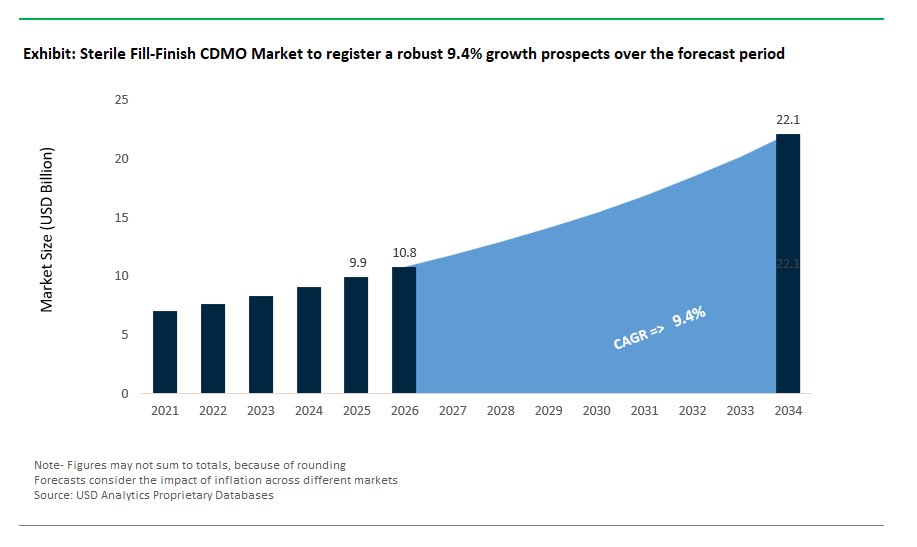
Sterile Fill-Finish CDMO Market Recent Developments: Aseptic Filling Capacity, Prefilled Syringe Manufacturing and CDMO Consolidation
Recent developments in the Sterile Fill-Finish CDMO Market reflect substantial expansion of aseptic manufacturing infrastructure serving biologics, injectable peptides and pharmaceutical drug-device combination products. On April 14, 2026, Grand River Aseptic Manufacturing (GRAM) announced a USD 100 million manufacturing expansion covering its fifth sterile filling line and fifth GMP facility in Grand Rapids, Michigan. The sterile fill-finish capacity expansion includes a 150,000-square-foot facility with four filling bays, three reserved for future manufacturing and assembly lines. Its new groninger filling system incorporates SKAN isolator technology and is designed for medium- to high-volume prefilled syringe and cartridge manufacturing. Installation was scheduled for the third quarter of 2026, with GMP readiness targeted for the first quarter of 2027, distinguishing the announced expansion from existing commercial production capacity.
Integrated CDMO providers have also expanded sterile manufacturing and drug-device combination services. In April 2026, PCI Pharma Services announced major U.S. sterile fill-finish and drug delivery manufacturing expansions, forming part of a broader program exceeding USD 1 billion across its U.S. and European operations. The announcement included a USD 100 million project at its San Diego campus for a high-speed isolator line processing ready-to-use prefilled syringes and cartridges, with operation planned for the first half of 2028. At Bedford, New Hampshire, PCI was commissioning an isolator-based vial filling and lyophilization line designed for batches of up to 300,000 vials, with a stated annual capacity of 33 million vials once fully operational. The company's expansion also encompasses automated visual inspection and pharmaceutical-device assembly capabilities.
Specialized sterile injectable manufacturers are broadening their production networks across North America and Europe. In October 2025, Simtra BioPharma Solutions reported progress on its manufacturing expansion in Bloomington, Indiana, including a flexible clinical filling line and construction of additional commercial-scale isolator facilities. Its development plans include high-potency sterile manufacturing infrastructure and dedicated lyophilization capacity for complex injectable products. The company also reported additional capabilities in Halle/Westfalen, Germany, including new high-speed isolator lines for syringes and liquid or lyophilized vials. These facilities accommodate different drug-product presentations and manufacturing scales, ranging from clinical development to commercial injectable supply.
Acquisition activity has further altered the ownership and capacity structure of sterile manufacturing services. In September 2025, Thermo Fisher Scientific completed its acquisition of Sanofi's sterile fill-finish and packaging facility in Ridgefield, New Jersey. Under the associated manufacturing arrangement, Thermo Fisher continues producing selected Sanofi medicines while incorporating additional U.S. contract manufacturing capacity into its pharmaceutical services network. PCI Pharma Services separately completed the acquisition of Ajinomoto Althea in May 2025, adding specialized aseptic manufacturing capabilities to its U.S. operations. These transactions expanded existing CDMO networks through manufacturing assets with established pharmaceutical production operations and customer relationships.
Sterile Fill-Finish CDMO Market Regulatory Framework, EU GMP Annex 1 and Aseptic Manufacturing Quality
The Sterile Fill-Finish CDMO Market is governed by pharmaceutical current good manufacturing practice requirements addressing microbial contamination, process validation, product integrity and manufacturing quality. In Europe, EU GMP Annex 1: Manufacture of Sterile Medicinal Products became applicable on August 25, 2023, with one deferred provision taking effect in August 2024. Annex 1 places substantial emphasis on contamination control strategies, facility design, aseptic processing equipment and environmental monitoring. Restricted access barrier systems (RABS) and isolators are recognized contamination-control technologies, while alternative approaches require justification within the applicable manufacturing control framework.
In the United States, sterile pharmaceutical manufacturing is subject to current good manufacturing practice requirements under 21 CFR Parts 210 and 211. The FDA's aseptic processing guidance addresses personnel qualification, environmental controls, equipment design, sterilization and aseptic process simulation. CDMO manufacturing activities involve additional quality controls for sterile filtration, container handling, filling accuracy, lyophilization and batch release. Drug-product manufacturers remain responsible for establishing validated processes and maintaining documented control over outsourced manufacturing operations.
Container closure integrity is particularly important for prefilled syringes, sterile vials and pharmaceutical cartridges. In August 2026, the FDA published a draft guidance on container closure systems for human drugs and biological products, covering quality considerations for primary packaging systems, including device constituent parts of combination products. The document remained draft guidance as of October 2026 and was not an implemented regulatory requirement. Evaluation of sterile container systems encompasses material compatibility, protection from contamination, closure performance and integrity throughout the intended shelf life.
The ICH Q9(R1) Quality Risk Management guideline provides an internationally harmonized framework for assessing pharmaceutical quality risks across development, manufacturing and product lifecycle activities. Sterile CDMO quality systems also encompass aseptic process simulation, microbiological monitoring, batch documentation, deviation investigation and pharmaceutical technology transfer, with operational requirements varying by product, container configuration and manufacturing process.
Key Market Trends Shaping Sterile Fill-Finish CDMO Manufacturing
Automated Isolator Systems and Reduced Operator Intervention Reshape Sterile Fill-Finish CDMO Manufacturing
The Sterile Fill-Finish CDMO Market is experiencing increasing adoption of automated aseptic manufacturing systems designed to minimize direct operator interaction with exposed sterile drug products and critical filling components. Isolator-based manufacturing provides physical separation between the surrounding cleanroom and aseptic processing environment, while restricted access barrier systems (RABS) maintain controlled access through engineered barriers and qualified operating procedures. Robotic filling technologies can automate container transfer, filling, stoppering and selected material handling operations, reducing the frequency of manual interventions in critical processing areas. The commercial differentiation of automated sterile fill-finish facilities depends on aseptic processing consistency, equipment availability, decontamination cycle duration and the efficiency of transferring materials into controlled environments. Manufacturing productivity is also influenced by filling-line speed, intervention recovery time and the ability to maintain consistent production conditions across successive batches. Isolator-based systems can involve substantial initial equipment and validation costs, with operating economics varying according to line utilization, product characteristics and campaign duration.
Ready-to-Use Prefilled Syringes, Cartridges and Flexible Filling Lines Transform Sterile Drug Product Manufacturing
Ready-to-use (RTU) pharmaceutical containers and multi-format filling systems are changing the operational structure of outsourced sterile drug-product manufacturing. Prewashed and presterilized vials, prefilled syringe barrels and pharmaceutical cartridges can enter appropriately designed aseptic filling operations without requiring the same in-house washing and sterilization stages as bulk containers. Nested container formats are particularly relevant to automated handling systems where direct glass-to-glass contact, container breakage and format conversion influence production efficiency. Flexible filling lines accommodate different container geometries and filling volumes, enabling contract manufacturers to support biological medicines, peptide therapies and specialized injectables across clinical and commercial applications. Higher-viscosity formulations introduce additional engineering requirements involving pump selection, filling pressure, fluid-path compatibility and accurate low-volume dispensing. For sterile fill-finish CDMOs, commercial performance is influenced by line changeover time, container compatibility, batch yield, primary packaging supply and the extent of equipment qualification required when transferring between pharmaceutical products.
Key Growth Drivers of the Sterile Fill-Finish CDMO Market
GLP-1 Therapies, Biologics and Specialty Injectables Accelerate Outsourced Sterile Fill-Finish Demand
Expanding commercial requirements for injectable biologics, GLP-1-based therapies, monoclonal antibodies and specialty pharmaceutical products are supporting demand for outsourced sterile fill-finish manufacturing services. Drug developers require sterile drug-product capacity after formulation and drug-substance manufacturing, with service demand influenced by commercial treatment volumes, primary container selection, product stability and manufacturing batch size. High-volume chronic therapies can generate recurring requirements for syringe and cartridge filling, while oncology products, hospital injectables and specialty biologics may involve distinct vial presentations and production schedules. Contract manufacturing demand is also affected by the availability of internally operated pharmaceutical filling facilities and the timing of drug-product commercialization. The economic relationship between filling capacity and contracted revenue depends on actual line utilization, filling speed, product changeovers and batch acceptance. Different injectable products require varying levels of formulation preparation, in-process testing, inspection and secondary packaging, creating differences in service revenue per filled unit and overall manufacturing campaign complexity.
Pharmaceutical GMP Compliance and Contamination Control Requirements Increase Demand for Specialized Sterile CDMOs
The technical complexity of sterile pharmaceutical manufacturing is a major driver of demand for specialized fill-finish contract development and manufacturing organizations. Aseptic processing requires coordinated control of personnel activities, production equipment, environmental conditions, sterilized components and material transfers throughout drug-product manufacturing. Differences in facility configuration, product formulation and manufacturing technology influence the contamination-control measures and validation activities associated with each production process. Sterile filling operations also require evidence of container closure integrity, filling accuracy, product compatibility and consistent manufacturing performance, with deviations potentially affecting product disposition and commercial supply continuity. For pharmaceutical sponsors, external manufacturing qualification involves assessment of a CDMO's process capabilities, quality history and ability to maintain validated operating conditions. Commercial differentiation among sterile manufacturers reflects facility design, aseptic process experience, deviation management, manufacturing documentation and the ability to support technically demanding drug products without excessive production interruptions or batch rejection.
Emerging Opportunities in the Sterile Fill-Finish CDMO Market
Lyophilization and High-Potency Injectable Manufacturing Expand Specialized Sterile Fill-Finish CDMO Services
Specialized sterile fill-finish requirements are creating opportunities for contract manufacturers operating lyophilization systems and containment infrastructure for highly potent pharmaceutical products. Freeze-drying is used for injectable formulations whose stability characteristics can favor a solid drug-product presentation over extended storage in liquid form. Lyophilized manufacturing involves controlled freezing, primary drying, secondary drying and subsequent vial stoppering, with cycle duration and chamber loading characteristics influencing production capacity. Highly potent injectables, including selected cytotoxic oncology drugs and antibody drug conjugates, introduce additional occupational containment and product-handling requirements during formulation, filling and equipment cleaning. Facilities capable of processing potent compounds under aseptic conditions require coordination between personnel protection, material transfer systems and sterile drug-product controls. Commercial service differentiation depends on lyophilizer availability, cycle development expertise, containment performance, drug-product recovery and the ability to process formulations with different thermal and stability characteristics. Specialized production campaigns can have different throughput and operating economics from conventional high-volume liquid filling.
Flexible Clinical-to-Commercial Manufacturing Creates Opportunities for Small-Batch Sterile Fill-Finish CDMOs
Clinical-stage pharmaceutical development and specialized therapeutic production create demand for sterile fill-finish facilities capable of processing relatively small batches without the fixed operating requirements of conventional high-volume filling lines. Early development programs may require limited quantities of drug product for clinical trials, formulation assessment, stability studies and subsequent manufacturing qualification. Small-batch production places considerable economic importance on formulation hold-up volume, tubing losses, filling accuracy and the amount of valuable drug substance consumed during equipment preparation and line clearance. Flexible robotic filling platforms, disposable fluid paths and ready-to-use primary containers support processing of multiple drug products with differing batch sizes and container requirements. As clinical programs progress, manufacturing activity can expand to larger batches and more structured production campaigns, creating associated technology transfer and process comparability requirements. CDMO revenue in this segment includes formulation support, clinical drug-product manufacturing, analytical testing, stability services and subsequent commercial manufacturing transfers.
Integrated Fill-Finish, Autoinjector Assembly and Regional Manufacturing Expand End-to-End CDMO Service Opportunities
Integration of sterile drug-product manufacturing with injection-device assembly and secondary packaging is expanding the scope of services offered by pharmaceutical CDMOs. Injectable combination products involve multiple manufacturing interfaces, including primary container filling, closure placement, device-component assembly, functional inspection, labeling and finished-product packaging. Separately managed operations can require additional product transfers, packaging stages and technical coordination between container suppliers, filling facilities and device assembly manufacturers. Integrated service models bring selected manufacturing activities within a coordinated supply network, with commercial value associated with product traceability, manufacturing scheduling and compatibility between filled containers and device mechanisms. Regional manufacturing capabilities also influence pharmaceutical supply arrangements where commercial demand, distribution requirements and production continuity differ across geographic markets. Service contracts can encompass sterile filling, device assembly, automated inspection, serialization where applicable and commercial packaging, with contract value determined by the combination of services, validated manufacturing capacity and product-specific handling requirements.
Sterile Fill-Finish CDMO Market Share Analysis, 2026
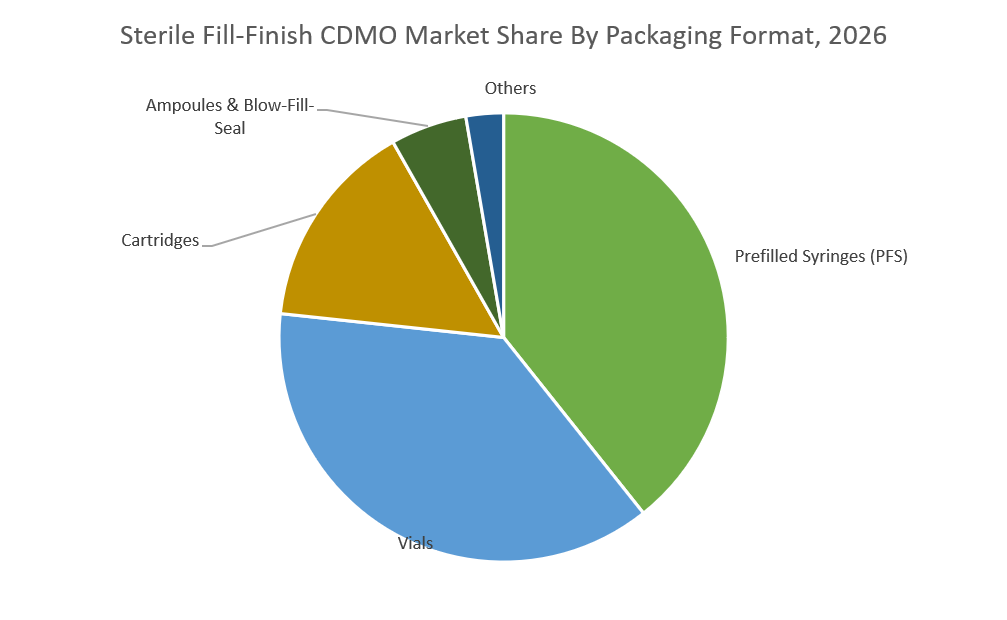
Sterile Fill-Finish CDMO Market Share by Packaging Format: Prefilled Syringes Lead Sterile Drug Product Manufacturing
Prefilled Syringes (PFS) account for the largest packaging format segment in the global Sterile Fill-Finish CDMO Market, representing an estimated 39.3% of total revenue in 2026, supported by outsourced manufacturing demand for biologics, injectable chronic disease therapies and ready-to-administer pharmaceutical products. Prefilled syringe manufacturing involves precision filling, plunger placement, container closure integrity and compatibility between drug formulations and primary packaging materials. Vials maintain a substantial market position through their broad application in liquid and lyophilized injectable medicines, including monoclonal antibodies, vaccines and hospital-administered drugs. Cartridge filling supports injection pen platforms, with manufacturing requirements involving accurate fill volumes, stopper positioning and drug delivery device compatibility. Ampoules and blow-fill-seal containers serve specialized sterile dosage presentations, while other packaging formats address application-specific pharmaceutical requirements. CDMO competitiveness across these formats reflects aseptic filling capacity, container handling flexibility, manufacturing batch size, line changeover efficiency and validated commercial production capabilities.
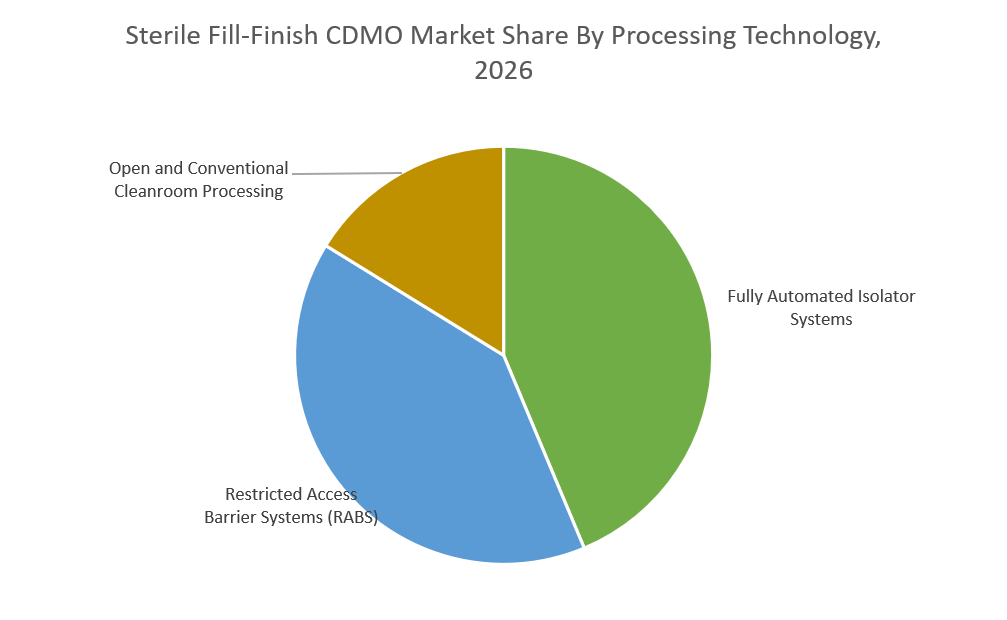
Sterile Fill-Finish CDMO Market Share by Processing Technology: Fully Automated Isolator Systems Lead Aseptic Manufacturing
Fully Automated Isolator Systems dominate the global Sterile Fill-Finish CDMO Market by processing technology, accounting for an estimated 43.7% of total revenue in 2026, supported by the increasing importance of contamination-controlled aseptic manufacturing for sterile injectable drug products. Isolator-based filling systems provide physical separation between operators and critical aseptic processing zones, with integrated decontamination, automated container handling and controlled filling operations supporting commercial pharmaceutical manufacturing. Restricted Access Barrier Systems (RABS) represent another major processing category, supported by their established deployment in sterile filling facilities and compatibility with automated vial, syringe and cartridge production lines. Open and conventional cleanroom processing remains relevant to selected existing manufacturing operations and specialized production configurations, although it involves different contamination-control and operator intervention requirements. Competitive differentiation among sterile fill-finish CDMOs reflects validated aseptic processing capabilities, contamination control performance, equipment utilization, line flexibility and manufacturing compliance under applicable pharmaceutical GMP requirements.
Sterile Fill-Finish CDMO Market Competitive Landscape
The global Sterile Fill-Finish CDMO Market comprises multinational pharmaceutical contract manufacturers, specialized aseptic processing providers and organizations offering integrated drug-product development and manufacturing services. Thermo Fisher Scientific's Patheon business, Catalent, Vetter, PCI Pharma Services, Simtra BioPharma Solutions and Recipharm participate across clinical and commercial sterile manufacturing programs. Competition involves different combinations of formulation services, aseptic filling, lyophilization, analytical testing and finished-product packaging. CDMOs vary considerably in their manufacturing footprint, customer portfolio, available container formats and production-line configurations, creating distinct competitive positions in high-volume commercial manufacturing and smaller specialized drug-product programs.
Competition across prefilled syringe, vial and cartridge fill-finish services is influenced by production-line capability, batch-size flexibility and the types of pharmaceutical formulations supported. Vetter and Simtra maintain specialized sterile manufacturing operations, while CordenPharma, Aenova, Siegfried and Grand River Aseptic Manufacturing provide additional capabilities across selected injectable formats and production scales. Contract manufacturing requirements differ between conventional liquid injectables, lyophilized products, biologics and complex formulations, affecting facility utilization and technical service requirements. Competitive differentiation is associated with aseptic manufacturing experience, filling accuracy, packaging compatibility, production scheduling and the availability of equipment configured for specific drug-product presentations.
Specialized sterile manufacturers compete through product complexity, pharmaceutical development stage and manufacturing service integration. Curia, Jubilant HollisterStier and IDT Biologika participate in selected sterile injectable manufacturing applications, including biologics, vaccines or specialized pharmaceutical products. Alcami and Fareva contribute additional pharmaceutical development and manufacturing capabilities across different dosage forms and customer requirements. Contract relationships range from early clinical manufacturing and formulation development to validated commercial production, with different operating economics associated with batch size, product changeovers, lyophilization and additional quality services. CDMOs serving technically demanding pharmaceutical formulations may derive a greater proportion of contract value from development, analytical support and specialized manufacturing operations than from high-volume filling alone.
The competitive economics of sterile fill-finish contract manufacturing depend on qualified production capacity, customer program continuity and utilization of installed manufacturing infrastructure. Aseptic manufacturing facilities incur substantial fixed operating costs associated with equipment, facility controls, trained personnel and quality operations, making production scheduling and campaign efficiency important determinants of service profitability. Customer relationships frequently involve manufacturing technology transfer, product-specific qualification and recurring commercial batches, which can create extended supplier relationships. CDMOs also compete through geographical manufacturing coverage, integrated inspection and packaging services, technical transfer capabilities and the consistency of manufacturing performance across development and commercial supply programs.
Sterile Fill-Finish CDMO Market Geographical Analysis: Leading Aseptic Drug Product Manufacturing Countries
United States Sterile Fill-Finish CDMO Market: Prefilled Syringe Capacity and Commercial Aseptic Manufacturing
The United States represents a major operating market for sterile fill-finish CDMOs, supported by extensive pharmaceutical outsourcing activity and specialized aseptic drug-product manufacturing facilities. Thermo Fisher Scientific's Patheon network provides sterile filling capabilities at locations including Greenville, North Carolina, Plainville, Massachusetts, and Ridgefield, New Jersey. Grand River Aseptic Manufacturing operates facilities in Grand Rapids, Michigan, supporting liquid and lyophilized vial filling, prefilled syringes and pharmaceutical cartridges. Its manufacturing infrastructure includes more than 50 million units of stated syringe and cartridge filling capacity, although available capacity varies by product requirements and manufacturing commitments. Curia also maintains sterile drug-product operations in Albuquerque, New Mexico, while other specialized CDMOs serve biologics and complex injectable applications. Commercial competition encompasses clinical-to-commercial technology transfer, aseptic filling capacity, product-specific validation and integrated inspection or packaging services. Manufacturing economics depend on line utilization, filling throughput, product changeovers and the number of qualified containers and formulations supported within each facility.
Germany Sterile Fill-Finish CDMO Market: Commercial Biologics Filling and Lyophilization Services
Germany is a major European manufacturing center for sterile pharmaceutical contract services, supported by established aseptic filling facilities and specialized drug-product development capabilities. Vetter operates multiple manufacturing locations around Ravensburg and Langenargen, supplying liquid and lyophilized injectable products in vials, prefilled syringes and cartridges. Its Ravensburg South site reported approximately 133 million injectable units filled during 2025, providing a verified indication of commercial manufacturing scale at an individual facility. Siegfried's Hameln operation also manufactures sterile pharmaceutical products in several primary container formats, including ampoules, vials, cartridges and prefilled syringes, with associated formulation and development services. Germany's CDMO market is characterized by established customer relationships, specialized sterile production technologies and extensive supporting analytical and inspection operations. Commercial differentiation centers on commercial batch throughput, lyophilization capability, container format flexibility, manufacturing yield and the availability of validated filling infrastructure for complex pharmaceutical products.
Italy Sterile Fill-Finish CDMO Market: High-Capacity Injectable Manufacturing and Specialized Aseptic Services
Italy represents an important market for outsourced sterile drug-product manufacturing through its established pharmaceutical CDMO industry and specialized aseptic processing operations. CordenPharma's Caponago facility near Milan provides clinical and commercial sterile filling services covering vials, prefilled syringes, cartridges and ampoules, with additional capabilities in formulation development and injectable drug-product packaging. BSP Pharmaceuticals operates highly specialized manufacturing infrastructure in Latina, including sterile filling for cytotoxic and non-cytotoxic pharmaceutical products. Italy's CDMO service portfolio spans conventional liquid injectables, lyophilized formulations, highly potent oncology drugs and complex biological products. Manufacturing infrastructure includes dedicated filling lines, controlled material handling, visual inspection and analytical quality-control operations. Commercial differentiation is associated with the ability to manufacture technically demanding formulations, accommodate different production batch sizes and combine aseptic manufacturing with related development and packaging services. Planned additional production capacity remains separate from the output achievable through existing qualified manufacturing lines.
Switzerland Sterile Fill-Finish CDMO Market: Biologics Drug Product Manufacturing and Integrated Contract Services
Switzerland maintains a specialized position in sterile fill-finish outsourcing through established biopharmaceutical contract manufacturers and technical expertise in injectable drug-product development. Lonza's Stein facility provides GMP drug-product manufacturing for liquid and lyophilized vials and prefilled syringes, serving clinical and commercial pharmaceutical programs. Its operations form part of a wider manufacturing network that includes biologic drug substance development, antibody production and specialized pharmaceutical processing. Switzerland's commercial role is associated with complex biologic formulations, aseptic manufacturing, analytical testing and integration between different pharmaceutical production stages. Contract manufacturing requirements vary by molecule stability, filling volume, container material and the manufacturing controls needed for individual therapeutic products. CDMO service differentiation encompasses formulation compatibility, process transfer capabilities, contamination-controlled handling and quality documentation. The country's pharmaceutical manufacturing ecosystem also supports specialized engineering, analytical services and product-development activities connected to international commercial supply.
France Sterile Fill-Finish CDMO Market: Sterile Vial Manufacturing and Pharmaceutical Contract Production
France has an established sterile pharmaceutical manufacturing base, supported by contract manufacturers supplying injectable medicines for hospital use, biologics and other pharmaceutical applications. Delpharm operates sterile manufacturing facilities, including its Saint-Rémy-sur-Avre site, which supports vial filling and lyophilized drug products. The facility's additional aseptic filling infrastructure provides a stated annual capacity of 45 million vials in a 2 mL presentation, with larger vial formats requiring different processing conditions and achievable throughput. France's pharmaceutical contract manufacturing ecosystem also includes formulation development, quality testing, packaging and production support for domestic and international pharmaceutical sponsors. Manufacturing economics depend on vial format, formulation characteristics, batch size, line configuration and the relative proportion of liquid and lyophilized product campaigns. Competitive differentiation reflects established technical expertise, qualified production capacity, process reliability and the ability to supply specialized medicines through recurring pharmaceutical manufacturing contracts.
South Korea Sterile Fill-Finish CDMO Market: Integrated Biologics Manufacturing and Aseptic Drug Product Services
South Korea holds a significant position in the sterile biologics manufacturing supply chain through large-scale contract manufacturing operations concentrated in the Incheon and Songdo biopharmaceutical clusters. Samsung Biologics operates an integrated manufacturing network incorporating mammalian cell culture, drug-substance purification, aseptic filling and pharmaceutical quality-control capabilities. Its drug-product services include liquid and lyophilized vial presentations and prefilled syringe applications, with manufacturing processes configured to support clinical and commercial biologics. The country's CDMO capabilities are closely associated with monoclonal antibody manufacturing, technology transfer and coordination between upstream biological production and final drug-product operations. Manufacturing arrangements can combine several stages under one provider, while individual sterile filling operations remain subject to separate process qualification and batch acceptance requirements. Commercial competition reflects biologics manufacturing capacity, quality-system integration, production scheduling and the availability of compatible sterile filling infrastructure for international pharmaceutical customer programs.
Sterile Fill-Finish CDMO Market Report Scope
Sterile Fill-Finish CDMO Market Report Scope, Packaging Formats, Processing Technologies and Forecast, 2026–2034
|
Parameter
|
Details
|
|
Market Size (2026)
|
$10.8 Billion
|
|
Market Size (2034)
|
$22.1 Billion
|
|
Market Growth Rate
|
9.4%
|
|
Segments
|
By Packaging Format (Prefilled Syringes (PFS), Vials, Cartridges, Ampoules & Blow-Fill-Seal, Others), By Primary Molecule Class (Biologics, Peptides & Incretins, Small Molecules & Cytotoxic Compounds, Advanced Therapy Medicinal Products, Others), By Processing Technology (Fully Automated Isolator Systems, Restricted Access Barrier Systems (RABS), Open and Conventional Cleanroom Processing), By Phase of Development (Clinical-Scale Fill-Finish (Phase I–III), Commercial-Scale Fill-Finish), By End-User (Pharmaceutical Enterprises, Biotechnology Companies, Others)
|
|
Study Period
|
Historical: 2021–2025; Forecast: 2026–2034
|
|
Units
|
Revenue (USD Million); Market Share (%); CAGR (%)
|
|
Technology Coverage
|
Aseptic Liquid Filling, Lyophilized Vial Filling, Prefilled Syringe Filling, Pharmaceutical Cartridge Filling, Ampoule Filling, Blow-Fill-Seal Technology, Fully Automated Isolator Filling, RABS-Based Processing, Robotic Aseptic Filling, Ready-to-Use (RTU) Containers, High-Viscosity Formulation Filling, Sterile Filtration, Container Closure Integrity Testing, Automated Visual Inspection, High-Potency Injectable Manufacturing, Clinical-to-Commercial Fill-Finish, Autoinjector Assembly and Secondary Packaging
|
|
Qualitative Analysis
|
Porter's Five Forces, SWOT Profiles, Market Share Analysis, Market Dynamics, Competitive Landscape, CDMO Benchmarking, Manufacturing Capacity Analysis, Aseptic Filling Technology Comparison, Batch-Size Economics, Cost per Filled Unit, Capacity Utilization, Pharmaceutical Outsourcing Analysis, Manufacturing Value Chain, Supply-Chain Assessment and Regional Market Outlook
|
|
Regulatory & Standards Coverage
|
EU GMP Annex 1 for Sterile Medicinal Products, FDA Current Good Manufacturing Practice Requirements (21 CFR Parts 210 and 211), FDA Aseptic Processing Guidance, ICH Q9(R1) Quality Risk Management, ICH Q10 Pharmaceutical Quality System, Applicable ISO 11040 Prefilled Syringe Standards, Container Closure Integrity Requirements, Aseptic Process Simulation and Environmental Monitoring Requirements
|
|
Companies
|
Thermo Fisher Scientific (Patheon), Vetter, Catalent (Novo Holdings), PCI Pharma Services, Simtra BioPharma Solutions, Recipharm, CordenPharma, Curia, Grand River Aseptic Manufacturing, Aenova Group, Siegfried, Jubilant HollisterStier, IDT Biologika, Alcami, FAREVA
|
|
Countries
|
United States, Canada, Mexico, Germany, France, Spain, Italy, United Kingdom, Russia, China, India, Japan, South Korea, Australia, Southeast Asia, Brazil, Argentina, Middle East, Africa
|
Sterile Fill-Finish CDMO Market Segmentation
By Packaging Format
- Prefilled Syringes (PFS)
- Vials
- Cartridges
- Ampoules & Blow-Fill-Seal
- Other Container Formats
By Primary Molecule Class
- Biologics
- Peptides & Incretins
- Small Molecules & Cytotoxic Compounds
- Advanced Therapy Medicinal Products (Cell & Gene Therapies, mRNA)
- Other Therapeutic Modalities
By Processing Technology
- Fully Automated Isolator Systems
- Restricted Access Barrier Systems (RABS)
- Open and Conventional Cleanroom Processing
By Phase of Development
- Clinical-Scale Fill-Finish (Phase I–III)
- Commercial-Scale Fill-Finish
By End-User
- Pharmaceutical Enterprises
- Biotechnology Companies
- Other Research & Academic Institutions
Countries Analyzed
- North America (US, Canada, Mexico)
- Europe (Germany, UK, France, Spain, Italy, Russia, Rest of Europe)
- Asia Pacific (China, India, Japan, South Korea, Australia, South East Asia, Rest of Asia)
- South America (Brazil, Argentina, Rest of South America)
- Middle East and Africa (Saudi Arabia, UAE, Rest of Middle East, South Africa, Egypt, Rest of Africa)
Leading Companies in the Sterile Fill-Finish CDMO Market
- Thermo Fisher Scientific Inc. (Patheon)
- Vetter Pharma-Fertigung GmbH & Co. KG
- Catalent, Inc. (Novo Holdings)
- PCI Pharma Services
- Simtra BioPharma Solutions
- Recipharm AB
- CordenPharma
- Curia Global, Inc.
- Grand River Aseptic Manufacturing (GRAM)
- Aenova Group
- Siegfried Holding AG
- Jubilant HollisterStier LLC (Jubilant Pharmova)
- IDT Biologika GmbH
- Alcami Corporation
- FAREVA Group
*List not Exhaustive
Sterile Fill-Finish CDMO Market Research Methodology
The Sterile Fill-Finish CDMO Market assessment uses a secondary-research framework covering outsourced pharmaceutical drug-product manufacturing, aseptic processing technologies and commercial injectable production capabilities. Research inputs include official CDMO service portfolios, pharmaceutical manufacturer disclosures, facility documentation, regulatory guidance and pharmaceutical manufacturing industry publications. The market scope covers sterile filling of vials, prefilled syringes, cartridges, ampoules and other applicable container formats, including associated formulation, lyophilization, inspection and packaging services where attributable to fill-finish contracts. Market revenue excludes pharmaceutical drug sales and separately contracted drug-substance manufacturing.
Market sizing is structured by packaging format and processing technology, with revenue allocation informed by manufacturing capacity, contracted filling activities, batch sizes, facility utilization and specialized processing requirements. The analytical framework distinguishes fully automated isolator systems, restricted access barrier systems and conventional cleanroom processing according to their primary manufacturing configurations. Demand assessment considers clinical and commercial pharmaceutical production, outsourced manufacturing requirements, filling-line productivity and the complexity of individual drug-product presentations. Forecast assumptions incorporate injectable drug demand, aseptic manufacturing capacity and the commercial value of associated manufacturing services, with planned capacity differentiated from operational production infrastructure.
Table of Contents: Sterile Fill-Finish CDMO Market, 2026–2034
1. Executive Summary
- 1.1. Global Sterile Fill-Finish CDMO Market Highlights
- 1.2. Key Insights for Pharmaceutical Sponsors and Contract Manufacturers
- 1.3. Global Market Size, Growth Rate and Forecast Snapshot
- 1.4. Market Share by Packaging Format and Processing Technology
- 1.5. Regional Sterile Manufacturing Capacity and Market Share Overview
- 1.6. Pharmaceutical Outsourcing and Commercial Manufacturing Outlook
- 1.7. Competitive Landscape and Key Industry Findings
2. Sterile Fill-Finish CDMO Market Outlook (2021–2034)
2.1. Market Introduction and Industry Structure
- 2.1.1. Sterile Fill-Finish Contract Manufacturing: Definition and Scope
- 2.1.2. Pharmaceutical Drug Substance and Drug Product Manufacturing Boundaries
- 2.1.3. Sterile Manufacturing Industry Value Chain
- 2.1.4. Clinical and Commercial Sterile Fill-Finish CDMO Business Models
- 2.1.5. Pharmaceutical Outsourcing and Manufacturing Service Revenue
2.2. Global Market Size and Growth Outlook
- 2.2.1. Historical Market Revenue Analysis, 2021–2025
- 2.2.2. Global Sterile Fill-Finish CDMO Market Size, 2026
- 2.2.3. Annual Market Revenue Forecast, 2026–2034
- 2.2.4. Compound Annual Growth Rate (CAGR), 2026–2034
- 2.2.5. Contract Manufacturing Revenue by Packaging Format
- 2.2.6. Revenue Distribution by Processing Technology
- 2.2.7. Regional and Country-Level Market Share Outlook
2.3. Key Market Trends
- 2.3.1. Automated Isolator Systems and Reduced Operator Intervention
- 2.3.2. Ready-to-Use Prefilled Syringes, Cartridges and Flexible Filling Lines
2.4. Key Market Growth Drivers
- 2.4.1. GLP-1 Therapies, Biologics and Specialty Injectable Manufacturing Demand
- 2.4.2. Pharmaceutical GMP Compliance and Contamination Control Requirements
2.5. Emerging Market Opportunities
- 2.5.1. Lyophilization and High-Potency Sterile Injectable Manufacturing
- 2.5.2. Flexible Clinical-to-Commercial and Small-Batch Fill-Finish Services
- 2.5.3. Integrated Fill-Finish, Device Assembly and Regional Manufacturing
2.6. Market Restraints and Operational Challenges
- 2.6.1. Sterile Manufacturing Infrastructure and Qualification Costs
- 2.6.2. Capacity Utilization and Manufacturing Campaign Scheduling
- 2.6.3. Sterility Assurance, Batch Rejection and Product Release Risks
- 2.6.4. Pharmaceutical Technology Transfer and Container Compatibility
- 2.6.5. Specialized Personnel, Equipment and Component Availability
2.7. Sterile Fill-Finish CDMO Manufacturing Economics
- 2.7.1. Manufacturing Cost per Filled Unit
- 2.7.2. Production-Line Utilization and Batch-Size Economics
- 2.7.3. Vial, Syringe and Cartridge Filling Productivity
- 2.7.4. Lyophilization Cycle Economics and Equipment Occupancy
- 2.7.5. Technical Transfer, Validation and Analytical Service Revenue
- 2.7.6. Commercial Supply Agreements and Capacity Reservation Models
- 2.7.7. Integrated Drug Product and Device Assembly Service Economics
2.8. Regulatory and Quality Framework
- 2.8.1. EU GMP Annex 1 and Contamination Control Strategies
- 2.8.2. FDA Current Good Manufacturing Practice Requirements
- 2.8.3. Aseptic Process Simulation and Manufacturing Qualification
- 2.8.4. Container Closure Integrity and Primary Packaging Quality
- 2.8.5. Pharmaceutical Quality Risk Management and Batch Release
3. Recent Developments and Technology Advancements in Sterile Fill-Finish Contract Manufacturing
- 3.1. New Aseptic Filling Facilities and Commercial Production Capacity
- 3.2. Automated Isolator and Robotic Sterile Filling Technologies
- 3.3. Prefilled Syringe, Cartridge and RTU Container Manufacturing Developments
- 3.4. Lyophilization and High-Potency Injectable Manufacturing Developments
- 3.5. Clinical Manufacturing and Flexible Small-Batch Filling Platforms
- 3.6. CDMO Acquisitions, Manufacturing Partnerships and Service Integration
- 3.7. Geographic Manufacturing Expansion and Supply Network Developments
- 3.8. Pharmaceutical Inspection, Packaging and Serialization Technologies
- 3.9. Recent Developments Timeline, 2024–2026
4. Competitive Landscape: Global Sterile Fill-Finish CDMO Market
4.1. Global Sterile Manufacturing Competition
- 4.1.1. Multinational Integrated Pharmaceutical CDMOs
- 4.1.2. Specialized Aseptic Fill-Finish Contract Manufacturers
- 4.1.3. Clinical-Stage and Commercial-Scale Manufacturing Providers
4.2. Competitive Benchmarking and Market Positioning
- 4.2.1. CDMO Market Position and Revenue Share Assessment
- 4.2.2. Prefilled Syringe, Vial and Cartridge Filling Capabilities
- 4.2.3. Isolator, RABS and Conventional Processing Capabilities
- 4.2.4. Lyophilization and Specialized Sterile Manufacturing Services
- 4.2.5. Geographic Manufacturing Footprint
- 4.2.6. Commercial Manufacturing Capacity and Utilization
- 4.2.7. Clinical-to-Commercial Manufacturing Capabilities
- 4.2.8. Integrated Fill-Finish, Device Assembly and Packaging Services
- 4.2.9. Company SWOT and Competitive Positioning Analysis
4.3. Industry Structure and Competitive Forces
- 4.3.1. Market Concentration and CDMO Service Specialization
- 4.3.2. Facility Qualification and Barriers to Entry
- 4.3.3. Manufacturing Contract Structures and Customer Relationships
- 4.3.4. Porter’s Five Forces Analysis
- 4.3.5. Sterile Manufacturing Industry Value Chain
5. Sterile Fill-Finish CDMO Market Segmentation and Market Share Analysis
5.1. Market Size and Share by Packaging Format, 2021–2034
- 5.1.1. Prefilled Syringes (PFS)
- 5.1.2. Vials
- 5.1.3. Cartridges
- 5.1.4. Ampoules & Blow-Fill-Seal
- 5.1.5. Other Container Formats
- 5.1.6. Packaging Format Revenue Comparison and 2026 Market Shares
- 5.1.7. Packaging Format Growth Forecast and CAGR Analysis
5.2. Market Size and Share by Processing Technology, 2021–2034
- 5.2.1. Fully Automated Isolator Systems
- 5.2.2. Restricted Access Barrier Systems (RABS)
- 5.2.3. Open and Conventional Cleanroom Processing
- 5.2.4. Processing Technology Revenue Comparison and 2026 Market Shares
- 5.2.5. Processing Technology Growth Forecast and CAGR Analysis
5.3. Sterile Manufacturing Service Analysis
- 5.3.1. Liquid Injectable Fill-Finish Services
- 5.3.2. Lyophilized Drug Product Manufacturing
- 5.3.3. Clinical-Stage and Commercial-Scale Production
- 5.3.4. Biologics, GLP-1 and Specialty Injectable Manufacturing Requirements
- 5.3.5. High-Potency and Cytotoxic Drug Product Processing
- 5.3.6. Primary Container Handling and Packaging Compatibility
- 5.3.7. Finished-Product Inspection and Secondary Packaging Services
6. Country Analysis and Outlook: Sterile Fill-Finish CDMO Market
6.1. North America
- 6.1.1. United States: Commercial Aseptic Manufacturing and Prefilled Syringe Capacity
- 6.1.2. Canada: Biologics Manufacturing and Sterile Pharmaceutical Services
- 6.1.3. Mexico: Pharmaceutical Contract Manufacturing and Sterile Injectable Supply
6.2. Europe
- 6.2.1. Germany: Commercial Sterile Filling and Lyophilization Infrastructure
- 6.2.2. France: Sterile Vial Manufacturing and Pharmaceutical CDMO Services
- 6.2.3. Spain: Injectable Drug Manufacturing and Aseptic Production
- 6.2.4. Italy: Specialized Sterile Filling and High-Potency Drug Products
- 6.2.5. United Kingdom: Clinical and Commercial Aseptic Manufacturing
- 6.2.6. Russia: Domestic Sterile Pharmaceutical Production and Outsourcing
6.3. Asia Pacific
- 6.3.1. China: Sterile Injectable Manufacturing and Biologics Drug Product Capacity
- 6.3.2. India: Pharmaceutical Contract Manufacturing and Sterile Injectables
- 6.3.3. Japan: Aseptic Drug Product Manufacturing and Specialized Filling Technologies
- 6.3.4. South Korea: Integrated Biologics Manufacturing and Sterile Fill-Finish
- 6.3.5. Australia: Clinical Manufacturing and Biopharmaceutical Drug Product Services
- 6.3.6. Southeast Asia: Regional Aseptic Manufacturing and Pharmaceutical Supply
6.4. South America
- 6.4.1. Brazil: Sterile Injectable Manufacturing and Pharmaceutical CDMO Demand
- 6.4.2. Argentina: Pharmaceutical Manufacturing and Sterile Drug Product Supply
6.5. Middle East and Africa
- 6.5.1. Middle East: Sterile Pharmaceutical Manufacturing and Local Drug Product Supply
- 6.5.2. Africa: Injectable Pharmaceutical Manufacturing and Regional Supply Networks
6.6. Comparative Geographic Assessment
- 6.6.1. Sterile Manufacturing Facility Distribution
- 6.6.2. Clinical and Commercial Fill-Finish Capabilities by Geography
- 6.6.3. Country Market Size and Global Revenue Share
- 6.6.4. Geographic Manufacturing Capacity and Growth Comparison
7. Sterile Fill-Finish CDMO Market Size and Share Outlook by Region and Country (2026–2034)
7.1. Global Sterile Fill-Finish Geographic Forecast
- 7.1.1. Global Annual CDMO Revenue Forecast, 2026–2034
- 7.1.2. Market Size and Revenue Share by Region, 2026
- 7.1.3. Market Size and Revenue Share by Region, 2034
- 7.1.4. Regional CAGR and Growth Contribution
- 7.1.5. All 19 Geographic Reporting Units: Annual Revenue and Global Market Share
7.2. North America Sterile Fill-Finish CDMO Market
- 7.2.1. Regional Revenue, Global Share and CAGR
- 7.2.2. Market Size and Share by Packaging Format
- 7.2.3. Market Size and Share by Processing Technology
- 7.2.4. Country Revenue, Market Share and Forecast:
- 7.2.4.1. United States
- 7.2.4.2. Canada
- 7.2.4.3. Mexico
7.3. Europe Sterile Fill-Finish CDMO Market
- 7.3.1. Regional Revenue, Global Share and CAGR
- 7.3.2. Market Size and Share by Packaging Format
- 7.3.3. Market Size and Share by Processing Technology
- 7.3.4. Country Revenue, Market Share and Forecast:
- 7.3.4.1. Germany
- 7.3.4.2. France
- 7.3.4.3. Spain
- 7.3.4.4. Italy
- 7.3.4.5. United Kingdom
- 7.3.4.6. Russia
7.4. Asia Pacific Sterile Fill-Finish CDMO Market
- 7.4.1. Regional Revenue, Global Share and CAGR
- 7.4.2. Market Size and Share by Packaging Format
- 7.4.3. Market Size and Share by Processing Technology
- 7.4.4. Country and Subregional Revenue, Market Share and Forecast:
- 7.4.4.1. China
- 7.4.4.2. India
- 7.4.4.3. Japan
- 7.4.4.4. South Korea
- 7.4.4.5. Australia
- 7.4.4.6. Southeast Asia
7.5. South America Sterile Fill-Finish CDMO Market
- 7.5.1. Regional Revenue, Global Share and CAGR
- 7.5.2. Market Size and Share by Packaging Format
- 7.5.3. Market Size and Share by Processing Technology
- 7.5.4. Country Revenue, Market Share and Forecast:
- 7.5.4.1. Brazil
- 7.5.4.2. Argentina
7.6. Middle East and Africa Sterile Fill-Finish CDMO Market
- 7.6.1. Regional Revenue, Global Share and CAGR
- 7.6.2. Market Size and Share by Packaging Format
- 7.6.3. Market Size and Share by Processing Technology
- 7.6.4. Geographic Revenue, Market Share and Forecast:
- 7.6.4.1. Middle East
- 7.6.4.2. Africa
7.7. Regional and Country Market Share Reconciliation
- 7.7.1. Country Revenue Aggregation and Regional Totals
- 7.7.2. Regional Revenue Shares and Global Market Reconciliation
- 7.7.3. Rest-of-Region Revenue Adjustments
- 7.7.4. Country and Regional Growth Ranking, 2026–2034
8. Company Profiles: Leading Sterile Fill-Finish CDMOs
- 8.1. Thermo Fisher Scientific Inc. (Patheon)
- 8.2. Vetter Pharma-Fertigung GmbH & Co. KG
- 8.3. Catalent, Inc. (Novo Holdings)
- 8.4. PCI Pharma Services
- 8.5. Simtra BioPharma Solutions
- 8.6. Recipharm AB
- 8.7. CordenPharma
- 8.8. Curia Global, Inc.
- 8.9. Grand River Aseptic Manufacturing
- 8.10. Aenova Group
- 8.11. Siegfried Holding AG
- 8.12. Jubilant HollisterStier LLC
- 8.13. IDT Biologika GmbH
- 8.14. Alcami Corporation
- 8.15. FAREVA Group
- 8.16. Company Benchmarking: Filling Formats, Aseptic Technologies, Manufacturing Facilities, Service Portfolios and Commercial Capabilities
9. Research Methodology
- 9.1. Market Definition, Contract Revenue Scope and Exclusions
- 9.2. Secondary Research Sources and Data Collection
- 9.3. Bottom-Up Sterile Manufacturing Revenue Estimation
- 9.4. Top-Down CDMO Revenue and Outsourcing Market Validation
- 9.5. Packaging Format and Processing Technology Revenue Allocation
- 9.6. Manufacturing Capacity, Utilization and Service Revenue Assumptions
- 9.7. Country and Regional Market Sizing Methodology
- 9.8. Historical Market Reconstruction, 2021–2025
- 9.9. Annual Market Forecasting, 2026–2034
- 9.10. Market Share Triangulation and Data Reconciliation
- 9.11. Forecast Scenarios, Sensitivity and Data Limitations
- 9.12. Research Coverage and Deliverables
10. Appendix
- 10.1. Sterile Manufacturing Terminology and Definitions
- 10.2. Packaging Format and Processing Technology Classification
- 10.3. Acronyms and Abbreviations
- 10.4. Geographic Definitions and Revenue Attribution
- 10.5. Detailed Historical Market Data
- 10.6. Annual Market Forecast and Market Share Tables
- 10.7. List of Tables
- 10.8. List of Figures
- 10.9. Research Sources and References
- 10.10. Market Estimation Assumptions and Disclaimer