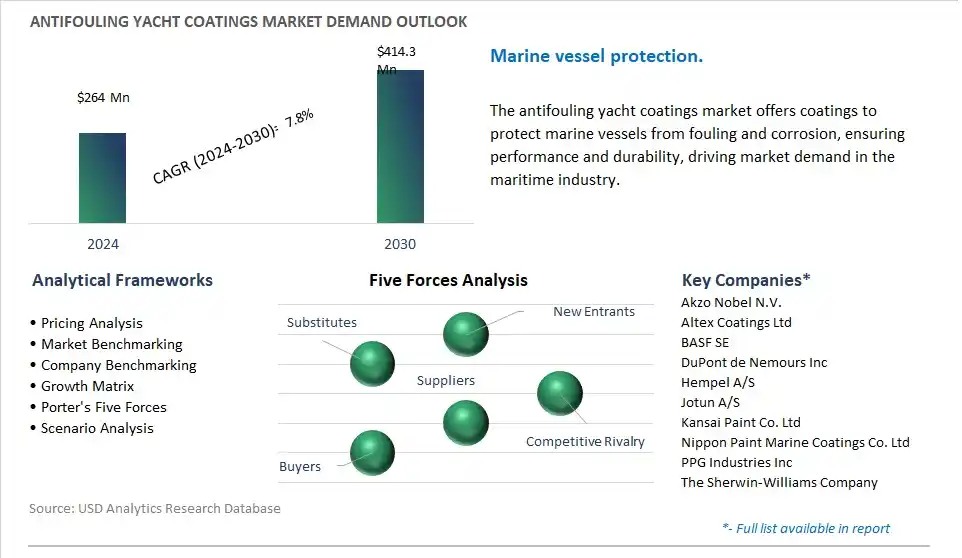
The global Antifouling Yacht Coatings Market is poised to register a 7.8% CAGR from $264 Million in 2024 to $414.3 Million in 2030.
The global Antifouling Yacht Coatings Market Study analyzes and forecasts the market size across 6 regions and 24 countries for diverse segments -By Application (Super Yacht, Flybridge Yacht, Sport Yacht, Long Range Yacht, Sailing Yacht, Motor Yacht), By Type (Copper Based, Biocides, Self-Polishing Copolymer, Hybrid).
An Introduction to Global Antifouling Yacht Coatings Market in 2024
The market for antifouling yacht coatings is evolving to meet the demand for coatings that provide effective fouling protection while minimizing environmental impact in marine environments. Key trends shaping the future of this industry include the development of eco-friendly and biocide-free antifouling formulations that use alternative technologies such as silicone, hydrogel, or ultrasonic systems to prevent marine growth on vessel hulls. Additionally, advancements in coating durability, adhesion, and self-cleaning properties improve performance and longevity, reducing the need for frequent hull maintenance and recoating. Moreover, the adoption of antifouling coatings with low leaching rates and non-toxic mechanisms of action aligns with regulatory restrictions on harmful biocides and promotes sustainable boating practices. As boat owners and marine industry stakeholders prioritize environmental stewardship and compliance with antifouling regulations, the demand for environmentally friendly yacht coatings is expected to continue growing, driving innovation and market expansion in this sector.
Antifouling Yacht Coatings Market Competitive Landscape
The market report analyses the leading companies in the industry including Akzo Nobel N.V., Altex Coatings Ltd, BASF SE, DuPont de Nemours Inc, Hempel A/S, Jotun A/S, Kansai Paint Co. Ltd, Nippon Paint Marine Coatings Co. Ltd, PPG Industries Inc, The Sherwin-Williams Company.
Antifouling Yacht Coatings Market Dynamics
Antifouling Yacht Coatings Market Trend: Shift Towards Environmentally Friendly Formulations
A prominent trend in the market for antifouling yacht coatings is the shift towards environmentally friendly formulations, driven by increasing awareness of marine pollution, regulatory restrictions on biocidal ingredients, and consumer preferences for sustainable boating practices. Traditional antifouling coatings often contain biocides such as copper and tributyltin (TBT), which can leach into marine ecosystems and harm aquatic organisms. In response, there is a growing demand for eco-friendly antifouling coatings that utilize alternative technologies such as silicone, hydrogel, or non-toxic biocides to prevent fouling without causing harm to marine life. This is reshaping the antifouling yacht coatings market, driving innovation and investment in sustainable coating solutions that offer effective fouling protection while minimizing environmental impact.
Antifouling Yacht Coatings Market Driver: Growth in Recreational Boating Industry
A key driver propelling the market for antifouling yacht coatings is the growth in the recreational boating industry, fueled by increasing disposable incomes, leisure spending, and tourism activities. As more individuals and families participate in recreational boating and yachting activities, there is a rising demand for antifouling coatings that protect vessel hulls from biofouling and maintain optimal performance and fuel efficiency. Antifouling coatings help prevent the attachment of algae, barnacles, and other marine organisms to boat hulls, reducing drag, improving fuel economy, and prolonging vessel lifespan. With the expanding global fleet of pleasure boats, yachts, and luxury cruisers, the market for antifouling yacht coatings is expected to grow, driven by the need to preserve and maintain the appearance and performance of recreational vessels in diverse marine environments.
Antifouling Yacht Coatings Market Opportunity: Development of Long-lasting and Self-cleaning Coatings
An opportunity for the antifouling yacht coatings market lies in the development of long-lasting and self-cleaning coatings that provide durable fouling protection and ease of maintenance for boat owners and operators. With advancements in nanotechnology, polymer chemistry, and surface engineering, there is potential to engineer antifouling coatings with enhanced durability, adhesion, and fouling resistance, capable of withstanding harsh marine conditions and prolonged exposure to seawater. Additionally, there is opportunity to integrate self-cleaning properties into antifouling coatings, leveraging superhydrophobic or photocatalytic technologies to repel fouling organisms and facilitate easy removal of dirt, grime, and fouling debris from boat surfaces. By developing long-lasting and self-cleaning coatings, manufacturers can offer value-added solutions that improve vessel performance, reduce maintenance costs, and enhance the overall boating experience for yacht owners and enthusiasts.
Antifouling Yacht Coatings Market Ecosystem
The antifouling yacht coatings market involves a complex Market Ecosystem encompassing various stages and industry players. It begins with raw material acquisition, where chemical companies including BASF SE, Dow, and DuPont specialize in sourcing biocides, binders, solvents, and pigments essential for coating production. Research and development efforts by antifouling coating manufacturers and research institutions focus on enhancing coating performance, reducing environmental impact, and improving durability.
Coating manufacturing with specialty paint and coating companies including AkzoNobel N.V., Hempel A/S, and Jotun formulating antifouling coatings using specific technologies including ablative, self-polishing copolymeric (SPC), and foul-release coatings.
Packaging and distribution channels, including direct sales to boatyards, marine supply stores, and online retailers, facilitate access for boat owners. Professional application and maintenance services ensure proper coating application and re-application, involving certified marine applicators, boatyards, and yacht owners.
Antifouling Yacht Coatings Market Share Analysis: Motor Yacht held the dominant revenue share in 2024
Motor yachts stand out as the largest segment in the antifouling yacht coatings market due to their widespread use and unique requirements for hull protection. Motor yachts have larger hull surfaces compared to other types of yachts, making them more susceptible to fouling by marine organisms such as barnacles, algae, and mollusks. As a result, owners and operators of motor yachts place a strong emphasis on maintaining hull performance and fuel efficiency through effective antifouling coatings. Antifouling coatings for motor yachts are specifically formulated to provide long-lasting protection against fouling organisms, reducing drag and improving fuel economy. Additionally, motor yachts often operate in a variety of marine environments, from coastal waters to open seas, necessitating antifouling coatings that can withstand different conditions and water velocities. The demand for antifouling coatings for motor yachts is further driven by the growing popularity of recreational boating and luxury yacht ownership, particularly in regions with extensive coastlines and favorable boating conditions. Consequently, motor yachts emerge as the largest segment in the antifouling yacht coatings market, owing to their unique requirements and significant presence in the global yacht industry.
Antifouling Yacht Coatings Market Share Analysis: Hybrid is the fastest growing market segment over the forecast period to 2030
The hybrid segment is the fastest-growing segment in the antifouling yacht coatings market due to its innovative formulation and superior performance characteristics. Hybrid antifouling coatings combine the benefits of multiple technologies, such as copper-based compounds, biocides, and self-polishing copolymers, to deliver enhanced fouling protection and durability. This hybrid approach allows for synergistic effects, maximizing antifouling efficacy while minimizing environmental impact and regulatory concerns associated with traditional antifouling agents. In addition, hybrid coatings offer versatility in application, catering to a wide range of yacht sizes, hull materials, and operating conditions. Their ability to provide long-lasting fouling protection with minimal maintenance requirements makes them increasingly popular among yacht owners and operators seeking high-performance solutions for hull protection. Additionally, advancements in hybrid coating formulations, including improved adhesion, abrasion resistance, and compatibility with different substrates, further drive their adoption in the antifouling yacht coatings market. As environmental regulations become stricter and the demand for sustainable boating practices rises, hybrid antifouling coatings are poised to experience significant growth, establishing themselves as the leading choice for yacht owners worldwide.
Antifouling Yacht Coatings Market Report Scope-
By Application
Super Yacht
Flybridge Yacht
Sport Yacht
Long Range Yacht
Sailing Yacht
Motor Yacht
By Type
Copper Based
Biocides
Self-Polishing Copolymer
Hybrid
Antifouling Yacht Coatings Market Companies Profiled
Akzo Nobel N.V.
Altex Coatings Ltd
BASF SE
DuPont de Nemours Inc
Hempel A/S
Jotun A/S
Kansai Paint Co. Ltd
Nippon Paint Marine Coatings Co. Ltd
PPG Industries Inc
The Sherwin-Williams Company
*- List Not Exhaustive
TABLE OF CONTENTS
1 Introduction to 2024 Antifouling Yacht Coatings Market
1.1 Market Overview
1.2 Quick Facts
1.3 Scope/Objective of the Study
1.4 Market Definition
1.5 Countries and Regions Covered
1.6 Units, Currency, and Conversions
1.7 Industry Value Chain
2 Research Methodology
2.1 Market Size Estimation
2.2 Sources and Research Methodology
2.3 Data Triangulation
2.4 Assumptions and Limitations
3 Executive Summary
3.1 Global Antifouling Yacht Coatings Market Size Outlook, $ Million, 2021 to 2030
3.2 Antifouling Yacht Coatings Market Outlook by Type, $ Million, 2021 to 2030
3.3 Antifouling Yacht Coatings Market Outlook by Product, $ Million, 2021 to 2030
3.4 Antifouling Yacht Coatings Market Outlook by Application, $ Million, 2021 to 2030
3.5 Antifouling Yacht Coatings Market Outlook by Key Countries, $ Million, 2021 to 2030
4 Market Dynamics
4.1 Key Driving Forces of Antifouling Yacht Coatings Industry
4.2 Key Market Trends in Antifouling Yacht Coatings Industry
4.3 Potential Opportunities in Antifouling Yacht Coatings Industry
4.4 Key Challenges in Antifouling Yacht Coatings Industry
5 Market Factor Analysis
5.1 Value Chain Analysis
5.2 Competitive Landscape
5.2.1 Global Antifouling Yacht Coatings Market Share by Company (%), 2023
5.2.2 Product Offerings by Company
5.3 Porter’s Five Forces Analysis
5.4 Pricing Analysis and Outlook
6 Growth Outlook Across Scenarios
6.1 Growth Analysis-Case Scenario Definitions
6.2 Low Growth Scenario Forecasts
6.3 Reference Growth Scenario Forecasts
6.4 High Growth Scenario Forecasts
7 Global Antifouling Yacht Coatings Market Outlook by Segments
7.1 Antifouling Yacht Coatings Market Outlook by Segments, $ Million, 2021- 2030
By Application
Super Yacht
Flybridge Yacht
Sport Yacht
Long Range Yacht
Sailing Yacht
Motor Yacht
By Type
Copper Based
Biocides
Self-Polishing Copolymer
Hybrid
8 North America Antifouling Yacht Coatings Market Analysis and Outlook To 2030
8.1 Introduction to North America Antifouling Yacht Coatings Markets in 2024
8.2 North America Antifouling Yacht Coatings Market Size Outlook by Country, 2021-2030
8.2.1 United States
8.2.2 Canada
8.2.3 Mexico
8.3 North America Antifouling Yacht Coatings Market size Outlook by Segments, 2021-2030
By Application
Super Yacht
Flybridge Yacht
Sport Yacht
Long Range Yacht
Sailing Yacht
Motor Yacht
By Type
Copper Based
Biocides
Self-Polishing Copolymer
Hybrid
9 Europe Antifouling Yacht Coatings Market Analysis and Outlook To 2030
9.1 Introduction to Europe Antifouling Yacht Coatings Markets in 2024
9.2 Europe Antifouling Yacht Coatings Market Size Outlook by Country, 2021-2030
9.2.1 Germany
9.2.2 France
9.2.3 Spain
9.2.4 United Kingdom
9.2.4 Italy
9.2.5 Russia
9.2.6 Norway
9.2.7 Rest of Europe
9.3 Europe Antifouling Yacht Coatings Market Size Outlook by Segments, 2021-2030
By Application
Super Yacht
Flybridge Yacht
Sport Yacht
Long Range Yacht
Sailing Yacht
Motor Yacht
By Type
Copper Based
Biocides
Self-Polishing Copolymer
Hybrid
10 Asia Pacific Antifouling Yacht Coatings Market Analysis and Outlook To 2030
10.1 Introduction to Asia Pacific Antifouling Yacht Coatings Markets in 2024
10.2 Asia Pacific Antifouling Yacht Coatings Market Size Outlook by Country, 2021-2030
10.2.1 China
10.2.2 India
10.2.3 Japan
10.2.4 South Korea
10.2.5 Indonesia
10.2.6 Malaysia
10.2.7 Australia
10.2.8 Rest of Asia Pacific
10.3 Asia Pacific Antifouling Yacht Coatings Market size Outlook by Segments, 2021-2030
By Application
Super Yacht
Flybridge Yacht
Sport Yacht
Long Range Yacht
Sailing Yacht
Motor Yacht
By Type
Copper Based
Biocides
Self-Polishing Copolymer
Hybrid
11 South America Antifouling Yacht Coatings Market Analysis and Outlook To 2030
11.1 Introduction to South America Antifouling Yacht Coatings Markets in 2024
11.2 South America Antifouling Yacht Coatings Market Size Outlook by Country, 2021-2030
11.2.1 Brazil
11.2.2 Argentina
11.2.3 Rest of South America
11.3 South America Antifouling Yacht Coatings Market size Outlook by Segments, 2021-2030
By Application
Super Yacht
Flybridge Yacht
Sport Yacht
Long Range Yacht
Sailing Yacht
Motor Yacht
By Type
Copper Based
Biocides
Self-Polishing Copolymer
Hybrid
12 Middle East and Africa Antifouling Yacht Coatings Market Analysis and Outlook To 2030
12.1 Introduction to Middle East and Africa Antifouling Yacht Coatings Markets in 2024
12.2 Middle East and Africa Antifouling Yacht Coatings Market Size Outlook by Country, 2021-2030
12.2.1 Saudi Arabia
12.2.2 UAE
12.2.3 Oman
12.2.4 Rest of Middle East
12.2.5 Egypt
12.2.6 Nigeria
12.2.7 South Africa
12.2.8 Rest of Africa
12.3 Middle East and Africa Antifouling Yacht Coatings Market size Outlook by Segments, 2021-2030
By Application
Super Yacht
Flybridge Yacht
Sport Yacht
Long Range Yacht
Sailing Yacht
Motor Yacht
By Type
Copper Based
Biocides
Self-Polishing Copolymer
Hybrid
13 Company Profiles
13.1 Company Snapshot
13.2 SWOT Profiles
13.3 Products and Services
13.4 Recent Developments
13.5 Financial Profile
Akzo Nobel N.V.
Altex Coatings Ltd
BASF SE
DuPont de Nemours Inc
Hempel A/S
Jotun A/S
Kansai Paint Co. Ltd
Nippon Paint Marine Coatings Co. Ltd
PPG Industries Inc
The Sherwin-Williams Company
14 Appendix
14.1 Customization Offerings
14.2 Subscription Services
14.3 Related Reports
14.4 Publisher Expertise
By Application
Super Yacht
Flybridge Yacht
Sport Yacht
Long Range Yacht
Sailing Yacht
Motor Yacht
By Type
Copper Based
Biocides
Self-Polishing Copolymer
Hybrid
Countries Analyzed
North America (US, Canada, Mexico)
Europe (Germany, UK, France, Spain, Italy, Russia, Rest of Europe)
Asia Pacific (China, India, Japan, South Korea, Australia, South East Asia, Rest of Asia)
South America (Brazil, Argentina, Rest of South America)
Middle East and Africa (Saudi Arabia, UAE, Rest of Middle East, South Africa, Egypt, Rest of Africa)
