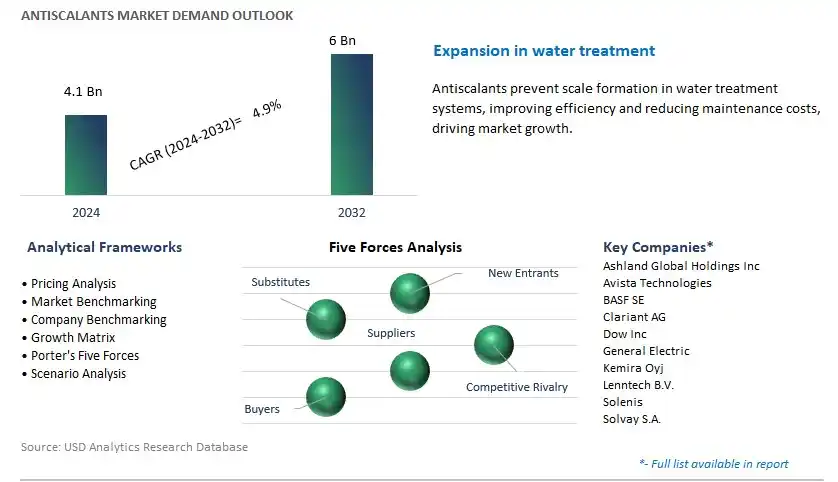
Global Antiscalants Market Size is valued at $4.1 Billion in 2024 and is forecast to register a growth rate (CAGR) of 4.9% to reach $6 Billion by 2032.
The global Antiscalants Market Study analyzes and forecasts the market size across 6 regions and 24 countries for diverse segments -By Type (Carboxylate, Sulfonates, Phosphonates, Fluorids, Others), By Method (Threshold Inhibition, Crystal Modification, Dispersion, Others), By End-User (Pulp and Paper, Mining, Water and Wastewater Treatment, Power and Construction, Chemical, Others).
An Introduction to Antiscalants Market in 2024
Antiscalants are chemical compounds or formulations designed to prevent the formation and deposition of scale in industrial equipment and processes, such as boilers, cooling towers, and water treatment systems. Scale formation occurs when dissolved minerals in water, such as calcium, magnesium, and silica, precipitate and adhere to surfaces, leading to fouling, reduced efficiency, and equipment damage. The market for antiscalants is driven by the need to maintain operational efficiency, extend equipment lifespan, and reduce maintenance costs in industrial applications. Antiscalants work by inhibiting crystal growth and agglomeration, dispersing colloidal particles, and preventing scale deposition on surfaces. Additionally, antiscalants can be tailored to specific water chemistries and operating conditions, providing customized solutions for diverse applications. Further, advancements in antiscalant formulations, such as environmentally friendly and biodegradable additives, are driving innovation and growth within the market. As industries seek sustainable and cost-effective solutions for scale control, antiscalants play a crucial role in ensuring the smooth operation and reliability of industrial processes.
Antiscalants Market Competitive Landscape
The market report analyses the leading companies in the industry including Ashland Global Holdings Inc, Avista Technologies, BASF SE, Clariant AG, Dow Inc, General Electric, Kemira Oyj, Lenntech B.V., Solenis, Solvay S.A., and others.
Antiscalants Market Dynamics
Market Trend: Increasing Adoption in Water Treatment Industry
A significant market trend for Antiscalants is the increasing adoption in the water treatment industry, driven by growing concerns about scale formation and mineral deposition in industrial processes, municipal water systems, and desalination plants. Antiscalants are chemical additives designed to prevent the precipitation of mineral scales such as calcium carbonate, calcium sulfate, and silica, which can cause fouling and reduced efficiency in water treatment equipment and infrastructure. With rising water scarcity, population growth, and industrialization, there is a growing demand for effective antiscalant solutions that help maintain operational efficiency, extend equipment lifespan, and reduce maintenance costs in water treatment facilities. This trend reflects a broader industry focus on water conservation, resource optimization, and sustainable solutions, driving the adoption of antiscalants as an essential component of water management strategies worldwide.
Market Driver: Industrial Expansion and Water Infrastructure Development
A significant market driver for Antiscalants is industrial expansion and water infrastructure development, particularly in sectors such as power generation, oil and gas, mining, and chemical manufacturing, where water is essential for process operations. As industries expand and water-intensive processes become more prevalent, there is an increasing need to manage scaling and fouling issues in water treatment systems to ensure reliable production, compliance with regulatory standards, and environmental sustainability. Antiscalants play a vital role in preventing scale formation in boilers, cooling towers, heat exchangers, membranes, and pipelines, helping industries optimize water usage, reduce downtime, and improve operational efficiency. The growth of industrial activities and investment in water infrastructure projects worldwide stimulate the demand for antiscalants and drive market growth in the water treatment sector.
Market Opportunity: Innovation in Green and Sustainable Antiscalant Technologies
An attractive opportunity in the Antiscalants market lies in innovation in green and sustainable antiscalant technologies to address environmental concerns and regulatory requirements while providing effective scale inhibition performance. As sustainability becomes increasingly important in water treatment practices, there is a growing demand for antiscalant formulations that are biodegradable, environmentally friendly, and safe for human health. Opportunities exist to develop antiscalants based on eco-friendly ingredients, bio-based polymers, and green chemistry principles that offer comparable or superior performance to conventional antiscalants while minimizing environmental impact. By investing in research and development, collaborating with academia and research institutions, and partnering with water treatment companies, manufacturers can capitalize on opportunities to develop innovative antiscalant solutions that meet customer needs, comply with regulatory standards, and contribute to sustainable water management practices globally.
Antiscalants Market Share Analysis: Phosphonates generated the highest revenue in 2024
Within the Antiscalants Market, the Phosphonates segment is the largest segment. Phosphonates are widely recognized for their effectiveness in preventing scale formation in various industrial processes, including water treatment, oil and gas production, and chemical manufacturing. These compounds act as chelating agents, sequestering metal ions and preventing their precipitation and deposition as scales on equipment surfaces. Additionally, phosphonates offer excellent thermal stability, compatibility with a wide range of water chemistries, and environmental sustainability, making them preferred antiscalants in industrial applications. Moreover, the increasing demand for water treatment solutions to address issues such as scaling, corrosion, and fouling in industrial processes further drives the growth of the Phosphonates segment within the Antiscalants Market. With their superior performance and versatility, phosphonates remain the largest segment in the market.
Antiscalants Market Share Analysis: Crystal Modification is poised to register the fastest CAGR over the forecast period
Among the options provided, the Crystal Modification segment is experiencing rapid growth within the Antiscalants Market. Crystal modification methods involve altering the crystal structure of scaling minerals to prevent their adherence to surfaces and inhibit scale formation in industrial processes. This approach offers advantages such as enhanced scalability, reduced fouling, and improved efficiency compared to traditional threshold inhibition methods. Additionally, crystal modification techniques are versatile and can be tailored to specific water chemistries and scaling minerals, making them effective in diverse industrial applications. Moreover, with the increasing demand for sustainable and environmentally friendly antiscalant solutions, crystal modification methods are gaining traction due to their ability to minimize chemical usage and reduce environmental impact. As industries prioritize efficient water management and scale prevention measures, the Crystal Modification segment is poised for significant growth in the Antiscalants Market.
Antiscalants Market
By Type
Carboxylate
Sulfonates
Phosphonates
Fluorids
Others
By Method
Threshold Inhibition
Crystal Modification
Dispersion
Others
By End-User
Pulp and Paper
Mining
Water and Wastewater Treatment
Power and Construction
Chemical
Others
Countries Analyzed
North America (US, Canada, Mexico)
Europe (Germany, UK, France, Spain, Italy, Russia, Rest of Europe)
Asia Pacific (China, India, Japan, South Korea, Australia, South East Asia, Rest of Asia)
South America (Brazil, Argentina, Rest of South America)
Middle East and Africa (Saudi Arabia, UAE, Rest of Middle East, South Africa, Egypt, Rest of Africa)
Antiscalants Companies Profiled in the Study
Ashland Global Holdings Inc
Avista Technologies
BASF SE
Clariant AG
Dow Inc
General Electric
Kemira Oyj
Lenntech B.V.
Solenis
Solvay S.A.
*- List Not Exhaustive
TABLE OF CONTENTS
1 Introduction to 2024 Antiscalants Market
1.1 Market Overview
1.2 Quick Facts
1.3 Scope/Objective of the Study
1.4 Market Definition
1.5 Countries and Regions Covered
1.6 Units, Currency, and Conversions
1.7 Industry Value Chain
2 Research Methodology
2.1 Market Size Estimation
2.2 Sources and Research Methodology
2.3 Data Triangulation
2.4 Assumptions and Limitations
3 Executive Summary
3.1 Global Antiscalants Market Size Outlook, $ Million, 2021 to 2032
3.2 Antiscalants Market Outlook by Type, $ Million, 2021 to 2032
3.3 Antiscalants Market Outlook by Product, $ Million, 2021 to 2032
3.4 Antiscalants Market Outlook by Application, $ Million, 2021 to 2032
3.5 Antiscalants Market Outlook by Key Countries, $ Million, 2021 to 2032
4 Market Dynamics
4.1 Key Driving Forces of Antiscalants Industry
4.2 Key Market Trends in Antiscalants Industry
4.3 Potential Opportunities in Antiscalants Industry
4.4 Key Challenges in Antiscalants Industry
5 Market Factor Analysis
5.1 Value Chain Analysis
5.2 Competitive Landscape
5.2.1 Global Antiscalants Market Share by Company (%), 2023
5.2.2 Product Offerings by Company
5.3 Porter’s Five Forces Analysis
5.4 Pricing Analysis and Outlook
6 Growth Outlook Across Scenarios
6.1 Growth Analysis-Case Scenario Definitions
6.2 Low Growth Scenario Forecasts
6.3 Reference Growth Scenario Forecasts
6.4 High Growth Scenario Forecasts
7 Global Antiscalants Market Outlook by Segments
7.1 Antiscalants Market Outlook by Segments, $ Million, 2021- 2032
By Type
Carboxylate
Sulfonates
Phosphonates
Fluorids
Others
By Method
Threshold Inhibition
Crystal Modification
Dispersion
Others
By End-User
Pulp and Paper
Mining
Water and Wastewater Treatment
Power and Construction
Chemical
Others
8 North America Antiscalants Market Analysis and Outlook To 2032
8.1 Introduction to North America Antiscalants Markets in 2024
8.2 North America Antiscalants Market Size Outlook by Country, 2021-2032
8.2.1 United States
8.2.2 Canada
8.2.3 Mexico
8.3 North America Antiscalants Market size Outlook by Segments, 2021-2032
By Type
Carboxylate
Sulfonates
Phosphonates
Fluorids
Others
By Method
Threshold Inhibition
Crystal Modification
Dispersion
Others
By End-User
Pulp and Paper
Mining
Water and Wastewater Treatment
Power and Construction
Chemical
Others
9 Europe Antiscalants Market Analysis and Outlook To 2032
9.1 Introduction to Europe Antiscalants Markets in 2024
9.2 Europe Antiscalants Market Size Outlook by Country, 2021-2032
9.2.1 Germany
9.2.2 France
9.2.3 Spain
9.2.4 United Kingdom
9.2.4 Italy
9.2.5 Russia
9.2.6 Norway
9.2.7 Rest of Europe
9.3 Europe Antiscalants Market Size Outlook by Segments, 2021-2032
By Type
Carboxylate
Sulfonates
Phosphonates
Fluorids
Others
By Method
Threshold Inhibition
Crystal Modification
Dispersion
Others
By End-User
Pulp and Paper
Mining
Water and Wastewater Treatment
Power and Construction
Chemical
Others
10 Asia Pacific Antiscalants Market Analysis and Outlook To 2032
10.1 Introduction to Asia Pacific Antiscalants Markets in 2024
10.2 Asia Pacific Antiscalants Market Size Outlook by Country, 2021-2032
10.2.1 China
10.2.2 India
10.2.3 Japan
10.2.4 South Korea
10.2.5 Indonesia
10.2.6 Malaysia
10.2.7 Australia
10.2.8 Rest of Asia Pacific
10.3 Asia Pacific Antiscalants Market size Outlook by Segments, 2021-2032
By Type
Carboxylate
Sulfonates
Phosphonates
Fluorids
Others
By Method
Threshold Inhibition
Crystal Modification
Dispersion
Others
By End-User
Pulp and Paper
Mining
Water and Wastewater Treatment
Power and Construction
Chemical
Others
11 South America Antiscalants Market Analysis and Outlook To 2032
11.1 Introduction to South America Antiscalants Markets in 2024
11.2 South America Antiscalants Market Size Outlook by Country, 2021-2032
11.2.1 Brazil
11.2.2 Argentina
11.2.3 Rest of South America
11.3 South America Antiscalants Market size Outlook by Segments, 2021-2032
By Type
Carboxylate
Sulfonates
Phosphonates
Fluorids
Others
By Method
Threshold Inhibition
Crystal Modification
Dispersion
Others
By End-User
Pulp and Paper
Mining
Water and Wastewater Treatment
Power and Construction
Chemical
Others
12 Middle East and Africa Antiscalants Market Analysis and Outlook To 2032
12.1 Introduction to Middle East and Africa Antiscalants Markets in 2024
12.2 Middle East and Africa Antiscalants Market Size Outlook by Country, 2021-2032
12.2.1 Saudi Arabia
12.2.2 UAE
12.2.3 Oman
12.2.4 Rest of Middle East
12.2.5 Egypt
12.2.6 Nigeria
12.2.7 South Africa
12.2.8 Rest of Africa
12.3 Middle East and Africa Antiscalants Market size Outlook by Segments, 2021-2032
By Type
Carboxylate
Sulfonates
Phosphonates
Fluorids
Others
By Method
Threshold Inhibition
Crystal Modification
Dispersion
Others
By End-User
Pulp and Paper
Mining
Water and Wastewater Treatment
Power and Construction
Chemical
Others
13 Company Profiles
13.1 Company Snapshot
13.2 SWOT Profiles
13.3 Products and Services
13.4 Recent Developments
13.5 Financial Profile
Ashland Global Holdings Inc
Avista Technologies
BASF SE
Clariant AG
Dow Inc
General Electric
Kemira Oyj
Lenntech B.V.
Solenis
Solvay S.A.
14 Appendix
14.1 Customization Offerings
14.2 Subscription Services
14.3 Related Reports
14.4 Publisher Expertise
By Type
Carboxylate
Sulfonates
Phosphonates
Fluorids
Others
By Method
Threshold Inhibition
Crystal Modification
Dispersion
Others
By End-User
Pulp and Paper
Mining
Water and Wastewater Treatment
Power and Construction
Chemical
Others
Countries Analyzed
North America (US, Canada, Mexico)
Europe (Germany, UK, France, Spain, Italy, Russia, Rest of Europe)
Asia Pacific (China, India, Japan, South Korea, Australia, South East Asia, Rest of Asia)
South America (Brazil, Argentina, Rest of South America)
Middle East and Africa (Saudi Arabia, UAE, Rest of Middle East, South Africa, Egypt, Rest of Africa)
