The global Antiscalants Scale Inhibitors Market is poised to register a 4.9% CAGR from $3.6 Billion in 2024 to $4.8 Billion in 2030.
The global Antiscalants Scale Inhibitors Market Study analyzes and forecasts the market size across 6 regions and 24 countries for diverse segments -By Type (Carboxylate, Sulfonates, Phosphonates, Fluorids, Others), By Method (Threshold Inhibition, Crystal Modification, Dispersion, Others), By End-User (Pulp and Paper, Mining, Others, Oil and Gas, Water and Wastewater Treatment, Power and Construction, Chemical Industry).
An Introduction to Global Antiscalants Scale Inhibitors Market in 2024
The market for antiscalants and scale inhibitors is witnessing growth driven by the increasing demand for water treatment solutions in industrial processes, power generation, and municipal water systems. Key trends shaping the future of the industry include innovations in chemical formulations, membrane technologies, and digital monitoring systems to prevent scale formation and fouling in water treatment equipment and pipelines. Advanced antiscalants offer benefits such as calcium carbonate inhibition, dispersancy, and compatibility with various water chemistries, making them essential for maintaining system efficiency and productivity while minimizing downtime and maintenance costs. Moreover, the integration of advanced analytical tools, such as online sensors, predictive modeling, and remote monitoring, enables real-time detection of scaling tendencies and proactive treatment strategies, optimizing antiscalant dosing and performance. Additionally, the growing emphasis on water conservation, resource management, and regulatory compliance drives market demand for antiscalants and scale inhibitors that improve water quality, reduce chemical usage, and enhance operational sustainability across industries. As water scarcity concerns and stricter environmental regulations continue to drive investments in water treatment technologies, the antiscalants market is poised for continued growth and innovation as a critical solution for addressing scaling challenges and ensuring reliable water supply and quality.
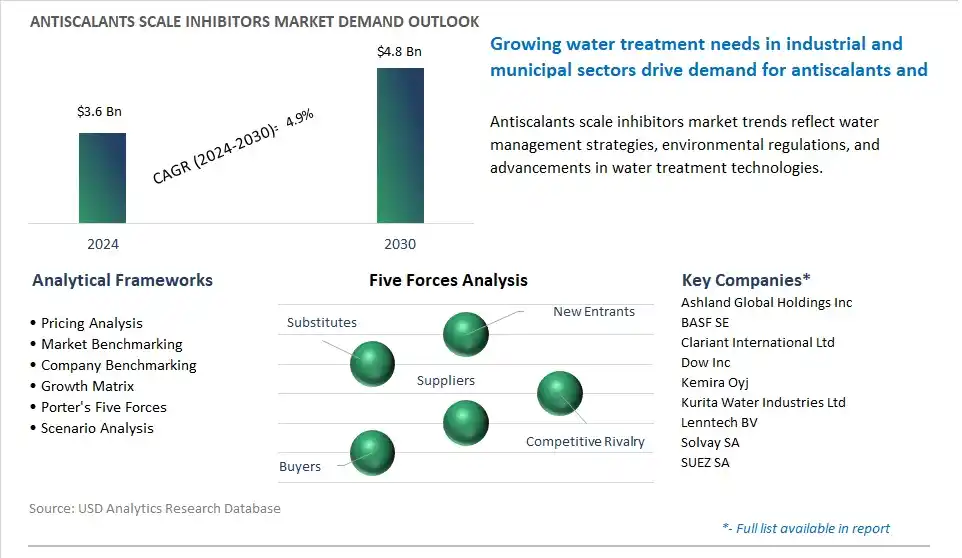
Antiscalants Scale Inhibitors Market Competitive Landscape
The market report analyses the leading companies in the industry including Ashland Global Holdings Inc, BASF SE, Clariant International Ltd, Dow Inc, Kemira Oyj, Kurita Water Industries Ltd, Lenntech BV, Solvay SA, SUEZ SA.
Antiscalants Scale Inhibitors Market Dynamics
Antiscalants Scale Inhibitor Market Trend: Growing Importance of Water Treatment and Conservation
A prominent trend in the antiscalants scale inhibitor market is the growing importance of water treatment and conservation. With increasing water scarcity and environmental concerns, industries and municipalities are investing in water treatment technologies to ensure the availability of clean and safe water for various applications. Antiscalants and scale inhibitors play a crucial role in water treatment processes by preventing the formation of scale deposits in industrial equipment, pipelines, and water distribution systems. This trend is driven by regulatory mandates, sustainability initiatives, and the need to optimize water usage and reduce operational costs, shaping the future of the antiscalants scale inhibitor market towards greater adoption in water treatment and conservation efforts.
Antiscalants Scale Inhibitor Market Driver: Rising Demand in Industrial and Municipal Water Treatment
The primary driver behind the growth of the antiscalants scale inhibitor market is the rising demand in industrial and municipal water treatment applications. Industries such as power generation, oil and gas, mining, and food and beverage rely on water-intensive processes that are susceptible to scale formation, corrosion, and fouling. Municipalities require effective water treatment solutions to ensure the quality and reliability of drinking water supplies and wastewater treatment systems. Antiscalants and scale inhibitors offer cost-effective solutions for preventing scale buildup, extending equipment lifespan, and maintaining process efficiency in diverse water treatment applications. This driver is fueled by increasing industrialization, urbanization, and regulatory requirements for water quality and environmental protection, stimulating market growth and investment in antiscalant technologies and applications.
Antiscalants Scale Inhibitor Market Opportunity: Expansion into Desalination and Reverse Osmosis
An opportunity for market growth within the antiscalants scale inhibitor sector lies in expansion into desalination and reverse osmosis (RO) applications. While antiscalants are commonly used in industrial water treatment, there is untapped potential in desalination plants and RO systems for treating brackish water and seawater. Scale formation is a common challenge in desalination processes due to the high concentrations of dissolved minerals, such as calcium, magnesium, and silica. Antiscalants and scale inhibitors can be added to desalination membranes to prevent scale buildup and improve system efficiency, reducing energy consumption and operating costs. By developing specialized formulations and solutions for desalination and RO applications, antiscalant suppliers can capitalize on the growing demand for freshwater resources and the expansion of desalination projects worldwide. Additionally, collaboration with desalination plant operators, membrane manufacturers, and engineering firms enables antiscalant producers to address specific challenges, optimize performance, and unlock new opportunities in the desalination market.
Antiscalants Scale Inhibitor Market Share Analysis: Phosphonates segment generated the highest revenue in the industry
The Phosphonates segment is the largest segment in the Antiscalants Scale Inhibitor Market for diverse reasons. The phosphonates are widely recognized and utilized as effective scale inhibitors in various industrial applications, including water treatment, oil and gas production, power generation, and chemical processing. Additionally, phosphonates exhibit excellent scale inhibition properties by forming stable complexes with metal ions present in water, thus preventing the formation and deposition of scale deposits on surfaces and equipment. In addition, phosphonates offer versatility and compatibility with different water chemistries, temperatures, and operating conditions, making them suitable for a wide range of water treatment applications. Further, phosphonates are cost-effective and environmentally friendly alternatives to traditional scale inhibitors, such as carboxylates and sulfonates, due to their high efficiency and low dosage requirements. As industries prioritize efficient and sustainable solutions for scale control and equipment protection, the Phosphonates segment maintains its dominance as the largest segment in the Antiscalants Scale Inhibitor Market.
Antiscalants Scale Inhibitor Market Share Analysis: Crystal Modification Segment is poised to register the fastest growth rate (CAGR) over the forecast period to 2030
The Crystal Modification segment is the fastest-growing segment in the Antiscalants Scale Inhibitor Market for diverse compelling reasons. The crystal modification methods involve altering the crystal structure of scale-forming minerals in water to inhibit their growth and agglomeration, thus preventing scale deposition on surfaces and equipment. Additionally, crystal modification techniques offer effective and environmentally friendly solutions for scale control in various industrial processes, including water treatment, oil and gas production, and chemical processing. In addition, crystal modification methods can be tailored to target specific types of scale-forming minerals, such as calcium carbonate, calcium sulfate, and silica, thereby providing customized solutions for different water chemistries and operating conditions. Further, crystal modification techniques offer advantages such as scalability, cost-effectiveness, and compatibility with existing water treatment systems, making them increasingly popular among industries seeking efficient and sustainable solutions for scale inhibition. As industries continue to invest in innovative technologies and methods for water treatment and equipment protection, the Crystal Modification segment experiences rapid growth in the Antiscalants Scale Inhibitor Market.
Antiscalants Scale Inhibitor Market Share Analysis: Water and Wastewater Treatment Segment is poised to register the fastest growth rate (CAGR) over the forecast period to 2030
The Water and Wastewater Treatment segment is the fastest-growing segment in the Antiscalants Scale Inhibitor Market for diverse compelling reasons. The water scarcity and the increasing demand for clean water drive the growth of the water and wastewater treatment industry globally. Additionally, water and wastewater treatment plants face challenges such as scaling, fouling, and corrosion, which can impair equipment performance and efficiency. In addition, antiscalants and scale inhibitors play a crucial role in preventing scale formation and minimizing downtime and maintenance costs in water treatment systems. Further, as industries and municipalities invest in upgrading and expanding water treatment infrastructure to meet regulatory standards and address emerging contaminants, the demand for effective scale inhibition solutions continues to rise. Additionally, the growing adoption of membrane-based water treatment technologies, such as reverse osmosis and nanofiltration, further drives the need for antiscalants to protect membrane surfaces from scaling and fouling. As a result, the Water and Wastewater Treatment segment experiences rapid growth in the Antiscalants Scale Inhibitor Market, driven by the increasing demand for efficient and sustainable solutions for water treatment and resource management.
Antiscalants Scale Inhibitors Market Report Segmentation
By Type
Carboxylate
Sulfonates
Phosphonates
Fluorids
Others
By Method
Threshold Inhibition
Crystal Modification
Dispersion
Others
By End-User
Pulp and Paper
Mining
Others
Oil and Gas
Water and Wastewater Treatment
Power and Construction
Chemical Industry
Regions Included
North America (US, Canada, Mexico)
Europe (Germany, UK, France, Spain, Italy, Russia, Rest of Europe)
Asia Pacific (China, India, Japan, South Korea, Australia, South East Asia, Rest of Asia)
South America (Brazil, Argentina, Rest of South America)
Middle East and Africa (Saudi Arabia, UAE, Rest of Middle East, South Africa, Egypt, Rest of Africa)
Antiscalants Scale Inhibitors Companies Profiled in the Market Study
Ashland Global Holdings Inc
BASF SE
Clariant International Ltd
Dow Inc
Kemira Oyj
Kurita Water Industries Ltd
Lenntech BV
Solvay SA
SUEZ SA
*- List Not Exhaustive
TABLE OF CONTENTS
1 Introduction to 2024 Antiscalants Scale Inhibitors Market
1.1 Market Overview
1.2 Quick Facts
1.3 Scope/Objective of the Study
1.4 Market Definition
1.5 Countries and Regions Covered
1.6 Units, Currency, and Conversions
1.7 Industry Value Chain
2 Research Methodology
2.1 Market Size Estimation
2.2 Sources and Research Methodology
2.3 Data Triangulation
2.4 Assumptions and Limitations
3 Executive Summary
3.1 Global Antiscalants Scale Inhibitors Market Size Outlook, $ Million, 2021 to 2030
3.2 Antiscalants Scale Inhibitors Market Outlook by Type, $ Million, 2021 to 2030
3.3 Antiscalants Scale Inhibitors Market Outlook by Product, $ Million, 2021 to 2030
3.4 Antiscalants Scale Inhibitors Market Outlook by Application, $ Million, 2021 to 2030
3.5 Antiscalants Scale Inhibitors Market Outlook by Key Countries, $ Million, 2021 to 2030
4 Market Dynamics
4.1 Key Driving Forces of Antiscalants Scale Inhibitors Industry
4.2 Key Market Trends in Antiscalants Scale Inhibitors Industry
4.3 Potential Opportunities in Antiscalants Scale Inhibitors Industry
4.4 Key Challenges in Antiscalants Scale Inhibitors Industry
5 Market Factor Analysis
5.1 Value Chain Analysis
5.2 Competitive Landscape
5.2.1 Global Antiscalants Scale Inhibitors Market Share by Company (%), 2023
5.2.2 Product Offerings by Company
5.3 Porter’s Five Forces Analysis
5.4 Pricing Analysis and Outlook
6 Growth Outlook Across Scenarios
6.1 Growth Analysis-Case Scenario Definitions
6.2 Low Growth Scenario Forecasts
6.3 Reference Growth Scenario Forecasts
6.4 High Growth Scenario Forecasts
7 Global Antiscalants Scale Inhibitors Market Outlook by Segments
7.1 Antiscalants Scale Inhibitors Market Outlook by Segments, $ Million, 2021- 2030
By Type
Carboxylate
Sulfonates
Phosphonates
Fluorids
Others
By Method
Threshold Inhibition
Crystal Modification
Dispersion
Others
By End-User
Pulp and Paper
Mining
Others
Oil and Gas
Water and Wastewater Treatment
Power and Construction
Chemical Industry
8 North America Antiscalants Scale Inhibitors Market Analysis and Outlook To 2030
8.1 Introduction to North America Antiscalants Scale Inhibitors Markets in 2024
8.2 North America Antiscalants Scale Inhibitors Market Size Outlook by Country, 2021-2030
8.2.1 United States
8.2.2 Canada
8.2.3 Mexico
8.3 North America Antiscalants Scale Inhibitors Market size Outlook by Segments, 2021-2030
By Type
Carboxylate
Sulfonates
Phosphonates
Fluorids
Others
By Method
Threshold Inhibition
Crystal Modification
Dispersion
Others
By End-User
Pulp and Paper
Mining
Others
Oil and Gas
Water and Wastewater Treatment
Power and Construction
Chemical Industry
9 Europe Antiscalants Scale Inhibitors Market Analysis and Outlook To 2030
9.1 Introduction to Europe Antiscalants Scale Inhibitors Markets in 2024
9.2 Europe Antiscalants Scale Inhibitors Market Size Outlook by Country, 2021-2030
9.2.1 Germany
9.2.2 France
9.2.3 Spain
9.2.4 United Kingdom
9.2.4 Italy
9.2.5 Russia
9.2.6 Norway
9.2.7 Rest of Europe
9.3 Europe Antiscalants Scale Inhibitors Market Size Outlook by Segments, 2021-2030
By Type
Carboxylate
Sulfonates
Phosphonates
Fluorids
Others
By Method
Threshold Inhibition
Crystal Modification
Dispersion
Others
By End-User
Pulp and Paper
Mining
Others
Oil and Gas
Water and Wastewater Treatment
Power and Construction
Chemical Industry
10 Asia Pacific Antiscalants Scale Inhibitors Market Analysis and Outlook To 2030
10.1 Introduction to Asia Pacific Antiscalants Scale Inhibitors Markets in 2024
10.2 Asia Pacific Antiscalants Scale Inhibitors Market Size Outlook by Country, 2021-2030
10.2.1 China
10.2.2 India
10.2.3 Japan
10.2.4 South Korea
10.2.5 Indonesia
10.2.6 Malaysia
10.2.7 Australia
10.2.8 Rest of Asia Pacific
10.3 Asia Pacific Antiscalants Scale Inhibitors Market size Outlook by Segments, 2021-2030
By Type
Carboxylate
Sulfonates
Phosphonates
Fluorids
Others
By Method
Threshold Inhibition
Crystal Modification
Dispersion
Others
By End-User
Pulp and Paper
Mining
Others
Oil and Gas
Water and Wastewater Treatment
Power and Construction
Chemical Industry
11 South America Antiscalants Scale Inhibitors Market Analysis and Outlook To 2030
11.1 Introduction to South America Antiscalants Scale Inhibitors Markets in 2024
11.2 South America Antiscalants Scale Inhibitors Market Size Outlook by Country, 2021-2030
11.2.1 Brazil
11.2.2 Argentina
11.2.3 Rest of South America
11.3 South America Antiscalants Scale Inhibitors Market size Outlook by Segments, 2021-2030
By Type
Carboxylate
Sulfonates
Phosphonates
Fluorids
Others
By Method
Threshold Inhibition
Crystal Modification
Dispersion
Others
By End-User
Pulp and Paper
Mining
Others
Oil and Gas
Water and Wastewater Treatment
Power and Construction
Chemical Industry
12 Middle East and Africa Antiscalants Scale Inhibitors Market Analysis and Outlook To 2030
12.1 Introduction to Middle East and Africa Antiscalants Scale Inhibitors Markets in 2024
12.2 Middle East and Africa Antiscalants Scale Inhibitors Market Size Outlook by Country, 2021-2030
12.2.1 Saudi Arabia
12.2.2 UAE
12.2.3 Oman
12.2.4 Rest of Middle East
12.2.5 Egypt
12.2.6 Nigeria
12.2.7 South Africa
12.2.8 Rest of Africa
12.3 Middle East and Africa Antiscalants Scale Inhibitors Market size Outlook by Segments, 2021-2030
By Type
Carboxylate
Sulfonates
Phosphonates
Fluorids
Others
By Method
Threshold Inhibition
Crystal Modification
Dispersion
Others
By End-User
Pulp and Paper
Mining
Others
Oil and Gas
Water and Wastewater Treatment
Power and Construction
Chemical Industry
13 Company Profiles
13.1 Company Snapshot
13.2 SWOT Profiles
13.3 Products and Services
13.4 Recent Developments
13.5 Financial Profile
Ashland Global Holdings Inc
BASF SE
Clariant International Ltd
Dow Inc
Kemira Oyj
Kurita Water Industries Ltd
Lenntech BV
Solvay SA
SUEZ SA
14 Appendix
14.1 Customization Offerings
14.2 Subscription Services
14.3 Related Reports
14.4 Publisher Expertise
By Type
Carboxylate
Sulfonates
Phosphonates
Fluorids
Others
By Method
Threshold Inhibition
Crystal Modification
Dispersion
Others
By End-User
Pulp and Paper
Mining
Others
Oil and Gas
Water and Wastewater Treatment
Power and Construction
Chemical Industry
Countries Analyzed
North America (US, Canada, Mexico)
Europe (Germany, UK, France, Spain, Italy, Russia, Rest of Europe)
Asia Pacific (China, India, Japan, South Korea, Australia, South East Asia, Rest of Asia)
South America (Brazil, Argentina, Rest of South America)
Middle East and Africa (Saudi Arabia, UAE, Rest of Middle East, South Africa, Egypt, Rest of Africa)
