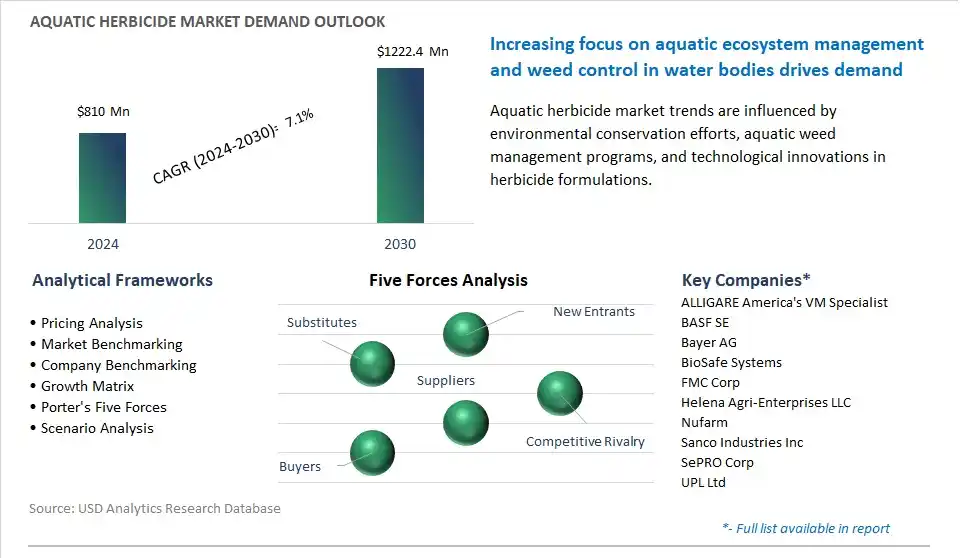
The global Aquatic Herbicide Market is poised to register a 7.1% CAGR from $810 Million in 2024 to $1222.4 Million in 2030.
The global Aquatic Herbicide Market Study analyzes and forecasts the market size across 6 regions and 24 countries for diverse segments -By Type (Glyphosate, 2,4-D, Diquat, Triclopyr, Imazapyr, Others), By Mode of Action (Selective, Non-Selective), By Method (Foliar, Submerged), By Application (Agricultural waters, Fisheries, Recreational waters, Others).
An Introduction to Global Aquatic Herbicide Market in 2024
The market for aquatic herbicides is experiencing growth driven by the increasing need for effective weed control in lakes, ponds, rivers, and other water bodies to maintain water quality, biodiversity, and recreational activities. Key trends shaping the future of the industry include innovations in herbicide formulations, application methods, and environmental risk assessment to ensure targeted weed management while minimizing impacts on non-target organisms and ecosystems. Advanced aquatic herbicides offer benefits such as broad-spectrum weed control, rapid degradation, and selective toxicity to aquatic plants, making them essential for controlling invasive species, nuisance algae, and submerged weeds in aquatic environments. Moreover, the integration of eco-friendly herbicides, such as bioherbicides and natural products, addresses concerns about chemical persistence and toxicity, supporting integrated weed management (IWM) strategies and sustainable aquatic ecosystems. Additionally, the growing emphasis on integrated lake management, watershed protection, and ecosystem restoration drives market demand for aquatic herbicides that provide effective, long-lasting weed control while minimizing risks to aquatic habitats and human health. As water resource managers and environmental agencies seek solutions to balance weed control with ecological stewardship, the aquatic herbicide market is poised for continued growth and innovation as a vital tool for aquatic vegetation management and habitat preservation.
Aquatic Herbicide Market Competitive Landscape
The market report analyses the leading companies in the industry including ALLIGARE America's VM Specialist, BASF SE, Bayer AG, BioSafe Systems, FMC Corp, Helena Agri-Enterprises LLC, Nufarm, Sanco Industries Inc, SePRO Corp, UPL Ltd.
Aquatic Herbicide Market Dynamics
Aquatic Herbicide Market Trend: Increasing Concerns Over Aquatic Weed Infestation
A prominent trend in the aquatic herbicide market is the increasing concerns over aquatic weed infestation. With the proliferation of invasive aquatic plant species in lakes, ponds, rivers, and reservoirs, there is a growing need for effective solutions to control and manage aquatic weeds. These invasive plants can disrupt ecosystems, hinder water flow, impede recreational activities, and jeopardize water quality. As a result, there is a rising demand for aquatic herbicides that can selectively target and eliminate unwanted aquatic vegetation while minimizing harm to the surrounding environment. This trend is driven by environmental conservation efforts, regulatory mandates, and the need to preserve the ecological balance of aquatic ecosystems, shaping the future of the aquatic herbicide market towards greater adoption in weed management strategies.
Aquatic Herbicide Market Driver: Expansion of Aquatic Weed Control Programs
The primary driver behind the growth of the aquatic herbicide market is the expansion of aquatic weed control programs. Governments, municipalities, water resource management agencies, and private landowners are implementing comprehensive weed management plans to address the growing threat of aquatic weed infestation. These programs involve the use of herbicides as part of integrated weed management strategies, which may include mechanical removal, biological control, and cultural practices. Aquatic herbicides offer a cost-effective and efficient solution for controlling submerged, emergent, and floating aquatic weeds, allowing for the restoration of aquatic habitats, improvement of water quality, and enhancement of recreational opportunities. This driver is fueled by the need to maintain navigable waterways, protect natural habitats, and mitigate the economic and ecological impacts of invasive aquatic plants, stimulating market growth and investment in aquatic herbicide products and application technologies.
Aquatic Herbicide Market Opportunity: Development of Environmentally Friendly Formulations
An opportunity for market growth within the aquatic herbicide sector lies in the development of environmentally friendly formulations. While aquatic herbicides are essential tools for weed control, there is a growing demand for products that minimize adverse effects on non-target organisms and aquatic ecosystems. Manufacturers have an opportunity to innovate and develop herbicide formulations that are biodegradable, non-toxic to aquatic organisms, and have minimal residual effects on water quality. Additionally, there is a need for herbicides that can selectively target specific weed species while sparing beneficial native vegetation and aquatic wildlife. By investing in research and development, leveraging green chemistry principles, and collaborating with environmental scientists and regulatory agencies, herbicide manufacturers can capitalize on the growing demand for environmentally friendly weed control solutions, differentiate their product offerings, and gain a competitive edge in the market.
Aquatic Herbicide Market Share Analysis: Glyphosate segment generated the highest revenue in the industry
The Glyphosate segment is the largest segment in the Aquatic Herbicide Market for diverse reasons. The glyphosate is one of the most widely used herbicides globally, known for its broad-spectrum effectiveness in controlling a wide range of aquatic weeds and plants. Additionally, glyphosate-based herbicides are highly effective in killing both emerged and submerged aquatic vegetation, making them suitable for various aquatic weed management applications, including lakes, ponds, rivers, and irrigation channels. In addition, glyphosate is a systemic herbicide that works by inhibiting the production of essential amino acids in plants, leading to their eventual death. Further, glyphosate-based herbicides are relatively cost-effective and easy to apply, making them preferred choices for aquatic weed control by government agencies, environmental management organizations, and private landowners. As a result, the Glyphosate segment maintains its dominance as the largest segment in the Aquatic Herbicide Market due to its widespread usage, effectiveness, and versatility in controlling aquatic vegetation.
Aquatic Herbicide Market Share Analysis: Selective Segment is poised to register the fastest growth rate (CAGR) over the forecast period to 2030
The Selective segment is the fastest-growing segment in the Aquatic Herbicide Market for diverse compelling reasons. The selective herbicides target specific types of plants while leaving non-target species unharmed, making them ideal for managing aquatic weeds without causing harm to desirable vegetation or sensitive aquatic ecosystems. Additionally, selective herbicides offer precision and control in weed management, allowing for targeted treatment of invasive or nuisance aquatic plants while preserving native vegetation and biodiversity. In addition, selective herbicides are often preferred in environmentally sensitive areas such as wetlands, riparian zones, and protected habitats, where the preservation of native flora and fauna is a priority. Further, advancements in herbicide formulation and application technologies have led to the development of selective herbicides with improved efficacy, safety, and environmental profiles, driving their adoption in aquatic weed management programs. As environmental awareness grows and regulations tighten around the use of herbicides in aquatic environments, the demand for selective herbicides continues to rise, positioning the Selective segment as the fastest-growing segment in the Aquatic Herbicide Market.
Aquatic Herbicide Market Share Analysis: Submerged Segment is poised to register the fastest growth rate (CAGR) over the forecast period to 2030
The Submerged segment is the fastest-growing segment in the Aquatic Herbicide Market for diverse compelling reasons. The submerged aquatic weeds pose significant challenges to water bodies, including lakes, ponds, and reservoirs, by degrading water quality, impeding water flow, and disrupting aquatic ecosystems. Additionally, submerged weeds, such as hydrilla, milfoil, and pondweed, often proliferate rapidly and can quickly dominate aquatic environments if left unchecked. In addition, traditional methods of mechanical removal or manual harvesting of submerged weeds are often labor-intensive, time-consuming, and impractical for large water bodies or areas with difficult access. Further, herbicides applied directly to the water column target submerged vegetation effectively, delivering precise and targeted control of nuisance weeds while minimizing impacts on non-target organisms and the surrounding environment. As aquatic resource managers, lake associations, and property owners seek efficient and sustainable solutions for controlling submerged aquatic vegetation, the demand for herbicides targeting submerged weeds continues to rise, driving growth in the Submerged segment of the Aquatic Herbicide Market.
Aquatic Herbicide Market Report Segmentation
By Type
Glyphosate
2,4-D
Diquat
Triclopyr
Imazapyr
Others
By Mode of Action
Selective
Non-Selective
By Method
Foliar
Submerged
By Application
Agricultural waters
Fisheries
Recreational waters
Others
Regions Included
North America (US, Canada, Mexico)
Europe (Germany, UK, France, Spain, Italy, Russia, Rest of Europe)
Asia Pacific (China, India, Japan, South Korea, Australia, South East Asia, Rest of Asia)
South America (Brazil, Argentina, Rest of South America)
Middle East and Africa (Saudi Arabia, UAE, Rest of Middle East, South Africa, Egypt, Rest of Africa)
Aquatic Herbicide Companies Profiled in the Market Study
ALLIGARE America's VM Specialist
BASF SE
Bayer AG
BioSafe Systems
FMC Corp
Helena Agri-Enterprises LLC
Nufarm
Sanco Industries Inc
SePRO Corp
UPL Ltd
*- List Not Exhaustive
TABLE OF CONTENTS
1 Introduction to 2024 Aquatic Herbicide Market
1.1 Market Overview
1.2 Quick Facts
1.3 Scope/Objective of the Study
1.4 Market Definition
1.5 Countries and Regions Covered
1.6 Units, Currency, and Conversions
1.7 Industry Value Chain
2 Research Methodology
2.1 Market Size Estimation
2.2 Sources and Research Methodology
2.3 Data Triangulation
2.4 Assumptions and Limitations
3 Executive Summary
3.1 Global Aquatic Herbicide Market Size Outlook, $ Million, 2021 to 2030
3.2 Aquatic Herbicide Market Outlook by Type, $ Million, 2021 to 2030
3.3 Aquatic Herbicide Market Outlook by Product, $ Million, 2021 to 2030
3.4 Aquatic Herbicide Market Outlook by Application, $ Million, 2021 to 2030
3.5 Aquatic Herbicide Market Outlook by Key Countries, $ Million, 2021 to 2030
4 Market Dynamics
4.1 Key Driving Forces of Aquatic Herbicide Industry
4.2 Key Market Trends in Aquatic Herbicide Industry
4.3 Potential Opportunities in Aquatic Herbicide Industry
4.4 Key Challenges in Aquatic Herbicide Industry
5 Market Factor Analysis
5.1 Value Chain Analysis
5.2 Competitive Landscape
5.2.1 Global Aquatic Herbicide Market Share by Company (%), 2023
5.2.2 Product Offerings by Company
5.3 Porter’s Five Forces Analysis
5.4 Pricing Analysis and Outlook
6 Growth Outlook Across Scenarios
6.1 Growth Analysis-Case Scenario Definitions
6.2 Low Growth Scenario Forecasts
6.3 Reference Growth Scenario Forecasts
6.4 High Growth Scenario Forecasts
7 Global Aquatic Herbicide Market Outlook by Segments
7.1 Aquatic Herbicide Market Outlook by Segments, $ Million, 2021- 2030
By Type
Glyphosate
2,4-D
Diquat
Triclopyr
Imazapyr
Others
By Mode of Action
Selective
Non-Selective
By Method
Foliar
Submerged
By Application
Agricultural waters
Fisheries
Recreational waters
Others
8 North America Aquatic Herbicide Market Analysis and Outlook To 2030
8.1 Introduction to North America Aquatic Herbicide Markets in 2024
8.2 North America Aquatic Herbicide Market Size Outlook by Country, 2021-2030
8.2.1 United States
8.2.2 Canada
8.2.3 Mexico
8.3 North America Aquatic Herbicide Market size Outlook by Segments, 2021-2030
By Type
Glyphosate
2,4-D
Diquat
Triclopyr
Imazapyr
Others
By Mode of Action
Selective
Non-Selective
By Method
Foliar
Submerged
By Application
Agricultural waters
Fisheries
Recreational waters
Others
9 Europe Aquatic Herbicide Market Analysis and Outlook To 2030
9.1 Introduction to Europe Aquatic Herbicide Markets in 2024
9.2 Europe Aquatic Herbicide Market Size Outlook by Country, 2021-2030
9.2.1 Germany
9.2.2 France
9.2.3 Spain
9.2.4 United Kingdom
9.2.4 Italy
9.2.5 Russia
9.2.6 Norway
9.2.7 Rest of Europe
9.3 Europe Aquatic Herbicide Market Size Outlook by Segments, 2021-2030
By Type
Glyphosate
2,4-D
Diquat
Triclopyr
Imazapyr
Others
By Mode of Action
Selective
Non-Selective
By Method
Foliar
Submerged
By Application
Agricultural waters
Fisheries
Recreational waters
Others
10 Asia Pacific Aquatic Herbicide Market Analysis and Outlook To 2030
10.1 Introduction to Asia Pacific Aquatic Herbicide Markets in 2024
10.2 Asia Pacific Aquatic Herbicide Market Size Outlook by Country, 2021-2030
10.2.1 China
10.2.2 India
10.2.3 Japan
10.2.4 South Korea
10.2.5 Indonesia
10.2.6 Malaysia
10.2.7 Australia
10.2.8 Rest of Asia Pacific
10.3 Asia Pacific Aquatic Herbicide Market size Outlook by Segments, 2021-2030
By Type
Glyphosate
2,4-D
Diquat
Triclopyr
Imazapyr
Others
By Mode of Action
Selective
Non-Selective
By Method
Foliar
Submerged
By Application
Agricultural waters
Fisheries
Recreational waters
Others
11 South America Aquatic Herbicide Market Analysis and Outlook To 2030
11.1 Introduction to South America Aquatic Herbicide Markets in 2024
11.2 South America Aquatic Herbicide Market Size Outlook by Country, 2021-2030
11.2.1 Brazil
11.2.2 Argentina
11.2.3 Rest of South America
11.3 South America Aquatic Herbicide Market size Outlook by Segments, 2021-2030
By Type
Glyphosate
2,4-D
Diquat
Triclopyr
Imazapyr
Others
By Mode of Action
Selective
Non-Selective
By Method
Foliar
Submerged
By Application
Agricultural waters
Fisheries
Recreational waters
Others
12 Middle East and Africa Aquatic Herbicide Market Analysis and Outlook To 2030
12.1 Introduction to Middle East and Africa Aquatic Herbicide Markets in 2024
12.2 Middle East and Africa Aquatic Herbicide Market Size Outlook by Country, 2021-2030
12.2.1 Saudi Arabia
12.2.2 UAE
12.2.3 Oman
12.2.4 Rest of Middle East
12.2.5 Egypt
12.2.6 Nigeria
12.2.7 South Africa
12.2.8 Rest of Africa
12.3 Middle East and Africa Aquatic Herbicide Market size Outlook by Segments, 2021-2030
By Type
Glyphosate
2,4-D
Diquat
Triclopyr
Imazapyr
Others
By Mode of Action
Selective
Non-Selective
By Method
Foliar
Submerged
By Application
Agricultural waters
Fisheries
Recreational waters
Others
13 Company Profiles
13.1 Company Snapshot
13.2 SWOT Profiles
13.3 Products and Services
13.4 Recent Developments
13.5 Financial Profile
ALLIGARE America's VM Specialist
BASF SE
Bayer AG
BioSafe Systems
FMC Corp
Helena Agri-Enterprises LLC
Nufarm
Sanco Industries Inc
SePRO Corp
UPL Ltd
14 Appendix
14.1 Customization Offerings
14.2 Subscription Services
14.3 Related Reports
14.4 Publisher Expertise
By Type
Glyphosate
2,4-D
Diquat
Triclopyr
Imazapyr
Others
By Mode of Action
Selective
Non-Selective
By Method
Foliar
Submerged
By Application
Agricultural waters
Fisheries
Recreational waters
Others
Countries Analyzed
North America (US, Canada, Mexico)
Europe (Germany, UK, France, Spain, Italy, Russia, Rest of Europe)
Asia Pacific (China, India, Japan, South Korea, Australia, South East Asia, Rest of Asia)
South America (Brazil, Argentina, Rest of South America)
Middle East and Africa (Saudi Arabia, UAE, Rest of Middle East, South Africa, Egypt, Rest of Africa)
