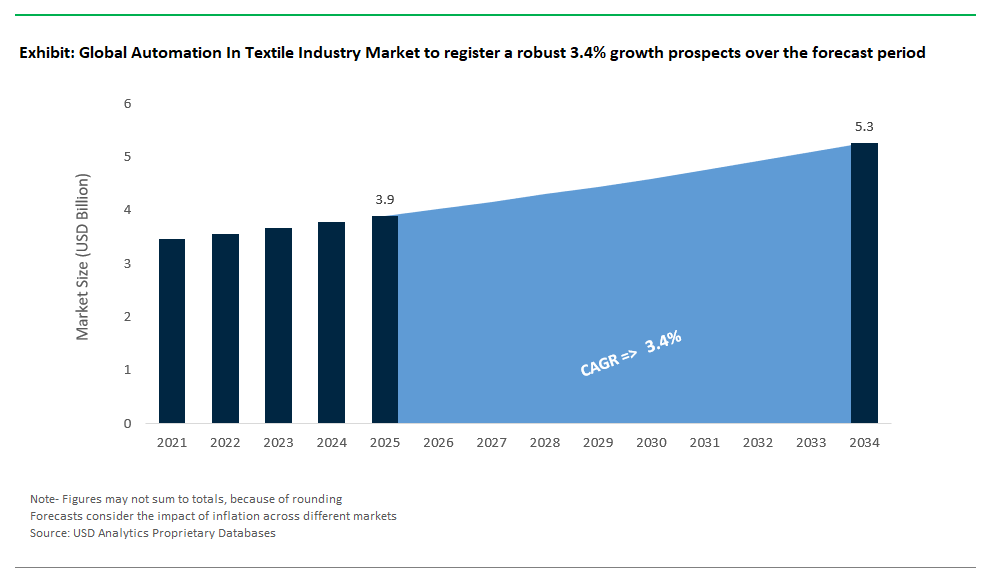
The Global Automation In Textile Industry Market Size is estimated at $3.9 Billion in 2025 and is forecast to register an annual growth rate (CAGR) of 3.4% to reach $5.3 Billion by 2034.
The global Automation In Textile Industry Market Study analyzes and forecasts the market size across 6 regions and 24 countries for diverse segments -By Component (Field devices, Control devices, Communication), By Solution (Hardware and software, Services).
An Introduction to Automation In Textile Industry Market in 2025
The Automation in Textile Industry Market is anticipated to grow significantly in 2025, driven by the rising need for productivity, efficiency, and cost reduction in textile manufacturing. Automated solutions, including robotic arms, smart looms, and AI-integrated quality control systems, are transforming traditional operations. The shift towards sustainable and customized textile production is further fueling demand for automation technologies. Europe and Asia-Pacific lead the market due to advanced manufacturing capabilities and high production volumes. While the high cost of initial implementation poses a challenge, innovations in affordable and modular automation systems are making these technologies accessible to small- and medium-sized enterprises.
Automation In Textile Industry Competitive Landscape
The market report analyses the leading companies in the industry including ATE Pvt. Ltd, Baumuller Nurnberg GmbH, BrainChild Electronic Co. Ltd, Classic Loom Data, Cotmac Electronics Inc, Delta Electronics Inc, Festo SE and Co. KG, Hitachi Ltd, Honeywell International Inc, KUKA AG, Lenze SE, Parker Hannifin Corp, Rockwell Automation Inc, SAURER INTELLIGENT TECHNOLOGY AG, Schneider Electric SE, SIEGER SPINTECH EQUIPMENTS Pvt. Ltd, Siemens AG, Yaskawa Electric Corp, and others.
Automation In Textile Industry Market Dynamics
Automation in Textile Industry Market Trend: Integration of AI and Robotics in Textile Manufacturing
A significant trend in the Automation in Textile Industry Market is the growing integration of artificial intelligence (AI) and robotics into textile manufacturing processes. As textile companies strive to enhance production efficiency, reduce labor costs, and improve product quality, AI-powered solutions and robotic systems are becoming indispensable. Automation systems powered by AI can optimize production schedules, monitor quality control, and even predict machine failures before they occur. Additionally, robotics is increasingly used for tasks such as weaving, stitching, and packaging, reducing the need for manual labor and increasing production speed. This shift toward smart automation is making the textile industry more agile and responsive to market demands, driving growth in the market for automation solutions.
Automation in Textile Industry Market Driver: Demand for Cost Reduction and Increased Efficiency
The demand for cost reduction and increased operational efficiency is a primary driver of the Automation in Textile Industry Market. Labor costs in the textile industry, particularly in emerging markets, have been rising, pushing companies to seek ways to reduce dependency on manual labor. Automation provides a solution by improving operational efficiency, reducing the risk of human error, and accelerating production cycles. Additionally, automation technologies can help reduce material waste, optimize energy consumption, and streamline workflows, all contributing to overall cost savings. These benefits are particularly appealing in an industry where margins are often thin, making automation a key factor for companies looking to remain competitive in a global market.
Automation in Textile Industry Market Opportunity: Expansion in Sustainable and Eco-Friendly Manufacturing
An emerging opportunity in the Automation in Textile Industry Market is the growing demand for sustainable and eco-friendly manufacturing processes. Automation technologies can play a pivotal role in enhancing sustainability in textile production by enabling better control over resource usage, reducing waste, and lowering energy consumption. Automated systems can precisely manage material usage, optimize dyeing processes, and minimize water and chemical waste, which are major environmental concerns in textile manufacturing. As consumers and governments increasingly demand eco-friendly practices, textile companies that adopt automation technologies with sustainability at the forefront will not only improve their environmental footprint but also gain a competitive edge in the market.
Automation In Textile Industry Market Share Analysis: Hardware and Software is expected to generate the highest revenue in 2025.
The largest segment in the automation in the textile industry market by solution is hardware and software. This segment is dominant due to the essential role of integrated systems in optimizing textile manufacturing processes. Automation solutions that combine both hardware, such as sensors, actuators, and robotics, with software for controlling and monitoring operations, are critical in improving production efficiency, quality control, and resource management. The increasing need for automation to reduce labor costs, enhance precision, and streamline operations in textile manufacturing has made hardware and software solutions indispensable in the industry. As textile companies continue to adopt smart technologies, this segment remains the largest and most influential in driving market growth.
Automation In Textile Industry Market Share Analysis: Field Devices is poised to register the fastest growth rate (CAGR) over the forecast period from 2025 to 2034.
The fastest-growing segment in the automation in the textile industry market by component is field devices. Field devices, which include sensors, actuators, and transmitters, play a critical role in collecting data, monitoring processes, and controlling machinery on the factory floor. As the textile industry moves toward more advanced and precise automation systems, the demand for field devices is increasing. These devices enable real-time monitoring, better quality control, and energy-efficient operations, making them essential for optimizing production. The rise of smart factories, IoT integration, and the push for greater automation in textile manufacturing are key factors driving the rapid growth of the field devices segment over the forecast period to 2034.
Automation In Textile Industry Market Report Scope
|
Parameter
|
Details
|
|
Market Size (2025)
|
3.9 Billion
|
|
Market Size (2034)
|
5.3 Billion
|
|
Market Growth Rate
|
3.4%
|
|
Segments
|
By Component (Field devices, Control devices, Communication), By Solution (Hardware and software, Services)
|
|
Study Period
|
2019- 2024 and 2025-2034
|
|
Units
|
Revenue (USD)
|
|
Qualitative Analysis
|
Porter’s Five Forces, SWOT Profile, Market Share, Scenario Forecasts, Market Ecosystem, Company Ranking, Market Dynamics, Industry Benchmarking
|
|
Companies
|
ATE Pvt. Ltd, Baumuller Nurnberg GmbH, BrainChild Electronic Co. Ltd, Classic Loom Data, Cotmac Electronics Inc, Delta Electronics Inc, Festo SE and Co. KG, Hitachi Ltd, Honeywell International Inc, KUKA AG, Lenze SE, Parker Hannifin Corp, Rockwell Automation Inc, SAURER INTELLIGENT TECHNOLOGY AG, Schneider Electric SE, SIEGER SPINTECH EQUIPMENTS Pvt. Ltd, Siemens AG, Yaskawa Electric Corp
|
|
Countries
|
US, Canada, Mexico, Germany, France, Spain, Italy, UK, Russia, China, India, Japan, South Korea, Australia, South East Asia, Brazil, Argentina, Middle East, Africa
|
Automation In Textile Industry Market Segmentation
By Component
Field devices
Control devices
Communication
By Solution
Hardware and software
Services
Countries Analyzed
North America (US, Canada, Mexico)
Europe (Germany, UK, France, Spain, Italy, Russia, Rest of Europe)
Asia Pacific (China, India, Japan, South Korea, Australia, South East Asia, Rest of Asia)
South America (Brazil, Argentina, Rest of South America)
Middle East and Africa (Saudi Arabia, UAE, Rest of Middle East, South Africa, Egypt, Rest of Africa)
Automation In Textile Industry Companies Profiled in the Study
ATE Pvt. Ltd
Baumuller Nurnberg GmbH
BrainChild Electronic Co. Ltd
Classic Loom Data
Cotmac Electronics Inc
Delta Electronics Inc
Festo SE and Co. KG
Hitachi Ltd
Honeywell International Inc
KUKA AG
Lenze SE
Parker Hannifin Corp
Rockwell Automation Inc
SAURER INTELLIGENT TECHNOLOGY AG
Schneider Electric SE
SIEGER SPINTECH EQUIPMENTS Pvt. Ltd
Siemens AG
Yaskawa Electric Corp
*- List Not Exhaustive
TABLE OF CONTENTS
1 Introduction to 2025 Automation In Textile Industry Market
1.1 Market Overview
1.2 Quick Facts
1.3 Scope/Objective of the Study
1.4 Market Definition
1.5 Countries and Regions Covered
1.6 Units, Currency, and Conversions
1.7 Industry Value Chain
2 Research Methodology
2.1 Market Size Estimation
2.2 Sources and Research Methodology
2.3 Data Triangulation
2.4 Assumptions and Limitations
3 Executive Summary
3.1 Global Automation In Textile Industry Market Size Outlook, $ Million, 2021 to 2034
3.2 Automation In Textile Industry Market Outlook by Type, $ Million, 2021 to 2034
3.3 Automation In Textile Industry Market Outlook by Product, $ Million, 2021 to 2034
3.4 Automation In Textile Industry Market Outlook by Application, $ Million, 2021 to 2034
3.5 Automation In Textile Industry Market Outlook by Key Countries, $ Million, 2021 to 2034
4 Market Dynamics
4.1 Key Driving Forces of Automation In Textile Industry Industry
4.2 Key Market Trends in Automation In Textile Industry Industry
4.3 Potential Opportunities in Automation In Textile Industry Industry
4.4 Key Challenges in Automation In Textile Industry Industry
5 Market Factor Analysis
5.1 Value Chain Analysis
5.2 Competitive Landscape
5.2.1 Global Automation In Textile Industry Market Share by Company (%), 2024
5.2.2 Product Offerings by Company
5.3 Porter’s Five Forces Analysis
5.4 Pricing Analysis and Outlook
6 Growth Outlook Across Scenarios
6.1 Growth Analysis-Case Scenario Definitions
6.2 Low Growth Scenario Forecasts
6.3 Reference Growth Scenario Forecasts
6.4 High Growth Scenario Forecasts
7 Global Automation In Textile Industry Market Outlook by Segments
7.1 Automation In Textile Industry Market Outlook by Segments, $ Million, 2021- 2034
By Component
Field devices
Control devices
Communication
By Solution
Hardware and software
Services
8 North America Automation In Textile Industry Market Analysis and Outlook To 2034
8.1 Introduction to North America Automation In Textile Industry Markets in 2025
8.2 North America Automation In Textile Industry Market Size Outlook by Country, 2021-2034
8.2.1 United States
8.2.2 Canada
8.2.3 Mexico
8.3 North America Automation In Textile Industry Market size Outlook by Segments, 2021-2034
By Component
Field devices
Control devices
Communication
By Solution
Hardware and software
Services
9 Europe Automation In Textile Industry Market Analysis and Outlook To 2034
9.1 Introduction to Europe Automation In Textile Industry Markets in 2025
9.2 Europe Automation In Textile Industry Market Size Outlook by Country, 2021-2034
9.2.1 Germany
9.2.2 France
9.2.3 Spain
9.2.4 United Kingdom
9.2.4 Italy
9.2.5 Russia
9.2.6 Norway
9.2.7 Rest of Europe
9.3 Europe Automation In Textile Industry Market Size Outlook by Segments, 2021-2034
By Component
Field devices
Control devices
Communication
By Solution
Hardware and software
Services
10 Asia Pacific Automation In Textile Industry Market Analysis and Outlook To 2034
10.1 Introduction to Asia Pacific Automation In Textile Industry Markets in 2025
10.2 Asia Pacific Automation In Textile Industry Market Size Outlook by Country, 2021-2034
10.2.1 China
10.2.2 India
10.2.3 Japan
10.2.4 South Korea
10.2.5 Indonesia
10.2.6 Malaysia
10.2.7 Australia
10.2.8 Rest of Asia Pacific
10.3 Asia Pacific Automation In Textile Industry Market size Outlook by Segments, 2021-2034
By Component
Field devices
Control devices
Communication
By Solution
Hardware and software
Services
11 South America Automation In Textile Industry Market Analysis and Outlook To 2034
11.1 Introduction to South America Automation In Textile Industry Markets in 2025
11.2 South America Automation In Textile Industry Market Size Outlook by Country, 2021-2034
11.2.1 Brazil
11.2.2 Argentina
11.2.3 Rest of South America
11.3 South America Automation In Textile Industry Market size Outlook by Segments, 2021-2034
By Component
Field devices
Control devices
Communication
By Solution
Hardware and software
Services
12 Middle East and Africa Automation In Textile Industry Market Analysis and Outlook To 2034
12.1 Introduction to Middle East and Africa Automation In Textile Industry Markets in 2025
12.2 Middle East and Africa Automation In Textile Industry Market Size Outlook by Country, 2021-2034
12.2.1 Saudi Arabia
12.2.2 UAE
12.2.3 Oman
12.2.4 Rest of Middle East
12.2.5 Egypt
12.2.6 Nigeria
12.2.7 South Africa
12.2.8 Rest of Africa
12.3 Middle East and Africa Automation In Textile Industry Market size Outlook by Segments, 2021-2034
By Component
Field devices
Control devices
Communication
By Solution
Hardware and software
Services
13 Company Profiles
13.1 Company Snapshot
13.2 SWOT Profiles
13.3 Products and Services
13.4 Recent Developments
13.5 Financial Profile
ATE Pvt. Ltd
Baumuller Nurnberg GmbH
BrainChild Electronic Co. Ltd
Classic Loom Data
Cotmac Electronics Inc
Delta Electronics Inc
Festo SE and Co. KG
Hitachi Ltd
Honeywell International Inc
KUKA AG
Lenze SE
Parker Hannifin Corp
Rockwell Automation Inc
SAURER INTELLIGENT TECHNOLOGY AG
Schneider Electric SE
SIEGER SPINTECH EQUIPMENTS Pvt. Ltd
Siemens AG
Yaskawa Electric Corp
14 Appendix
14.1 Customization Offerings
14.2 Subscription Services
14.3 Related Reports
14.4 Publisher Expertise
