
The global Automotive Control Valves Market study analyzes and forecasts the market size across 6 regions and 24 countries for diverse segments including By Type (Electric, Hydraulic), By Application (Braking System, Hydraulic Control System, Drive System), By Vehicle (Passenger Car, Light Commercial Vehicle, Heavy Commercial Vehicle, Electric Vehicle).
The Automotive Control Valves market encompasses a variety of valves used in vehicle systems such as engine control, transmission control, HVAC (heating, ventilation, and air conditioning), and hydraulic systems. These valves play a crucial role in regulating fluid flow, pressure, and temperature, enabling precise control of vehicle functions and systems. With the automotive industry's increasing focus on efficiency, performance, and emissions reduction, the demand for advanced control valves continues to grow. Manufacturers in this market focus on developing valves with innovative designs, materials, and actuation methods to meet the stringent requirements of modern vehicles and regulatory standards. Moreover, advancements in control valve technology, including electronic actuators, variable valve timing systems, and adaptive valve controls, drive innovation, enabling improved efficiency, responsiveness, and durability. Additionally, as vehicle designs evolve to incorporate more electrification, connectivity, and autonomous features, the Automotive Control Valves market presents opportunities for further innovation and customization to meet the evolving needs of vehicle manufacturers and consumers, ensuring optimal vehicle performance and comfort.
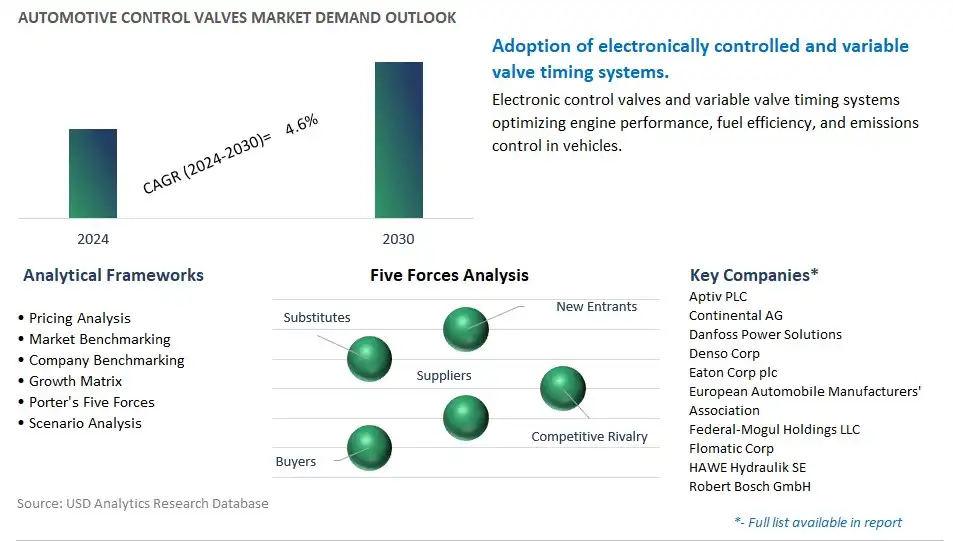
The global Automotive Control Valves market is highly competitive with a large number of companies focusing on niche market segments. Amidst intense competitive conditions, Automotive Control Valves Companies are investing in new product launches and strengthening distribution channels. Key companies operating in the Automotive Control Valves Market Industry include- Aptiv PLC, Continental AG, Danfoss Power Solutions, Denso Corp, Eaton Corp plc, European Automobile Manufacturers' Association, Federal-Mogul Holdings LLC, Flomatic Corp, HAWE Hydraulik SE, Robert Bosch GmbH.
A prominent trend in the automotive control valves market is the integration of electronic control valve systems. With advancements in vehicle technology and the increasing complexity of automotive systems, there's a growing demand for control valves that can be electronically controlled and monitored. Electronic control valve systems offer precise control over fluid flow, pressure, and temperature, allowing for optimized engine performance, fuel efficiency, and emissions reduction. Automakers are integrating electronic control valve systems into various vehicle subsystems such as engine, transmission, HVAC (heating, ventilation, and air conditioning), and suspension to enhance functionality, reliability, and driver comfort. This trend towards the integration of electronic control valve systems is driven by the need for advanced control solutions that can meet the stringent performance and emissions requirements of modern vehicles.
A significant driver shaping the automotive control valves market is the focus on engine efficiency and emissions reduction. With increasingly stringent emissions regulations and consumer demand for fuel-efficient vehicles, automakers are seeking ways to optimize engine performance and reduce environmental impact. Control valves play a crucial role in regulating fluid flow and pressure within the engine and other vehicle systems, influencing factors such as combustion efficiency, exhaust gas recirculation (EGR), and turbocharger operation. By utilizing advanced control valve technologies, automakers can improve engine efficiency, reduce emissions of harmful pollutants, and enhance overall vehicle performance. As regulatory pressures intensify and consumer preferences shift towards greener transportation options, the demand for control valves that contribute to engine efficiency and emissions reduction is expected to grow, propelling market expansion in the automotive control valves segment.
An emerging opportunity in the automotive control valves market lies in the development of smart and connected valve systems. With the proliferation of vehicle connectivity, sensors, and data analytics, there's potential to enhance traditional control valve systems with smart features that enable real-time monitoring, predictive maintenance, and remote diagnostics. Smart control valve systems can collect and analyze data on fluid flow rates, temperatures, and operating conditions, allowing for proactive maintenance and optimization of vehicle performance. Additionally, integrating control valve systems with vehicle telematics and cloud-based platforms enables remote monitoring and management, improving vehicle uptime and reducing maintenance costs. By capitalizing on this opportunity and offering innovative smart and connected valve systems, manufacturers can differentiate themselves in the market, meet the evolving needs of automakers for intelligent control solutions, and drive growth in the automotive control valves segment.
By Type
Electric
Hydraulic
By Application
Braking System
Hydraulic Control System
Drive System
By Vehicle
Passenger Car
Light Commercial Vehicle
Heavy Commercial Vehicle
Electric VehicleGeographical Analysis
North America (United States, Canada, Mexico)
Europe (Germany, France, United Kingdom, Spain, Italy, Rest of Europe)
Asia Pacific (China, India, Japan, South Korea, Rest of Asia Pacific)
South America (Brazil, Argentina, Rest of South America)
Middle East and Africa (Saudi Arabia, UAE, Rest of Middle East, South Africa, Egypt, Rest of Africa
Aptiv PLC
Continental AG
Danfoss Power Solutions
Denso Corp
Eaton Corp plc
European Automobile Manufacturers' Association
Federal-Mogul Holdings LLC
Flomatic Corp
HAWE Hydraulik SE
Robert Bosch GmbH
*- List not Exhaustive
TABLE OF CONTENTS
1 Introduction to 2024 Automotive Control Valves Market
1.1 Market Overview
1.2 Quick Facts
1.3 Scope/Objective of the Study
1.4 Market Definition
1.5 Countries and Regions Analyzed
1.6 Units, Currency, and Conversions
1.7 Industry Value Chain
2 Research Methodology
2.1 Market Size Estimation
2.2 Sources and Research Methodology
2.3 Data Triangulation
2.4 Assumptions and Limitations
3 Executive Summary
3.1 Global Automotive Control Valves Market Size Outlook, $ Million, 2021 to 2030
3.2 Automotive Control Valves Market Outlook by Type, $ Million, 2021 to 2030
3.3 Automotive Control Valves Market Outlook by Product, $ Million, 2021 to 2030
3.4 Automotive Control Valves Market Outlook by Application, $ Million, 2021 to 2030
3.5 Automotive Control Valves Market Outlook by Key Countries, $ Million, 2021 to 2030
4 Market Dynamics
4.1 Key Driving Forces of Automotive Control Valves Industry
4.2 Key Market Trends in Automotive Control Valves Industry
4.3 Potential Opportunities in Automotive Control Valves Industry
4.4 Key Challenges in Automotive Control Valves Industry
5 Market Factor Analysis
5.1 Value Chain Analysis
5.2 Competitive Landscape
5.2.1 Global Automotive Control Valves Market Share by Company (%), 2023
5.2.2 Product Offerings by Company
5.3 Porter’s Five Forces Analysis
5.4 Pricing Analysis and Outlook
6 Growth Outlook Across Scenarios
6.1 Growth Analysis-Case Scenario Definitions
6.2 Low Growth Scenario Forecasts
6.3 Reference Growth Scenario Forecasts
6.4 High Growth Scenario Forecasts
7 Global Automotive Control Valves Market Outlook by Segments
7.1 Automotive Control Valves Market Outlook by Segments, $ Million, 2021- 2030
By Type
Electric
Hydraulic
By Application
Braking System
Hydraulic Control System
Drive System
By Vehicle
Passenger Car
Light Commercial Vehicle
Heavy Commercial Vehicle
Electric Vehicle
8 North America Automotive Control Valves Market Analysis and Outlook To 2030
8.1 Introduction to North America Automotive Control Valves Markets in 2024
8.2 North America Automotive Control Valves Market Size Outlook by Country, 2021-2030
8.2.1 United States
8.2.2 Canada
8.2.3 Mexico
8.3 North America Automotive Control Valves Market size Outlook by Segments, 2021-2030
By Type
Electric
Hydraulic
By Application
Braking System
Hydraulic Control System
Drive System
By Vehicle
Passenger Car
Light Commercial Vehicle
Heavy Commercial Vehicle
Electric Vehicle
9 Europe Automotive Control Valves Market Analysis and Outlook To 2030
9.1 Introduction to Europe Automotive Control Valves Markets in 2024
9.2 Europe Automotive Control Valves Market Size Outlook by Country, 2021-2030
9.2.1 Germany
9.2.2 France
9.2.3 Spain
9.2.4 United Kingdom
9.2.4 Italy
9.2.5 Russia
9.2.6 Norway
9.2.7 Rest of Europe
9.3 Europe Automotive Control Valves Market Size Outlook by Segments, 2021-2030
By Type
Electric
Hydraulic
By Application
Braking System
Hydraulic Control System
Drive System
By Vehicle
Passenger Car
Light Commercial Vehicle
Heavy Commercial Vehicle
Electric Vehicle
10 Asia Pacific Automotive Control Valves Market Analysis and Outlook To 2030
10.1 Introduction to Asia Pacific Automotive Control Valves Markets in 2024
10.2 Asia Pacific Automotive Control Valves Market Size Outlook by Country, 2021-2030
10.2.1 China
10.2.2 India
10.2.3 Japan
10.2.4 South Korea
10.2.5 Indonesia
10.2.6 Malaysia
10.2.7 Australia
10.2.8 Rest of Asia Pacific
10.3 Asia Pacific Automotive Control Valves Market size Outlook by Segments, 2021-2030
By Type
Electric
Hydraulic
By Application
Braking System
Hydraulic Control System
Drive System
By Vehicle
Passenger Car
Light Commercial Vehicle
Heavy Commercial Vehicle
Electric Vehicle
11 South America Automotive Control Valves Market Analysis and Outlook To 2030
11.1 Introduction to South America Automotive Control Valves Markets in 2024
11.2 South America Automotive Control Valves Market Size Outlook by Country, 2021-2030
11.2.1 Brazil
11.2.2 Argentina
11.2.3 Rest of South America
11.3 South America Automotive Control Valves Market size Outlook by Segments, 2021-2030
By Type
Electric
Hydraulic
By Application
Braking System
Hydraulic Control System
Drive System
By Vehicle
Passenger Car
Light Commercial Vehicle
Heavy Commercial Vehicle
Electric Vehicle
12 Middle East and Africa Automotive Control Valves Market Analysis and Outlook To 2030
12.1 Introduction to Middle East and Africa Automotive Control Valves Markets in 2024
12.2 Middle East and Africa Automotive Control Valves Market Size Outlook by Country, 2021-2030
12.2.1 Saudi Arabia
12.2.2 UAE
12.2.3 Oman
12.2.4 Rest of Middle East
12.2.5 Egypt
12.2.6 Nigeria
12.2.7 South Africa
12.2.8 Rest of Africa
12.3 Middle East and Africa Automotive Control Valves Market size Outlook by Segments, 2021-2030
By Type
Electric
Hydraulic
By Application
Braking System
Hydraulic Control System
Drive System
By Vehicle
Passenger Car
Light Commercial Vehicle
Heavy Commercial Vehicle
Electric Vehicle
13 Company Profiles
13.1 Company Snapshot
13.2 SWOT Profiles
13.3 Products and Services
13.4 Recent Developments
13.5 Financial Profile
List of Companies
Aptiv PLC
Continental AG
Danfoss Power Solutions
Denso Corp
Eaton Corp plc
European Automobile Manufacturers' Association
Federal-Mogul Holdings LLC
Flomatic Corp
HAWE Hydraulik SE
Robert Bosch GmbH
14 Appendix
14.1 Customization Offerings
14.2 Subscription Services
14.3 Related Reports
14.4 Publisher Expertise
By Type
Electric
Hydraulic
By Application
Braking System
Hydraulic Control System
Drive System
By Vehicle
Passenger Car
Light Commercial Vehicle
Heavy Commercial Vehicle
Electric Vehicle
The global Automotive Control Valves Market is one of the lucrative growth markets, poised to register a 4.6% growth (CAGR) between 2024 and 2030.
Emerging Markets across Asia Pacific, Europe, and Americas present robust growth prospects.
Aptiv PLC, Continental AG, Danfoss Power Solutions, Denso Corp, Eaton Corp plc, European Automobile Manufacturers' Association, Federal-Mogul Holdings LLC, Flomatic Corp, HAWE Hydraulik SE, Robert Bosch GmbH
Base Year- 2023; Estimated Year- 2024; Historic Period- 2018-2023; Forecast period- 2024 to 2030; Currency: USD; Volume