The global Automotive Tinting Film Market is poised to register a 6.3% CAGR from $9.6 Billion in 2024 to $13.9 Billion in 2030.
The global Automotive Tinting Film Market Study analyzes and forecasts the market size across 6 regions and 24 countries for diverse segments -By Vehicle (Passenger Cars, Light Commercial Vehicles, Heavy Commercial Vehicles), By Application (Windows, Windshields).
An Introduction to Global Automotive Tinting Film Market in 2024
The automotive tinting film market is experiencing robust growth driven by increasing demand for solar heat rejection, UV protection, and privacy enhancement in vehicles. Key trends shaping the future of the industry include the growing popularity of ceramic window films for their superior heat rejection properties, optical clarity, and color stability compared to traditional dyed and metalized films. Moreover, there's a rising emphasis on regulations and standards for automotive window tinting, leading to innovations in film formulations, installation techniques, and tinting equipment to ensure compliance with legal requirements and safety standards. Additionally, advancements in film manufacturing processes, nanotechnology, and spectral analysis tools are driving innovation and market competitiveness, enabling tint film manufacturers to offer a wide range of products and performance options for automotive aftermarket channels and professional installers in the global automotive tinting film market.
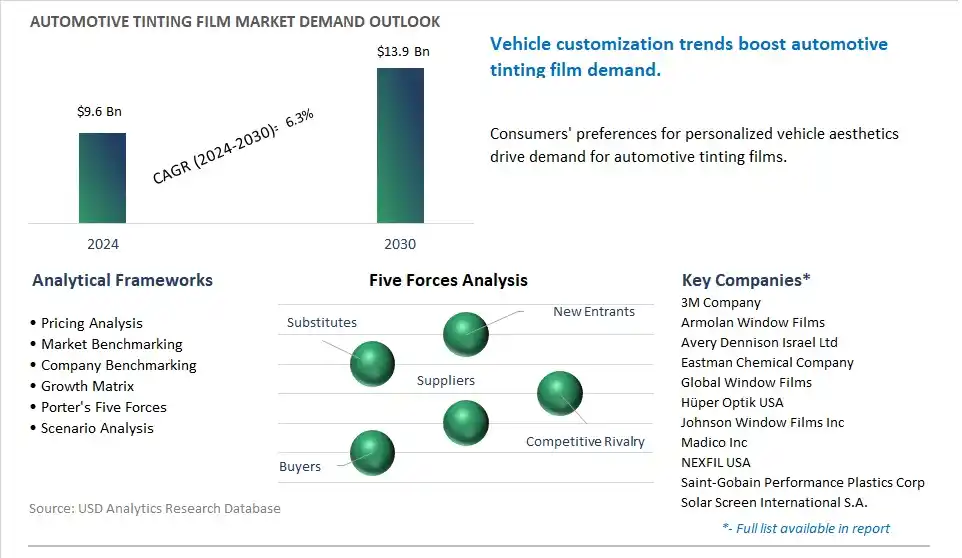
Automotive Tinting Film Market Competitive Landscape
The market report analyses the leading companies in the industry including 3M Company, Armolan Window Films, Avery Dennison Israel Ltd, Eastman Chemical Company, Global Window Films, Hüper Optik USA, Johnson Window Films Inc, Madico Inc, NEXFIL USA, Saint-Gobain Performance Plastics Corp, Solar Screen International S.A., Tintfit Window Films Ltd, TWF Tinting.
Automotive Tinting Film Market Dynamics
Automotive Tinting Film Market Trend: Increasing Demand for Energy-Efficient and UV-Resistant Solutions
A prominent market trend for automotive tinting film is the increasing demand for energy-efficient and UV-resistant solutions. With growing concerns about solar heat gain, glare reduction, and UV protection in vehicles, there's a rising trend towards the adoption of tinting films that offer superior heat rejection properties and UV blocking capabilities. Automotive consumers seek tinting films that not only enhance comfort by reducing interior temperatures but also protect occupants and interior surfaces from harmful UV radiation. As a result, manufacturers are developing tinting films with advanced technologies such as nano-ceramic coatings, multi-layered constructions, and spectrally selective films to provide effective heat rejection while maintaining high visible light transmission. This trend reflects the industry's focus on improving occupant comfort, preserving vehicle interiors, and enhancing energy efficiency, driving the demand for innovative automotive tinting film solutions.
Automotive Tinting Film Market Driver: Regulatory Compliance and Safety Standards
A significant driver for the automotive tinting film market is regulatory compliance and safety standards governing vehicle window tinting. Regulatory agencies in various regions enforce standards and regulations regarding the allowable visible light transmission (VLT) levels for automotive window tinting to ensure driver visibility, road safety, and law enforcement visibility into vehicles. Additionally, regulations may address issues such as coloration, reflectivity, and the use of certain materials in tinting films to prevent interference with electronic devices or emergency services communication. Compliance with these regulations is a critical factor for automotive manufacturers and aftermarket tinting film suppliers to ensure legal compliance and avoid penalties. As a result, the demand for automotive tinting films that meet regulatory requirements and safety standards remains a key driver in the market, influencing product development, manufacturing processes, and distribution strategies.
Automotive Tinting Film Market Opportunity: Development of Smart and Connected Tinting Film Solutions
An opportunity for the automotive tinting film market lies in the development of smart and connected tinting film solutions. With the advancement of automotive technology and the rise of connected vehicles, there's an opportunity to integrate tinting films with smart features and connectivity capabilities. Smart tinting films equipped with sensors, embedded electronics, and wireless communication modules can offer functionalities such as automatic adjustment of tinting levels based on ambient light conditions, occupant preferences, or vehicle operation modes. Additionally, connected tinting films can interface with vehicle infotainment systems, mobile apps, or cloud platforms to provide real-time monitoring, control, and data analytics for tinting performance and maintenance. By leveraging smart and connected technologies, automotive tinting film manufacturers can offer value-added solutions that enhance convenience, safety, and user experience, tapping into emerging market segments and catering to the evolving needs of automotive consumers and OEMs.
Automotive Tinting Film Market Share Analysis: Passenger Cars segment generated the highest revenue in the industry
The Passenger Cars segment is the largest in the Automotive Tinting Film Market, primarily due to diverse key factors. Passenger cars represent the largest segment of the automotive market, with a significant number of vehicles produced and sold globally. As a result, there is a consistently high demand for automotive tinting films among passenger car owners seeking to enhance the appearance, comfort, and privacy of their vehicles. Additionally, passenger car owners often prioritize customization and personalization, including the installation of tinting films to improve aesthetics and reduce interior heat buildup. In addition, automotive tinting films offer diverse benefits for passenger cars, such as UV protection, glare reduction, heat rejection, and privacy enhancement, making them a popular choice among consumers. Further, advancements in tinting film technology, such as ceramic and nano-ceramic films, have further increased their popularity by providing superior optical clarity, durability, and performance. Additionally, regulatory requirements and consumer preferences for energy-efficient and environmentally friendly vehicles have contributed to the adoption of tinting films that offer thermal insulation properties, reducing the need for excessive air conditioning and improving Over the forecast period energy efficiency. As a result of these factors, the Passenger Cars segment remains the largest in the Automotive Tinting Film Market.
Automotive Tinting Film Market Share Analysis: Windshields Segment is poised to register the fastest growth rate (CAGR) over the forecast period to 2030
The Windshields segment is the fastest-growing sector within the Automotive Tinting Film Market, driven by diverse key factors. Traditionally, automotive tinting films were primarily applied to side windows to enhance privacy, reduce glare, and block UV rays. However, advancements in tinting film technology and changes in consumer preferences have led to an increasing demand for tinted windshields. Tinted windshields offer numerous benefits, including improved visibility by reducing glare from sunlight and headlights, enhanced UV protection, and increased cabin comfort by reducing heat buildup. In addition, tinted windshields can help mitigate interior fading and damage caused by UV radiation, prolonging the lifespan of interior components and upholstery. Additionally, as vehicle manufacturers continue to introduce advanced driver assistance systems (ADAS) and in-vehicle display technologies, tinted windshields can help improve the visibility and performance of these systems by reducing glare and reflections. Further, regulatory changes and safety standards that permit the use of tinted windshields in certain jurisdictions have further fueled market growth in this segment. As a result of these factors, the Windshields segment is expected to experience rapid growth in the Automotive Tinting Film Market.
Automotive Tinting Film Market Report Segmentation
By Vehicle
Passenger Cars
Light Commercial Vehicles
Heavy Commercial Vehicles
By Application
Windows
Windshields
Regions Included
North America (US, Canada, Mexico)
Europe (Germany, UK, France, Spain, Italy, Russia, Rest of Europe)
Asia Pacific (China, India, Japan, South Korea, Australia, South East Asia, Rest of Asia)
South America (Brazil, Argentina, Rest of South America)
Middle East and Africa (Saudi Arabia, UAE, Rest of Middle East, South Africa, Egypt, Rest of Africa)
Automotive Tinting Film Companies Profiled in the Market Study
3M Company
Armolan Window Films
Avery Dennison Israel Ltd
Eastman Chemical Company
Global Window Films
Hüper Optik USA
Johnson Window Films Inc
Madico Inc
NEXFIL USA
Saint-Gobain Performance Plastics Corp
Solar Screen International S.A.
Tintfit Window Films Ltd
TWF Tinting
*- List Not Exhaustive
TABLE OF CONTENTS
1 Introduction to 2024 Automotive Tinting Film Market
1.1 Market Overview
1.2 Quick Facts
1.3 Scope/Objective of the Study
1.4 Market Definition
1.5 Countries and Regions Covered
1.6 Units, Currency, and Conversions
1.7 Industry Value Chain
2 Research Methodology
2.1 Market Size Estimation
2.2 Sources and Research Methodology
2.3 Data Triangulation
2.4 Assumptions and Limitations
3 Executive Summary
3.1 Global Automotive Tinting Film Market Size Outlook, $ Million, 2021 to 2030
3.2 Automotive Tinting Film Market Outlook by Type, $ Million, 2021 to 2030
3.3 Automotive Tinting Film Market Outlook by Product, $ Million, 2021 to 2030
3.4 Automotive Tinting Film Market Outlook by Application, $ Million, 2021 to 2030
3.5 Automotive Tinting Film Market Outlook by Key Countries, $ Million, 2021 to 2030
4 Market Dynamics
4.1 Key Driving Forces of Automotive Tinting Film Industry
4.2 Key Market Trends in Automotive Tinting Film Industry
4.3 Potential Opportunities in Automotive Tinting Film Industry
4.4 Key Challenges in Automotive Tinting Film Industry
5 Market Factor Analysis
5.1 Value Chain Analysis
5.2 Competitive Landscape
5.2.1 Global Automotive Tinting Film Market Share by Company (%), 2023
5.2.2 Product Offerings by Company
5.3 Porter’s Five Forces Analysis
5.4 Pricing Analysis and Outlook
6 Growth Outlook Across Scenarios
6.1 Growth Analysis-Case Scenario Definitions
6.2 Low Growth Scenario Forecasts
6.3 Reference Growth Scenario Forecasts
6.4 High Growth Scenario Forecasts
7 Global Automotive Tinting Film Market Outlook by Segments
7.1 Automotive Tinting Film Market Outlook by Segments, $ Million, 2021- 2030
By Vehicle
Passenger Cars
Light Commercial Vehicles
Heavy Commercial Vehicles
By Application
Windows
Windshields
8 North America Automotive Tinting Film Market Analysis and Outlook To 2030
8.1 Introduction to North America Automotive Tinting Film Markets in 2024
8.2 North America Automotive Tinting Film Market Size Outlook by Country, 2021-2030
8.2.1 United States
8.2.2 Canada
8.2.3 Mexico
8.3 North America Automotive Tinting Film Market size Outlook by Segments, 2021-2030
By Vehicle
Passenger Cars
Light Commercial Vehicles
Heavy Commercial Vehicles
By Application
Windows
Windshields
9 Europe Automotive Tinting Film Market Analysis and Outlook To 2030
9.1 Introduction to Europe Automotive Tinting Film Markets in 2024
9.2 Europe Automotive Tinting Film Market Size Outlook by Country, 2021-2030
9.2.1 Germany
9.2.2 France
9.2.3 Spain
9.2.4 United Kingdom
9.2.4 Italy
9.2.5 Russia
9.2.6 Norway
9.2.7 Rest of Europe
9.3 Europe Automotive Tinting Film Market Size Outlook by Segments, 2021-2030
By Vehicle
Passenger Cars
Light Commercial Vehicles
Heavy Commercial Vehicles
By Application
Windows
Windshields
10 Asia Pacific Automotive Tinting Film Market Analysis and Outlook To 2030
10.1 Introduction to Asia Pacific Automotive Tinting Film Markets in 2024
10.2 Asia Pacific Automotive Tinting Film Market Size Outlook by Country, 2021-2030
10.2.1 China
10.2.2 India
10.2.3 Japan
10.2.4 South Korea
10.2.5 Indonesia
10.2.6 Malaysia
10.2.7 Australia
10.2.8 Rest of Asia Pacific
10.3 Asia Pacific Automotive Tinting Film Market size Outlook by Segments, 2021-2030
By Vehicle
Passenger Cars
Light Commercial Vehicles
Heavy Commercial Vehicles
By Application
Windows
Windshields
11 South America Automotive Tinting Film Market Analysis and Outlook To 2030
11.1 Introduction to South America Automotive Tinting Film Markets in 2024
11.2 South America Automotive Tinting Film Market Size Outlook by Country, 2021-2030
11.2.1 Brazil
11.2.2 Argentina
11.2.3 Rest of South America
11.3 South America Automotive Tinting Film Market size Outlook by Segments, 2021-2030
By Vehicle
Passenger Cars
Light Commercial Vehicles
Heavy Commercial Vehicles
By Application
Windows
Windshields
12 Middle East and Africa Automotive Tinting Film Market Analysis and Outlook To 2030
12.1 Introduction to Middle East and Africa Automotive Tinting Film Markets in 2024
12.2 Middle East and Africa Automotive Tinting Film Market Size Outlook by Country, 2021-2030
12.2.1 Saudi Arabia
12.2.2 UAE
12.2.3 Oman
12.2.4 Rest of Middle East
12.2.5 Egypt
12.2.6 Nigeria
12.2.7 South Africa
12.2.8 Rest of Africa
12.3 Middle East and Africa Automotive Tinting Film Market size Outlook by Segments, 2021-2030
By Vehicle
Passenger Cars
Light Commercial Vehicles
Heavy Commercial Vehicles
By Application
Windows
Windshields
13 Company Profiles
13.1 Company Snapshot
13.2 SWOT Profiles
13.3 Products and Services
13.4 Recent Developments
13.5 Financial Profile
3M Company
Armolan Window Films
Avery Dennison Israel Ltd
Eastman Chemical Company
Global Window Films
Hüper Optik USA
Johnson Window Films Inc
Madico Inc
NEXFIL USA
Saint-Gobain Performance Plastics Corp
Solar Screen International S.A.
Tintfit Window Films Ltd
TWF Tinting
14 Appendix
14.1 Customization Offerings
14.2 Subscription Services
14.3 Related Reports
14.4 Publisher Expertise
By Vehicle
Passenger Cars
Light Commercial Vehicles
Heavy Commercial Vehicles
By Application
Windows
Windshields
Countries Analyzed
North America (US, Canada, Mexico)
Europe (Germany, UK, France, Spain, Italy, Russia, Rest of Europe)
Asia Pacific (China, India, Japan, South Korea, Australia, South East Asia, Rest of Asia)
South America (Brazil, Argentina, Rest of South America)
Middle East and Africa (Saudi Arabia, UAE, Rest of Middle East, South Africa, Egypt, Rest of Africa)
