Global Baby Formula Fat Market Size is valued at $3.8 Billion in 2024 and is forecast to register a growth rate (CAGR) of 9.4% to reach $7.8 Billion by 2032.
The global Baby Formula Fat Market Comprehensive Study analyzes and forecasts the market size across 6 regions and 24 countries for diverse segments -By Type (OPO Fat, Others), By Application (0 to 6 Months, 6 to 12 Months, 12 to 36 Months)
An Introduction to Baby Formula Fat Market
The Baby Formula Fat market in 2024 is experiencing significant growth, driven by the critical role of fats in infant development, particularly for brain and eye health. The market includes various fat sources such as vegetable oils, dairy fats, and specialized lipid blends designed to mimic the nutritional profile of human milk. The market is supported by increasing consumer awareness of the importance of high-quality fats in baby formula and the growing demand for premium and scientifically formulated products. Advances in fat extraction and blending technologies are enhancing the nutritional quality and digestibility of baby formula fats, appealing to health-conscious parents.
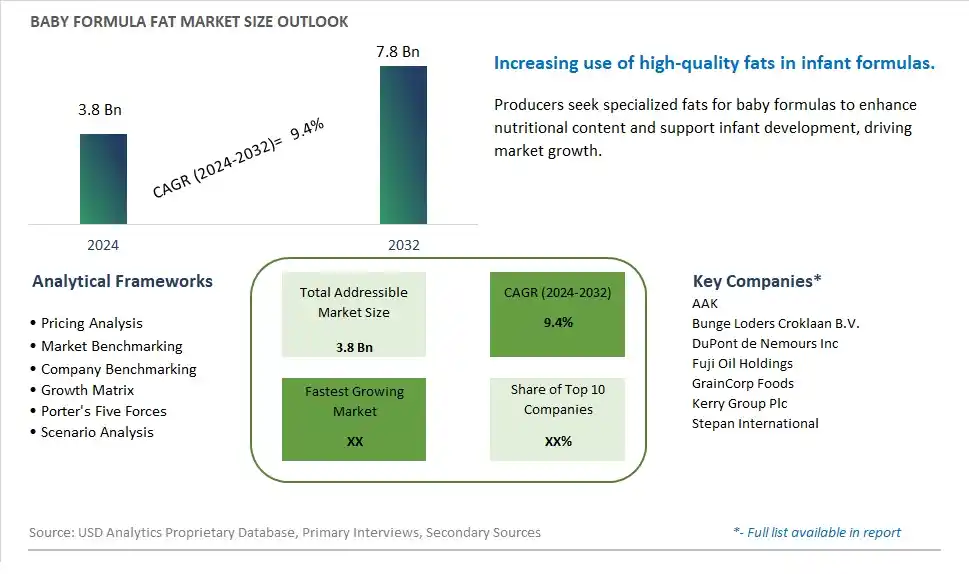
Baby Formula Fat Competitive Landscape
The market report analyses the leading companies in the industry including AAK, Bunge Loders Croklaan B.V., DuPont de Nemours Inc, Fuji Oil Holdings, GrainCorp Foods, Kerry Group Plc, Stepan International, and Others.
Baby Formula Fat Market Dynamics
Baby Formula Fat Market Trend: Demand for Specialized Nutritional Formulations
The most prominent market trend for Baby Formula Fat is the increasing demand for specialized nutritional formulations in infant formula products. As parents become more aware of the importance of early childhood nutrition, there's a growing interest in baby formulas that mimic the composition of breast milk, including the type and ratio of fats. Baby formula fat plays a crucial role in providing essential fatty acids, energy, and supporting brain and eye development in infants, driving the demand for formulas with carefully selected and optimized fat sources that mirror the nutritional benefits of breast milk.
Baby Formula Fat Market Driver: Focus on Infant Health and Development
A key market driver for Baby Formula Fat is the focus on infant health, growth, and cognitive development. Parents and healthcare professionals prioritize formulas that support optimal growth, immune function, and neurological development in infants who are formula-fed. The inclusion of specific fats such as docosahexaenoic acid (DHA) and arachidonic acid (ARA), essential fatty acids found in breast milk, in baby formulas drives demand as these fats are critical for brain development, vision, and overall health during the early stages of life.
Baby Formula Fat Market Opportunity: Innovation in Fat Sources and Nutrient Delivery
A potential opportunity within the Baby Formula Fat market lies in innovation in fat sources and nutrient delivery systems to enhance the nutritional profile and bioavailability of infant formulas. Collaborating with lipid scientists, nutritional experts, and pediatricians can lead to the development of novel fat blends derived from sources such as plant-based oils, algae oils, or human milk oligosaccharides (HMOs) that offer benefits similar to breast milk fats. Additionally, exploring advancements in emulsification technologies, microencapsulation, and liposomal delivery systems can improve the digestion, absorption, and utilization of fats and other nutrients in baby formulas, creating opportunities to create next-generation infant nutrition products that meet the evolving needs and preferences of parents and healthcare providers.
Baby Formula Fat Market Share Analysis: OPO Fat segment generated the highest revenue share in the industry
The largest segment in the Baby Formula Fat Market based on type is OPO Fat. OPO (Oleic-Palmitic-Oleic) fat is a specialized fat blend used in infant formula to mimic the composition of human milk fat. It is designed to provide essential nutrients and promote healthy growth and development in infants. OPO fat has gained significant popularity among manufacturers of infant formula due to its structural and functional similarities to breast milk fat. The fast growth of this segment can be attributed to several factors. Firstly, OPO fat is known for its superior digestibility and absorption, making it a preferred choice for infant formula formulations aimed at supporting optimal digestion and nutrient uptake in babies. Further, OPO fat has been extensively researched and clinically proven to offer benefits such as improved fat absorption, softer stools, and reduced constipation in infants, leading to its increased adoption by parents and healthcare professionals. Furthermore, rising awareness among consumers about the importance of nutrition and the demand for high-quality infant formula products has contributed to the growing preference for OPO fat-based formulations. As the market continues to focus on providing nutritionally advanced and scientifically validated infant nutrition solutions, the OPO fat segment is expected to maintain its prominence and drive further growth in the Baby Formula Fat Market.
Baby Formula Fat Market Share Analysis: 0 to 6 Months is the fastest growing segment over the forecast period to 2032
The fastest-growing segment in the Baby Formula Fat Market based on application is the 0 to 6 Months category. This segment represents the age group of infants from birth to 6 months old who are primarily fed infant formula as a substitute for or supplement to breast milk. The growth of this segment can be attributed to several key factors. Firstly, there is a growing trend of mothers opting for infant formula feeding due to various reasons such as lactation difficulties, work commitments, or personal preferences, especially during the initial months of a baby's life. Further, advancements in infant formula formulations, including specialized fat blends like OPO (Oleic-Palmitic-Oleic) fat, which mimic the composition of human milk fat, have significantly improved the nutritional content and digestibility of infant formula for newborns and young infants. In addition, increased awareness among parents and healthcare professionals about the importance of early nutrition and the role of infant formula in providing essential nutrients for optimal growth and development has led to a higher adoption rate of infant formula among newborns and infants aged 0 to 6 months. As a result, this segment is experiencing rapid growth and is expected to continue expanding as the demand for high-quality infant nutrition solutions remains strong.
Baby Formula Fat Market Segmentation
By Type
OPO Fat
Others
By Application
0 to 6 Months
6 to 12 Months
12 to 36 Months
Countries Analyzed
North America (US, Canada, Mexico)
Europe (Germany, UK, France, Spain, Italy, Russia, Rest of Europe)
Asia Pacific (China, India, Japan, South Korea, Australia, South East Asia, Rest of Asia)
South America (Brazil, Argentina, Rest of South America)
Middle East and Africa (Saudi Arabia, UAE, Rest of Middle East, South Africa, Egypt, Rest of Africa)
Baby Formula Fat Companies Profiled in the Study
AAK
Bunge Loders Croklaan B.V.
DuPont de Nemours Inc
Fuji Oil Holdings
GrainCorp Foods
Kerry Group Plc
Stepan International
*- List Not Exhaustive
Chapter 1. TABLE OF CONTENTS
Chapter 2. Introduction to Baby Formula Fat Market
2.1. Market Overview
2.2. Key Statistics and Report Highlights
2.3. Scope of the Comprehensive Study
2.3.1. Market Definition
2.3.2 Countries and Regions Covered
2.3.3 Research Objective
2.3.4 Units, Currency, and Conversions
2.3.5 Industry Value Chain
2.4. Key Market Segments
2.5. Key Companies
2.6. Study Period
Chapter 3. Strategic Analysis Review
3.1. Baby Formula Fat Pricing Analysis and Forecast
3.2. Porter’s Five Forces
3.3. Market Ecosystem
3.4. SWOT Analysis
3.5. Regulatory Scenario
3.3. Effects of Inflation, Russia-Ukraine War, moderating economic growth, and other macroeconomic factors
Chapter 4. Competitive Landscape
4.1. Market Share Analysis
4.1.1. Global Baby Formula Fat Market Share by Company, 2023
4.1.2. Product Offerings of Leading Baby Formula Fat Companies
4.2. Market Entropy
4.2.1. New Product Launches in the Industry
4.2.2. Mergers, Acquisitions, Joint ventures, and Partnerships
4.3. Key Strategies and Best Practices
Chapter 5. Global Market Projections: Best, Reference, and Low Case Scenarios
5.1. Growth Analysis- Case Scenario Definitions
5.2. Low Growth Case Scenario Forecasts
5.3. Reference Growth Case Scenario Forecasts
5.4. High Growth Case Scenario Forecasts
Chapter 6. Market Dynamics
6.1. Baby Formula Fat Market Drivers
6.2. Baby Formula Fat Market Challenges
6.6. Baby Formula Fat Market Opportunities
6.4. Baby Formula Fat Market Trends
Chapter 7. Global Baby Formula Fat Market Outlook Trends
7.1. Global Baby Formula Fat Revenue (USD Million) and CAGR (%) by Type (2021-2032)
7.2. Global Baby Formula Fat Revenue (USD Million) and CAGR (%) by Application (2021-2032)
7.3. Global Baby Formula Fat Revenue (USD Million) and CAGR (%) by Product (2021-2032)
By Type
OPO Fat
Others
By Application
0 to 6 Months
6 to 12 Months
12 to 36 Months
Chapter 8. Global Baby Formula Fat Regional Analysis and Outlook
8.1. Global Baby Formula Fat Revenue (USD Million) By Regions (2021- 2032)
8.2. North America Baby Formula Fat Revenue (USD Million) by Country (2021-2032)
8.2.1. United States Baby Formula Fat Regional Analysis and Outlook
8.2.2. Canada Baby Formula Fat Regional Analysis and Outlook
8.2.3. Mexico Baby Formula Fat Regional Analysis and Outlook
8.3. Europe Baby Formula Fat Revenue (USD Million), by Country (2021-2032)
8.3.1. Germany Baby Formula Fat Regional Analysis and Outlook
8.3.2. France Baby Formula Fat Regional Analysis and Outlook
8.3.3. United Kingdom Baby Formula Fat Regional Analysis and Outlook
8.3.4. Spain Baby Formula Fat Regional Analysis and Outlook
8.3.5. Italy Baby Formula Fat Regional Analysis and Outlook
8.3.6. Russia Baby Formula Fat Regional Analysis and Outlook
8.3.7. Rest of Europe Baby Formula Fat Regional Analysis and Outlook
8.4. Asia Pacific Baby Formula Fat Revenue (USD Million) by Country (2021-2032)
8.4.1. China Baby Formula Fat Regional Analysis and Outlook
8.4.2. Japan Baby Formula Fat Regional Analysis and Outlook
8.4.3. India Baby Formula Fat Regional Analysis and Outlook
8.4.4. South Korea Baby Formula Fat Regional Analysis and Outlook
8.4.5. Australia Baby Formula Fat Regional Analysis and Outlook
8.4.6. South East Asia Baby Formula Fat Regional Analysis and Outlook
8.4.7. Rest of Asia Pacific Baby Formula Fat Regional Analysis and Outlook
8.5. South America Baby Formula Fat Revenue (USD Million), by Country (2021-2032)
8.5.1. Brazil Baby Formula Fat Regional Analysis and Outlook
8.5.2. Argentina Baby Formula Fat Regional Analysis and Outlook
8.5.3. Rest of South America Baby Formula Fat Regional Analysis and Outlook
8.6. Middle East and Africa Baby Formula Fat Revenue (USD Million) by Country (2021-2032)
8.6.1. Middle East Baby Formula Fat Regional Analysis and Outlook
8.6.2. Africa Baby Formula Fat Regional Analysis and Outlook
Chapter 9. North America Baby Formula Fat Analysis and Outlook
9.1. North America Baby Formula Fat Revenue (USD Million) by Segments (2021-2032)
9.1.1. North America Baby Formula Fat Revenue (USD Million) by Type (2021-2032)
9.1.2. North America Baby Formula Fat Revenue (USD Million) by Application (2021-2032)
9.1.3. North America Baby Formula Fat Revenue (USD Million) by Product (2021-2032)
By Type
OPO Fat
Others
By Application
0 to 6 Months
6 to 12 Months
12 to 36 Months
Chapter 10. Europe Baby Formula Fat Analysis and Outlook
10.1. Europe Baby Formula Fat Revenue (USD Million), by Segments (USD Million) (2021-2032)
10.1.1. Europe Baby Formula Fat Revenue (USD Million) by Type (2021-2032)
10.1.2. Europe Baby Formula Fat Revenue (USD Million) by Application (2021-2032)
10.1.3. Europe Baby Formula Fat Revenue (USD Million) by Product (2021-2032)
By Type
OPO Fat
Others
By Application
0 to 6 Months
6 to 12 Months
12 to 36 Months
Chapter 11. Asia Pacific Baby Formula Fat Analysis and Outlook
11.1. Asia Pacific Baby Formula Fat Revenue (USD Million), and Revenue (USD Million) by Segments (2021-2032)
11.1.1. Asia Pacific Baby Formula Fat Revenue (USD Million) by Type (2021-2032)
11.1.2. Asia Pacific Baby Formula Fat Revenue (USD Million) by Application (2021-2032)
11.1.3. Asia Pacific Baby Formula Fat Revenue (USD Million) by Product (2021-2032)
By Type
OPO Fat
Others
By Application
0 to 6 Months
6 to 12 Months
12 to 36 Months
Chapter 12. South America Baby Formula Fat Analysis and Outlook
12.1. South America Baby Formula Fat Revenue (USD Million), by Segments (2021-2032)
12.1.1. South America Baby Formula Fat Revenue (USD Million) by Type (2021-2032)
12.1.2. South America Baby Formula Fat Revenue (USD Million) by Application (2021-2032)
12.1.3. South America Baby Formula Fat Revenue (USD Million) by Product (2021-2032)
By Type
OPO Fat
Others
By Application
0 to 6 Months
6 to 12 Months
12 to 36 Months
Chapter 13. Middle East and Africa Baby Formula Fat Analysis and Outlook
13.1. Middle East and Africa Baby Formula Fat Revenue (USD Million), by Segments (2021-2032)
13.1.1. Middle East and Africa Baby Formula Fat Revenue (USD Million) by Type (2021-2032)
13.1.2. Middle East and Africa Baby Formula Fat Revenue (USD Million) by Application (2021-2032)
13.1.3. Middle East and Africa Baby Formula Fat Revenue (USD Million) by Product (2021-2032)
By Type
OPO Fat
Others
By Application
0 to 6 Months
6 to 12 Months
12 to 36 Months
Chapter 14. Baby Formula Fat Company Profiles
14.1 Business Overview
14.2 Product Profiles
14.3 SWOT Profiles
14.5 Recent Developments
14.6 Financial Profile
List of Companies
AAK
Bunge Loders Croklaan B.V.
DuPont de Nemours Inc
Fuji Oil Holdings
GrainCorp Foods
Kerry Group Plc
Stepan International
15. Methodology and Data Sources
15.1 Customization Offerings
15.2 Subscription Services
15.3 Related Reports
15.4 Publisher Expertise
LIST OF TABLES
Table 1 Market Segmentation Analysis
Table 2 Global Baby Formula Fat Market Share of Leading Companies, 2023
Table 3 Product Offerings of Leading Companies
Table 4 Low Growth Scenario Forecasts
Table 5 Reference Case Growth Scenario
Table 6 High Growth Case Scenario
Table 7 Global Baby Formula Fat Revenue (USD Million) And CAGR (%) By Type (2021-2032)
Table 8 Global Baby Formula Fat Revenue (USD Million) And CAGR (%) By Application (2021-2032)
Table 9 Global Baby Formula Fat Revenue (USD Million) And CAGR (%) By Product (2021-2032)
Table 10 Global Baby Formula Fat Market Revenue (USD Million) By Regions (2021-2032)
Table 11 Global Baby Formula Fat Market Share (%) By Regions (2021-2032)
Table 12 North America Baby Formula Fat Revenue (USD Million) By Country (2021-2032)
Table 13 Europe Baby Formula Fat Revenue (USD Million) By Country (2021-2032)
Table 14 Asia Pacific Baby Formula Fat Revenue (USD Million) By Country (2021-2032)
Table 15 South America Baby Formula Fat Revenue (USD Million) By Country (2021-2032)
Table 16 Middle East and Africa Baby Formula Fat Revenue (USD Million) By Region (2021-2032)
Table 17 North America Baby Formula Fat Revenue (USD Million) By Type (2021-2032)
Table 18 North America Baby Formula Fat Revenue (USD Million) By Application (2021-2032)
Table 19 North America Baby Formula Fat Revenue (USD Million) By Product (2021-2032)
Table 20 Europe Baby Formula Fat Revenue (USD Million) By Type (2021-2032)
Table 21 Europe Baby Formula Fat Revenue (USD Million) By Application (2021-2032)
Table 22 Europe Baby Formula Fat Revenue (USD Million) By Product (2021-2032)
Table 23 Asia Pacific Baby Formula Fat Revenue (USD Million) By Type (2021-2032)
Table 24 Asia Pacific Baby Formula Fat Revenue (USD Million) By Application (2021-2032)
Table 25 Asia Pacific Baby Formula Fat Revenue (USD Million) By Product (2021-2032)
Table 26 South America Baby Formula Fat Revenue (USD Million) By Type (2021-2032)
Table 27 South America Baby Formula Fat Revenue (USD Million) By Application (2021-2032)
Table 28 South America Baby Formula Fat Revenue (USD Million) By Product (2021-2032)
Table 29 Middle East and Africa Baby Formula Fat Revenue (USD Million) By Type (2021-2032)
Table 30 Middle East and Africa Baby Formula Fat Revenue (USD Million) By Application (2021-2032)
Table 31 Middle East and Africa Baby Formula Fat Revenue (USD Million) By Product (2021-2032)
LIST OF FIGURES
Figure 1. Market Scope
Figure 2. Pricing Forecasts Per Unit, 2023- 2032
Figure 3. Porter’s Five Forces
Figure 4. Global Baby Formula Fat Market Revenue (USD Million) By Regions (2021-2032)
Figure 5. Global Baby Formula Fat Market Share (%) By Regions (2023)
Figure 6. North America Baby Formula Fat Revenue (USD Million) By Country (2021-2032)
Figure 7. United States Baby Formula Fat Revenue (USD Million) By Country (2021-2032)
Figure 8. Canada Baby Formula Fat Revenue (USD Million) By Country (2021-2032)
Figure 9. Mexico Baby Formula Fat Revenue (USD Million) By Country (2021-2032)
Figure 10. Europe Baby Formula Fat Revenue (USD Million) By Country (2021-2032)
Figure 11. Germany Baby Formula Fat Revenue (USD Million) By Country (2021-2032)
Figure 12. France Baby Formula Fat Revenue (USD Million) By Country (2021-2032)
Figure 13. United Kingdom Baby Formula Fat Revenue (USD Million) By Country (2021-2032)
Figure 14. Spain Baby Formula Fat Revenue (USD Million) By Country (2021-2032)
Figure 15. Italy Baby Formula Fat Revenue (USD Million) By Country (2021-2032)
Figure 16. Russia Baby Formula Fat Revenue (USD Million) By Country (2021-2032)
Figure 17. Rest of Europe Baby Formula Fat Revenue (USD Million) By Country (2021-2032)
Figure 11. Asia Pacific Baby Formula Fat Revenue (USD Million) By Country (2021-2032)
Figure 12. China Baby Formula Fat Revenue (USD Million) By Country (2021-2032)
Figure 13. Japan Baby Formula Fat Revenue (USD Million) By Country (2021-2032)
Figure 14. India Baby Formula Fat Revenue (USD Million) By Country (2021-2032)
Figure 15. South Korea Baby Formula Fat Revenue (USD Million) By Country (2021-2032)
Figure 16. Australia Baby Formula Fat Revenue (USD Million) By Country (2021-2032)
Figure 17. South East Asia Baby Formula Fat Revenue (USD Million) By Country (2021-2032)
Figure 18. South America Baby Formula Fat Revenue (USD Million) By Country (2021-2032)
Figure 19. Brazil Baby Formula Fat Revenue (USD Million) By Country (2021-2032)
Figure 20. Argentina Baby Formula Fat Revenue (USD Million) By Country (2021-2032)
Figure 21. Rest of Asia Pacific Baby Formula Fat Revenue (USD Million) By Country (2021-2032)
Figure 22. Middle East and Africa Baby Formula Fat Revenue (USD Million) By Region (2021-2032)
Figure 23. Saudi Arabia Baby Formula Fat Revenue (USD Million) By Region (2021-2032)
Figure 24. The UAE Baby Formula Fat Revenue (USD Million) By Region (2021-2032)
Figure 25. Rest of Middle East Baby Formula Fat Revenue (USD Million) By Region (2021-2032)
Figure 26. South Africa Baby Formula Fat Revenue (USD Million) By Region (2021-2032)
Figure 27. Africa Baby Formula Fat Revenue (USD Million) By Region (2021-2032)
Figure 28. North America Baby Formula Fat Revenue (USD Million) By Type (2021-2032)
Figure 29. North America Baby Formula Fat Revenue (USD Million) By Application (2021-2032)
Figure 30. North America Baby Formula Fat Revenue (USD Million) By Product (2021-2032)
Figure 31. Europe Baby Formula Fat Revenue (USD Million) By Type (2021-2032)
Figure 32. Europe Baby Formula Fat Revenue (USD Million) By Application (2021-2032)
Figure 33. Europe Baby Formula Fat Revenue (USD Million) By Product (2021-2032)
Figure 34. Asia Pacific Baby Formula Fat Revenue (USD Million) By Type (2021-2032)
Figure 35. Asia Pacific Baby Formula Fat Revenue (USD Million) By Application (2021-2032)
Figure 36. Asia Pacific Baby Formula Fat Revenue (USD Million) By Product (2021-2032)
Figure 37. South America Baby Formula Fat Revenue (USD Million) By Type (2021-2032)
Figure 38. South America Baby Formula Fat Revenue (USD Million) By Application (2021-2032)
Figure 39. South America Baby Formula Fat Revenue (USD Million) By Product (2021-2032)
Figure 40. Middle East and Africa Baby Formula Fat Revenue (USD Million) By Type (2021-2032)
Figure 41. Middle East and Africa Baby Formula Fat Revenue (USD Million) By Application (2021-2032)
Figure 42. Middle East and Africa Baby Formula Fat Revenue (USD Million) By Product (2021-2032)
By Type
OPO Fat
Others
By Application
0 to 6 Months
6 to 12 Months
12 to 36 Months
Countries Analyzed
North America (US, Canada, Mexico)
Europe (Germany, UK, France, Spain, Italy, Russia, Rest of Europe)
Asia Pacific (China, India, Japan, South Korea, Australia, South East Asia, Rest of Asia)
South America (Brazil, Argentina, Rest of South America)
Middle East and Africa (Saudi Arabia, UAE, Rest of Middle East, South Africa, Egypt, Rest of Africa)
