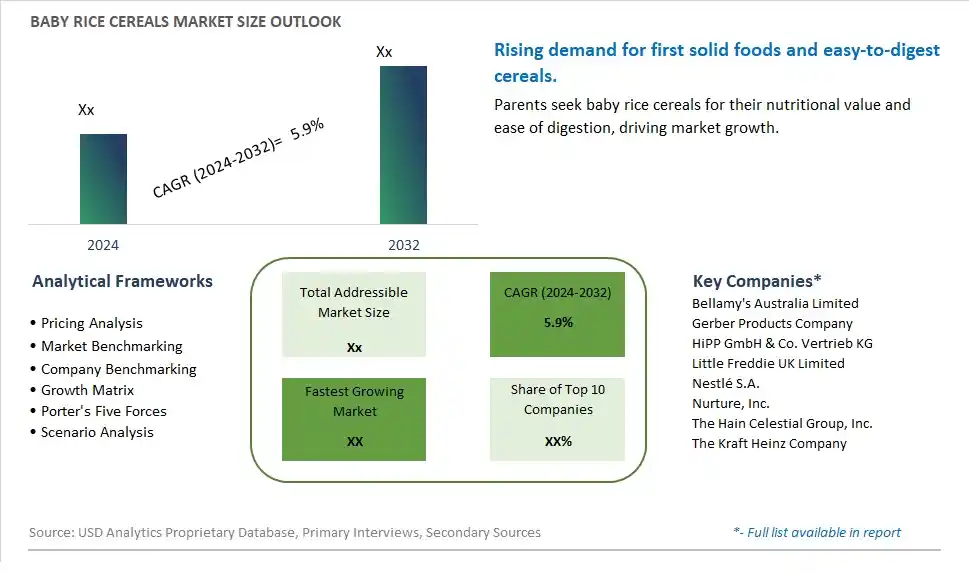
Global Baby Rice Cereals Market Size is valued at $XX Million in 2024 and is forecast to register a growth rate (CAGR) of 5.9% to reach $XX Million by 2032.
The global Baby Rice Cereals Market Comprehensive Study analyzes and forecasts the market size across 6 regions and 24 countries for diverse segments -By Type (Canned, Boxed, Bag, Others), By Sales Channel (Online, Offline)
An Introduction to Baby Rice Cereals Market
The Baby Rice Cereals market in 2024 is expanding rapidly, driven by the growing demand for nutritious, easy-to-digest, and convenient first foods for infants. Baby rice cereals are a popular choice for weaning, providing essential nutrients such as iron, vitamins, and minerals. The market is supported by the increasing awareness of the importance of early childhood nutrition and the preference for hypoallergenic and easily digestible food options. Innovations in cereal formulation and fortification are enhancing the nutritional profile and appeal of baby rice cereals. The market is also benefiting from the trend towards organic and clean-label baby foods, appealing to health-conscious parents.
Baby Rice Cereals Competitive Landscape
The market report analyses the leading companies in the industry including Bellamy's Australia Limited, Gerber Products Company, HiPP GmbH & Co. Vertrieb KG, Little Freddie UK Limited, Nestlé S.A., Nurture, Inc., The Hain Celestial Group, Inc., The Kraft Heinz Company, and Others.
Baby Rice Cereals Market Dynamics
Baby Rice Cereals Market Trend: Diversification and Innovation in Baby Rice Cereals
The most prominent market trend for Baby Rice Cereals is the diversification and innovation in product offerings. While rice cereals have been a staple in infant nutrition, there's a growing trend towards offering a wider variety of rice cereals with added nutrients, flavors, and textures. This trend reflects the desire of parents to provide their babies with diverse and nutritious food options during the weaning process, promoting healthy eating habits from an early age and catering to different taste preferences and dietary needs.
Baby Rice Cereals Market Driver: Focus on Early Childhood Nutrition and Development
A key market driver for Baby Rice Cereals is the focus on early childhood nutrition and development. Parents and caregivers prioritize cereals that provide essential nutrients such as iron, calcium, vitamins, and minerals necessary for healthy growth, cognitive development, and immune function in infants. The convenience and versatility of rice cereals make them a popular choice for introducing solid foods to babies, driving demand for fortified rice cereals that support optimal infant nutrition and meet nutritional recommendations during the weaning period.
Baby Rice Cereals Market Opportunity: Innovation in Nutrient Fortification and Flavor Profiles
A potential opportunity within the Baby Rice Cereals market lies in innovation in nutrient fortification and flavor profiles to enhance product appeal and nutritional value. Collaborating with nutrition experts, food scientists, and flavor specialists can lead to the development of fortified rice cereals with added vitamins, probiotics, prebiotics, and other functional ingredients that promote digestive health, immune support, and overall well-being in babies. Additionally, exploring diverse flavor options such as fruit puree-infused rice cereals, savory blends, and organic varieties can cater to different taste preferences and expand market reach, creating opportunities to attract new consumers and drive growth in the competitive baby cereal segment.
Baby Rice Cereals Market Share Analysis: Boxed segment generated the highest revenue share in the industry
The largest segment in the Baby Rice Cereals Market based on type is "Boxed." Boxed baby rice cereals refer to products that are packaged in boxes for retail sale. This segment's prominence can be attributed to several key factors. Firstly, boxed baby rice cereals offer convenience and ease of use for parents and caregivers, as they come in pre-packaged servings that are convenient for feeding infants and toddlers. The packaging also ensures freshness and easy storage, making it a preferred choice among consumers looking for practical and hygienic baby food options. Further, boxed baby rice cereals often come in a variety of flavors and nutritional formulations, catering to different dietary preferences and requirements, thereby appealing to a broader consumer base. The convenience, variety, and nutritional benefits offered by boxed baby rice cereals have contributed to their widespread adoption and popularity, making the "Boxed" segment the largest in the Baby Rice Cereals Market.
Baby Rice Cereals Market Share Analysis: Online is the fastest growing segment over the forecast period to 2032
The fastest-growing segment in the Baby Rice Cereals Market based on sales channel is "Online." This segment's rapid growth can be attributed to several significant trends in consumer behavior and market dynamics. Firstly, the increasing adoption of e-commerce platforms and digital channels for shopping has transformed the way consumers purchase baby products, including rice cereals. Online sales channels offer convenience, a wide variety of options, and often competitive pricing, attracting busy parents and caregivers looking for hassle-free shopping experiences. Additionally, the ongoing digitalization and advancements in technology have improved the overall online shopping experience, including secure payment options, efficient delivery services, and personalized recommendations, further driving the growth of online sales in the baby food market. As more consumers embrace online shopping for baby products, the "Online" segment is poised for continued rapid growth in the Baby Rice Cereals Market through 2032.
Baby Rice Cereals Market Segmentation
By Type
Canned
Boxed
Bag
Others
By Sales Channel
Online
Offline
Countries Analyzed
North America (US, Canada, Mexico)
Europe (Germany, UK, France, Spain, Italy, Russia, Rest of Europe)
Asia Pacific (China, India, Japan, South Korea, Australia, South East Asia, Rest of Asia)
South America (Brazil, Argentina, Rest of South America)
Middle East and Africa (Saudi Arabia, UAE, Rest of Middle East, South Africa, Egypt, Rest of Africa)
Baby Rice Cereals Companies Profiled in the Study
Bellamy's Australia Limited
Gerber Products Company
HiPP GmbH & Co. Vertrieb KG
Little Freddie UK Limited
Nestlé S.A.
Nurture, Inc.
The Hain Celestial Group, Inc.
The Kraft Heinz Company
*- List Not Exhaustive
Chapter 1. TABLE OF CONTENTS
Chapter 2. Introduction to Baby Rice Cereals Market
2.1. Market Overview
2.2. Key Statistics and Report Highlights
2.3. Scope of the Comprehensive Study
2.3.1. Market Definition
2.3.2 Countries and Regions Covered
2.3.3 Research Objective
2.3.4 Units, Currency, and Conversions
2.3.5 Industry Value Chain
2.4. Key Market Segments
2.5. Key Companies
2.6. Study Period
Chapter 3. Strategic Analysis Review
3.1. Baby Rice Cereals Pricing Analysis and Forecast
3.2. Porter’s Five Forces
3.3. Market Ecosystem
3.4. SWOT Analysis
3.5. Regulatory Scenario
3.3. Effects of Inflation, Russia-Ukraine War, moderating economic growth, and other macroeconomic factors
Chapter 4. Competitive Landscape
4.1. Market Share Analysis
4.1.1. Global Baby Rice Cereals Market Share by Company, 2023
4.1.2. Product Offerings of Leading Baby Rice Cereals Companies
4.2. Market Entropy
4.2.1. New Product Launches in the Industry
4.2.2. Mergers, Acquisitions, Joint ventures, and Partnerships
4.3. Key Strategies and Best Practices
Chapter 5. Global Market Projections: Best, Reference, and Low Case Scenarios
5.1. Growth Analysis- Case Scenario Definitions
5.2. Low Growth Case Scenario Forecasts
5.3. Reference Growth Case Scenario Forecasts
5.4. High Growth Case Scenario Forecasts
Chapter 6. Market Dynamics
6.1. Baby Rice Cereals Market Drivers
6.2. Baby Rice Cereals Market Challenges
6.6. Baby Rice Cereals Market Opportunities
6.4. Baby Rice Cereals Market Trends
Chapter 7. Global Baby Rice Cereals Market Outlook Trends
7.1. Global Baby Rice Cereals Revenue (USD Million) and CAGR (%) by Type (2021-2032)
7.2. Global Baby Rice Cereals Revenue (USD Million) and CAGR (%) by Application (2021-2032)
7.3. Global Baby Rice Cereals Revenue (USD Million) and CAGR (%) by Product (2021-2032)
By Type
Canned
Boxed
Bag
Others
By Sales Channel
Online
Offline
Chapter 8. Global Baby Rice Cereals Regional Analysis and Outlook
8.1. Global Baby Rice Cereals Revenue (USD Million) By Regions (2021- 2032)
8.2. North America Baby Rice Cereals Revenue (USD Million) by Country (2021-2032)
8.2.1. United States Baby Rice Cereals Regional Analysis and Outlook
8.2.2. Canada Baby Rice Cereals Regional Analysis and Outlook
8.2.3. Mexico Baby Rice Cereals Regional Analysis and Outlook
8.3. Europe Baby Rice Cereals Revenue (USD Million), by Country (2021-2032)
8.3.1. Germany Baby Rice Cereals Regional Analysis and Outlook
8.3.2. France Baby Rice Cereals Regional Analysis and Outlook
8.3.3. United Kingdom Baby Rice Cereals Regional Analysis and Outlook
8.3.4. Spain Baby Rice Cereals Regional Analysis and Outlook
8.3.5. Italy Baby Rice Cereals Regional Analysis and Outlook
8.3.6. Russia Baby Rice Cereals Regional Analysis and Outlook
8.3.7. Rest of Europe Baby Rice Cereals Regional Analysis and Outlook
8.4. Asia Pacific Baby Rice Cereals Revenue (USD Million) by Country (2021-2032)
8.4.1. China Baby Rice Cereals Regional Analysis and Outlook
8.4.2. Japan Baby Rice Cereals Regional Analysis and Outlook
8.4.3. India Baby Rice Cereals Regional Analysis and Outlook
8.4.4. South Korea Baby Rice Cereals Regional Analysis and Outlook
8.4.5. Australia Baby Rice Cereals Regional Analysis and Outlook
8.4.6. South East Asia Baby Rice Cereals Regional Analysis and Outlook
8.4.7. Rest of Asia Pacific Baby Rice Cereals Regional Analysis and Outlook
8.5. South America Baby Rice Cereals Revenue (USD Million), by Country (2021-2032)
8.5.1. Brazil Baby Rice Cereals Regional Analysis and Outlook
8.5.2. Argentina Baby Rice Cereals Regional Analysis and Outlook
8.5.3. Rest of South America Baby Rice Cereals Regional Analysis and Outlook
8.6. Middle East and Africa Baby Rice Cereals Revenue (USD Million) by Country (2021-2032)
8.6.1. Middle East Baby Rice Cereals Regional Analysis and Outlook
8.6.2. Africa Baby Rice Cereals Regional Analysis and Outlook
Chapter 9. North America Baby Rice Cereals Analysis and Outlook
9.1. North America Baby Rice Cereals Revenue (USD Million) by Segments (2021-2032)
9.1.1. North America Baby Rice Cereals Revenue (USD Million) by Type (2021-2032)
9.1.2. North America Baby Rice Cereals Revenue (USD Million) by Application (2021-2032)
9.1.3. North America Baby Rice Cereals Revenue (USD Million) by Product (2021-2032)
By Type
Canned
Boxed
Bag
Others
By Sales Channel
Online
Offline
Chapter 10. Europe Baby Rice Cereals Analysis and Outlook
10.1. Europe Baby Rice Cereals Revenue (USD Million), by Segments (USD Million) (2021-2032)
10.1.1. Europe Baby Rice Cereals Revenue (USD Million) by Type (2021-2032)
10.1.2. Europe Baby Rice Cereals Revenue (USD Million) by Application (2021-2032)
10.1.3. Europe Baby Rice Cereals Revenue (USD Million) by Product (2021-2032)
By Type
Canned
Boxed
Bag
Others
By Sales Channel
Online
Offline
Chapter 11. Asia Pacific Baby Rice Cereals Analysis and Outlook
11.1. Asia Pacific Baby Rice Cereals Revenue (USD Million), and Revenue (USD Million) by Segments (2021-2032)
11.1.1. Asia Pacific Baby Rice Cereals Revenue (USD Million) by Type (2021-2032)
11.1.2. Asia Pacific Baby Rice Cereals Revenue (USD Million) by Application (2021-2032)
11.1.3. Asia Pacific Baby Rice Cereals Revenue (USD Million) by Product (2021-2032)
By Type
Canned
Boxed
Bag
Others
By Sales Channel
Online
Offline
Chapter 12. South America Baby Rice Cereals Analysis and Outlook
12.1. South America Baby Rice Cereals Revenue (USD Million), by Segments (2021-2032)
12.1.1. South America Baby Rice Cereals Revenue (USD Million) by Type (2021-2032)
12.1.2. South America Baby Rice Cereals Revenue (USD Million) by Application (2021-2032)
12.1.3. South America Baby Rice Cereals Revenue (USD Million) by Product (2021-2032)
By Type
Canned
Boxed
Bag
Others
By Sales Channel
Online
Offline
Chapter 13. Middle East and Africa Baby Rice Cereals Analysis and Outlook
13.1. Middle East and Africa Baby Rice Cereals Revenue (USD Million), by Segments (2021-2032)
13.1.1. Middle East and Africa Baby Rice Cereals Revenue (USD Million) by Type (2021-2032)
13.1.2. Middle East and Africa Baby Rice Cereals Revenue (USD Million) by Application (2021-2032)
13.1.3. Middle East and Africa Baby Rice Cereals Revenue (USD Million) by Product (2021-2032)
By Type
Canned
Boxed
Bag
Others
By Sales Channel
Online
Offline
Chapter 14. Baby Rice Cereals Company Profiles
14.1 Business Overview
14.2 Product Profiles
14.3 SWOT Profiles
14.5 Recent Developments
14.6 Financial Profile
List of Companies
Bellamy's Australia Limited
Gerber Products Company
HiPP GmbH & Co. Vertrieb KG
Little Freddie UK Limited
Nestlé S.A.
Nurture, Inc.
The Hain Celestial Group, Inc.
The Kraft Heinz Company
15. Methodology and Data Sources
15.1 Customization Offerings
15.2 Subscription Services
15.3 Related Reports
15.4 Publisher Expertise
LIST OF TABLES
Table 1 Market Segmentation Analysis
Table 2 Global Baby Rice Cereals Market Share of Leading Companies, 2023
Table 3 Product Offerings of Leading Companies
Table 4 Low Growth Scenario Forecasts
Table 5 Reference Case Growth Scenario
Table 6 High Growth Case Scenario
Table 7 Global Baby Rice Cereals Revenue (USD Million) And CAGR (%) By Type (2021-2032)
Table 8 Global Baby Rice Cereals Revenue (USD Million) And CAGR (%) By Application (2021-2032)
Table 9 Global Baby Rice Cereals Revenue (USD Million) And CAGR (%) By Product (2021-2032)
Table 10 Global Baby Rice Cereals Market Revenue (USD Million) By Regions (2021-2032)
Table 11 Global Baby Rice Cereals Market Share (%) By Regions (2021-2032)
Table 12 North America Baby Rice Cereals Revenue (USD Million) By Country (2021-2032)
Table 13 Europe Baby Rice Cereals Revenue (USD Million) By Country (2021-2032)
Table 14 Asia Pacific Baby Rice Cereals Revenue (USD Million) By Country (2021-2032)
Table 15 South America Baby Rice Cereals Revenue (USD Million) By Country (2021-2032)
Table 16 Middle East and Africa Baby Rice Cereals Revenue (USD Million) By Region (2021-2032)
Table 17 North America Baby Rice Cereals Revenue (USD Million) By Type (2021-2032)
Table 18 North America Baby Rice Cereals Revenue (USD Million) By Application (2021-2032)
Table 19 North America Baby Rice Cereals Revenue (USD Million) By Product (2021-2032)
Table 20 Europe Baby Rice Cereals Revenue (USD Million) By Type (2021-2032)
Table 21 Europe Baby Rice Cereals Revenue (USD Million) By Application (2021-2032)
Table 22 Europe Baby Rice Cereals Revenue (USD Million) By Product (2021-2032)
Table 23 Asia Pacific Baby Rice Cereals Revenue (USD Million) By Type (2021-2032)
Table 24 Asia Pacific Baby Rice Cereals Revenue (USD Million) By Application (2021-2032)
Table 25 Asia Pacific Baby Rice Cereals Revenue (USD Million) By Product (2021-2032)
Table 26 South America Baby Rice Cereals Revenue (USD Million) By Type (2021-2032)
Table 27 South America Baby Rice Cereals Revenue (USD Million) By Application (2021-2032)
Table 28 South America Baby Rice Cereals Revenue (USD Million) By Product (2021-2032)
Table 29 Middle East and Africa Baby Rice Cereals Revenue (USD Million) By Type (2021-2032)
Table 30 Middle East and Africa Baby Rice Cereals Revenue (USD Million) By Application (2021-2032)
Table 31 Middle East and Africa Baby Rice Cereals Revenue (USD Million) By Product (2021-2032)
LIST OF FIGURES
Figure 1. Market Scope
Figure 2. Pricing Forecasts Per Unit, 2023- 2032
Figure 3. Porter’s Five Forces
Figure 4. Global Baby Rice Cereals Market Revenue (USD Million) By Regions (2021-2032)
Figure 5. Global Baby Rice Cereals Market Share (%) By Regions (2023)
Figure 6. North America Baby Rice Cereals Revenue (USD Million) By Country (2021-2032)
Figure 7. United States Baby Rice Cereals Revenue (USD Million) By Country (2021-2032)
Figure 8. Canada Baby Rice Cereals Revenue (USD Million) By Country (2021-2032)
Figure 9. Mexico Baby Rice Cereals Revenue (USD Million) By Country (2021-2032)
Figure 10. Europe Baby Rice Cereals Revenue (USD Million) By Country (2021-2032)
Figure 11. Germany Baby Rice Cereals Revenue (USD Million) By Country (2021-2032)
Figure 12. France Baby Rice Cereals Revenue (USD Million) By Country (2021-2032)
Figure 13. United Kingdom Baby Rice Cereals Revenue (USD Million) By Country (2021-2032)
Figure 14. Spain Baby Rice Cereals Revenue (USD Million) By Country (2021-2032)
Figure 15. Italy Baby Rice Cereals Revenue (USD Million) By Country (2021-2032)
Figure 16. Russia Baby Rice Cereals Revenue (USD Million) By Country (2021-2032)
Figure 17. Rest of Europe Baby Rice Cereals Revenue (USD Million) By Country (2021-2032)
Figure 11. Asia Pacific Baby Rice Cereals Revenue (USD Million) By Country (2021-2032)
Figure 12. China Baby Rice Cereals Revenue (USD Million) By Country (2021-2032)
Figure 13. Japan Baby Rice Cereals Revenue (USD Million) By Country (2021-2032)
Figure 14. India Baby Rice Cereals Revenue (USD Million) By Country (2021-2032)
Figure 15. South Korea Baby Rice Cereals Revenue (USD Million) By Country (2021-2032)
Figure 16. Australia Baby Rice Cereals Revenue (USD Million) By Country (2021-2032)
Figure 17. South East Asia Baby Rice Cereals Revenue (USD Million) By Country (2021-2032)
Figure 18. South America Baby Rice Cereals Revenue (USD Million) By Country (2021-2032)
Figure 19. Brazil Baby Rice Cereals Revenue (USD Million) By Country (2021-2032)
Figure 20. Argentina Baby Rice Cereals Revenue (USD Million) By Country (2021-2032)
Figure 21. Rest of Asia Pacific Baby Rice Cereals Revenue (USD Million) By Country (2021-2032)
Figure 22. Middle East and Africa Baby Rice Cereals Revenue (USD Million) By Region (2021-2032)
Figure 23. Saudi Arabia Baby Rice Cereals Revenue (USD Million) By Region (2021-2032)
Figure 24. The UAE Baby Rice Cereals Revenue (USD Million) By Region (2021-2032)
Figure 25. Rest of Middle East Baby Rice Cereals Revenue (USD Million) By Region (2021-2032)
Figure 26. South Africa Baby Rice Cereals Revenue (USD Million) By Region (2021-2032)
Figure 27. Africa Baby Rice Cereals Revenue (USD Million) By Region (2021-2032)
Figure 28. North America Baby Rice Cereals Revenue (USD Million) By Type (2021-2032)
Figure 29. North America Baby Rice Cereals Revenue (USD Million) By Application (2021-2032)
Figure 30. North America Baby Rice Cereals Revenue (USD Million) By Product (2021-2032)
Figure 31. Europe Baby Rice Cereals Revenue (USD Million) By Type (2021-2032)
Figure 32. Europe Baby Rice Cereals Revenue (USD Million) By Application (2021-2032)
Figure 33. Europe Baby Rice Cereals Revenue (USD Million) By Product (2021-2032)
Figure 34. Asia Pacific Baby Rice Cereals Revenue (USD Million) By Type (2021-2032)
Figure 35. Asia Pacific Baby Rice Cereals Revenue (USD Million) By Application (2021-2032)
Figure 36. Asia Pacific Baby Rice Cereals Revenue (USD Million) By Product (2021-2032)
Figure 37. South America Baby Rice Cereals Revenue (USD Million) By Type (2021-2032)
Figure 38. South America Baby Rice Cereals Revenue (USD Million) By Application (2021-2032)
Figure 39. South America Baby Rice Cereals Revenue (USD Million) By Product (2021-2032)
Figure 40. Middle East and Africa Baby Rice Cereals Revenue (USD Million) By Type (2021-2032)
Figure 41. Middle East and Africa Baby Rice Cereals Revenue (USD Million) By Application (2021-2032)
Figure 42. Middle East and Africa Baby Rice Cereals Revenue (USD Million) By Product (2021-2032)
By Type
Canned
Boxed
Bag
Others
By Sales Channel
Online
Offline
Countries Analyzed
North America (US, Canada, Mexico)
Europe (Germany, UK, France, Spain, Italy, Russia, Rest of Europe)
Asia Pacific (China, India, Japan, South Korea, Australia, South East Asia, Rest of Asia)
South America (Brazil, Argentina, Rest of South America)
Middle East and Africa (Saudi Arabia, UAE, Rest of Middle East, South Africa, Egypt, Rest of Africa)
