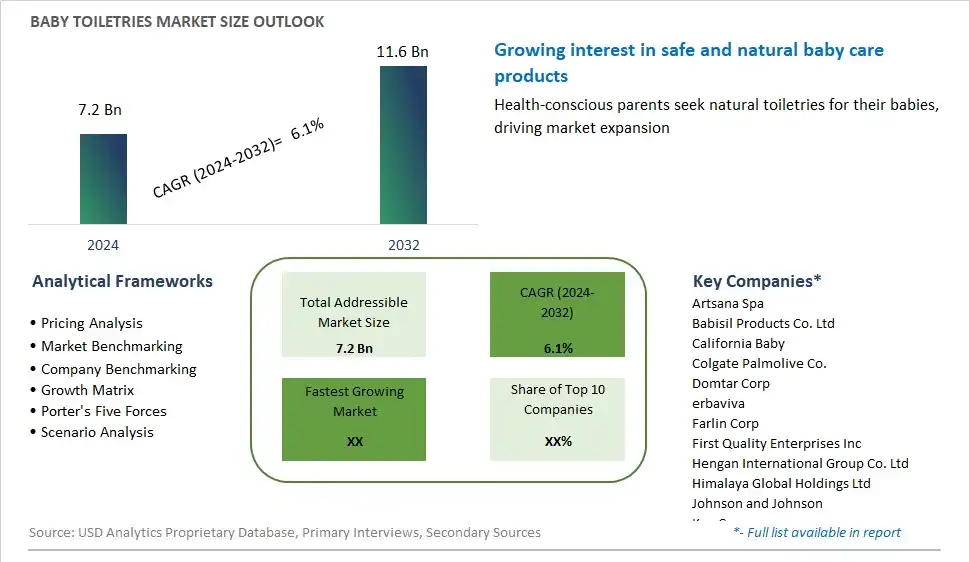
Global Baby Toiletries Market Size is valued at $7.2 Billion in 2024 and is forecast to register a growth rate (CAGR) of 6.1% to reach $11.6 Billion by 2032.
The global Baby Toiletries Market Comprehensive Study analyzes and forecasts the market size across 6 regions and 24 countries for diverse segments -By Product (Skin Care Products, Diapers, Hair Care Products, Wipes, Bathing Products, Others), By Distribution Channel (Hypermarkets/Supermarkets, Chemist and Pharmacy Stores, E-commerce, Others)
An Introduction to Baby Toiletries Market
In 2024, the baby toiletries market is characterized by a growing emphasis on natural, gentle formulations that prioritize the delicate skin and health of infants and toddlers. Parents are increasingly seeking toiletry products free from harsh chemicals, synthetic fragrances, and allergens, opting instead for natural and organic ingredients known for their soothing and moisturizing properties. Baby toiletries encompass a wide range of products, including body washes, lotions, oils, and creams, all formulated to cleanse, hydrate, and protect sensitive skin without causing irritation or dryness. Brands are responding to this demand by incorporating ingredients such as aloe vera, calendula, and chamomile into their formulations, which are known for their calming and nourishing effects on baby's skin. Additionally, there is a growing trend towards sustainable packaging and eco-friendly practices, with brands prioritizing biodegradable materials and recyclable packaging to minimize environmental impact. As parents become more conscious of ingredient safety and environmental sustainability, the baby toiletries market is evolving to meet their needs, offering a wide range of gentle, effective, and planet-friendly options for maintaining baby's hygiene and well-being.
Baby Toiletries Competitive Landscape
The market report analyses the leading companies in the industry including Artsana Spa, Babisil Products Co. Ltd, California Baby, Colgate Palmolive Co., Domtar Corp, erbaviva, Farlin Corp, First Quality Enterprises Inc, Hengan International Group Co. Ltd, Himalaya Global Holdings Ltd, Johnson and Johnson, Kao Corp, Kimberly-Clark Corp, Mothercare Plc, Naterra International Inc, Pigeon Corp, Sebapharma GmbH and Co. KG, The Procter & Gamble Company (P&G), Unicharm Corp, Unilever PLC, and Others.
Baby Toiletries Market Dynamics
Baby Toiletries Market Trend: Rise in Demand for Natural and Organic Baby Toiletries
One prominent trend in the baby toiletries market is the increasing demand for natural and organic products. Parents are becoming more conscious of the ingredients used in baby toiletries, seeking formulations that are free from harsh chemicals, artificial fragrances, and potential allergens. This trend is driven by a growing awareness of the importance of using gentle and safe products on babies' delicate skin, as well as a desire to minimize exposure to potentially harmful substances. As a result, there is a rising preference for baby toiletries made with natural and organic ingredients such as plant extracts, essential oils, and botanicals, which offer gentle cleansing and nourishment without compromising on efficacy.
Market Driver: Parental Focus on Baby's Skin Health and Safety
A key driver shaping the baby toiletries market is parental focus on baby's skin health and safety. Parents prioritize products that are specifically formulated to meet the unique needs of infant skin, which is more sensitive and prone to irritation than adult skin. They seek gentle and hypoallergenic formulations that minimize the risk of skin reactions, dryness, and discomfort. Additionally, with an increasing emphasis on baby grooming and hygiene routines, there is a growing demand for toiletries that offer effective cleansing, moisturizing, and protection against common skin concerns such as diaper rash and eczema. Manufacturers can capitalize on this driver by developing baby toiletry products that address these specific skin care needs, providing parents with peace of mind and confidence in the products they choose for their little ones.
Market Opportunity: Innovation in Sustainable Packaging Solutions
An opportunity for growth in the baby toiletries market lies in innovation in sustainable packaging solutions. With a rising awareness of environmental issues and plastic pollution, consumers, including parents, are seeking eco-friendly alternatives to traditional packaging materials. Manufacturers can seize this opportunity by exploring sustainable packaging options such as biodegradable plastics, recyclable materials, and compostable packaging. By incorporating sustainable packaging practices into their product offerings, brands can appeal to environmentally conscious consumers and differentiate themselves in the market. Additionally, adopting sustainable packaging can enhance brand reputation, foster customer loyalty, and contribute to a more sustainable future for baby care products.
Baby Toiletries Market Share Analysis: Diapers held the dominant market share in 2024
Among the diverse range of products in the baby toiletries market, diapers emerge as the largest segment, primarily due to their essential role in infant care routines. Diapers are indispensable for maintaining cleanliness, comfort, and hygiene for babies, making them a staple product for parents worldwide. The market dominance of diapers is further reinforced by their widespread availability, with a variety of options catering to different preferences, sizes, and absorbency levels. Additionally, advancements in diaper technology, such as improved absorbent materials and leak-proof designs, enhance their performance and reliability, further solidifying their position as the preferred choice for parents. Further, the convenience offered by disposable diapers aligns with the fast-paced lifestyles of modern parents, driving their sustained demand and dominance in the baby toiletries market.
Baby Toiletries Market Share Analysis: E-commerce market is poised to register the fastest growth rae over the forecast period to 2032
The e-commerce segment is the fastest-growing in the baby toiletries market, driven by several key factors. Firstly, the convenience and accessibility offered by online shopping platforms cater to the evolving preferences of modern parents, who prioritize convenience and time-saving solutions for their baby care needs. Secondly, the COVID-19 pandemic has accelerated the shift towards online shopping, as consumers seek contactless transactions and doorstep delivery options to ensure safety. Thirdly, the vast array of baby toiletry products available online, coupled with user-friendly interfaces and personalized recommendations, enhances the overall shopping experience and encourages consumer engagement. Additionally, online platforms provide a platform for niche and boutique brands to reach a wider audience, further diversifying the product offerings in the market. Further, targeted marketing campaigns and promotional offers on online platforms stimulate consumer interest and drive sales in this segment. As a result, the e-commerce distribution channel is poised to continue its rapid expansion, capitalizing on the convenience and accessibility of online shopping and evolving consumer shopping behaviors.
Baby Toiletries Market Segmentation
By Product
Skin Care Products
Diapers
Hair Care Products
Wipes
Bathing Products
Others
By Distribution Channel
Hypermarkets/Supermarkets
Chemist and Pharmacy Stores
E-commerce
Others
Countries Analyzed
North America (US, Canada, Mexico)
Europe (Germany, UK, France, Spain, Italy, Russia, Rest of Europe)
Asia Pacific (China, India, Japan, South Korea, Australia, South East Asia, Rest of Asia)
South America (Brazil, Argentina, Rest of South America)
Middle East and Africa (Saudi Arabia, UAE, Rest of Middle East, South Africa, Egypt, Rest of Africa)
Baby Toiletries Companies Profiled in the Study
Artsana Spa
Babisil Products Co. Ltd
California Baby
Colgate Palmolive Co.
Domtar Corp
erbaviva
Farlin Corp
First Quality Enterprises Inc
Hengan International Group Co. Ltd
Himalaya Global Holdings Ltd
Johnson and Johnson
Kao Corp
Kimberly-Clark Corp
Mothercare Plc
Naterra International Inc
Pigeon Corp
Sebapharma GmbH and Co. KG
The Procter & Gamble Company (P&G)
Unicharm Corp
Unilever PLC
*- List Not Exhaustive
Chapter 1. TABLE OF CONTENTS
Chapter 2. Introduction to Baby Toiletries Market
2.1. Market Overview
2.2. Key Statistics and Report Highlights
2.3. Scope of the Comprehensive Study
2.3.1. Market Definition
2.3.2 Countries and Regions Covered
2.3.3 Research Objective
2.3.4 Units, Currency, and Conversions
2.3.5 Industry Value Chain
2.4. Key Market Segments
2.5. Key Companies
2.6. Study Period
Chapter 3. Strategic Analysis Review
3.1. Baby Toiletries Pricing Analysis and Forecast
3.2. Porter’s Five Forces
3.3. Market Ecosystem
3.4. SWOT Analysis
3.5. Regulatory Scenario
3.3. Effects of Inflation, Russia-Ukraine War, moderating economic growth, and other macroeconomic factors
Chapter 4. Competitive Landscape
4.1. Market Share Analysis
4.1.1. Global Baby Toiletries Market Share by Company, 2023
4.1.2. Product Offerings of Leading Baby Toiletries Companies
4.2. Market Entropy
4.2.1. New Product Launches in the Industry
4.2.2. Mergers, Acquisitions, Joint ventures, and Partnerships
4.3. Key Strategies and Best Practices
Chapter 5. Global Market Projections: Best, Reference, and Low Case Scenarios
5.1. Growth Analysis- Case Scenario Definitions
5.2. Low Growth Case Scenario Forecasts
5.3. Reference Growth Case Scenario Forecasts
5.4. High Growth Case Scenario Forecasts
Chapter 6. Market Dynamics
6.1. Baby Toiletries Market Drivers
6.2. Baby Toiletries Market Challenges
6.6. Baby Toiletries Market Opportunities
6.4. Baby Toiletries Market Trends
Chapter 7. Global Baby Toiletries Market Outlook Trends
7.1. Global Baby Toiletries Revenue (USD Million) and CAGR (%) by Type (2021-2032)
7.2. Global Baby Toiletries Revenue (USD Million) and CAGR (%) by Application (2021-2032)
7.3. Global Baby Toiletries Revenue (USD Million) and CAGR (%) by Product (2021-2032)
By Product
Skin Care Products
Diapers
Hair Care Products
Wipes
Bathing Products
Others
By Distribution Channel
Hypermarkets/Supermarkets
Chemist and Pharmacy Stores
E-commerce
Others
Chapter 8. Global Baby Toiletries Regional Analysis and Outlook
8.1. Global Baby Toiletries Revenue (USD Million) By Regions (2021- 2032)
8.2. North America Baby Toiletries Revenue (USD Million) by Country (2021-2032)
8.2.1. United States Baby Toiletries Regional Analysis and Outlook
8.2.2. Canada Baby Toiletries Regional Analysis and Outlook
8.2.3. Mexico Baby Toiletries Regional Analysis and Outlook
8.3. Europe Baby Toiletries Revenue (USD Million), by Country (2021-2032)
8.3.1. Germany Baby Toiletries Regional Analysis and Outlook
8.3.2. France Baby Toiletries Regional Analysis and Outlook
8.3.3. United Kingdom Baby Toiletries Regional Analysis and Outlook
8.3.4. Spain Baby Toiletries Regional Analysis and Outlook
8.3.5. Italy Baby Toiletries Regional Analysis and Outlook
8.3.6. Russia Baby Toiletries Regional Analysis and Outlook
8.3.7. Rest of Europe Baby Toiletries Regional Analysis and Outlook
8.4. Asia Pacific Baby Toiletries Revenue (USD Million) by Country (2021-2032)
8.4.1. China Baby Toiletries Regional Analysis and Outlook
8.4.2. Japan Baby Toiletries Regional Analysis and Outlook
8.4.3. India Baby Toiletries Regional Analysis and Outlook
8.4.4. South Korea Baby Toiletries Regional Analysis and Outlook
8.4.5. Australia Baby Toiletries Regional Analysis and Outlook
8.4.6. South East Asia Baby Toiletries Regional Analysis and Outlook
8.4.7. Rest of Asia Pacific Baby Toiletries Regional Analysis and Outlook
8.5. South America Baby Toiletries Revenue (USD Million), by Country (2021-2032)
8.5.1. Brazil Baby Toiletries Regional Analysis and Outlook
8.5.2. Argentina Baby Toiletries Regional Analysis and Outlook
8.5.3. Rest of South America Baby Toiletries Regional Analysis and Outlook
8.6. Middle East and Africa Baby Toiletries Revenue (USD Million) by Country (2021-2032)
8.6.1. Middle East Baby Toiletries Regional Analysis and Outlook
8.6.2. Africa Baby Toiletries Regional Analysis and Outlook
Chapter 9. North America Baby Toiletries Analysis and Outlook
9.1. North America Baby Toiletries Revenue (USD Million) by Segments (2021-2032)
9.1.1. North America Baby Toiletries Revenue (USD Million) by Type (2021-2032)
9.1.2. North America Baby Toiletries Revenue (USD Million) by Application (2021-2032)
9.1.3. North America Baby Toiletries Revenue (USD Million) by Product (2021-2032)
By Product
Skin Care Products
Diapers
Hair Care Products
Wipes
Bathing Products
Others
By Distribution Channel
Hypermarkets/Supermarkets
Chemist and Pharmacy Stores
E-commerce
Others
Chapter 10. Europe Baby Toiletries Analysis and Outlook
10.1. Europe Baby Toiletries Revenue (USD Million), by Segments (USD Million) (2021-2032)
10.1.1. Europe Baby Toiletries Revenue (USD Million) by Type (2021-2032)
10.1.2. Europe Baby Toiletries Revenue (USD Million) by Application (2021-2032)
10.1.3. Europe Baby Toiletries Revenue (USD Million) by Product (2021-2032)
By Product
Skin Care Products
Diapers
Hair Care Products
Wipes
Bathing Products
Others
By Distribution Channel
Hypermarkets/Supermarkets
Chemist and Pharmacy Stores
E-commerce
Others
Chapter 11. Asia Pacific Baby Toiletries Analysis and Outlook
11.1. Asia Pacific Baby Toiletries Revenue (USD Million), and Revenue (USD Million) by Segments (2021-2032)
11.1.1. Asia Pacific Baby Toiletries Revenue (USD Million) by Type (2021-2032)
11.1.2. Asia Pacific Baby Toiletries Revenue (USD Million) by Application (2021-2032)
11.1.3. Asia Pacific Baby Toiletries Revenue (USD Million) by Product (2021-2032)
By Product
Skin Care Products
Diapers
Hair Care Products
Wipes
Bathing Products
Others
By Distribution Channel
Hypermarkets/Supermarkets
Chemist and Pharmacy Stores
E-commerce
Others
Chapter 12. South America Baby Toiletries Analysis and Outlook
12.1. South America Baby Toiletries Revenue (USD Million), by Segments (2021-2032)
12.1.1. South America Baby Toiletries Revenue (USD Million) by Type (2021-2032)
12.1.2. South America Baby Toiletries Revenue (USD Million) by Application (2021-2032)
12.1.3. South America Baby Toiletries Revenue (USD Million) by Product (2021-2032)
By Product
Skin Care Products
Diapers
Hair Care Products
Wipes
Bathing Products
Others
By Distribution Channel
Hypermarkets/Supermarkets
Chemist and Pharmacy Stores
E-commerce
Others
Chapter 13. Middle East and Africa Baby Toiletries Analysis and Outlook
13.1. Middle East and Africa Baby Toiletries Revenue (USD Million), by Segments (2021-2032)
13.1.1. Middle East and Africa Baby Toiletries Revenue (USD Million) by Type (2021-2032)
13.1.2. Middle East and Africa Baby Toiletries Revenue (USD Million) by Application (2021-2032)
13.1.3. Middle East and Africa Baby Toiletries Revenue (USD Million) by Product (2021-2032)
By Product
Skin Care Products
Diapers
Hair Care Products
Wipes
Bathing Products
Others
By Distribution Channel
Hypermarkets/Supermarkets
Chemist and Pharmacy Stores
E-commerce
Others
Chapter 14. Baby Toiletries Company Profiles
14.1 Business Overview
14.2 Product Profiles
14.3 SWOT Profiles
14.5 Recent Developments
14.6 Financial Profile
List of Companies
Artsana Spa
Babisil Products Co. Ltd
California Baby
Colgate Palmolive Co.
Domtar Corp
erbaviva
Farlin Corp
First Quality Enterprises Inc
Hengan International Group Co. Ltd
Himalaya Global Holdings Ltd
Johnson and Johnson
Kao Corp
Kimberly-Clark Corp
Mothercare Plc
Naterra International Inc
Pigeon Corp
Sebapharma GmbH and Co. KG
The Procter & Gamble Company (P&G)
Unicharm Corp
Unilever PLC
15. Methodology and Data Sources
15.1 Customization Offerings
15.2 Subscription Services
15.3 Related Reports
15.4 Publisher Expertise
LIST OF TABLES
Table 1 Market Segmentation Analysis
Table 2 Global Baby Toiletries Market Share of Leading Companies, 2023
Table 3 Product Offerings of Leading Companies
Table 4 Low Growth Scenario Forecasts
Table 5 Reference Case Growth Scenario
Table 6 High Growth Case Scenario
Table 7 Global Baby Toiletries Revenue (USD Million) And CAGR (%) By Type (2021-2032)
Table 8 Global Baby Toiletries Revenue (USD Million) And CAGR (%) By Application (2021-2032)
Table 9 Global Baby Toiletries Revenue (USD Million) And CAGR (%) By Product (2021-2032)
Table 10 Global Baby Toiletries Market Revenue (USD Million) By Regions (2021-2032)
Table 11 Global Baby Toiletries Market Share (%) By Regions (2021-2032)
Table 12 North America Baby Toiletries Revenue (USD Million) By Country (2021-2032)
Table 13 Europe Baby Toiletries Revenue (USD Million) By Country (2021-2032)
Table 14 Asia Pacific Baby Toiletries Revenue (USD Million) By Country (2021-2032)
Table 15 South America Baby Toiletries Revenue (USD Million) By Country (2021-2032)
Table 16 Middle East and Africa Baby Toiletries Revenue (USD Million) By Region (2021-2032)
Table 17 North America Baby Toiletries Revenue (USD Million) By Type (2021-2032)
Table 18 North America Baby Toiletries Revenue (USD Million) By Application (2021-2032)
Table 19 North America Baby Toiletries Revenue (USD Million) By Product (2021-2032)
Table 20 Europe Baby Toiletries Revenue (USD Million) By Type (2021-2032)
Table 21 Europe Baby Toiletries Revenue (USD Million) By Application (2021-2032)
Table 22 Europe Baby Toiletries Revenue (USD Million) By Product (2021-2032)
Table 23 Asia Pacific Baby Toiletries Revenue (USD Million) By Type (2021-2032)
Table 24 Asia Pacific Baby Toiletries Revenue (USD Million) By Application (2021-2032)
Table 25 Asia Pacific Baby Toiletries Revenue (USD Million) By Product (2021-2032)
Table 26 South America Baby Toiletries Revenue (USD Million) By Type (2021-2032)
Table 27 South America Baby Toiletries Revenue (USD Million) By Application (2021-2032)
Table 28 South America Baby Toiletries Revenue (USD Million) By Product (2021-2032)
Table 29 Middle East and Africa Baby Toiletries Revenue (USD Million) By Type (2021-2032)
Table 30 Middle East and Africa Baby Toiletries Revenue (USD Million) By Application (2021-2032)
Table 31 Middle East and Africa Baby Toiletries Revenue (USD Million) By Product (2021-2032)
LIST OF FIGURES
Figure 1. Market Scope
Figure 2. Pricing Forecasts Per Unit, 2023- 2032
Figure 3. Porter’s Five Forces
Figure 4. Global Baby Toiletries Market Revenue (USD Million) By Regions (2021-2032)
Figure 5. Global Baby Toiletries Market Share (%) By Regions (2023)
Figure 6. North America Baby Toiletries Revenue (USD Million) By Country (2021-2032)
Figure 7. United States Baby Toiletries Revenue (USD Million) By Country (2021-2032)
Figure 8. Canada Baby Toiletries Revenue (USD Million) By Country (2021-2032)
Figure 9. Mexico Baby Toiletries Revenue (USD Million) By Country (2021-2032)
Figure 10. Europe Baby Toiletries Revenue (USD Million) By Country (2021-2032)
Figure 11. Germany Baby Toiletries Revenue (USD Million) By Country (2021-2032)
Figure 12. France Baby Toiletries Revenue (USD Million) By Country (2021-2032)
Figure 13. United Kingdom Baby Toiletries Revenue (USD Million) By Country (2021-2032)
Figure 14. Spain Baby Toiletries Revenue (USD Million) By Country (2021-2032)
Figure 15. Italy Baby Toiletries Revenue (USD Million) By Country (2021-2032)
Figure 16. Russia Baby Toiletries Revenue (USD Million) By Country (2021-2032)
Figure 17. Rest of Europe Baby Toiletries Revenue (USD Million) By Country (2021-2032)
Figure 11. Asia Pacific Baby Toiletries Revenue (USD Million) By Country (2021-2032)
Figure 12. China Baby Toiletries Revenue (USD Million) By Country (2021-2032)
Figure 13. Japan Baby Toiletries Revenue (USD Million) By Country (2021-2032)
Figure 14. India Baby Toiletries Revenue (USD Million) By Country (2021-2032)
Figure 15. South Korea Baby Toiletries Revenue (USD Million) By Country (2021-2032)
Figure 16. Australia Baby Toiletries Revenue (USD Million) By Country (2021-2032)
Figure 17. South East Asia Baby Toiletries Revenue (USD Million) By Country (2021-2032)
Figure 18. South America Baby Toiletries Revenue (USD Million) By Country (2021-2032)
Figure 19. Brazil Baby Toiletries Revenue (USD Million) By Country (2021-2032)
Figure 20. Argentina Baby Toiletries Revenue (USD Million) By Country (2021-2032)
Figure 21. Rest of Asia Pacific Baby Toiletries Revenue (USD Million) By Country (2021-2032)
Figure 22. Middle East and Africa Baby Toiletries Revenue (USD Million) By Region (2021-2032)
Figure 23. Saudi Arabia Baby Toiletries Revenue (USD Million) By Region (2021-2032)
Figure 24. The UAE Baby Toiletries Revenue (USD Million) By Region (2021-2032)
Figure 25. Rest of Middle East Baby Toiletries Revenue (USD Million) By Region (2021-2032)
Figure 26. South Africa Baby Toiletries Revenue (USD Million) By Region (2021-2032)
Figure 27. Africa Baby Toiletries Revenue (USD Million) By Region (2021-2032)
Figure 28. North America Baby Toiletries Revenue (USD Million) By Type (2021-2032)
Figure 29. North America Baby Toiletries Revenue (USD Million) By Application (2021-2032)
Figure 30. North America Baby Toiletries Revenue (USD Million) By Product (2021-2032)
Figure 31. Europe Baby Toiletries Revenue (USD Million) By Type (2021-2032)
Figure 32. Europe Baby Toiletries Revenue (USD Million) By Application (2021-2032)
Figure 33. Europe Baby Toiletries Revenue (USD Million) By Product (2021-2032)
Figure 34. Asia Pacific Baby Toiletries Revenue (USD Million) By Type (2021-2032)
Figure 35. Asia Pacific Baby Toiletries Revenue (USD Million) By Application (2021-2032)
Figure 36. Asia Pacific Baby Toiletries Revenue (USD Million) By Product (2021-2032)
Figure 37. South America Baby Toiletries Revenue (USD Million) By Type (2021-2032)
Figure 38. South America Baby Toiletries Revenue (USD Million) By Application (2021-2032)
Figure 39. South America Baby Toiletries Revenue (USD Million) By Product (2021-2032)
Figure 40. Middle East and Africa Baby Toiletries Revenue (USD Million) By Type (2021-2032)
Figure 41. Middle East and Africa Baby Toiletries Revenue (USD Million) By Application (2021-2032)
Figure 42. Middle East and Africa Baby Toiletries Revenue (USD Million) By Product (2021-2032)
By Product
Skin Care Products
Diapers
Hair Care Products
Wipes
Bathing Products
Others
By Distribution Channel
Hypermarkets/Supermarkets
Chemist and Pharmacy Stores
E-commerce
Others
Countries Analyzed
North America (US, Canada, Mexico)
Europe (Germany, UK, France, Spain, Italy, Russia, Rest of Europe)
Asia Pacific (China, India, Japan, South Korea, Australia, South East Asia, Rest of Asia)
South America (Brazil, Argentina, Rest of South America)
Middle East and Africa (Saudi Arabia, UAE, Rest of Middle East, South Africa, Egypt, Rest of Africa)
