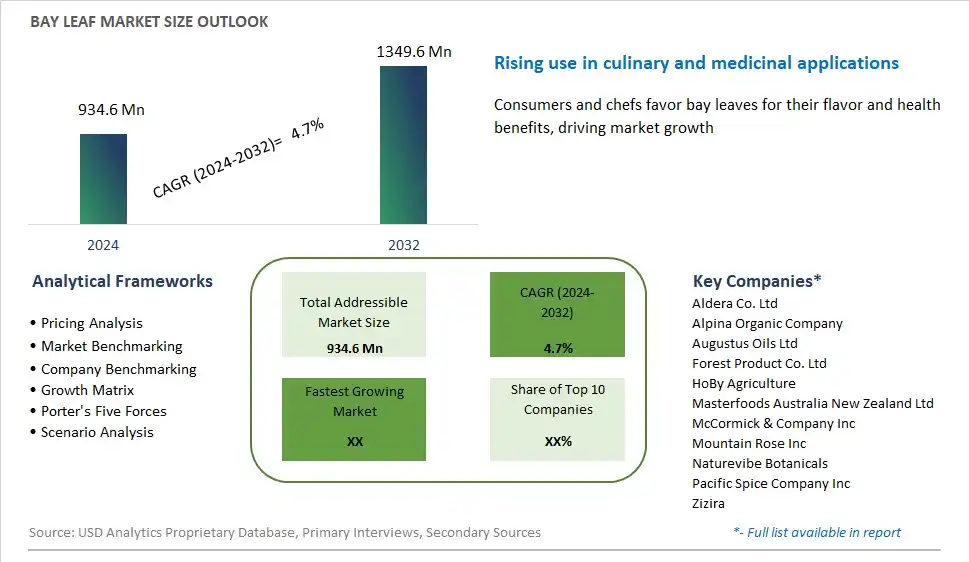
Global Bay Leaf Market Size is valued at $934.6 Million in 2024 and is forecast to register a growth rate (CAGR) of 4.7% to reach $1349.6 Million by 2032.
The global Bay Leaf Market Comprehensive Study analyzes and forecasts the market size across 6 regions and 24 countries for diverse segments -By Type (Flake, Powder), By Application (Food and Beverage, Pharmaceutical, Cosmetics and Personal Care, Others), By Product (Conventional, Organic)
An Introduction to Bay Leaf Market
Bay leaf, an aromatic herb commonly used in cooking, continues to be a staple ingredient in kitchens worldwide in 2024. Known for its distinctive flavor and fragrance, bay leaf adds depth and complexity to a wide range of savory dishes, including soups, stews, sauces, and braises. While primarily used whole and removed before serving, bay leaves can also be ground into a fine powder to infuse their essence more thoroughly into dishes. In addition to its culinary applications, bay leaf is valued for its potential health benefits, including digestive support, anti-inflammatory properties, and antimicrobial effects. Moreover, bay leaf is often incorporated into natural remedies and home remedies for various ailments, ranging from indigestion and respiratory issues to skin conditions and hair care. With its versatility and aromatic allure, bay leaf remains a cherished ingredient in culinary traditions around the world, adding depth, flavor, and a touch of nostalgia to home-cooked meals and culinary creations.
Bay Leaf Competitive Landscape
The market report analyses the leading companies in the industry including Aldera Co. Ltd, Alpina Organic Company, Augustus Oils Ltd, Forest Product Co. Ltd, HoBy Agriculture, Masterfoods Australia New Zealand Ltd, McCormick & Company Inc, Mountain Rose Inc, Naturevibe Botanicals, Pacific Spice Company Inc, Zizira, and Others.
Bay Leaf Market Dynamics
Bay Leaf Market Trend: Growing Demand for Natural and Organic Ingredients in Food and Wellness Products
The market trend for bay leaf reflects a growing consumer preference for natural and organic ingredients in food and wellness products. Bay leaf, with its distinct aroma and flavor profile, is sought after for its culinary uses in various cuisines worldwide. Moreover, its medicinal properties, including anti-inflammatory and digestive benefits, contribute to its popularity in herbal remedies and wellness products. As consumers become more health-conscious and seek alternatives to artificial additives and preservatives, the demand for bay leaf as a natural flavoring and therapeutic ingredient is expected to continue rising. This trend is driving manufacturers and suppliers to ensure sustainable sourcing practices and quality standards to meet the increasing demand for bay leaf products.
Market Driver: Expansion of Ethnic and International Cuisines
The expansion of ethnic and international cuisines is a significant driver of the bay leaf market. Bay leaf is a staple ingredient in many traditional dishes from Mediterranean, Indian, and Southeast Asian cuisines, among others. As global travel and cultural exchange increase, so does the popularity of these cuisines worldwide. Additionally, the growing trend of home cooking and culinary exploration has led consumers to seek out authentic ingredients to recreate traditional flavors at home. Bay leaf's versatility and ability to enhance the taste and aroma of diverse dishes make it a valuable ingredient in both professional and home kitchens. This driver is fueling the demand for bay leaf in various forms, including dried whole leaves, ground powder, and essential oil extracts.
Market Opportunity: Diversification of Bay Leaf Products and Applications
One potential opportunity in the bay leaf market lies in the diversification of products and applications beyond traditional culinary uses. While bay leaf is primarily known as a culinary herb, its aromatic and medicinal properties open doors to a wide range of applications across industries. For instance, bay leaf extracts and essential oils can be incorporated into personal care products such as soaps, lotions, and aromatherapy blends for their fragrance and therapeutic benefits. Furthermore, bay leaf-infused beverages, teas, and dietary supplements present opportunities to capitalize on its health-promoting properties. By exploring innovative product formulations and tapping into emerging trends in health and wellness, companies can unlock new revenue streams and expand the market reach of bay leaf beyond traditional boundaries.
Bay Leaf Market Share Analysis: Bay Leaf Powder held the dominant market share in 2024
In the bay leaf market, bay leaf powder is the largest segment, primarily due to its convenience, versatility, and ease of use in culinary applications. Bay leaf powder is derived from dried bay leaves that have been ground into a fine powder, offering a concentrated flavor profile and aroma reminiscent of fresh bay leaves. Its powdered form allows for easy incorporation into various dishes, sauces, soups, and stews, eliminating the need for removing whole bay leaves before serving. Additionally, bay leaf powder offers consistent flavor distribution throughout the dish, ensuring a uniform taste experience for consumers. Further, the longer shelf life of bay leaf powder compared to whole bay leaves contributes to its popularity among consumers and food manufacturers. With its convenience, versatility, and prolonged freshness, bay leaf powder maintains its stronghold as the largest segment in the bay leaf market, meeting the diverse culinary needs and preferences of consumers worldwide.
Bay Leaf Market Share Analysis: Pharmaceutical Application market is poised to register the fastest growth rae over the forecast period to 2032
Among the applications in the bay leaf market, the pharmaceutical segment is the fastest-growing, driven by several key factors. Firstly, bay leaves contain bioactive compounds such as polyphenols, flavonoids, and essential oils, which possess antioxidant, anti-inflammatory, and antimicrobial properties. These medicinal properties make bay leaves a valuable ingredient in herbal remedies and pharmaceutical formulations targeting various health conditions, including digestive disorders, respiratory ailments, and skin conditions. Secondly, the increasing consumer interest in natural and plant-based alternatives to conventional medications fuels the demand for bay leaf extracts and supplements in the pharmaceutical industry. Thirdly, ongoing research and scientific studies exploring the therapeutic potential of bay leaves further validate their efficacy and safety for medicinal use, contributing to their growing acceptance and adoption in pharmaceutical applications. Further, the versatility of bay leaves in addressing multiple health concerns and their historical use in traditional medicine systems worldwide bolster their appeal to pharmaceutical manufacturers and healthcare professionals. With their promising medicinal properties and expanding applications in pharmaceutical formulations, bay leaves are poised to continue their rapid growth trajectory in the market, meeting the growing demand for natural and holistic healthcare solutions.
Bay Leaf Market Share Analysis: Conventional Bay Leaf Products held the dominant market share in 2024
In the bay leaf market, conventional bay leaf products emerge as the largest segment, primarily due to their widespread availability, established production practices, and consumer familiarity. Conventional bay leaf products are cultivated using traditional farming methods and may incorporate standard agricultural practices, including the use of synthetic fertilizers and pesticides. Their accessibility and affordability make them a preferred choice for consumers across various demographics and regions. Additionally, conventional bay leaf products maintain consistent quality standards and flavor profiles, ensuring a reliable and satisfactory culinary experience for consumers. Further, the established supply chain networks for conventional bay leaf products ensure their widespread distribution in supermarkets, grocery stores, and foodservice establishments worldwide. With their accessibility, affordability, and consistent quality, conventional bay leaf products maintain their stronghold as the largest segment in the market, meeting the diverse culinary needs and preferences of consumers.
Bay Leaf Market Segmentation
By Type
Flake
Powder
By Application
Food and Beverage
Pharmaceutical
Cosmetics and Personal Care
Others
By Product
Conventional
Organic
Countries Analyzed
North America (US, Canada, Mexico)
Europe (Germany, UK, France, Spain, Italy, Russia, Rest of Europe)
Asia Pacific (China, India, Japan, South Korea, Australia, South East Asia, Rest of Asia)
South America (Brazil, Argentina, Rest of South America)
Middle East and Africa (Saudi Arabia, UAE, Rest of Middle East, South Africa, Egypt, Rest of Africa)
Bay Leaf Companies Profiled in the Study
Aldera Co. Ltd
Alpina Organic Company
Augustus Oils Ltd
Forest Product Co. Ltd
HoBy Agriculture
Masterfoods Australia New Zealand Ltd
McCormick & Company Inc
Mountain Rose Inc
Naturevibe Botanicals
Pacific Spice Company Inc
Zizira
*- List Not Exhaustive
Chapter 1. TABLE OF CONTENTS
Chapter 2. Introduction to Bay Leaf Market
2.1. Market Overview
2.2. Key Statistics and Report Highlights
2.3. Scope of the Comprehensive Study
2.3.1. Market Definition
2.3.2 Countries and Regions Covered
2.3.3 Research Objective
2.3.4 Units, Currency, and Conversions
2.3.5 Industry Value Chain
2.4. Key Market Segments
2.5. Key Companies
2.6. Study Period
Chapter 3. Strategic Analysis Review
3.1. Bay Leaf Pricing Analysis and Forecast
3.2. Porter’s Five Forces
3.3. Market Ecosystem
3.4. SWOT Analysis
3.5. Regulatory Scenario
3.3. Effects of Inflation, Russia-Ukraine War, moderating economic growth, and other macroeconomic factors
Chapter 4. Competitive Landscape
4.1. Market Share Analysis
4.1.1. Global Bay Leaf Market Share by Company, 2023
4.1.2. Product Offerings of Leading Bay Leaf Companies
4.2. Market Entropy
4.2.1. New Product Launches in the Industry
4.2.2. Mergers, Acquisitions, Joint ventures, and Partnerships
4.3. Key Strategies and Best Practices
Chapter 5. Global Market Projections: Best, Reference, and Low Case Scenarios
5.1. Growth Analysis- Case Scenario Definitions
5.2. Low Growth Case Scenario Forecasts
5.3. Reference Growth Case Scenario Forecasts
5.4. High Growth Case Scenario Forecasts
Chapter 6. Market Dynamics
6.1. Bay Leaf Market Drivers
6.2. Bay Leaf Market Challenges
6.6. Bay Leaf Market Opportunities
6.4. Bay Leaf Market Trends
Chapter 7. Global Bay Leaf Market Outlook Trends
7.1. Global Bay Leaf Revenue (USD Million) and CAGR (%) by Type (2021-2032)
7.2. Global Bay Leaf Revenue (USD Million) and CAGR (%) by Application (2021-2032)
7.3. Global Bay Leaf Revenue (USD Million) and CAGR (%) by Product (2021-2032)
By Type
Flake
Powder
By Application
Food and Beverage
Pharmaceutical
Cosmetics and Personal Care
Others
By Product
Conventional
Organic
Chapter 8. Global Bay Leaf Regional Analysis and Outlook
8.1. Global Bay Leaf Revenue (USD Million) By Regions (2021- 2032)
8.2. North America Bay Leaf Revenue (USD Million) by Country (2021-2032)
8.2.1. United States Bay Leaf Regional Analysis and Outlook
8.2.2. Canada Bay Leaf Regional Analysis and Outlook
8.2.3. Mexico Bay Leaf Regional Analysis and Outlook
8.3. Europe Bay Leaf Revenue (USD Million), by Country (2021-2032)
8.3.1. Germany Bay Leaf Regional Analysis and Outlook
8.3.2. France Bay Leaf Regional Analysis and Outlook
8.3.3. United Kingdom Bay Leaf Regional Analysis and Outlook
8.3.4. Spain Bay Leaf Regional Analysis and Outlook
8.3.5. Italy Bay Leaf Regional Analysis and Outlook
8.3.6. Russia Bay Leaf Regional Analysis and Outlook
8.3.7. Rest of Europe Bay Leaf Regional Analysis and Outlook
8.4. Asia Pacific Bay Leaf Revenue (USD Million) by Country (2021-2032)
8.4.1. China Bay Leaf Regional Analysis and Outlook
8.4.2. Japan Bay Leaf Regional Analysis and Outlook
8.4.3. India Bay Leaf Regional Analysis and Outlook
8.4.4. South Korea Bay Leaf Regional Analysis and Outlook
8.4.5. Australia Bay Leaf Regional Analysis and Outlook
8.4.6. South East Asia Bay Leaf Regional Analysis and Outlook
8.4.7. Rest of Asia Pacific Bay Leaf Regional Analysis and Outlook
8.5. South America Bay Leaf Revenue (USD Million), by Country (2021-2032)
8.5.1. Brazil Bay Leaf Regional Analysis and Outlook
8.5.2. Argentina Bay Leaf Regional Analysis and Outlook
8.5.3. Rest of South America Bay Leaf Regional Analysis and Outlook
8.6. Middle East and Africa Bay Leaf Revenue (USD Million) by Country (2021-2032)
8.6.1. Middle East Bay Leaf Regional Analysis and Outlook
8.6.2. Africa Bay Leaf Regional Analysis and Outlook
Chapter 9. North America Bay Leaf Analysis and Outlook
9.1. North America Bay Leaf Revenue (USD Million) by Segments (2021-2032)
9.1.1. North America Bay Leaf Revenue (USD Million) by Type (2021-2032)
9.1.2. North America Bay Leaf Revenue (USD Million) by Application (2021-2032)
9.1.3. North America Bay Leaf Revenue (USD Million) by Product (2021-2032)
By Type
Flake
Powder
By Application
Food and Beverage
Pharmaceutical
Cosmetics and Personal Care
Others
By Product
Conventional
Organic
Chapter 10. Europe Bay Leaf Analysis and Outlook
10.1. Europe Bay Leaf Revenue (USD Million), by Segments (USD Million) (2021-2032)
10.1.1. Europe Bay Leaf Revenue (USD Million) by Type (2021-2032)
10.1.2. Europe Bay Leaf Revenue (USD Million) by Application (2021-2032)
10.1.3. Europe Bay Leaf Revenue (USD Million) by Product (2021-2032)
By Type
Flake
Powder
By Application
Food and Beverage
Pharmaceutical
Cosmetics and Personal Care
Others
By Product
Conventional
Organic
Chapter 11. Asia Pacific Bay Leaf Analysis and Outlook
11.1. Asia Pacific Bay Leaf Revenue (USD Million), and Revenue (USD Million) by Segments (2021-2032)
11.1.1. Asia Pacific Bay Leaf Revenue (USD Million) by Type (2021-2032)
11.1.2. Asia Pacific Bay Leaf Revenue (USD Million) by Application (2021-2032)
11.1.3. Asia Pacific Bay Leaf Revenue (USD Million) by Product (2021-2032)
By Type
Flake
Powder
By Application
Food and Beverage
Pharmaceutical
Cosmetics and Personal Care
Others
By Product
Conventional
Organic
Chapter 12. South America Bay Leaf Analysis and Outlook
12.1. South America Bay Leaf Revenue (USD Million), by Segments (2021-2032)
12.1.1. South America Bay Leaf Revenue (USD Million) by Type (2021-2032)
12.1.2. South America Bay Leaf Revenue (USD Million) by Application (2021-2032)
12.1.3. South America Bay Leaf Revenue (USD Million) by Product (2021-2032)
By Type
Flake
Powder
By Application
Food and Beverage
Pharmaceutical
Cosmetics and Personal Care
Others
By Product
Conventional
Organic
Chapter 13. Middle East and Africa Bay Leaf Analysis and Outlook
13.1. Middle East and Africa Bay Leaf Revenue (USD Million), by Segments (2021-2032)
13.1.1. Middle East and Africa Bay Leaf Revenue (USD Million) by Type (2021-2032)
13.1.2. Middle East and Africa Bay Leaf Revenue (USD Million) by Application (2021-2032)
13.1.3. Middle East and Africa Bay Leaf Revenue (USD Million) by Product (2021-2032)
By Type
Flake
Powder
By Application
Food and Beverage
Pharmaceutical
Cosmetics and Personal Care
Others
By Product
Conventional
Organic
Chapter 14. Bay Leaf Company Profiles
14.1 Business Overview
14.2 Product Profiles
14.3 SWOT Profiles
14.5 Recent Developments
14.6 Financial Profile
List of Companies
Aldera Co. Ltd
Alpina Organic Company
Augustus Oils Ltd
Forest Product Co. Ltd
HoBy Agriculture
Masterfoods Australia New Zealand Ltd
McCormick & Company Inc
Mountain Rose Inc
Naturevibe Botanicals
Pacific Spice Company Inc
Zizira
15. Methodology and Data Sources
15.1 Customization Offerings
15.2 Subscription Services
15.3 Related Reports
15.4 Publisher Expertise
LIST OF TABLES
Table 1 Market Segmentation Analysis
Table 2 Global Bay Leaf Market Share of Leading Companies, 2023
Table 3 Product Offerings of Leading Companies
Table 4 Low Growth Scenario Forecasts
Table 5 Reference Case Growth Scenario
Table 6 High Growth Case Scenario
Table 7 Global Bay Leaf Revenue (USD Million) And CAGR (%) By Type (2021-2032)
Table 8 Global Bay Leaf Revenue (USD Million) And CAGR (%) By Application (2021-2032)
Table 9 Global Bay Leaf Revenue (USD Million) And CAGR (%) By Product (2021-2032)
Table 10 Global Bay Leaf Market Revenue (USD Million) By Regions (2021-2032)
Table 11 Global Bay Leaf Market Share (%) By Regions (2021-2032)
Table 12 North America Bay Leaf Revenue (USD Million) By Country (2021-2032)
Table 13 Europe Bay Leaf Revenue (USD Million) By Country (2021-2032)
Table 14 Asia Pacific Bay Leaf Revenue (USD Million) By Country (2021-2032)
Table 15 South America Bay Leaf Revenue (USD Million) By Country (2021-2032)
Table 16 Middle East and Africa Bay Leaf Revenue (USD Million) By Region (2021-2032)
Table 17 North America Bay Leaf Revenue (USD Million) By Type (2021-2032)
Table 18 North America Bay Leaf Revenue (USD Million) By Application (2021-2032)
Table 19 North America Bay Leaf Revenue (USD Million) By Product (2021-2032)
Table 20 Europe Bay Leaf Revenue (USD Million) By Type (2021-2032)
Table 21 Europe Bay Leaf Revenue (USD Million) By Application (2021-2032)
Table 22 Europe Bay Leaf Revenue (USD Million) By Product (2021-2032)
Table 23 Asia Pacific Bay Leaf Revenue (USD Million) By Type (2021-2032)
Table 24 Asia Pacific Bay Leaf Revenue (USD Million) By Application (2021-2032)
Table 25 Asia Pacific Bay Leaf Revenue (USD Million) By Product (2021-2032)
Table 26 South America Bay Leaf Revenue (USD Million) By Type (2021-2032)
Table 27 South America Bay Leaf Revenue (USD Million) By Application (2021-2032)
Table 28 South America Bay Leaf Revenue (USD Million) By Product (2021-2032)
Table 29 Middle East and Africa Bay Leaf Revenue (USD Million) By Type (2021-2032)
Table 30 Middle East and Africa Bay Leaf Revenue (USD Million) By Application (2021-2032)
Table 31 Middle East and Africa Bay Leaf Revenue (USD Million) By Product (2021-2032)
LIST OF FIGURES
Figure 1. Market Scope
Figure 2. Pricing Forecasts Per Unit, 2023- 2032
Figure 3. Porter’s Five Forces
Figure 4. Global Bay Leaf Market Revenue (USD Million) By Regions (2021-2032)
Figure 5. Global Bay Leaf Market Share (%) By Regions (2023)
Figure 6. North America Bay Leaf Revenue (USD Million) By Country (2021-2032)
Figure 7. United States Bay Leaf Revenue (USD Million) By Country (2021-2032)
Figure 8. Canada Bay Leaf Revenue (USD Million) By Country (2021-2032)
Figure 9. Mexico Bay Leaf Revenue (USD Million) By Country (2021-2032)
Figure 10. Europe Bay Leaf Revenue (USD Million) By Country (2021-2032)
Figure 11. Germany Bay Leaf Revenue (USD Million) By Country (2021-2032)
Figure 12. France Bay Leaf Revenue (USD Million) By Country (2021-2032)
Figure 13. United Kingdom Bay Leaf Revenue (USD Million) By Country (2021-2032)
Figure 14. Spain Bay Leaf Revenue (USD Million) By Country (2021-2032)
Figure 15. Italy Bay Leaf Revenue (USD Million) By Country (2021-2032)
Figure 16. Russia Bay Leaf Revenue (USD Million) By Country (2021-2032)
Figure 17. Rest of Europe Bay Leaf Revenue (USD Million) By Country (2021-2032)
Figure 11. Asia Pacific Bay Leaf Revenue (USD Million) By Country (2021-2032)
Figure 12. China Bay Leaf Revenue (USD Million) By Country (2021-2032)
Figure 13. Japan Bay Leaf Revenue (USD Million) By Country (2021-2032)
Figure 14. India Bay Leaf Revenue (USD Million) By Country (2021-2032)
Figure 15. South Korea Bay Leaf Revenue (USD Million) By Country (2021-2032)
Figure 16. Australia Bay Leaf Revenue (USD Million) By Country (2021-2032)
Figure 17. South East Asia Bay Leaf Revenue (USD Million) By Country (2021-2032)
Figure 18. South America Bay Leaf Revenue (USD Million) By Country (2021-2032)
Figure 19. Brazil Bay Leaf Revenue (USD Million) By Country (2021-2032)
Figure 20. Argentina Bay Leaf Revenue (USD Million) By Country (2021-2032)
Figure 21. Rest of Asia Pacific Bay Leaf Revenue (USD Million) By Country (2021-2032)
Figure 22. Middle East and Africa Bay Leaf Revenue (USD Million) By Region (2021-2032)
Figure 23. Saudi Arabia Bay Leaf Revenue (USD Million) By Region (2021-2032)
Figure 24. The UAE Bay Leaf Revenue (USD Million) By Region (2021-2032)
Figure 25. Rest of Middle East Bay Leaf Revenue (USD Million) By Region (2021-2032)
Figure 26. South Africa Bay Leaf Revenue (USD Million) By Region (2021-2032)
Figure 27. Africa Bay Leaf Revenue (USD Million) By Region (2021-2032)
Figure 28. North America Bay Leaf Revenue (USD Million) By Type (2021-2032)
Figure 29. North America Bay Leaf Revenue (USD Million) By Application (2021-2032)
Figure 30. North America Bay Leaf Revenue (USD Million) By Product (2021-2032)
Figure 31. Europe Bay Leaf Revenue (USD Million) By Type (2021-2032)
Figure 32. Europe Bay Leaf Revenue (USD Million) By Application (2021-2032)
Figure 33. Europe Bay Leaf Revenue (USD Million) By Product (2021-2032)
Figure 34. Asia Pacific Bay Leaf Revenue (USD Million) By Type (2021-2032)
Figure 35. Asia Pacific Bay Leaf Revenue (USD Million) By Application (2021-2032)
Figure 36. Asia Pacific Bay Leaf Revenue (USD Million) By Product (2021-2032)
Figure 37. South America Bay Leaf Revenue (USD Million) By Type (2021-2032)
Figure 38. South America Bay Leaf Revenue (USD Million) By Application (2021-2032)
Figure 39. South America Bay Leaf Revenue (USD Million) By Product (2021-2032)
Figure 40. Middle East and Africa Bay Leaf Revenue (USD Million) By Type (2021-2032)
Figure 41. Middle East and Africa Bay Leaf Revenue (USD Million) By Application (2021-2032)
Figure 42. Middle East and Africa Bay Leaf Revenue (USD Million) By Product (2021-2032)
By Type
Flake
Powder
By Application
Food and Beverage
Pharmaceutical
Cosmetics and Personal Care
Others
By Product
Conventional
Organic
Countries Analyzed
North America (US, Canada, Mexico)
Europe (Germany, UK, France, Spain, Italy, Russia, Rest of Europe)
Asia Pacific (China, India, Japan, South Korea, Australia, South East Asia, Rest of Asia)
South America (Brazil, Argentina, Rest of South America)
Middle East and Africa (Saudi Arabia, UAE, Rest of Middle East, South Africa, Egypt, Rest of Africa)
