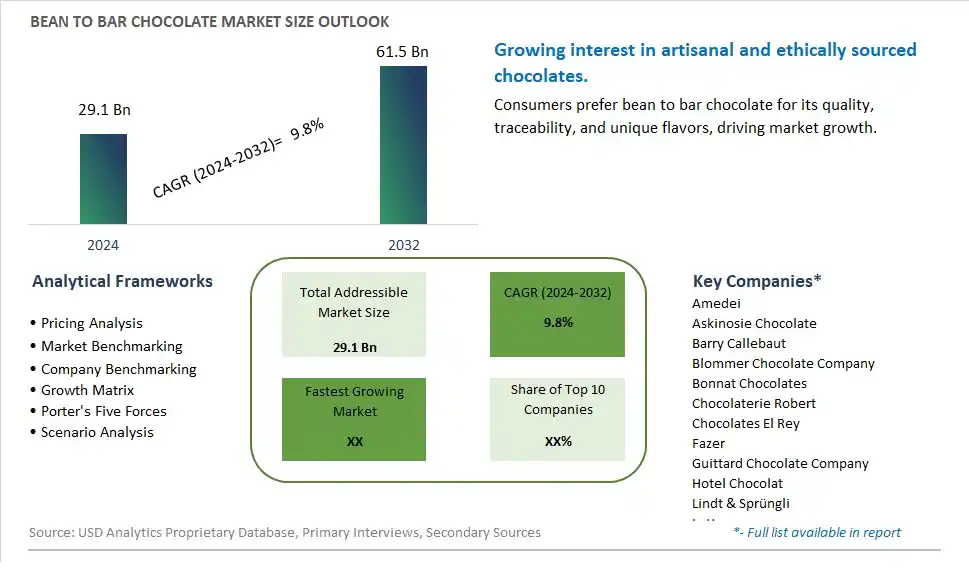
Global Bean to bar Chocolate Market Size is valued at $29.1 Billion in 2024 and is forecast to register a growth rate (CAGR) of 9.8% to reach $61.5 Billion by 2032.
The global Bean to bar Chocolate Market Comprehensive Study analyzes and forecasts the market size across 6 regions and 24 countries for diverse segments -By Type (Dark Chocolate, Milk Chocolate, White Chocolate), By Cacao Content (High Cacao Percentage, Medium Cacao Percentage, Low Cacao Percentage), By Flavor (Single-Origin Chocolate, Flavored Chocolate, Inclusion Chocolate)
An Introduction to Bean to bar Chocolate Market
In 2024, bean-to-bar chocolate has emerged as a niche yet burgeoning segment within the global chocolate industry, catering to discerning consumers' preferences for artisanal, ethically sourced products. Unlike traditional chocolate manufacturing, which involves the bulk processing of cocoa beans, bean-to-bar chocolate makers prioritize quality, traceability, and sustainability throughout the production process. By directly sourcing cocoa beans from smallholder farmers and overseeing every stage of production, from roasting to conching, these artisanal chocolatiers ensure flavor complexity, terroir expression, and social responsibility. The bean-to-bar movement resonates with consumers seeking authenticity, transparency, and unique tasting experiences, driving market growth despite premium pricing. Moreover, as concerns over child labor, deforestation, and cocoa quality intensify, bean-to-bar chocolate represents a conscientious choice for ethically minded consumers, shaping the future trajectory of the chocolate industry towards sustainability and social equity.
Bean to bar Chocolate Competitive Landscape
The market report analyses the leading companies in the industry including Amedei, Askinosie Chocolate, Barry Callebaut, Blommer Chocolate Company, Bonnat Chocolates, Chocolaterie Robert, Chocolates El Rey, Fazer, Guittard Chocolate Company, Hotel Chocolat, Lindt & Sprüngli, Lotte, Nestlé Haigh's Chocolates, Toms International, Venchi, Whitman's, and Others.
Bean to bar Chocolate Market Dynamics
Bean to bar Chocolate Market Trend: Growing Preference for Artisanal and Ethically Sourced Chocolate
One prominent trend in the bean to bar chocolate market is the growing preference for artisanal and ethically sourced chocolate. Consumers are increasingly seeking high-quality chocolate products that are made from scratch, from sourcing cacao beans to crafting the final chocolate bars. This trend is driven by a desire for transparency in the chocolate supply chain, as well as a growing appreciation for the craftsmanship and flavor complexity of bean to bar chocolate. As a result, there's a rising demand for bean to bar chocolate makers who prioritize ethical sourcing practices, fair trade relationships with cacao farmers, and sustainable production methods, resonating with consumers who value social responsibility and environmental sustainability.
Market Driver: Increasing Consumer Awareness of Cacao Origins and Flavor Profiles
A key driver in the bean to bar chocolate market is the increasing consumer awareness of cacao origins and flavor profiles. As chocolate enthusiasts become more educated about the nuances of cacao beans, including their terroir, varietals, and processing methods, there's a growing demand for bean to bar chocolate that highlights these unique characteristics. Consumers are seeking chocolate bars that showcase the distinct flavors and aromas of single-origin cacao beans, as well as innovative flavor combinations and inclusion of specialty ingredients. This driver is fueling the growth of the bean to bar chocolate market as chocolate makers and chocolatiers strive to differentiate their products based on cacao sourcing and flavor craftsmanship, catering to the evolving tastes of discerning chocolate connoisseurs.
Market Opportunity: Expansion into Premium and Niche Market Segments
An emerging opportunity in the bean to bar chocolate market is the expansion into premium and niche market segments. While bean to bar chocolate has traditionally appealed to a niche audience of chocolate aficionados and craft chocolate enthusiasts, there's potential for its broader adoption among mainstream consumers seeking premium chocolate experiences. This presents an opportunity for bean to bar chocolate makers to elevate their branding, packaging, and marketing strategies to position their products as luxury indulgences or gourmet treats. Additionally, there's an opportunity to innovate with unique flavor profiles, limited edition releases, and collaborations with cacao producers, chefs, and artisans to create exclusive offerings that appeal to discerning consumers willing to pay a premium for exceptional chocolate experiences. By tapping into premium and niche market segments, bean to bar chocolate makers can drive growth and differentiation in the competitive chocolate market landscape.
Bean to Bar Chocolate Market Share Analysis: Dark Chocolate held the dominant market share in 2024
The dark chocolate segment commands the largest share in the bean to bar chocolate market due to its growing popularity among health-conscious consumers and its perceived health benefits. Dark chocolate is rich in cocoa solids and antioxidants, with lower sugar content compared to milk and white chocolate varieties. Its intense cocoa flavor, coupled with its potential health-promoting properties such as improved heart health and mood enhancement, appeals to consumers seeking indulgence with health benefits. Further, the rising demand for premium and artisanal chocolates further drives the growth of the dark chocolate segment as consumers prioritize quality and authenticity in their chocolate choices. As a result, dark chocolate maintains its dominance in the bean to bar chocolate market, catering to the evolving preferences of discerning chocolate enthusiasts.
Bean to Bar Chocolate Market Share Analysis: High Cacao Percentage market is poised to register the fastest growth rae over the forecast period to 2032
The high cacao percentage segment is experiencing the fastest growth in the bean to bar chocolate market, driven by the increasing demand for premium, dark chocolates with intense cocoa flavor and rich health benefits. High cacao percentage chocolates contain a higher proportion of cocoa solids, typically above 70%, resulting in a more intense and robust chocolate experience. Health-conscious consumers are drawn to high cacao percentage chocolates due to their perceived health benefits, including antioxidants and potential cardiovascular benefits. Additionally, the rising popularity of artisanal and single-origin chocolates further fuels the growth of this segment as consumers seek unique and sophisticated chocolate experiences. As a result, chocolate makers are focusing on crafting high-quality, high cacao percentage chocolates to cater to the evolving preferences of chocolate enthusiasts, making it the fastest-growing segment in the bean to bar chocolate market.
Bean to Bar Chocolate Market Share Analysis: Single-Origin Chocolate held the dominant market share in 2024
The single-origin chocolate segment commands the largest share in the bean to bar chocolate market due to its growing popularity among chocolate connoisseurs and enthusiasts seeking unique flavor profiles and premium quality. Single-origin chocolates are made from cacao beans sourced from a specific region or country, allowing consumers to experience the distinct flavors and characteristics inherent to that particular origin. This focus on terroir and flavor purity resonates with consumers seeking authentic and high-quality chocolate experiences. Additionally, single-origin chocolates often highlight the craftsmanship and expertise of chocolate makers in sourcing and processing cacao beans, further enhancing their appeal. As consumers become more discerning and adventurous in their chocolate choices, the demand for single-origin chocolates continues to rise, solidifying its position as the largest segment in the bean to bar chocolate market.
Bean to bar Chocolate Market Segmentation
By Type
Dark Chocolate
Milk Chocolate
White Chocolate
By Cacao Content
High Cacao Percentage
Medium Cacao Percentage
Low Cacao Percentage
By Flavor
Single-Origin Chocolate
Flavored Chocolate
Inclusion Chocolate
Countries Analyzed
North America (US, Canada, Mexico)
Europe (Germany, UK, France, Spain, Italy, Russia, Rest of Europe)
Asia Pacific (China, India, Japan, South Korea, Australia, South East Asia, Rest of Asia)
South America (Brazil, Argentina, Rest of South America)
Middle East and Africa (Saudi Arabia, UAE, Rest of Middle East, South Africa, Egypt, Rest of Africa)
Bean to bar Chocolate Companies Profiled in the Study
Amedei
Askinosie Chocolate
Barry Callebaut
Blommer Chocolate Company
Bonnat Chocolates
Chocolaterie Robert
Chocolates El Rey
Fazer
Guittard Chocolate Company
Hotel Chocolat
Lindt & Sprüngli
Lotte
Nestlé Haigh's Chocolates
Toms International
Venchi
Whitman's
*- List Not Exhaustive
Chapter 1. TABLE OF CONTENTS
Chapter 2. Introduction to Bean to bar Chocolate Market
2.1. Market Overview
2.2. Key Statistics and Report Highlights
2.3. Scope of the Comprehensive Study
2.3.1. Market Definition
2.3.2 Countries and Regions Covered
2.3.3 Research Objective
2.3.4 Units, Currency, and Conversions
2.3.5 Industry Value Chain
2.4. Key Market Segments
2.5. Key Companies
2.6. Study Period
Chapter 3. Strategic Analysis Review
3.1. Bean to bar Chocolate Pricing Analysis and Forecast
3.2. Porter’s Five Forces
3.3. Market Ecosystem
3.4. SWOT Analysis
3.5. Regulatory Scenario
3.3. Effects of Inflation, Russia-Ukraine War, moderating economic growth, and other macroeconomic factors
Chapter 4. Competitive Landscape
4.1. Market Share Analysis
4.1.1. Global Bean to bar Chocolate Market Share by Company, 2023
4.1.2. Product Offerings of Leading Bean to bar Chocolate Companies
4.2. Market Entropy
4.2.1. New Product Launches in the Industry
4.2.2. Mergers, Acquisitions, Joint ventures, and Partnerships
4.3. Key Strategies and Best Practices
Chapter 5. Global Market Projections: Best, Reference, and Low Case Scenarios
5.1. Growth Analysis- Case Scenario Definitions
5.2. Low Growth Case Scenario Forecasts
5.3. Reference Growth Case Scenario Forecasts
5.4. High Growth Case Scenario Forecasts
Chapter 6. Market Dynamics
6.1. Bean to bar Chocolate Market Drivers
6.2. Bean to bar Chocolate Market Challenges
6.6. Bean to bar Chocolate Market Opportunities
6.4. Bean to bar Chocolate Market Trends
Chapter 7. Global Bean to bar Chocolate Market Outlook Trends
7.1. Global Bean to bar Chocolate Revenue (USD Million) and CAGR (%) by Type (2021-2032)
7.2. Global Bean to bar Chocolate Revenue (USD Million) and CAGR (%) by Application (2021-2032)
7.3. Global Bean to bar Chocolate Revenue (USD Million) and CAGR (%) by Product (2021-2032)
By Type
Dark Chocolate
Milk Chocolate
White Chocolate
By Cacao Content
High Cacao Percentage
Medium Cacao Percentage
Low Cacao Percentage
By Flavor
Single-Origin Chocolate
Flavored Chocolate
Inclusion Chocolate
Chapter 8. Global Bean to bar Chocolate Regional Analysis and Outlook
8.1. Global Bean to bar Chocolate Revenue (USD Million) By Regions (2021- 2032)
8.2. North America Bean to bar Chocolate Revenue (USD Million) by Country (2021-2032)
8.2.1. United States Bean to bar Chocolate Regional Analysis and Outlook
8.2.2. Canada Bean to bar Chocolate Regional Analysis and Outlook
8.2.3. Mexico Bean to bar Chocolate Regional Analysis and Outlook
8.3. Europe Bean to bar Chocolate Revenue (USD Million), by Country (2021-2032)
8.3.1. Germany Bean to bar Chocolate Regional Analysis and Outlook
8.3.2. France Bean to bar Chocolate Regional Analysis and Outlook
8.3.3. United Kingdom Bean to bar Chocolate Regional Analysis and Outlook
8.3.4. Spain Bean to bar Chocolate Regional Analysis and Outlook
8.3.5. Italy Bean to bar Chocolate Regional Analysis and Outlook
8.3.6. Russia Bean to bar Chocolate Regional Analysis and Outlook
8.3.7. Rest of Europe Bean to bar Chocolate Regional Analysis and Outlook
8.4. Asia Pacific Bean to bar Chocolate Revenue (USD Million) by Country (2021-2032)
8.4.1. China Bean to bar Chocolate Regional Analysis and Outlook
8.4.2. Japan Bean to bar Chocolate Regional Analysis and Outlook
8.4.3. India Bean to bar Chocolate Regional Analysis and Outlook
8.4.4. South Korea Bean to bar Chocolate Regional Analysis and Outlook
8.4.5. Australia Bean to bar Chocolate Regional Analysis and Outlook
8.4.6. South East Asia Bean to bar Chocolate Regional Analysis and Outlook
8.4.7. Rest of Asia Pacific Bean to bar Chocolate Regional Analysis and Outlook
8.5. South America Bean to bar Chocolate Revenue (USD Million), by Country (2021-2032)
8.5.1. Brazil Bean to bar Chocolate Regional Analysis and Outlook
8.5.2. Argentina Bean to bar Chocolate Regional Analysis and Outlook
8.5.3. Rest of South America Bean to bar Chocolate Regional Analysis and Outlook
8.6. Middle East and Africa Bean to bar Chocolate Revenue (USD Million) by Country (2021-2032)
8.6.1. Middle East Bean to bar Chocolate Regional Analysis and Outlook
8.6.2. Africa Bean to bar Chocolate Regional Analysis and Outlook
Chapter 9. North America Bean to bar Chocolate Analysis and Outlook
9.1. North America Bean to bar Chocolate Revenue (USD Million) by Segments (2021-2032)
9.1.1. North America Bean to bar Chocolate Revenue (USD Million) by Type (2021-2032)
9.1.2. North America Bean to bar Chocolate Revenue (USD Million) by Application (2021-2032)
9.1.3. North America Bean to bar Chocolate Revenue (USD Million) by Product (2021-2032)
By Type
Dark Chocolate
Milk Chocolate
White Chocolate
By Cacao Content
High Cacao Percentage
Medium Cacao Percentage
Low Cacao Percentage
By Flavor
Single-Origin Chocolate
Flavored Chocolate
Inclusion Chocolate
Chapter 10. Europe Bean to bar Chocolate Analysis and Outlook
10.1. Europe Bean to bar Chocolate Revenue (USD Million), by Segments (USD Million) (2021-2032)
10.1.1. Europe Bean to bar Chocolate Revenue (USD Million) by Type (2021-2032)
10.1.2. Europe Bean to bar Chocolate Revenue (USD Million) by Application (2021-2032)
10.1.3. Europe Bean to bar Chocolate Revenue (USD Million) by Product (2021-2032)
By Type
Dark Chocolate
Milk Chocolate
White Chocolate
By Cacao Content
High Cacao Percentage
Medium Cacao Percentage
Low Cacao Percentage
By Flavor
Single-Origin Chocolate
Flavored Chocolate
Inclusion Chocolate
Chapter 11. Asia Pacific Bean to bar Chocolate Analysis and Outlook
11.1. Asia Pacific Bean to bar Chocolate Revenue (USD Million), and Revenue (USD Million) by Segments (2021-2032)
11.1.1. Asia Pacific Bean to bar Chocolate Revenue (USD Million) by Type (2021-2032)
11.1.2. Asia Pacific Bean to bar Chocolate Revenue (USD Million) by Application (2021-2032)
11.1.3. Asia Pacific Bean to bar Chocolate Revenue (USD Million) by Product (2021-2032)
By Type
Dark Chocolate
Milk Chocolate
White Chocolate
By Cacao Content
High Cacao Percentage
Medium Cacao Percentage
Low Cacao Percentage
By Flavor
Single-Origin Chocolate
Flavored Chocolate
Inclusion Chocolate
Chapter 12. South America Bean to bar Chocolate Analysis and Outlook
12.1. South America Bean to bar Chocolate Revenue (USD Million), by Segments (2021-2032)
12.1.1. South America Bean to bar Chocolate Revenue (USD Million) by Type (2021-2032)
12.1.2. South America Bean to bar Chocolate Revenue (USD Million) by Application (2021-2032)
12.1.3. South America Bean to bar Chocolate Revenue (USD Million) by Product (2021-2032)
By Type
Dark Chocolate
Milk Chocolate
White Chocolate
By Cacao Content
High Cacao Percentage
Medium Cacao Percentage
Low Cacao Percentage
By Flavor
Single-Origin Chocolate
Flavored Chocolate
Inclusion Chocolate
Chapter 13. Middle East and Africa Bean to bar Chocolate Analysis and Outlook
13.1. Middle East and Africa Bean to bar Chocolate Revenue (USD Million), by Segments (2021-2032)
13.1.1. Middle East and Africa Bean to bar Chocolate Revenue (USD Million) by Type (2021-2032)
13.1.2. Middle East and Africa Bean to bar Chocolate Revenue (USD Million) by Application (2021-2032)
13.1.3. Middle East and Africa Bean to bar Chocolate Revenue (USD Million) by Product (2021-2032)
By Type
Dark Chocolate
Milk Chocolate
White Chocolate
By Cacao Content
High Cacao Percentage
Medium Cacao Percentage
Low Cacao Percentage
By Flavor
Single-Origin Chocolate
Flavored Chocolate
Inclusion Chocolate
Chapter 14. Bean to bar Chocolate Company Profiles
14.1 Business Overview
14.2 Product Profiles
14.3 SWOT Profiles
14.5 Recent Developments
14.6 Financial Profile
List of Companies
Amedei
Askinosie Chocolate
Barry Callebaut
Blommer Chocolate Company
Bonnat Chocolates
Chocolaterie Robert
Chocolates El Rey
Fazer
Guittard Chocolate Company
Hotel Chocolat
Lindt & Sprüngli
Lotte
Nestlé Haigh's Chocolates
Toms International
Venchi
Whitman's
15. Methodology and Data Sources
15.1 Customization Offerings
15.2 Subscription Services
15.3 Related Reports
15.4 Publisher Expertise
LIST OF TABLES
Table 1 Market Segmentation Analysis
Table 2 Global Bean to bar Chocolate Market Share of Leading Companies, 2023
Table 3 Product Offerings of Leading Companies
Table 4 Low Growth Scenario Forecasts
Table 5 Reference Case Growth Scenario
Table 6 High Growth Case Scenario
Table 7 Global Bean to bar Chocolate Revenue (USD Million) And CAGR (%) By Type (2021-2032)
Table 8 Global Bean to bar Chocolate Revenue (USD Million) And CAGR (%) By Application (2021-2032)
Table 9 Global Bean to bar Chocolate Revenue (USD Million) And CAGR (%) By Product (2021-2032)
Table 10 Global Bean to bar Chocolate Market Revenue (USD Million) By Regions (2021-2032)
Table 11 Global Bean to bar Chocolate Market Share (%) By Regions (2021-2032)
Table 12 North America Bean to bar Chocolate Revenue (USD Million) By Country (2021-2032)
Table 13 Europe Bean to bar Chocolate Revenue (USD Million) By Country (2021-2032)
Table 14 Asia Pacific Bean to bar Chocolate Revenue (USD Million) By Country (2021-2032)
Table 15 South America Bean to bar Chocolate Revenue (USD Million) By Country (2021-2032)
Table 16 Middle East and Africa Bean to bar Chocolate Revenue (USD Million) By Region (2021-2032)
Table 17 North America Bean to bar Chocolate Revenue (USD Million) By Type (2021-2032)
Table 18 North America Bean to bar Chocolate Revenue (USD Million) By Application (2021-2032)
Table 19 North America Bean to bar Chocolate Revenue (USD Million) By Product (2021-2032)
Table 20 Europe Bean to bar Chocolate Revenue (USD Million) By Type (2021-2032)
Table 21 Europe Bean to bar Chocolate Revenue (USD Million) By Application (2021-2032)
Table 22 Europe Bean to bar Chocolate Revenue (USD Million) By Product (2021-2032)
Table 23 Asia Pacific Bean to bar Chocolate Revenue (USD Million) By Type (2021-2032)
Table 24 Asia Pacific Bean to bar Chocolate Revenue (USD Million) By Application (2021-2032)
Table 25 Asia Pacific Bean to bar Chocolate Revenue (USD Million) By Product (2021-2032)
Table 26 South America Bean to bar Chocolate Revenue (USD Million) By Type (2021-2032)
Table 27 South America Bean to bar Chocolate Revenue (USD Million) By Application (2021-2032)
Table 28 South America Bean to bar Chocolate Revenue (USD Million) By Product (2021-2032)
Table 29 Middle East and Africa Bean to bar Chocolate Revenue (USD Million) By Type (2021-2032)
Table 30 Middle East and Africa Bean to bar Chocolate Revenue (USD Million) By Application (2021-2032)
Table 31 Middle East and Africa Bean to bar Chocolate Revenue (USD Million) By Product (2021-2032)
LIST OF FIGURES
Figure 1. Market Scope
Figure 2. Pricing Forecasts Per Unit, 2023- 2032
Figure 3. Porter’s Five Forces
Figure 4. Global Bean to bar Chocolate Market Revenue (USD Million) By Regions (2021-2032)
Figure 5. Global Bean to bar Chocolate Market Share (%) By Regions (2023)
Figure 6. North America Bean to bar Chocolate Revenue (USD Million) By Country (2021-2032)
Figure 7. United States Bean to bar Chocolate Revenue (USD Million) By Country (2021-2032)
Figure 8. Canada Bean to bar Chocolate Revenue (USD Million) By Country (2021-2032)
Figure 9. Mexico Bean to bar Chocolate Revenue (USD Million) By Country (2021-2032)
Figure 10. Europe Bean to bar Chocolate Revenue (USD Million) By Country (2021-2032)
Figure 11. Germany Bean to bar Chocolate Revenue (USD Million) By Country (2021-2032)
Figure 12. France Bean to bar Chocolate Revenue (USD Million) By Country (2021-2032)
Figure 13. United Kingdom Bean to bar Chocolate Revenue (USD Million) By Country (2021-2032)
Figure 14. Spain Bean to bar Chocolate Revenue (USD Million) By Country (2021-2032)
Figure 15. Italy Bean to bar Chocolate Revenue (USD Million) By Country (2021-2032)
Figure 16. Russia Bean to bar Chocolate Revenue (USD Million) By Country (2021-2032)
Figure 17. Rest of Europe Bean to bar Chocolate Revenue (USD Million) By Country (2021-2032)
Figure 11. Asia Pacific Bean to bar Chocolate Revenue (USD Million) By Country (2021-2032)
Figure 12. China Bean to bar Chocolate Revenue (USD Million) By Country (2021-2032)
Figure 13. Japan Bean to bar Chocolate Revenue (USD Million) By Country (2021-2032)
Figure 14. India Bean to bar Chocolate Revenue (USD Million) By Country (2021-2032)
Figure 15. South Korea Bean to bar Chocolate Revenue (USD Million) By Country (2021-2032)
Figure 16. Australia Bean to bar Chocolate Revenue (USD Million) By Country (2021-2032)
Figure 17. South East Asia Bean to bar Chocolate Revenue (USD Million) By Country (2021-2032)
Figure 18. South America Bean to bar Chocolate Revenue (USD Million) By Country (2021-2032)
Figure 19. Brazil Bean to bar Chocolate Revenue (USD Million) By Country (2021-2032)
Figure 20. Argentina Bean to bar Chocolate Revenue (USD Million) By Country (2021-2032)
Figure 21. Rest of Asia Pacific Bean to bar Chocolate Revenue (USD Million) By Country (2021-2032)
Figure 22. Middle East and Africa Bean to bar Chocolate Revenue (USD Million) By Region (2021-2032)
Figure 23. Saudi Arabia Bean to bar Chocolate Revenue (USD Million) By Region (2021-2032)
Figure 24. The UAE Bean to bar Chocolate Revenue (USD Million) By Region (2021-2032)
Figure 25. Rest of Middle East Bean to bar Chocolate Revenue (USD Million) By Region (2021-2032)
Figure 26. South Africa Bean to bar Chocolate Revenue (USD Million) By Region (2021-2032)
Figure 27. Africa Bean to bar Chocolate Revenue (USD Million) By Region (2021-2032)
Figure 28. North America Bean to bar Chocolate Revenue (USD Million) By Type (2021-2032)
Figure 29. North America Bean to bar Chocolate Revenue (USD Million) By Application (2021-2032)
Figure 30. North America Bean to bar Chocolate Revenue (USD Million) By Product (2021-2032)
Figure 31. Europe Bean to bar Chocolate Revenue (USD Million) By Type (2021-2032)
Figure 32. Europe Bean to bar Chocolate Revenue (USD Million) By Application (2021-2032)
Figure 33. Europe Bean to bar Chocolate Revenue (USD Million) By Product (2021-2032)
Figure 34. Asia Pacific Bean to bar Chocolate Revenue (USD Million) By Type (2021-2032)
Figure 35. Asia Pacific Bean to bar Chocolate Revenue (USD Million) By Application (2021-2032)
Figure 36. Asia Pacific Bean to bar Chocolate Revenue (USD Million) By Product (2021-2032)
Figure 37. South America Bean to bar Chocolate Revenue (USD Million) By Type (2021-2032)
Figure 38. South America Bean to bar Chocolate Revenue (USD Million) By Application (2021-2032)
Figure 39. South America Bean to bar Chocolate Revenue (USD Million) By Product (2021-2032)
Figure 40. Middle East and Africa Bean to bar Chocolate Revenue (USD Million) By Type (2021-2032)
Figure 41. Middle East and Africa Bean to bar Chocolate Revenue (USD Million) By Application (2021-2032)
Figure 42. Middle East and Africa Bean to bar Chocolate Revenue (USD Million) By Product (2021-2032)
By Type
Dark Chocolate
Milk Chocolate
White Chocolate
By Cacao Content
High Cacao Percentage
Medium Cacao Percentage
Low Cacao Percentage
By Flavor
Single-Origin Chocolate
Flavored Chocolate
Inclusion Chocolate
Countries Analyzed
North America (US, Canada, Mexico)
Europe (Germany, UK, France, Spain, Italy, Russia, Rest of Europe)
Asia Pacific (China, India, Japan, South Korea, Australia, South East Asia, Rest of Asia)
South America (Brazil, Argentina, Rest of South America)
Middle East and Africa (Saudi Arabia, UAE, Rest of Middle East, South Africa, Egypt, Rest of Africa)
