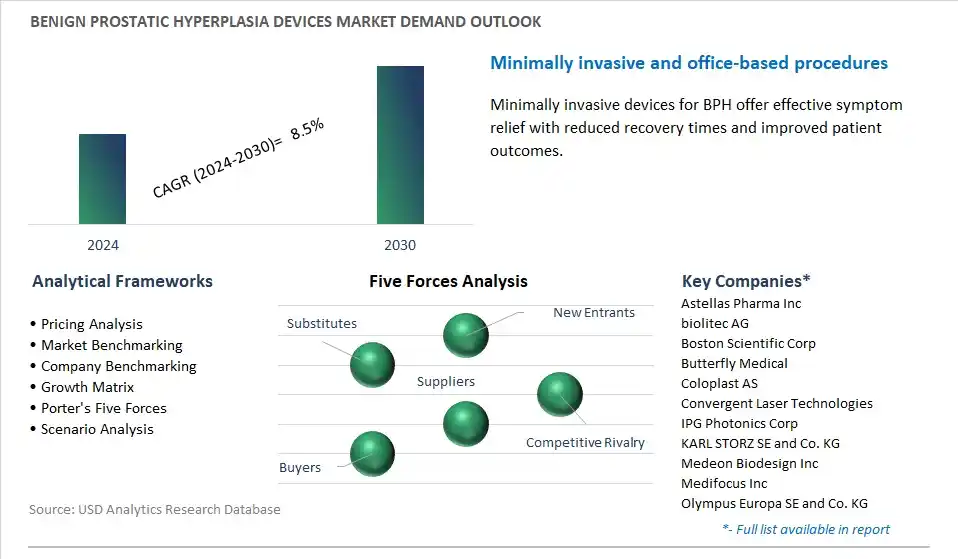
Benign Prostatic Hyperplasia (BPH) Devices Market is estimated to increase at a growth rate of 8.5% CAGR over the forecast period from 2024 to 2030.
The global Benign Prostatic Hyperplasia (BPH) Devices Market Study analyzes and forecasts the market size across 6 regions and 24 countries for diverse segments including By Product (Resectoscopes, Urology Lasers, Radiofrequency Ablation Devices, Prostatic Stents, Implants), By Type (Transurethral Microwave Therapy, Transurethral Resection of the Prostate, Transurethral Needle Ablation of the Prostate, Laser Surgery, Urolift Surgery, Others), By End-User (Hospitals, Clinics, Ambulatory Surgical Centers, Others).
An Introduction to Benign Prostatic Hyperplasia (BPH) Devices Market in 2024
The Benign Prostatic Hyperplasia (BPH) Devices Market focuses on medical devices and interventions designed to manage symptoms and treat benign prostatic hyperplasia, a common condition affecting older men characterized by prostate gland enlargement. In 2024, BPH devices include minimally invasive therapies (MITs), prostate stents, and transurethral procedures aimed at relieving urinary obstruction, improving voiding function, and reducing BPH-related complications. With advancements in device technologies, surgical techniques, and patient outcomes, the BPH devices market supports urological care, prostate health management, and treatment options for men with BPH.
Benign Prostatic Hyperplasia (BPH) Devices Market Competitive Landscape
The global Benign Prostatic Hyperplasia (BPH) Devices Industry is highly competitive with a large number of companies focusing on niche market segments. Amidst intense competitive conditions, Benign Prostatic Hyperplasia (BPH) Devices Companies are investing in new product launches and strengthening distribution channels. Key companies operating in the Benign Prostatic Hyperplasia (BPH) Devices Industry include- Astellas Pharma Inc, biolitec AG, Boston Scientific Corp, Butterfly Medical, Coloplast AS, Convergent Laser Technologies, IPG Photonics Corp, KARL STORZ SE and Co. KG, Medeon Biodesign Inc, Medifocus Inc, Olympus Europa SE and Co. KG, OmniGuide Holdings Inc, ProArc Medical, PROCEPT BioRobotics Corp, Richard Wolf GmbH, SRS Medical, Teleflex Inc, Urologix LLC, Vendor Credentialing Service LLC, Zenflow Inc.
Benign Prostatic Hyperplasia Devices Market Trend: Increasing Prevalence of Benign Prostatic Hyperplasia (BPH)
The market for benign prostatic hyperplasia (BPH) devices is witnessing a significant trend driven by the increasing prevalence of BPH among aging male populations worldwide. Factors such as hormonal changes, genetic predisposition, and lifestyle factors contribute to the enlargement of the prostate gland, leading to lower urinary tract symptoms (LUTS) and bladder dysfunction. As the aging population continues to grow, the prevalence of BPH and associated urinary symptoms is expected to rise, driving the demand for minimally invasive and effective treatment options. This trend underscores the importance of developing innovative BPH devices that offer symptom relief, improve quality of life, and minimize the risk of complications for patients suffering from BPH-related urinary problems.
Benign Prostatic Hyperplasia Devices Market Driver: Advancements in Minimally Invasive Treatment Technologies
A key driver propelling the market for BPH devices is the continuous advancements in minimally invasive treatment technologies for BPH. Traditional treatment options for BPH, such as medication therapy and transurethral resection of the prostate (TURP), are associated with limitations such as side effects, long recovery times, and risks of complications. Consequently, there is a growing demand for minimally invasive alternatives that offer symptom relief while preserving sexual function and urinary continence. Technologies such as prostatic artery embolization (PAE), laser therapy, and water vapor therapy provide less invasive approaches to treating BPH, resulting in shorter recovery times, reduced hospital stays, and improved patient satisfaction. As patients and healthcare providers seek safer and more effective alternatives to conventional BPH treatments, the market for minimally invasive BPH devices is poised for significant growth and innovation.
Benign Prostatic Hyperplasia Devices Market Opportunity: Personalized Treatment Approaches and Patient-Centric Care
An emerging opportunity within the market for BPH devices lies in the adoption of personalized treatment approaches and patient-centric care models. With the growing emphasis on value-based healthcare delivery and patient-centered outcomes, there is a shift towards tailoring BPH treatment strategies to individual patient characteristics, preferences, and treatment goals. By integrating patient-reported outcomes, shared decision-making tools, and risk stratification algorithms into clinical practice, healthcare providers can optimize treatment selection, enhance treatment adherence, and improve long-term patient outcomes. Additionally, advancements in imaging technologies, biomarkers, and predictive modeling enable clinicians to identify patients who are most likely to benefit from specific BPH interventions, facilitating personalized treatment planning and resource allocation. As the healthcare landscape evolves towards more personalized and value-driven care models, investing in patient-centric approaches presents a promising opportunity for differentiation and market leadership in the field of BPH devices.
Benign Prostatic Hyperplasia Devices Market Share Analysis: Urolift Surgery is the fastest growing market segment over the forecast period to 2030
The fastest growing segment in the Benign Prostatic Hyperplasia Devices market is the Urolift Surgery type. This growth is primarily driven by several factors, including the minimally invasive nature of the procedure, reduced recovery time, and lower risk of complications compared to traditional surgical methods. Urolift Surgery offers significant benefits such as improved urinary flow and symptom relief for patients with benign prostatic hyperplasia (BPH) while preserving sexual function, leading to its increasing adoption among healthcare providers and patients alike. Additionally, advancements in urology technologies and increased awareness about minimally invasive treatment options contribute to the rapid growth of Urolift Surgery within hospitals, clinics, ambulatory surgical centers, and other healthcare facilities.
Benign Prostatic Hyperplasia (BPH) Devices Market Segmentation
By Product
Resectoscopes
Urology Lasers
Radiofrequency Ablation Devices
Prostatic Stents
Implants
By Type
Transurethral Microwave Therapy
Transurethral Resection of the Prostate
Transurethral Needle Ablation of the Prostate
Laser Surgery
Urolift Surgery
Others
By End-User
Hospitals
Clinics
Ambulatory Surgical Centers
Others
Geographical Analysis
North America (United States, Canada, Mexico)
Europe (Germany, France, United Kingdom, Spain, Italy, Rest of Europe)
Asia Pacific (China, India, Japan, South Korea, Rest of Asia Pacific)
South America (Brazil, Argentina, Rest of South America)
Middle East and Africa (Saudi Arabia, UAE, Rest of Middle East, South Africa, Egypt, Rest of Africa)
Benign Prostatic Hyperplasia (BPH) Devices Companies
Astellas Pharma Inc
biolitec AG
Boston Scientific Corp
Butterfly Medical
Coloplast AS
Convergent Laser Technologies
IPG Photonics Corp
KARL STORZ SE and Co. KG
Medeon Biodesign Inc
Medifocus Inc
Olympus Europa SE and Co. KG
OmniGuide Holdings Inc
ProArc Medical
PROCEPT BioRobotics Corp
Richard Wolf GmbH
SRS Medical
Teleflex Inc
Urologix LLC
Vendor Credentialing Service LLC
Zenflow Inc
* List not Exhaustive
Reasons to Buy the Benign Prostatic Hyperplasia (BPH) Devices Market Study
• Deepen your industry insights and navigate uncertainties for strategy formulation, CAPEX, and Operational decisions
• Gain access to detailed insights on the Benign Prostatic Hyperplasia (BPH) Devices Market, encompassing current market size, growth trends, and forecasts till 2030.
• Access detailed competitor analysis, enabling competitive advantage through a thorough understanding of market players, strategies, and potential differentiation opportunities
• Stay ahead of the curve with insights on technological advancements, innovations, and upcoming trends
• Identify lucrative investment avenues and expansion opportunities within the Benign Prostatic Hyperplasia (BPH) Devices Industry, guided by robust, data-backed analysis.
• Understand regional and global markets through country-wise analysis, regional market potential, regulatory nuances, and dynamics
• Execute strategies with confidence and speed through information, analytics, and insights on the industry value chain
• Corporate leaders, strategists, financial experts, shareholders, asset managers, and governmental representatives can make long-term planning scenarios and build an integrated and timely understanding of market dynamics
• Benefit from tailored solutions and expert consultation based on report insights, providing personalized strategies aligned with specific business needs.
TABLE OF CONTENTS
1 Introduction to 2024 Benign Prostatic Hyperplasia (BPH) Devices Market
1.1 Market Overview
1.2 Quick Facts
1.3 Scope/Objective of the Study
1.4 Market Definition
1.5 Countries and Regions Analyzed
1.6 Units, Currency, and Conversions
1.7 Industry Value Chain
2 Research Methodology
2.1 Market Size Estimation
2.2 Sources and Research Methodology
2.3 Data Triangulation
2.4 Assumptions and Limitations
3 Executive Summary
3.1 Global Benign Prostatic Hyperplasia (BPH) Devices Market Size Outlook, $ Million, 2021 to 2030
3.2 Benign Prostatic Hyperplasia (BPH) Devices Market Outlook by Type, $ Million, 2021 to 2030
3.3 Benign Prostatic Hyperplasia (BPH) Devices Market Outlook by Product, $ Million, 2021 to 2030
3.4 Benign Prostatic Hyperplasia (BPH) Devices Market Outlook by Application, $ Million, 2021 to 2030
3.5 Benign Prostatic Hyperplasia (BPH) Devices Market Outlook by Key Countries, $ Million, 2021 to 2030
4 Market Dynamics
4.1 Key Driving Forces of Benign Prostatic Hyperplasia (BPH) Devices Industry
4.2 Key Market Trends in Benign Prostatic Hyperplasia (BPH) Devices Industry
4.3 Potential Opportunities in Benign Prostatic Hyperplasia (BPH) Devices Industry
4.4 Key Challenges in Benign Prostatic Hyperplasia (BPH) Devices Industry
5 Market Factor Analysis
5.1 Value Chain Analysis
5.2 Competitive Landscape
5.2.1 Global Benign Prostatic Hyperplasia (BPH) Devices Market Share by Company (%), 2023
5.2.2 Product Offerings by Company
5.3 Porter’s Five Forces Analysis
5.4 Pricing Analysis and Outlook
6 Growth Outlook Across Scenarios
6.1 Growth Analysis-Case Scenario Definitions
6.2 Low Growth Scenario Forecasts
6.3 Reference Growth Scenario Forecasts
6.4 High Growth Scenario Forecasts
7 Global Benign Prostatic Hyperplasia (BPH) Devices Market Outlook by Segments
7.1 Benign Prostatic Hyperplasia (BPH) Devices Market Outlook by Segments, $ Million, 2021- 2030
By Product
Resectoscopes
Urology Lasers
Radiofrequency Ablation Devices
Prostatic Stents
Implants
By Type
Transurethral Microwave Therapy
Transurethral Resection of the Prostate
Transurethral Needle Ablation of the Prostate
Laser Surgery
Urolift Surgery
Others
By End-User
Hospitals
Clinics
Ambulatory Surgical Centers
Others
8 North America Benign Prostatic Hyperplasia (BPH) Devices Market Analysis and Outlook To 2030
8.1 Introduction to North America Benign Prostatic Hyperplasia (BPH) Devices Markets in 2024
8.2 North America Benign Prostatic Hyperplasia (BPH) Devices Market Size Outlook by Country, 2021-2030
8.2.1 United States
8.2.2 Canada
8.2.3 Mexico
8.3 North America Benign Prostatic Hyperplasia (BPH) Devices Market size Outlook by Segments, 2021-2030
By Product
Resectoscopes
Urology Lasers
Radiofrequency Ablation Devices
Prostatic Stents
Implants
By Type
Transurethral Microwave Therapy
Transurethral Resection of the Prostate
Transurethral Needle Ablation of the Prostate
Laser Surgery
Urolift Surgery
Others
By End-User
Hospitals
Clinics
Ambulatory Surgical Centers
Others
9 Europe Benign Prostatic Hyperplasia (BPH) Devices Market Analysis and Outlook To 2030
9.1 Introduction to Europe Benign Prostatic Hyperplasia (BPH) Devices Markets in 2024
9.2 Europe Benign Prostatic Hyperplasia (BPH) Devices Market Size Outlook by Country, 2021-2030
9.2.1 Germany
9.2.2 France
9.2.3 Spain
9.2.4 United Kingdom
9.2.4 Italy
9.2.5 Russia
9.2.6 Norway
9.2.7 Rest of Europe
9.3 Europe Benign Prostatic Hyperplasia (BPH) Devices Market Size Outlook by Segments, 2021-2030
By Product
Resectoscopes
Urology Lasers
Radiofrequency Ablation Devices
Prostatic Stents
Implants
By Type
Transurethral Microwave Therapy
Transurethral Resection of the Prostate
Transurethral Needle Ablation of the Prostate
Laser Surgery
Urolift Surgery
Others
By End-User
Hospitals
Clinics
Ambulatory Surgical Centers
Others
10 Asia Pacific Benign Prostatic Hyperplasia (BPH) Devices Market Analysis and Outlook To 2030
10.1 Introduction to Asia Pacific Benign Prostatic Hyperplasia (BPH) Devices Markets in 2024
10.2 Asia Pacific Benign Prostatic Hyperplasia (BPH) Devices Market Size Outlook by Country, 2021-2030
10.2.1 China
10.2.2 India
10.2.3 Japan
10.2.4 South Korea
10.2.5 Indonesia
10.2.6 Malaysia
10.2.7 Australia
10.2.8 Rest of Asia Pacific
10.3 Asia Pacific Benign Prostatic Hyperplasia (BPH) Devices Market size Outlook by Segments, 2021-2030
By Product
Resectoscopes
Urology Lasers
Radiofrequency Ablation Devices
Prostatic Stents
Implants
By Type
Transurethral Microwave Therapy
Transurethral Resection of the Prostate
Transurethral Needle Ablation of the Prostate
Laser Surgery
Urolift Surgery
Others
By End-User
Hospitals
Clinics
Ambulatory Surgical Centers
Others
11 South America Benign Prostatic Hyperplasia (BPH) Devices Market Analysis and Outlook To 2030
11.1 Introduction to South America Benign Prostatic Hyperplasia (BPH) Devices Markets in 2024
11.2 South America Benign Prostatic Hyperplasia (BPH) Devices Market Size Outlook by Country, 2021-2030
11.2.1 Brazil
11.2.2 Argentina
11.2.3 Rest of South America
11.3 South America Benign Prostatic Hyperplasia (BPH) Devices Market size Outlook by Segments, 2021-2030
By Product
Resectoscopes
Urology Lasers
Radiofrequency Ablation Devices
Prostatic Stents
Implants
By Type
Transurethral Microwave Therapy
Transurethral Resection of the Prostate
Transurethral Needle Ablation of the Prostate
Laser Surgery
Urolift Surgery
Others
By End-User
Hospitals
Clinics
Ambulatory Surgical Centers
Others
12 Middle East and Africa Benign Prostatic Hyperplasia (BPH) Devices Market Analysis and Outlook To 2030
12.1 Introduction to Middle East and Africa Benign Prostatic Hyperplasia (BPH) Devices Markets in 2024
12.2 Middle East and Africa Benign Prostatic Hyperplasia (BPH) Devices Market Size Outlook by Country, 2021-2030
12.2.1 Saudi Arabia
12.2.2 UAE
12.2.3 Oman
12.2.4 Rest of Middle East
12.2.5 Egypt
12.2.6 Nigeria
12.2.7 South Africa
12.2.8 Rest of Africa
12.3 Middle East and Africa Benign Prostatic Hyperplasia (BPH) Devices Market size Outlook by Segments, 2021-2030
By Product
Resectoscopes
Urology Lasers
Radiofrequency Ablation Devices
Prostatic Stents
Implants
By Type
Transurethral Microwave Therapy
Transurethral Resection of the Prostate
Transurethral Needle Ablation of the Prostate
Laser Surgery
Urolift Surgery
Others
By End-User
Hospitals
Clinics
Ambulatory Surgical Centers
Others
13 Company Profiles
13.1 Company Snapshot
13.2 SWOT Profiles
13.3 Products and Services
13.4 Recent Developments
13.5 Financial Profile
List of Companies
Astellas Pharma Inc
biolitec AG
Boston Scientific Corp
Butterfly Medical
Coloplast AS
Convergent Laser Technologies
IPG Photonics Corp
KARL STORZ SE and Co. KG
Medeon Biodesign Inc
Medifocus Inc
Olympus Europa SE and Co. KG
OmniGuide Holdings Inc
ProArc Medical
PROCEPT BioRobotics Corp
Richard Wolf GmbH
SRS Medical
Teleflex Inc
Urologix LLC
Vendor Credentialing Service LLC
Zenflow Inc
14 Appendix
14.1 Customization Offerings
14.2 Subscription Services
14.3 Related Reports
14.4 Publisher Expertise
