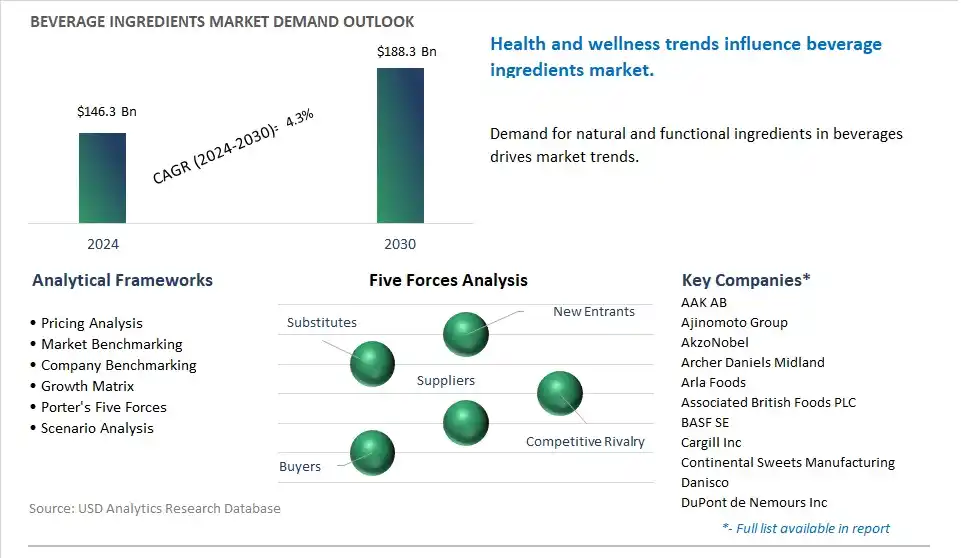
The global Beverage Ingredients Market is poised to register a 4.3% CAGR from $146.3 Billion in 2024 to $188.3 Billion in 2030.
The global Beverage Ingredients Market Study analyzes and forecasts the market size across 6 regions and 24 countries for diverse segments -By Type (Caloric Sweeteners, Low & No Calorie Sweeteners, Caffeine, Calcium, Vitamin, DHA, Plant Sterols), By End-User (Alcoholic, Non-Alcoholic, Dairy), By Function (Nutrition & Health Goals, Colorants, Stabilizer, Emulsifier, Others).
An Introduction to Global Beverage Ingredients Market in 2024
The beverage ingredients market is experiencing steady growth driven by increasing consumer demand for innovative and health-oriented beverage products. Key trends shaping the future of the industry include the growing popularity of natural and functional ingredients such as botanical extracts, vitamins, and probiotics in beverages, catering to consumer preferences for clean-label, nutritious, and functional beverages. Moreover, there's a rising emphasis on ingredient transparency, sustainability, and traceability throughout the supply chain, leading to certifications, sourcing partnerships, and eco-friendly packaging solutions. Additionally, advancements in beverage formulation technology, flavor encapsulation, and ingredient delivery systems are driving innovation and market competitiveness, enabling beverage manufacturers to develop unique and differentiated products that meet evolving consumer trends and preferences in the global beverage ingredients market.
Beverage Ingredients Market Competitive Landscape
The market report analyses the leading companies in the industry including AAK AB, Ajinomoto Group, AkzoNobel, Archer Daniels Midland, Arla Foods, Associated British Foods PLC, BASF SE, Cargill Inc, Continental Sweets Manufacturing, Danisco, DuPont de Nemours Inc, Givaudan SA, Ingredion Inc, International Flavors & Fragrances Inc, Kerry Group, Kraft Heinz Company, Monsanto Company, Royal DSM N.V., Tate & Lyle PLC.
Beverage Ingredients Market Dynamics
Beverage Ingredients Market Trend: Shift Towards Natural and Functional Ingredients
A prominent trend in the beverage ingredients market is the shift towards natural and functional ingredients. Consumers are increasingly seeking beverages that offer health benefits, taste enhancement, and natural flavors without artificial additives or preservatives. As a result, there is a growing demand for beverage ingredients sourced from natural sources such as fruits, herbs, spices, and botanical extracts. Additionally, functional ingredients such as vitamins, minerals, probiotics, and plant-based additives are gaining popularity for their perceived health-promoting properties, driving innovation and product development in the beverage industry. This trend reflects the evolving preferences and lifestyle choices of consumers seeking healthier and more nutritious beverage options.
Beverage Ingredients Market Driver: Growing Demand for Convenience and Ready-to-Drink Beverages
A primary driver fueling the beverage ingredients market is the growing demand for convenience and ready-to-drink (RTD) beverages. Busy lifestyles, urbanization, and on-the-go consumption patterns are driving the popularity of packaged and portable beverage formats that offer convenience, portability, and quick consumption. Ingredients such as flavorings, sweeteners, colors, and preservatives play a crucial role in enhancing the taste, texture, and shelf-life of RTD beverages, making them appealing to consumers seeking convenient refreshment options. Moreover, the proliferation of e-commerce platforms and delivery services has further accelerated the demand for RTD beverages, presenting opportunities for beverage manufacturers to innovate and differentiate their products with unique and appealing ingredient formulations.
Beverage Ingredients Market Opportunity: Expansion into Functional and Nutraceutical Beverages
An opportunity within the beverage ingredients market lies in the expansion into functional and nutraceutical beverages. As consumers prioritize health and wellness, there is a growing demand for beverages that offer functional benefits beyond basic hydration and refreshment. Functional beverages fortified with vitamins, minerals, antioxidants, and other bioactive compounds are gaining traction for their potential to support specific health goals such as immunity, energy, digestion, and cognitive function. Additionally, there is increasing interest in nutraceutical beverages containing ingredients with scientifically proven health benefits, such as botanical extracts, superfoods, and adaptogens. By incorporating functional and nutraceutical ingredients into beverage formulations, companies can cater to the growing demand for health-conscious beverages and capitalize on the trend towards functional foods and beverages, thereby expanding their product portfolios and market presence in the dynamic beverage industry.
Beverage Ingredients Market Share Analysis: Caloric Sweeteners Segment generated the highest revenue in the industry
The caloric sweeteners segment is the largest segment in the Beverage Ingredients Market due to diverse critical factors. The caloric sweeteners such as sugar and high-fructose corn syrup are widely used in the beverage industry to impart sweetness and enhance flavor profiles in various beverages, including soft drinks, juices, energy drinks, and flavored water. The universal appeal of sweetened beverages across diverse demographics contributes to the significant demand for caloric sweeteners. In addition, consumer preferences for indulgent and flavorful beverages drive the popularity of sweetened options, further bolstering the dominance of caloric sweeteners in the market. Additionally, the affordability and availability of caloric sweeteners make them a preferred choice for beverage manufacturers, enabling them to produce cost-effective products with mass appeal. Despite increasing concerns about sugar consumption and its potential health effects, caloric sweeteners continue to maintain their prominence in the beverage industry due to their unmatched taste and functionality. As a result, the caloric sweeteners segment remains the largest segment in the Beverage Ingredients Market.
Beverage Ingredients Market Share Analysis: Non-Alcoholic Segment is poised to register the fastest growth rate (CAGR) over the forecast period to 2030
The non-alcoholic segment is the fastest-growing segment in the Beverage Ingredients Market for diverse significant reasons. The there is a growing global trend towards healthier lifestyles, leading to increased consumer demand for non-alcoholic beverages perceived as healthier alternatives to sugary sodas and alcoholic drinks. This shift in consumer preferences is driving the demand for a wide range of non-alcoholic beverages, including carbonated soft drinks, bottled water, functional beverages, and ready-to-drink teas and coffees. Additionally, the rise of functional and wellness beverages, such as energy drinks, sports drinks, and plant-based beverages fortified with vitamins, minerals, and other functional ingredients, further contributes to the growth of the non-alcoholic segment. In addition, the increasing availability and variety of non-alcoholic beverages in both traditional retail channels and e-commerce platforms provide consumers with more options to explore and experiment with new flavors and formulations. As beverage manufacturers innovate to meet evolving consumer preferences and demands for healthier, more functional beverages, the non-alcoholic segment continues to experience rapid growth, making it a key focus area in the Beverage Ingredients Market.
Beverage Ingredients Market Share Analysis: Nutrition & Health Goals Segment is poised to register the fastest growth rate (CAGR) over the forecast period to 2030
The nutrition & health goals segment is the fastest-growing segment in the Beverage Ingredients Market due to diverse pivotal factors. The there is a growing global emphasis on health and wellness, leading consumers to seek beverages that offer functional benefits beyond mere refreshment. This trend has fueled the demand for beverages fortified with vitamins, minerals, antioxidants, and other bioactive compounds designed to support specific health goals, such as immune support, energy enhancement, weight management, and cognitive function. Consequently, beverage manufacturers are increasingly incorporating a diverse range of functional ingredients into their products to meet consumer demands for beverages that align with their health and nutrition objectives. In addition, advancements in food science and technology have enabled the development of innovative formulations and delivery systems that enhance the bioavailability and effectiveness of functional ingredients in beverages. Additionally, the rise of personalized nutrition and the increasing availability of data-driven insights allow beverage companies to tailor their products to meet the specific needs and preferences of individual consumers. As consumers continue to prioritize health and wellness and seek beverages that offer tangible health benefits, the demand for functional ingredients designed to support nutrition and health goals is expected to drive significant growth in the Beverage Ingredients Market.
Beverage Ingredients Market Report Segmentation
By Type
Caloric Sweeteners
Low & No Calorie Sweeteners
Caffeine
Calcium
Vitamin
DHA
Plant Sterols
By End-User
Alcoholic
Non-Alcoholic
Dairy
By Function
Nutrition & Health Goals
Colorants
Stabilizer
Emulsifier
Others
Regions Included
North America (US, Canada, Mexico)
Europe (Germany, UK, France, Spain, Italy, Russia, Rest of Europe)
Asia Pacific (China, India, Japan, South Korea, Australia, South East Asia, Rest of Asia)
South America (Brazil, Argentina, Rest of South America)
Middle East and Africa (Saudi Arabia, UAE, Rest of Middle East, South Africa, Egypt, Rest of Africa)
Beverage Ingredients Companies Profiled in the Market Study
AAK AB
Ajinomoto Group
AkzoNobel
Archer Daniels Midland
Arla Foods
Associated British Foods PLC
BASF SE
Cargill Inc
Continental Sweets Manufacturing
Danisco
DuPont de Nemours Inc
Givaudan SA
Ingredion Inc
International Flavors & Fragrances Inc
Kerry Group
Kraft Heinz Company
Monsanto Company
Royal DSM N.V.
Tate & Lyle PLC
*- List Not Exhaustive
TABLE OF CONTENTS
1 Introduction to 2024 Beverage Ingredients Market
1.1 Market Overview
1.2 Quick Facts
1.3 Scope/Objective of the Study
1.4 Market Definition
1.5 Countries and Regions Covered
1.6 Units, Currency, and Conversions
1.7 Industry Value Chain
2 Research Methodology
2.1 Market Size Estimation
2.2 Sources and Research Methodology
2.3 Data Triangulation
2.4 Assumptions and Limitations
3 Executive Summary
3.1 Global Beverage Ingredients Market Size Outlook, $ Million, 2021 to 2030
3.2 Beverage Ingredients Market Outlook by Type, $ Million, 2021 to 2030
3.3 Beverage Ingredients Market Outlook by Product, $ Million, 2021 to 2030
3.4 Beverage Ingredients Market Outlook by Application, $ Million, 2021 to 2030
3.5 Beverage Ingredients Market Outlook by Key Countries, $ Million, 2021 to 2030
4 Market Dynamics
4.1 Key Driving Forces of Beverage Ingredients Industry
4.2 Key Market Trends in Beverage Ingredients Industry
4.3 Potential Opportunities in Beverage Ingredients Industry
4.4 Key Challenges in Beverage Ingredients Industry
5 Market Factor Analysis
5.1 Value Chain Analysis
5.2 Competitive Landscape
5.2.1 Global Beverage Ingredients Market Share by Company (%), 2023
5.2.2 Product Offerings by Company
5.3 Porter’s Five Forces Analysis
5.4 Pricing Analysis and Outlook
6 Growth Outlook Across Scenarios
6.1 Growth Analysis-Case Scenario Definitions
6.2 Low Growth Scenario Forecasts
6.3 Reference Growth Scenario Forecasts
6.4 High Growth Scenario Forecasts
7 Global Beverage Ingredients Market Outlook by Segments
7.1 Beverage Ingredients Market Outlook by Segments, $ Million, 2021- 2030
By Type
Caloric Sweeteners
Low & No Calorie Sweeteners
Caffeine
Calcium
Vitamin
DHA
Plant Sterols
By End-User
Alcoholic
Non-Alcoholic
Dairy
By Function
Nutrition & Health Goals
Colorants
Stabilizer
Emulsifier
Others
8 North America Beverage Ingredients Market Analysis and Outlook To 2030
8.1 Introduction to North America Beverage Ingredients Markets in 2024
8.2 North America Beverage Ingredients Market Size Outlook by Country, 2021-2030
8.2.1 United States
8.2.2 Canada
8.2.3 Mexico
8.3 North America Beverage Ingredients Market size Outlook by Segments, 2021-2030
By Type
Caloric Sweeteners
Low & No Calorie Sweeteners
Caffeine
Calcium
Vitamin
DHA
Plant Sterols
By End-User
Alcoholic
Non-Alcoholic
Dairy
By Function
Nutrition & Health Goals
Colorants
Stabilizer
Emulsifier
Others
9 Europe Beverage Ingredients Market Analysis and Outlook To 2030
9.1 Introduction to Europe Beverage Ingredients Markets in 2024
9.2 Europe Beverage Ingredients Market Size Outlook by Country, 2021-2030
9.2.1 Germany
9.2.2 France
9.2.3 Spain
9.2.4 United Kingdom
9.2.4 Italy
9.2.5 Russia
9.2.6 Norway
9.2.7 Rest of Europe
9.3 Europe Beverage Ingredients Market Size Outlook by Segments, 2021-2030
By Type
Caloric Sweeteners
Low & No Calorie Sweeteners
Caffeine
Calcium
Vitamin
DHA
Plant Sterols
By End-User
Alcoholic
Non-Alcoholic
Dairy
By Function
Nutrition & Health Goals
Colorants
Stabilizer
Emulsifier
Others
10 Asia Pacific Beverage Ingredients Market Analysis and Outlook To 2030
10.1 Introduction to Asia Pacific Beverage Ingredients Markets in 2024
10.2 Asia Pacific Beverage Ingredients Market Size Outlook by Country, 2021-2030
10.2.1 China
10.2.2 India
10.2.3 Japan
10.2.4 South Korea
10.2.5 Indonesia
10.2.6 Malaysia
10.2.7 Australia
10.2.8 Rest of Asia Pacific
10.3 Asia Pacific Beverage Ingredients Market size Outlook by Segments, 2021-2030
By Type
Caloric Sweeteners
Low & No Calorie Sweeteners
Caffeine
Calcium
Vitamin
DHA
Plant Sterols
By End-User
Alcoholic
Non-Alcoholic
Dairy
By Function
Nutrition & Health Goals
Colorants
Stabilizer
Emulsifier
Others
11 South America Beverage Ingredients Market Analysis and Outlook To 2030
11.1 Introduction to South America Beverage Ingredients Markets in 2024
11.2 South America Beverage Ingredients Market Size Outlook by Country, 2021-2030
11.2.1 Brazil
11.2.2 Argentina
11.2.3 Rest of South America
11.3 South America Beverage Ingredients Market size Outlook by Segments, 2021-2030
By Type
Caloric Sweeteners
Low & No Calorie Sweeteners
Caffeine
Calcium
Vitamin
DHA
Plant Sterols
By End-User
Alcoholic
Non-Alcoholic
Dairy
By Function
Nutrition & Health Goals
Colorants
Stabilizer
Emulsifier
Others
12 Middle East and Africa Beverage Ingredients Market Analysis and Outlook To 2030
12.1 Introduction to Middle East and Africa Beverage Ingredients Markets in 2024
12.2 Middle East and Africa Beverage Ingredients Market Size Outlook by Country, 2021-2030
12.2.1 Saudi Arabia
12.2.2 UAE
12.2.3 Oman
12.2.4 Rest of Middle East
12.2.5 Egypt
12.2.6 Nigeria
12.2.7 South Africa
12.2.8 Rest of Africa
12.3 Middle East and Africa Beverage Ingredients Market size Outlook by Segments, 2021-2030
By Type
Caloric Sweeteners
Low & No Calorie Sweeteners
Caffeine
Calcium
Vitamin
DHA
Plant Sterols
By End-User
Alcoholic
Non-Alcoholic
Dairy
By Function
Nutrition & Health Goals
Colorants
Stabilizer
Emulsifier
Others
13 Company Profiles
13.1 Company Snapshot
13.2 SWOT Profiles
13.3 Products and Services
13.4 Recent Developments
13.5 Financial Profile
AAK AB
Ajinomoto Group
AkzoNobel
Archer Daniels Midland
Arla Foods
Associated British Foods PLC
BASF SE
Cargill Inc
Continental Sweets Manufacturing
Danisco
DuPont de Nemours Inc
Givaudan SA
Ingredion Inc
International Flavors & Fragrances Inc
Kerry Group
Kraft Heinz Company
Monsanto Company
Royal DSM N.V.
Tate & Lyle PLC
14 Appendix
14.1 Customization Offerings
14.2 Subscription Services
14.3 Related Reports
14.4 Publisher Expertise
By Type
Caloric Sweeteners
Low & No Calorie Sweeteners
Caffeine
Calcium
Vitamin
DHA
Plant Sterols
By End-User
Alcoholic
Non-Alcoholic
Dairy
By Function
Nutrition & Health Goals
Colorants
Stabilizer
Emulsifier
Others
Countries Analyzed
North America (US, Canada, Mexico)
Europe (Germany, UK, France, Spain, Italy, Russia, Rest of Europe)
Asia Pacific (China, India, Japan, South Korea, Australia, South East Asia, Rest of Asia)
South America (Brazil, Argentina, Rest of South America)
Middle East and Africa (Saudi Arabia, UAE, Rest of Middle East, South Africa, Egypt, Rest of Africa)
