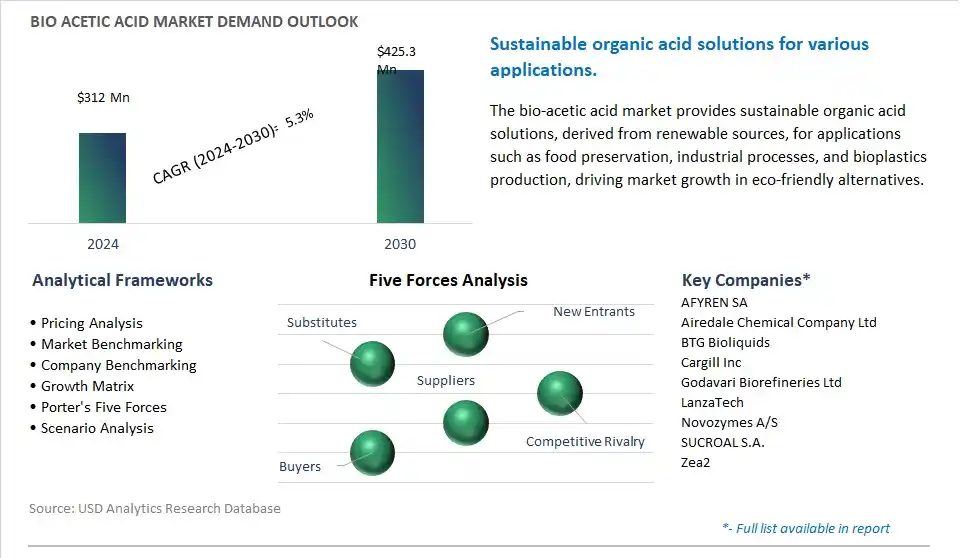
The global Bio acetic Acid Market is poised to register a 5.3% CAGR from $312 Million in 2024 to $425.3 Million in 2030.
The global Bio acetic Acid Market Study analyzes and forecasts the market size across 6 regions and 24 countries for diverse segments -By Raw Material (Biomass, Corn, Maize, Sugar, Others), By Application (Vinyl Acetate Monomer (VAM), Acetate Esters, Purified Terephthalic Acid (PTA), Acetic Anhydride, Others).
An Introduction to Global Bio acetic Acid Market in 2024
The market for bioacetic acid is gaining traction as industries seek sustainable alternatives to petrochemical-based acids for various industrial applications, including chemical synthesis, food processing, pharmaceuticals, and agriculture. Key trends shaping the future of this industry include the development of biotechnological processes for the microbial fermentation of renewable feedstocks such as biomass, agricultural residues, and industrial waste streams to produce acetic acid through eco-friendly and cost-effective methods. Additionally, advancements in downstream processing techniques such as separation, purification, and recovery enable the production of high-purity bioacetic acid suitable for diverse industrial applications. Moreover, the adoption of bio-based chemicals and green chemistry principles aligns with corporate sustainability goals and regulatory mandates for reducing carbon emissions and minimizing environmental impact, driving market growth and innovation in this sector. As industries transition towards bio-based and renewable feedstocks, the demand for bioacetic acid is expected to increase, fostering further innovation and market expansion in sustainable chemical production.
Bio acetic Acid Market Competitive Landscape
The market report analyses the leading companies in the industry including AFYREN SA, Airedale Chemical Company Ltd, BTG Bioliquids, Cargill Inc, Godavari Biorefineries Ltd, LanzaTech, Novozymes A/S, SUCROAL S.A., Zea2.
Bio acetic Acid Market Dynamics
Bio acetic Acid Market Trend: Increasing Demand for Sustainable and Renewable Chemicals
A prominent trend in the market for acetic acid is the increasing demand for sustainable and renewable chemicals. Bioacetic acid, also known as bio-based acetic acid, is produced from renewable biomass sources such as agricultural residues, wood chips, or bio-based ethanol through fermentation or chemical conversion processes. With growing concerns about environmental sustainability and climate change, there is a shift towards replacing fossil fuel-derived chemicals with bio-based alternatives. Industries such as food and beverage, pharmaceuticals, cosmetics, and textiles are seeking acetic acid as a sustainable ingredient for their products, driving the market for renewable chemicals and bio-based materials.
Bio acetic Acid Market Driver: Stringent Environmental Regulations and Sustainability Initiatives
A key driver behind the demand for bioacetic acid is the implementation of stringent environmental regulations and sustainability initiatives by governments, regulatory agencies, and corporations worldwide. As awareness of environmental issues such as carbon emissions, pollution, and resource depletion increases, there is pressure on industries to reduce their environmental footprint and transition towards more sustainable practices. Bioacetic acid offers a greener alternative to conventional acetic acid produced from fossil fuels, as it reduces greenhouse gas emissions, minimizes reliance on finite resources, and supports the circular economy. Regulatory incentives, carbon pricing mechanisms, and sustainability certifications encourage the adoption of bio-based chemicals, creating opportunities for bioacetic acid producers to meet the growing demand for sustainable solutions.
Bio acetic Acid Market Opportunity: Expansion into Diverse Applications and Markets
An emerging opportunity in the market for acetic acid lies in the expansion into diverse applications and markets beyond traditional uses. While acetic acid is widely used in industries such as chemicals, plastics, textiles, and pharmaceuticals, acetic acid offers new possibilities for innovative applications and value-added products. Opportunities exist to explore niche markets such as biodegradable plastics, eco-friendly solvents, bio-based polymers, and renewable fuels where bioacetic acid can serve as a key ingredient. Additionally, bioacetic acid can be utilized in food and beverage preservation, agricultural formulations, and personal care products as a natural and sustainable alternative to synthetic chemicals. By expanding into diverse applications and markets, producers of acetic acid can capitalize on the versatility and environmental benefits of their product, unlocking new revenue streams and strengthening their position in the bio-based chemicals industry.
Bio acetic Acid Market Ecosystem
The bio-acetic acid market encompasses diverse essential stages, with feedstock production from renewable sources including sugarcane, corn, or cellulosic biomass. Pre-treatment processes are employed, particularly for biomass, to enhance sugar extraction efficiency. Fermentation of sugars by microorganisms follows to produce bio-acetic acid, a process managed by bio-acetic acid producers or biotechnology firms. Purification and separation techniques ensure product quality, with companies specializing in this stage offering expertise in distillation or membrane separation.
Key players throughout the Market Ecosystem contribute to the bio-acetic acid market's dynamics. Feedstock production involves companies including Weyerhaeuser and Cargill, while LIG Renewable Fuels and Quadrise Fuels International handle pre-treatment. Fermentation is managed by firms including Airedale Chemicals and Myriant Corporation, typically integrated with purification and separation processes. Quality control is upheld by both bio-acetic acid producers and independent labs including SGS and Eurofins, with distribution managed by logistics companies including DHL and FedEx, along with chemical distributors including Brenntag and Univar Solutions. End-use applications involve VAM producers including Celanese and LyondellBasell, highlighting the market's diverse array of stakeholders and industries served.
Bio-acetic Acid Market Share Analysis: Corn held the dominant revenue share in 2024
Among the segments in the Bio-acetic Acid Market, Corn is the largest, driven by diverse significant factors contributing to its dominance. Corn-based bio-acetic acid production accounts for a substantial share of the market due to the widespread availability and cost-effectiveness of corn as a raw material. Corn, a versatile crop widely cultivated around the world, provides a reliable and abundant source of carbohydrates, which can be fermented to produce acetic acid through bio-based processes. The established infrastructure for corn cultivation, harvesting, and processing further supports its prominence in bio-acetic acid production. Additionally, advancements in biotechnological processes and fermentation technologies have enabled efficient conversion of corn-derived sugars into acetic acid, making it a preferred choice for bio-acetic acid manufacturers. In addition, the growing emphasis on sustainability and renewable resources drives the demand for bio-based alternatives to conventional acetic acid derived from fossil fuels, further boosting the adoption of corn-based bio-acetic acid. As industries across various sectors, including chemicals, pharmaceuticals, and food and beverages, increasingly embrace bio-based solutions, the dominance of Corn in the Bio-acetic Acid Market is expected to persist, offering manufacturers and suppliers significant opportunities for growth and market expansion.
Bio-acetic Acid Market Share Analysis: Acetate Esters is the fastest growing market segment over the forecast period to 2030
The Acetate Esters segment is the fastest-growing segment in the Bio-acetic Acid Market, propelled by diverse key factors contributing to its rapid expansion. Acetate esters, derived from bio-acetic acid, find extensive applications across various industries, including paints and coatings, adhesives, flavors and fragrances, and pharmaceuticals. As industries seek more sustainable and environmentally friendly alternatives to petroleum-based chemicals, the demand for bio-based acetate esters has surged significantly. Bio-acetic acid serves as a key feedstock for the production of acetate esters, offering manufacturers a renewable and eco-friendly source of raw material. In addition, acetate esters exhibit excellent solvency, volatility, and stability characteristics, making them versatile and highly sought-after in a wide range of applications. Additionally, the growing consumer preference for natural and biodegradable products further drives the demand for acetate esters derived from bio-acetic acid. As industries continue to prioritize sustainability and regulatory compliance, the Acetate Esters segment in the Bio-acetic Acid Market is expected to experience sustained growth, offering manufacturers and suppliers lucrative opportunities for expansion and market penetration.
Bio acetic Acid Market Report Scope-
By Raw Material
Biomass
Corn
Maize
Sugar
Others
By Application
Vinyl Acetate Monomer (VAM)
Acetate Esters
Purified Terephthalic Acid (PTA)
Acetic Anhydride
Others
Bio acetic Acid Market Companies Profiled
AFYREN SA
Airedale Chemical Company Ltd
BTG Bioliquids
Cargill Inc
Godavari Biorefineries Ltd
LanzaTech
Novozymes A/S
SUCROAL S.A.
Zea2
*- List Not Exhaustive
TABLE OF CONTENTS
1 Introduction to 2024 Bio acetic Acid Market
1.1 Market Overview
1.2 Quick Facts
1.3 Scope/Objective of the Study
1.4 Market Definition
1.5 Countries and Regions Covered
1.6 Units, Currency, and Conversions
1.7 Industry Value Chain
2 Research Methodology
2.1 Market Size Estimation
2.2 Sources and Research Methodology
2.3 Data Triangulation
2.4 Assumptions and Limitations
3 Executive Summary
3.1 Global Bio acetic Acid Market Size Outlook, $ Million, 2021 to 2030
3.2 Bio acetic Acid Market Outlook by Type, $ Million, 2021 to 2030
3.3 Bio acetic Acid Market Outlook by Product, $ Million, 2021 to 2030
3.4 Bio acetic Acid Market Outlook by Application, $ Million, 2021 to 2030
3.5 Bio acetic Acid Market Outlook by Key Countries, $ Million, 2021 to 2030
4 Market Dynamics
4.1 Key Driving Forces of Bio acetic Acid Industry
4.2 Key Market Trends in Bio acetic Acid Industry
4.3 Potential Opportunities in Bio acetic Acid Industry
4.4 Key Challenges in Bio acetic Acid Industry
5 Market Factor Analysis
5.1 Value Chain Analysis
5.2 Competitive Landscape
5.2.1 Global Bio acetic Acid Market Share by Company (%), 2023
5.2.2 Product Offerings by Company
5.3 Porter’s Five Forces Analysis
5.4 Pricing Analysis and Outlook
6 Growth Outlook Across Scenarios
6.1 Growth Analysis-Case Scenario Definitions
6.2 Low Growth Scenario Forecasts
6.3 Reference Growth Scenario Forecasts
6.4 High Growth Scenario Forecasts
7 Global Bio acetic Acid Market Outlook by Segments
7.1 Bio acetic Acid Market Outlook by Segments, $ Million, 2021- 2030
By Raw Material
Biomass
Corn
Maize
Sugar
Others
By Application
Vinyl Acetate Monomer (VAM)
Acetate Esters
Purified Terephthalic Acid (PTA)
Acetic Anhydride
Others
8 North America Bio acetic Acid Market Analysis and Outlook To 2030
8.1 Introduction to North America Bio acetic Acid Markets in 2024
8.2 North America Bio acetic Acid Market Size Outlook by Country, 2021-2030
8.2.1 United States
8.2.2 Canada
8.2.3 Mexico
8.3 North America Bio acetic Acid Market size Outlook by Segments, 2021-2030
By Raw Material
Biomass
Corn
Maize
Sugar
Others
By Application
Vinyl Acetate Monomer (VAM)
Acetate Esters
Purified Terephthalic Acid (PTA)
Acetic Anhydride
Others
9 Europe Bio acetic Acid Market Analysis and Outlook To 2030
9.1 Introduction to Europe Bio acetic Acid Markets in 2024
9.2 Europe Bio acetic Acid Market Size Outlook by Country, 2021-2030
9.2.1 Germany
9.2.2 France
9.2.3 Spain
9.2.4 United Kingdom
9.2.4 Italy
9.2.5 Russia
9.2.6 Norway
9.2.7 Rest of Europe
9.3 Europe Bio acetic Acid Market Size Outlook by Segments, 2021-2030
By Raw Material
Biomass
Corn
Maize
Sugar
Others
By Application
Vinyl Acetate Monomer (VAM)
Acetate Esters
Purified Terephthalic Acid (PTA)
Acetic Anhydride
Others
10 Asia Pacific Bio acetic Acid Market Analysis and Outlook To 2030
10.1 Introduction to Asia Pacific Bio acetic Acid Markets in 2024
10.2 Asia Pacific Bio acetic Acid Market Size Outlook by Country, 2021-2030
10.2.1 China
10.2.2 India
10.2.3 Japan
10.2.4 South Korea
10.2.5 Indonesia
10.2.6 Malaysia
10.2.7 Australia
10.2.8 Rest of Asia Pacific
10.3 Asia Pacific Bio acetic Acid Market size Outlook by Segments, 2021-2030
By Raw Material
Biomass
Corn
Maize
Sugar
Others
By Application
Vinyl Acetate Monomer (VAM)
Acetate Esters
Purified Terephthalic Acid (PTA)
Acetic Anhydride
Others
11 South America Bio acetic Acid Market Analysis and Outlook To 2030
11.1 Introduction to South America Bio acetic Acid Markets in 2024
11.2 South America Bio acetic Acid Market Size Outlook by Country, 2021-2030
11.2.1 Brazil
11.2.2 Argentina
11.2.3 Rest of South America
11.3 South America Bio acetic Acid Market size Outlook by Segments, 2021-2030
By Raw Material
Biomass
Corn
Maize
Sugar
Others
By Application
Vinyl Acetate Monomer (VAM)
Acetate Esters
Purified Terephthalic Acid (PTA)
Acetic Anhydride
Others
12 Middle East and Africa Bio acetic Acid Market Analysis and Outlook To 2030
12.1 Introduction to Middle East and Africa Bio acetic Acid Markets in 2024
12.2 Middle East and Africa Bio acetic Acid Market Size Outlook by Country, 2021-2030
12.2.1 Saudi Arabia
12.2.2 UAE
12.2.3 Oman
12.2.4 Rest of Middle East
12.2.5 Egypt
12.2.6 Nigeria
12.2.7 South Africa
12.2.8 Rest of Africa
12.3 Middle East and Africa Bio acetic Acid Market size Outlook by Segments, 2021-2030
By Raw Material
Biomass
Corn
Maize
Sugar
Others
By Application
Vinyl Acetate Monomer (VAM)
Acetate Esters
Purified Terephthalic Acid (PTA)
Acetic Anhydride
Others
13 Company Profiles
13.1 Company Snapshot
13.2 SWOT Profiles
13.3 Products and Services
13.4 Recent Developments
13.5 Financial Profile
AFYREN SA
Airedale Chemical Company Ltd
BTG Bioliquids
Cargill Inc
Godavari Biorefineries Ltd
LanzaTech
Novozymes A/S
SUCROAL S.A.
Zea2
14 Appendix
14.1 Customization Offerings
14.2 Subscription Services
14.3 Related Reports
14.4 Publisher Expertise
By Raw Material
Biomass
Corn
Maize
Sugar
Others
By Application
Vinyl Acetate Monomer (VAM)
Acetate Esters
Purified Terephthalic Acid (PTA)
Acetic Anhydride
Others
Countries Analyzed
North America (US, Canada, Mexico)
Europe (Germany, UK, France, Spain, Italy, Russia, Rest of Europe)
Asia Pacific (China, India, Japan, South Korea, Australia, South East Asia, Rest of Asia)
South America (Brazil, Argentina, Rest of South America)
Middle East and Africa (Saudi Arabia, UAE, Rest of Middle East, South Africa, Egypt, Rest of Africa)
