
The global Bio-Based Adipic Acid Market Study analyzes and forecasts the market size across 6 regions and 24 countries for diverse segments -By Application (Paints and Coatings, Low Temperature Lubricants, Plastic Additives, Polyurethane Resins, Food Additives, Others).
The market for bio-based adipic acid is gaining momentum as industries seek sustainable alternatives to petroleum-derived adipic acid for the production of nylon and other polyamide-based materials. Key trends shaping the future of this industry include the development of biotechnological processes for the microbial fermentation of renewable feedstocks such as plant sugars, lignocellulosic biomass, and waste streams to produce adipic acid through environmentally friendly and economically viable methods. Additionally, advancements in fermentation technology, metabolic engineering, and strain optimization enable the production of bio-based adipic acid with high yields, purity, and process efficiency, meeting the performance requirements of nylon manufacturing. Moreover, the adoption of bio-based and renewable chemicals aligns with corporate sustainability initiatives and regulatory mandates for reducing greenhouse gas emissions and dependence on fossil fuels, driving market growth and innovation in this sector. As industries seek to minimize environmental impact and enhance resource efficiency in nylon production, the demand for bio-based adipic acid is expected to increase, fostering further innovation and market expansion in sustainable polymer materials.
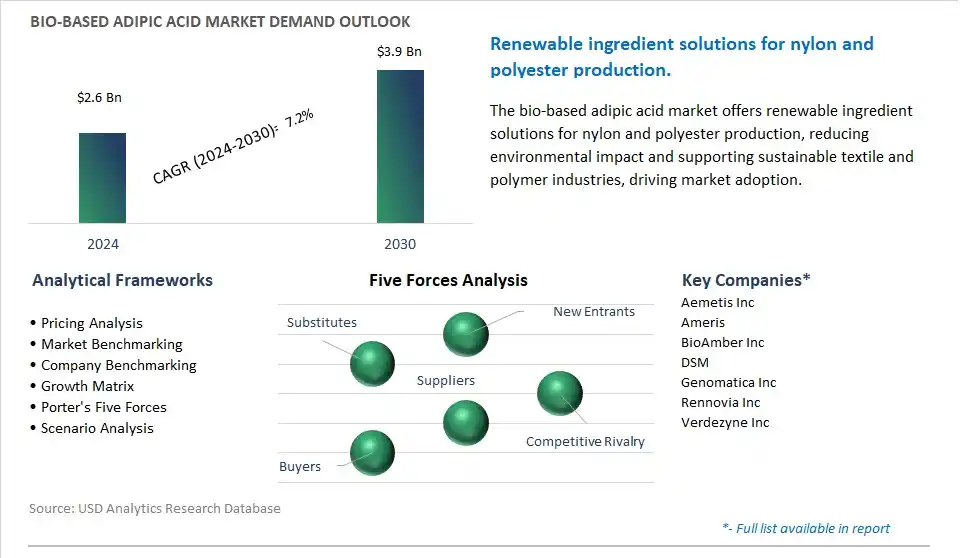
The market report analyses the leading companies in the industry including Aemetis Inc, Ameris, BioAmber Inc, DSM, Genomatica Inc, Rennovia Inc, Verdezyne Inc.
A prominent trend in the market for bio-based adipic acid is the growing demand for sustainable alternatives in the chemical industry. Adipic acid is a key raw material used in the production of nylon, polyurethane, and other polymers, which are widely used in textiles, automotive components, furniture, and packaging. As concerns about climate change, resource depletion, and environmental pollution escalate, there is a shift towards replacing fossil fuel-derived adipic acid with bio-based alternatives. Bio-based adipic acid, produced from renewable biomass sources such as plant sugars or bio-based intermediates, offers a sustainable and environmentally friendly alternative to traditional adipic acid, driving the market for bio-based chemicals and materials.
A key driver behind the demand for bio-based adipic acid is the implementation of environmental regulations and corporate sustainability initiatives aimed at reducing carbon emissions and promoting circular economy principles. Governments worldwide are introducing stringent regulations and policies to limit greenhouse gas emissions, incentivize renewable energy sources, and promote the use of bio-based materials in manufacturing processes. Additionally, companies are adopting sustainability goals and commitments to reduce their environmental footprint, improve resource efficiency, and enhance their corporate social responsibility (CSR) efforts. Bio-based adipic acid aligns with these regulatory requirements and sustainability objectives by offering a renewable and low-carbon alternative to fossil fuel-derived adipic acid, driving its adoption in various industries and supply chains.
An emerging opportunity in the market for bio-based adipic acid lies in collaboration and innovation in biorefinery technologies for biomass conversion and chemical synthesis. Biorefineries play a crucial role in the production of bio-based chemicals by converting renewable biomass feedstocks into value-added products through biochemical or thermochemical processes. Opportunities exist to develop integrated biorefinery systems that can efficiently produce bio-based adipic acid from a variety of biomass sources, such as lignocellulosic biomass, agricultural residues, or bio-based sugars. Collaboration between technology developers, chemical manufacturers, and biomass suppliers can accelerate the development and commercialization of cost-effective and scalable biorefinery technologies for bio-based adipic acid production. By investing in research and development of innovative biorefinery processes and forming strategic partnerships, companies can capitalize on the growing demand for bio-based chemicals and position themselves as leaders in sustainable manufacturing solutions.
The bio-based adipic acid market entails diverse critical stages, beginning with feedstock production sourced from renewable materials including sugarcane, corn, or vegetable oils. Fermentation processes, executed by companies including Myriant Corporation and Succinity, convert these feedstocks into bio-based succinic acid, a precursor to adipic acid. Alternatively, chemical conversion techniques, as demonstrated by PTT Global Chemical and BASF, transform vegetable oils into intermediates for adipic acid production. Purification and separation methods ensure product quality, with companies specializing in these processes integrated into the production chain. Quality control and testing labs verify adherence to standards, while logistics companies facilitate distribution to industrial customers, including bio-based nylon and bio-PU manufacturers, as well as plastics processors adopting sustainable solutions.
Feedstock producers, including Ecoleo and Precept, supply the necessary raw materials, while fermentation specialists including Metabolic Institute, and chemical conversion experts including BASF and PTT Global Chemical oversee key conversion processes. Companies integrated into purification and separation, typically overlapping with fermentation or chemical conversion, ensure product purity and quality. Independent labs including SGS and Eurofins play a role in quality control, while bio-based adipic acid producers manage distribution and sales through established networks. End-use applications, particularly in bio-based nylon and bio-PU manufacturing, demonstrate the diverse industries embracing sustainable alternatives to traditional polymers.
Among the segments in the Bio-Based Adipic Acid Market, Polyurethane Resins stand out as the largest, driven by diverse significant factors contributing to its dominance. Adipic acid is a key precursor in the production of polyurethane resins, which find extensive applications across various industries, including automotive, construction, furniture, and footwear. Polyurethane resins derived from bio-based adipic acid offer diverse advantages, including enhanced sustainability, reduced environmental impact, and compliance with stringent regulations regarding volatile organic compound (VOC) emissions. The versatility of polyurethane resins makes them indispensable in the formulation of adhesives, sealants, coatings, and flexible and rigid foams, driving their widespread adoption across multiple applications. Additionally, the growing demand for bio-based materials in response to environmental concerns and increasing regulatory pressure further fuels the demand for polyurethane resins derived from bio-based adipic acid. As industries continue to prioritize sustainability and seek alternatives to conventional petroleum-based chemicals, the dominance of Polyurethane Resins in the Bio-Based Adipic Acid Market is expected to persist, offering manufacturers and suppliers significant opportunities for growth and market expansion.
By Application
Paints and Coatings
Low Temperature Lubricants
Plastic Additives
Polyurethane Resins
Food Additives
Others
Aemetis Inc
Ameris
BioAmber Inc
DSM
Genomatica Inc
Rennovia Inc
Verdezyne Inc
*- List Not Exhaustive
TABLE OF CONTENTS
1 Introduction to 2024 Bio-Based Adipic Acid Market
1.1 Market Overview
1.2 Quick Facts
1.3 Scope/Objective of the Study
1.4 Market Definition
1.5 Countries and Regions Covered
1.6 Units, Currency, and Conversions
1.7 Industry Value Chain
2 Research Methodology
2.1 Market Size Estimation
2.2 Sources and Research Methodology
2.3 Data Triangulation
2.4 Assumptions and Limitations
3 Executive Summary
3.1 Global Bio-Based Adipic Acid Market Size Outlook, $ Million, 2021 to 2030
3.2 Bio-Based Adipic Acid Market Outlook by Type, $ Million, 2021 to 2030
3.3 Bio-Based Adipic Acid Market Outlook by Product, $ Million, 2021 to 2030
3.4 Bio-Based Adipic Acid Market Outlook by Application, $ Million, 2021 to 2030
3.5 Bio-Based Adipic Acid Market Outlook by Key Countries, $ Million, 2021 to 2030
4 Market Dynamics
4.1 Key Driving Forces of Bio-Based Adipic Acid Industry
4.2 Key Market Trends in Bio-Based Adipic Acid Industry
4.3 Potential Opportunities in Bio-Based Adipic Acid Industry
4.4 Key Challenges in Bio-Based Adipic Acid Industry
5 Market Factor Analysis
5.1 Value Chain Analysis
5.2 Competitive Landscape
5.2.1 Global Bio-Based Adipic Acid Market Share by Company (%), 2023
5.2.2 Product Offerings by Company
5.3 Porter’s Five Forces Analysis
5.4 Pricing Analysis and Outlook
6 Growth Outlook Across Scenarios
6.1 Growth Analysis-Case Scenario Definitions
6.2 Low Growth Scenario Forecasts
6.3 Reference Growth Scenario Forecasts
6.4 High Growth Scenario Forecasts
7 Global Bio-Based Adipic Acid Market Outlook by Segments
7.1 Bio-Based Adipic Acid Market Outlook by Segments, $ Million, 2021- 2030
By Application
Paints and Coatings
Low Temperature Lubricants
Plastic Additives
Polyurethane Resins
Food Additives
Others
8 North America Bio-Based Adipic Acid Market Analysis and Outlook To 2030
8.1 Introduction to North America Bio-Based Adipic Acid Markets in 2024
8.2 North America Bio-Based Adipic Acid Market Size Outlook by Country, 2021-2030
8.2.1 United States
8.2.2 Canada
8.2.3 Mexico
8.3 North America Bio-Based Adipic Acid Market size Outlook by Segments, 2021-2030
By Application
Paints and Coatings
Low Temperature Lubricants
Plastic Additives
Polyurethane Resins
Food Additives
Others
9 Europe Bio-Based Adipic Acid Market Analysis and Outlook To 2030
9.1 Introduction to Europe Bio-Based Adipic Acid Markets in 2024
9.2 Europe Bio-Based Adipic Acid Market Size Outlook by Country, 2021-2030
9.2.1 Germany
9.2.2 France
9.2.3 Spain
9.2.4 United Kingdom
9.2.4 Italy
9.2.5 Russia
9.2.6 Norway
9.2.7 Rest of Europe
9.3 Europe Bio-Based Adipic Acid Market Size Outlook by Segments, 2021-2030
By Application
Paints and Coatings
Low Temperature Lubricants
Plastic Additives
Polyurethane Resins
Food Additives
Others
10 Asia Pacific Bio-Based Adipic Acid Market Analysis and Outlook To 2030
10.1 Introduction to Asia Pacific Bio-Based Adipic Acid Markets in 2024
10.2 Asia Pacific Bio-Based Adipic Acid Market Size Outlook by Country, 2021-2030
10.2.1 China
10.2.2 India
10.2.3 Japan
10.2.4 South Korea
10.2.5 Indonesia
10.2.6 Malaysia
10.2.7 Australia
10.2.8 Rest of Asia Pacific
10.3 Asia Pacific Bio-Based Adipic Acid Market size Outlook by Segments, 2021-2030
By Application
Paints and Coatings
Low Temperature Lubricants
Plastic Additives
Polyurethane Resins
Food Additives
Others
11 South America Bio-Based Adipic Acid Market Analysis and Outlook To 2030
11.1 Introduction to South America Bio-Based Adipic Acid Markets in 2024
11.2 South America Bio-Based Adipic Acid Market Size Outlook by Country, 2021-2030
11.2.1 Brazil
11.2.2 Argentina
11.2.3 Rest of South America
11.3 South America Bio-Based Adipic Acid Market size Outlook by Segments, 2021-2030
By Application
Paints and Coatings
Low Temperature Lubricants
Plastic Additives
Polyurethane Resins
Food Additives
Others
12 Middle East and Africa Bio-Based Adipic Acid Market Analysis and Outlook To 2030
12.1 Introduction to Middle East and Africa Bio-Based Adipic Acid Markets in 2024
12.2 Middle East and Africa Bio-Based Adipic Acid Market Size Outlook by Country, 2021-2030
12.2.1 Saudi Arabia
12.2.2 UAE
12.2.3 Oman
12.2.4 Rest of Middle East
12.2.5 Egypt
12.2.6 Nigeria
12.2.7 South Africa
12.2.8 Rest of Africa
12.3 Middle East and Africa Bio-Based Adipic Acid Market size Outlook by Segments, 2021-2030
By Application
Paints and Coatings
Low Temperature Lubricants
Plastic Additives
Polyurethane Resins
Food Additives
Others
13 Company Profiles
13.1 Company Snapshot
13.2 SWOT Profiles
13.3 Products and Services
13.4 Recent Developments
13.5 Financial Profile
Aemetis Inc
Ameris
BioAmber Inc
DSM
Genomatica Inc
Rennovia Inc
Verdezyne Inc
14 Appendix
14.1 Customization Offerings
14.2 Subscription Services
14.3 Related Reports
14.4 Publisher Expertise
By Application
Paints and Coatings
Low Temperature Lubricants
Plastic Additives
Polyurethane Resins
Food Additives
Others
Countries Analyzed
North America (US, Canada, Mexico)
Europe (Germany, UK, France, Spain, Italy, Russia, Rest of Europe)
Asia Pacific (China, India, Japan, South Korea, Australia, South East Asia, Rest of Asia)
South America (Brazil, Argentina, Rest of South America)
Middle East and Africa (Saudi Arabia, UAE, Rest of Middle East, South Africa, Egypt, Rest of Africa)
Global Bio-Based Adipic Acid is forecast to reach $3.9 Billion in 2030 from $2.6 Billion in 2024, registering a CAGR of 7.2% over the outlook period
Emerging Markets across Asia Pacific, Europe, and Americas present robust growth prospects.
Aemetis Inc, Ameris, BioAmber Inc, DSM, Genomatica Inc, Rennovia Inc, Verdezyne Inc
Base Year- 2023; Estimated Year- 2024; Historic Period- 2018-2023; Forecast period- 2024 to 2030; Currency: Revenue (USD); Volume