
The global Bio-based Butanol Market Study analyzes and forecasts the market size across 6 regions and 24 countries for diverse segments -By Application (Acrylates, Acetates, Glycol ethers, Plasticizers, Biofuel, Others).
The market for bio-based butanol is witnessing significant growth, driven by the demand for sustainable alternatives to petroleum-based chemicals in various industries such as automotive, paints and coatings, and pharmaceuticals. Key trends shaping the future of the industry include advancements in biotechnology, fermentation processes, and feedstock utilization, enabling the production of butanol from renewable resources such as biomass, agricultural residues, and waste streams. Manufacturers are focusing on optimizing microbial strains, fermentation conditions, and downstream processing techniques to improve yield, purity, and cost-effectiveness of bio-based butanol production. Additionally, there is a growing emphasis on environmental sustainability and carbon footprint reduction, driving the adoption of bio-based butanol as a green solvent, fuel additive, and chemical intermediate that offers lower greenhouse gas emissions and improved eco-profile compared to conventional butanol derived from fossil fuels. Moreover, advancements in biorefinery integration and bioprocess engineering are driving market innovation, enabling the development of integrated biorefinery concepts that maximize resource efficiency and value generation from biomass feedstocks. Overall, the future of bio-based butanol lies in continuous technological advancements, regulatory support, and market acceptance to scale up production, expand application areas, and promote sustainable development in the global bioeconomy.
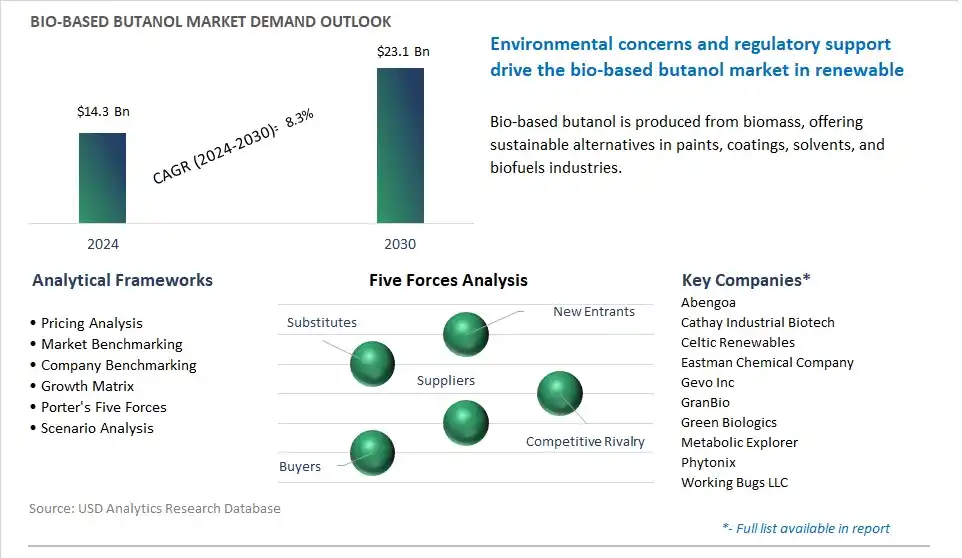
The market report analyses the leading companies in the industry including Abengoa, Cathay Industrial Biotech, Celtic Renewables, Eastman Chemical Company, Gevo Inc, GranBio, Green Biologics, Metabolic Explorer, Phytonix, Working Bugs LLC.
In the Bio-based Butanol market, a prominent trend is the shift towards sustainable and renewable energy sources. With increasing concerns about climate change and environmental sustainability, there's a growing demand for bio-based alternatives to traditional fossil fuels and petrochemicals. Bio-based butanol, derived from renewable biomass sources such as corn, sugarcane, or lignocellulosic feedstocks, offers a promising solution for reducing greenhouse gas emissions and dependence on finite resources. This trend is driven by factors such as government policies promoting biofuel usage, corporate sustainability initiatives, and consumer preferences for environmentally friendly products, all contributing to a growing market for bio-based butanol as a renewable fuel and chemical feedstock.
A significant driver in the Bio-based Butanol market is the advantages offered in biofuel blending and chemical production. Bio-based butanol exhibits properties such as high energy density, low vapor pressure, and compatibility with existing fuel infrastructure, making it an attractive option for blending with gasoline or diesel fuels to enhance octane ratings, reduce emissions, and improve fuel efficiency. Additionally, bio-based butanol serves as a versatile chemical intermediate for the production of various industrial chemicals, solvents, and polymers, offering potential applications in industries such as paints, coatings, plastics, and pharmaceuticals. This driver is fueled by the need for sustainable alternatives to conventional fuels and chemicals, driving investment in bio-based butanol production technologies and market expansion efforts.
A promising opportunity within the Bio-based Butanol market lies in the expansion into renewable chemicals and bioplastics. As the demand for eco-friendly alternatives to petroleum-based chemicals and plastics continues to grow, there's a rising opportunity for bio-based butanol to serve as a building block for renewable chemical synthesis and biopolymer production. Opportunities exist in developing bio-based butanol-derived chemicals such as butyl acrylate, butyl acetate, and glycol ethers, which are widely used in coatings, adhesives, and solvents. Additionally, bio-based butanol can be utilized in the production of bioplastics such as polybutylene succinate (PBS) and polybutylene adipate terephthalate (PBAT), offering biodegradable and compostable alternatives to traditional plastics. By leveraging its versatility and sustainability credentials, bio-based butanol can capitalize on this opportunity to penetrate new markets, diversify its application portfolio, and contribute to the transition towards a more circular and sustainable economy.
The largest segment in the Bio-based Butanol Market is the Biofuel application segment. bio-based butanol serves as a renewable and sustainable alternative to petroleum-based fuels, offering potential advantages such as lower greenhouse gas emissions, reduced dependence on fossil fuels, and enhanced energy security. Accordingly, there is a growing demand for bio-based butanol as a blending component in gasoline and diesel fuels to meet regulatory requirements and environmental targets for reducing carbon emissions. Additionally, bio-based butanol can be used as a feedstock for the production of biofuels such as biobutanol or biojet fuels, which have applications in transportation, aviation, and marine sectors. Further, the increasing focus on decarbonizing the transportation sector and achieving carbon neutrality goals drives investment and research in biofuel technologies, creating opportunities for bio-based butanol as a renewable fuel source. Furthermore, bio-based butanol offers versatility and compatibility with existing fuel infrastructure, blending seamlessly with conventional fuels and requiring minimal modifications to existing engines and distribution systems. Over the forecast period, the combination of environmental benefits, regulatory support, and technological advancements positions the Biofuel application segment as the largest in the Bio-based Butanol Market.
By Application
Acrylates
Acetates
Glycol ethers
Plasticizers
Biofuel
Others
Regions Included
North America (US, Canada, Mexico)
Europe (Germany, UK, France, Spain, Italy, Russia, Rest of Europe)
Asia Pacific (China, India, Japan, South Korea, Australia, South East Asia, Rest of Asia)
South America (Brazil, Argentina, Rest of South America)
Middle East and Africa (Saudi Arabia, UAE, Rest of Middle East, South Africa, Egypt, Rest of Africa)
Abengoa
Cathay Industrial Biotech
Celtic Renewables
Eastman Chemical Company
Gevo Inc
GranBio
Green Biologics
Metabolic Explorer
Phytonix
Working Bugs LLC
*- List Not Exhaustive
TABLE OF CONTENTS
1 Introduction to 2024 Bio-based Butanol Market
1.1 Market Overview
1.2 Quick Facts
1.3 Scope/Objective of the Study
1.4 Market Definition
1.5 Countries and Regions Covered
1.6 Units, Currency, and Conversions
1.7 Industry Value Chain
2 Research Methodology
2.1 Market Size Estimation
2.2 Sources and Research Methodology
2.3 Data Triangulation
2.4 Assumptions and Limitations
3 Executive Summary
3.1 Global Bio-based Butanol Market Size Outlook, $ Million, 2021 to 2030
3.2 Bio-based Butanol Market Outlook by Type, $ Million, 2021 to 2030
3.3 Bio-based Butanol Market Outlook by Product, $ Million, 2021 to 2030
3.4 Bio-based Butanol Market Outlook by Application, $ Million, 2021 to 2030
3.5 Bio-based Butanol Market Outlook by Key Countries, $ Million, 2021 to 2030
4 Market Dynamics
4.1 Key Driving Forces of Bio-based Butanol Industry
4.2 Key Market Trends in Bio-based Butanol Industry
4.3 Potential Opportunities in Bio-based Butanol Industry
4.4 Key Challenges in Bio-based Butanol Industry
5 Market Factor Analysis
5.1 Value Chain Analysis
5.2 Competitive Landscape
5.2.1 Global Bio-based Butanol Market Share by Company (%), 2023
5.2.2 Product Offerings by Company
5.3 Porter’s Five Forces Analysis
5.4 Pricing Analysis and Outlook
6 Growth Outlook Across Scenarios
6.1 Growth Analysis-Case Scenario Definitions
6.2 Low Growth Scenario Forecasts
6.3 Reference Growth Scenario Forecasts
6.4 High Growth Scenario Forecasts
7 Global Bio-based Butanol Market Outlook by Segments
7.1 Bio-based Butanol Market Outlook by Segments, $ Million, 2021- 2030
By Application
Acrylates
Acetates
Glycol ethers
Plasticizers
Biofuel
Others
8 North America Bio-based Butanol Market Analysis and Outlook To 2030
8.1 Introduction to North America Bio-based Butanol Markets in 2024
8.2 North America Bio-based Butanol Market Size Outlook by Country, 2021-2030
8.2.1 United States
8.2.2 Canada
8.2.3 Mexico
8.3 North America Bio-based Butanol Market size Outlook by Segments, 2021-2030
By Application
Acrylates
Acetates
Glycol ethers
Plasticizers
Biofuel
Others
9 Europe Bio-based Butanol Market Analysis and Outlook To 2030
9.1 Introduction to Europe Bio-based Butanol Markets in 2024
9.2 Europe Bio-based Butanol Market Size Outlook by Country, 2021-2030
9.2.1 Germany
9.2.2 France
9.2.3 Spain
9.2.4 United Kingdom
9.2.4 Italy
9.2.5 Russia
9.2.6 Norway
9.2.7 Rest of Europe
9.3 Europe Bio-based Butanol Market Size Outlook by Segments, 2021-2030
By Application
Acrylates
Acetates
Glycol ethers
Plasticizers
Biofuel
Others
10 Asia Pacific Bio-based Butanol Market Analysis and Outlook To 2030
10.1 Introduction to Asia Pacific Bio-based Butanol Markets in 2024
10.2 Asia Pacific Bio-based Butanol Market Size Outlook by Country, 2021-2030
10.2.1 China
10.2.2 India
10.2.3 Japan
10.2.4 South Korea
10.2.5 Indonesia
10.2.6 Malaysia
10.2.7 Australia
10.2.8 Rest of Asia Pacific
10.3 Asia Pacific Bio-based Butanol Market size Outlook by Segments, 2021-2030
By Application
Acrylates
Acetates
Glycol ethers
Plasticizers
Biofuel
Others
11 South America Bio-based Butanol Market Analysis and Outlook To 2030
11.1 Introduction to South America Bio-based Butanol Markets in 2024
11.2 South America Bio-based Butanol Market Size Outlook by Country, 2021-2030
11.2.1 Brazil
11.2.2 Argentina
11.2.3 Rest of South America
11.3 South America Bio-based Butanol Market size Outlook by Segments, 2021-2030
By Application
Acrylates
Acetates
Glycol ethers
Plasticizers
Biofuel
Others
12 Middle East and Africa Bio-based Butanol Market Analysis and Outlook To 2030
12.1 Introduction to Middle East and Africa Bio-based Butanol Markets in 2024
12.2 Middle East and Africa Bio-based Butanol Market Size Outlook by Country, 2021-2030
12.2.1 Saudi Arabia
12.2.2 UAE
12.2.3 Oman
12.2.4 Rest of Middle East
12.2.5 Egypt
12.2.6 Nigeria
12.2.7 South Africa
12.2.8 Rest of Africa
12.3 Middle East and Africa Bio-based Butanol Market size Outlook by Segments, 2021-2030
By Application
Acrylates
Acetates
Glycol ethers
Plasticizers
Biofuel
Others
13 Company Profiles
13.1 Company Snapshot
13.2 SWOT Profiles
13.3 Products and Services
13.4 Recent Developments
13.5 Financial Profile
Abengoa
Cathay Industrial Biotech
Celtic Renewables
Eastman Chemical Company
Gevo Inc
GranBio
Green Biologics
Metabolic Explorer
Phytonix
Working Bugs LLC
14 Appendix
14.1 Customization Offerings
14.2 Subscription Services
14.3 Related Reports
14.4 Publisher Expertise
By Application
Acrylates
Acetates
Glycol ethers
Plasticizers
Biofuel
Others
Countries Analyzed
North America (US, Canada, Mexico)
Europe (Germany, UK, France, Spain, Italy, Russia, Rest of Europe)
Asia Pacific (China, India, Japan, South Korea, Australia, South East Asia, Rest of Asia)
South America (Brazil, Argentina, Rest of South America)
Middle East and Africa (Saudi Arabia, UAE, Rest of Middle East, South Africa, Egypt, Rest of Africa)
Global Bio-based Butanol is forecast to reach $23.1 Billion in 2030 from $14.3 Billion in 2024, registering a CAGR of 8.3%
Emerging Markets across Asia Pacific, Europe, and Americas present robust growth prospects.
Abengoa, Cathay Industrial Biotech, Celtic Renewables, Eastman Chemical Company, Gevo Inc, GranBio, Green Biologics, Metabolic Explorer, Phytonix, Working Bugs LLC
Base Year- 2023; Estimated Year- 2024; Historic Period- 2018-2023; Forecast period- 2024 to 2030; Currency: Revenue (USD); Volume