The global Bio-based Polyethylene Market is poised to register a 4.3% CAGR from $1.9 Billion in 2024 to $2.4 Billion in 2030.
The global Bio-based Polyethylene Market Study analyzes and forecasts the market size across 6 regions and 24 countries for diverse segments -By Type (HDPE, LLDPE, LDPE), By Material (Rigid, Flexible), By Application (Agriculture, Food and Beverages, Cosmetics, Personal Care, Textiles, Pharmaceuticals, Others).
An Introduction to Global Bio based Polyethylene Market in 2024
The market for bio-based polyethylene is growing rapidly as industries seek sustainable alternatives to conventional plastics for packaging applications in food and beverage, cosmetics, personal care, and healthcare. Key trends shaping the future of this industry include the development of polyethylene polymers derived from renewable feedstocks such as sugarcane, corn, and cellulose, offering advantages in terms of biodegradability, carbon neutrality, and reduced environmental impact. Additionally, advancements in polymerization techniques, catalysts, and process optimization enable the production of bio-based polyethylene with properties comparable to traditional fossil fuel-derived polyethylene, meeting the performance requirements of various packaging formats and applications. Moreover, the adoption of sustainability certifications, eco-labeling initiatives, and regulatory mandates drives market demand for bio-based polyethylene, fostering innovation and market expansion in this sector. As consumers and brand owners increasingly prioritize sustainable packaging solutions, the demand for bio-based polyethylene is expected to continue growing, driving further innovation and market development in sustainable plastic packaging.
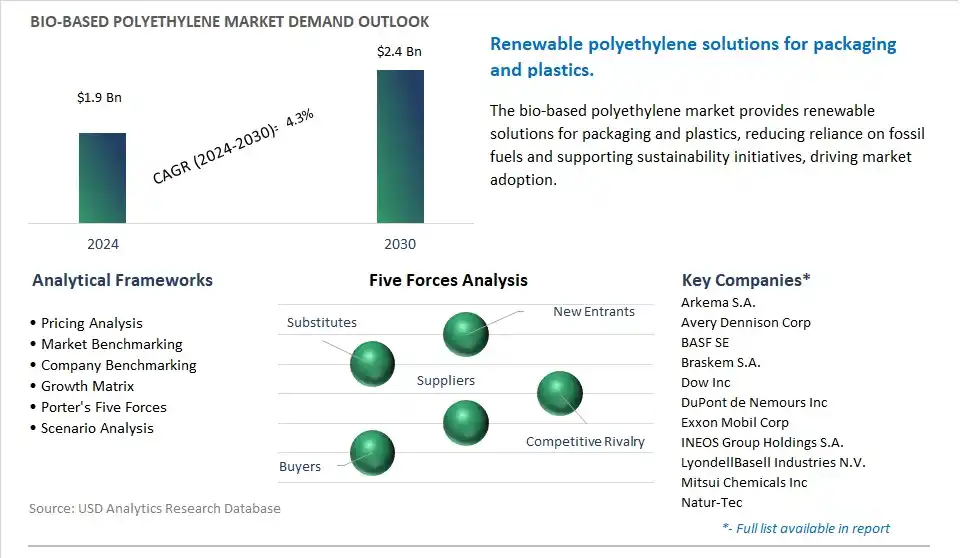
Bio-based Polyethylene Market Competitive Landscape
The market report analyses the leading companies in the industry including Arkema S.A., Avery Dennison Corp, BASF SE, Braskem S.A., Dow Inc, DuPont de Nemours Inc, Exxon Mobil Corp, INEOS Group Holdings S.A., LyondellBasell Industries N.V., Mitsui Chemicals Inc, Natur-Tec, Neste Corp, Plantic Technologies Ltd, Pont Europe SAS, Saudi Basic Industries Corp, Sealed Air Corp, Sojitz Corp, TotalEnergies SE, Toyota Tsusho Corp, TricorBraun Inc.
Bio-based Polyethylene Market Dynamics
Bio-based Polyethylene Market Trend: Surge in Demand for Sustainable Packaging Solutions
A prominent trend in the market for bio-based polyethylene is the surge in demand for sustainable packaging solutions. Polyethylene is one of the most widely used plastics in the world, found in various applications such as packaging, containers, films, and agricultural materials. With growing concerns about plastic pollution and environmental degradation, there is a significant shift towards replacing traditional petroleum-based polyethylene with bio-based alternatives. Bio-based polyethylene, derived from renewable biomass sources such as sugarcane, corn, or cellulose, offers a sustainable solution with reduced carbon footprint and lower environmental impact. As consumers and governments prioritize sustainability, there is an increasing demand for bio-based polyethylene in the packaging industry to meet the growing need for eco-friendly and recyclable packaging materials.
Bio-based Polyethylene Market Driver: Regulatory Pressure and Sustainability Initiatives
A key driver behind the demand for bio-based polyethylene is regulatory pressure and sustainability initiatives aimed at reducing plastic waste and promoting the use of renewable resources. Governments worldwide are implementing regulations and policies to encourage the adoption of bio-based materials, including polyethylene, in various industries. Additionally, companies are setting ambitious sustainability goals and commitments to reduce their environmental footprint and enhance their corporate social responsibility (CSR) efforts. Bio-based polyethylene aligns with these regulatory requirements and sustainability objectives by offering a renewable and eco-friendly alternative to conventional polyethylene derived from fossil fuels. As regulatory pressure increases and consumer preferences shift towards sustainable products, the demand for bio-based polyethylene is expected to rise, driving market growth and investment in the industry.
Bio-based Polyethylene Market Opportunity: Innovation in Material Properties and Applications
An emerging opportunity in the market for bio-based polyethylene lies in innovation in material properties and applications. While bio-based polyethylene offers environmental benefits, challenges remain in terms of performance, compatibility, and cost competitiveness compared to traditional polyethylene. Opportunities exist for research and development of bio-based polyethylene with enhanced mechanical properties, thermal stability, barrier properties, and processability to meet the needs of diverse applications. Additionally, bio-based polyethylene can capture market share in emerging sectors such as automotive, construction, and consumer goods where sustainability and performance are critical factors. By investing in innovation and collaboration with end-users and value-chain partners, manufacturers of bio-based polyethylene can capitalize on new opportunities and drive the adoption of sustainable plastics in various industries.
Bio-based Polyethylene Market Ecosystem
In the bio-based polyethylene (PE) market, multiple stages involve large-scale companies contributing to the sustainable production and distribution of bio-PE. Feedstock production relies on various players including sugarcane growers including Raízen and Tereos, corn farmers, cassava producers including Thai Tapioca Starch Factory, and companies specializing in feedstock production for bioplastics including Braskem and ISCC System.
Pre-treatment processes are managed by specialized companies including LIG Renewable Fuels and Quadrise Fuels International, while bio-based monomer production involves bio-based chemical companies including Myriant Corporation and Metabolic Institute, alongside integrated producers including Braskem. Alternatively, companies including Braskem utilize sugarcane ethanol for bio-PE production through alcoholysis, while others focus on developing or licensing fermentation technologies.
Polymerization is executed by established PE producers including Dow and ExxonMobil, as well as bio-based PE producers including Braskem. Compounding and modification are handled by bio-based PE producers with compounding capabilities and specialty compounding companies. In end-use applications, bio-based PE finds usage in packaging, consumer goods, automotive, agriculture, construction, textiles, and other sectors, with key players including packaging manufacturers, consumer goods manufacturers, automotive parts manufacturers, agricultural companies, and manufacturers in various industries adopting bio-based PE solutions.
Bio-based Polyethylene Market Share Analysis: HDPE held the dominant revenue share in 2024
Among the types in the Bio-based Polyethylene Market, High-Density Polyethylene (HDPE) is the largest segment, driven by diverse significant factors contributing to its dominance. HDPE is widely used in various industries for its excellent mechanical properties, including high tensile strength, chemical resistance, and durability. Its versatility and suitability for a wide range of applications, such as packaging, construction, automotive, and consumer goods, make it a preferred choice for manufacturers and end-users alike. In addition, the increasing demand for sustainable and eco-friendly alternatives to conventional plastics drives the adoption of bio-based HDPE. Bio-based HDPE offers diverse environmental advantages, including reduced reliance on fossil fuels, lower greenhouse gas emissions, and potential for biodegradability. Additionally, advancements in bio-based polymer technology and manufacturing processes have enhanced the performance and cost-effectiveness of bio-based HDPE, further consolidating its position as the largest segment in the Bio-based Polyethylene Market Share Analysis:
Bio-based Polyethylene Market Share Analysis: Flexible is the fastest growing market segment over the forecast period to 2030
Among the segments in the Bio-based Polyethylene Market, the Flexible segment is the fastest-growing, driven by diverse key factors contributing to its rapid expansion. Flexible bio-based polyethylene finds extensive applications in various industries such as packaging, agriculture, and consumer goods due to its versatility, durability, and lightweight nature. The increasing demand for sustainable and eco-friendly packaging solutions in response to environmental concerns and regulatory pressures drives the adoption of flexible bio-based polyethylene. In addition, the flexibility of bio-based polyethylene makes it suitable for a wide range of applications, including flexible films, bags, pouches, and wraps, catering to diverse end-user needs. Additionally, advancements in bio-based polymer technology and manufacturing processes have enhanced the performance and cost-effectiveness of flexible bio-based polyethylene, further fueling its market growth. As industries across sectors continue to prioritize sustainability and seek alternatives to conventional materials, the Flexible segment in the Bio-based Polyethylene Market is expected to experience sustained growth, presenting significant opportunities for manufacturers and suppliers to capitalize on this trend.
Bio-based Polyethylene Market Share Analysis: Food and Beverages is the fastest growing market segment over the forecast period to 2030
Among the segments in the Bio-based Polyethylene Market, the Food and Beverages segment is the fastest-growing, driven by diverse key factors contributing to its rapid expansion. Bio-based polyethylene is increasingly being utilized in food and beverage packaging applications due to its sustainability, safety, and versatility. With growing consumer awareness regarding environmental sustainability and health concerns associated with conventional plastics, there is a rising demand for bio-based polyethylene packaging solutions in the food and beverage industry. Bio-based polyethylene offers advantages such as biodegradability, reduced carbon footprint, and compatibility with food contact regulations, making it an attractive choice for packaging various food and beverage products. In addition, advancements in bio-based polymer technology have improved the performance and barrier properties of bio-based polyethylene, ensuring the preservation and safety of packaged food and beverages. As food and beverage companies continue to prioritize sustainable packaging solutions to meet consumer demands and regulatory requirements, the Food and Beverages segment in the Bio-based Polyethylene Market is expected to experience sustained growth, presenting significant opportunities for manufacturers and suppliers to capitalize on this trend.
Bio-based Polyethylene Market Report Scope-
By Type
HDPE
LLDPE
LDPE
By Material
Rigid
Flexible
By Application
Agriculture
Food and Beverages
Cosmetics
Personal Care
Textiles
Pharmaceuticals
Others
Bio-based Polyethylene Market Companies Profiled
Arkema S.A.
Avery Dennison Corp
BASF SE
Braskem S.A.
Dow Inc
DuPont de Nemours Inc
Exxon Mobil Corp
INEOS Group Holdings S.A.
LyondellBasell Industries N.V.
Mitsui Chemicals Inc
Natur-Tec
Neste Corp
Plantic Technologies Ltd
Pont Europe SAS
Saudi Basic Industries Corp
Sealed Air Corp
Sojitz Corp
TotalEnergies SE
Toyota Tsusho Corp
TricorBraun Inc
*- List Not Exhaustive
TABLE OF CONTENTS
1 Introduction to 2024 Bio-based Polyethylene Market
1.1 Market Overview
1.2 Quick Facts
1.3 Scope/Objective of the Study
1.4 Market Definition
1.5 Countries and Regions Covered
1.6 Units, Currency, and Conversions
1.7 Industry Value Chain
2 Research Methodology
2.1 Market Size Estimation
2.2 Sources and Research Methodology
2.3 Data Triangulation
2.4 Assumptions and Limitations
3 Executive Summary
3.1 Global Bio-based Polyethylene Market Size Outlook, $ Million, 2021 to 2030
3.2 Bio-based Polyethylene Market Outlook by Type, $ Million, 2021 to 2030
3.3 Bio-based Polyethylene Market Outlook by Product, $ Million, 2021 to 2030
3.4 Bio-based Polyethylene Market Outlook by Application, $ Million, 2021 to 2030
3.5 Bio-based Polyethylene Market Outlook by Key Countries, $ Million, 2021 to 2030
4 Market Dynamics
4.1 Key Driving Forces of Bio-based Polyethylene Industry
4.2 Key Market Trends in Bio-based Polyethylene Industry
4.3 Potential Opportunities in Bio-based Polyethylene Industry
4.4 Key Challenges in Bio-based Polyethylene Industry
5 Market Factor Analysis
5.1 Value Chain Analysis
5.2 Competitive Landscape
5.2.1 Global Bio-based Polyethylene Market Share by Company (%), 2023
5.2.2 Product Offerings by Company
5.3 Porter’s Five Forces Analysis
5.4 Pricing Analysis and Outlook
6 Growth Outlook Across Scenarios
6.1 Growth Analysis-Case Scenario Definitions
6.2 Low Growth Scenario Forecasts
6.3 Reference Growth Scenario Forecasts
6.4 High Growth Scenario Forecasts
7 Global Bio-based Polyethylene Market Outlook by Segments
7.1 Bio-based Polyethylene Market Outlook by Segments, $ Million, 2021- 2030
By Type
HDPE
LLDPE
LDPE
By Material
Rigid
Flexible
By Application
Agriculture
Food and Beverages
Cosmetics
Personal Care
Textiles
Pharmaceuticals
Others
8 North America Bio-based Polyethylene Market Analysis and Outlook To 2030
8.1 Introduction to North America Bio-based Polyethylene Markets in 2024
8.2 North America Bio-based Polyethylene Market Size Outlook by Country, 2021-2030
8.2.1 United States
8.2.2 Canada
8.2.3 Mexico
8.3 North America Bio-based Polyethylene Market size Outlook by Segments, 2021-2030
By Type
HDPE
LLDPE
LDPE
By Material
Rigid
Flexible
By Application
Agriculture
Food and Beverages
Cosmetics
Personal Care
Textiles
Pharmaceuticals
Others
9 Europe Bio-based Polyethylene Market Analysis and Outlook To 2030
9.1 Introduction to Europe Bio-based Polyethylene Markets in 2024
9.2 Europe Bio-based Polyethylene Market Size Outlook by Country, 2021-2030
9.2.1 Germany
9.2.2 France
9.2.3 Spain
9.2.4 United Kingdom
9.2.4 Italy
9.2.5 Russia
9.2.6 Norway
9.2.7 Rest of Europe
9.3 Europe Bio-based Polyethylene Market Size Outlook by Segments, 2021-2030
By Type
HDPE
LLDPE
LDPE
By Material
Rigid
Flexible
By Application
Agriculture
Food and Beverages
Cosmetics
Personal Care
Textiles
Pharmaceuticals
Others
10 Asia Pacific Bio-based Polyethylene Market Analysis and Outlook To 2030
10.1 Introduction to Asia Pacific Bio-based Polyethylene Markets in 2024
10.2 Asia Pacific Bio-based Polyethylene Market Size Outlook by Country, 2021-2030
10.2.1 China
10.2.2 India
10.2.3 Japan
10.2.4 South Korea
10.2.5 Indonesia
10.2.6 Malaysia
10.2.7 Australia
10.2.8 Rest of Asia Pacific
10.3 Asia Pacific Bio-based Polyethylene Market size Outlook by Segments, 2021-2030
By Type
HDPE
LLDPE
LDPE
By Material
Rigid
Flexible
By Application
Agriculture
Food and Beverages
Cosmetics
Personal Care
Textiles
Pharmaceuticals
Others
11 South America Bio-based Polyethylene Market Analysis and Outlook To 2030
11.1 Introduction to South America Bio-based Polyethylene Markets in 2024
11.2 South America Bio-based Polyethylene Market Size Outlook by Country, 2021-2030
11.2.1 Brazil
11.2.2 Argentina
11.2.3 Rest of South America
11.3 South America Bio-based Polyethylene Market size Outlook by Segments, 2021-2030
By Type
HDPE
LLDPE
LDPE
By Material
Rigid
Flexible
By Application
Agriculture
Food and Beverages
Cosmetics
Personal Care
Textiles
Pharmaceuticals
Others
12 Middle East and Africa Bio-based Polyethylene Market Analysis and Outlook To 2030
12.1 Introduction to Middle East and Africa Bio-based Polyethylene Markets in 2024
12.2 Middle East and Africa Bio-based Polyethylene Market Size Outlook by Country, 2021-2030
12.2.1 Saudi Arabia
12.2.2 UAE
12.2.3 Oman
12.2.4 Rest of Middle East
12.2.5 Egypt
12.2.6 Nigeria
12.2.7 South Africa
12.2.8 Rest of Africa
12.3 Middle East and Africa Bio-based Polyethylene Market size Outlook by Segments, 2021-2030
By Type
HDPE
LLDPE
LDPE
By Material
Rigid
Flexible
By Application
Agriculture
Food and Beverages
Cosmetics
Personal Care
Textiles
Pharmaceuticals
Others
13 Company Profiles
13.1 Company Snapshot
13.2 SWOT Profiles
13.3 Products and Services
13.4 Recent Developments
13.5 Financial Profile
Arkema S.A.
Avery Dennison Corp
BASF SE
Braskem S.A.
Dow Inc
DuPont de Nemours Inc
Exxon Mobil Corp
INEOS Group Holdings S.A.
LyondellBasell Industries N.V.
Mitsui Chemicals Inc
Natur-Tec
Neste Corp
Plantic Technologies Ltd
Pont Europe SAS
Saudi Basic Industries Corp
Sealed Air Corp
Sojitz Corp
TotalEnergies SE
Toyota Tsusho Corp
TricorBraun Inc
14 Appendix
14.1 Customization Offerings
14.2 Subscription Services
14.3 Related Reports
14.4 Publisher Expertise
By Type
HDPE
LLDPE
LDPE
By Material
Rigid
Flexible
By Application
Agriculture
Food and Beverages
Cosmetics
Personal Care
Textiles
Pharmaceuticals
Others
Countries Analyzed
North America (US, Canada, Mexico)
Europe (Germany, UK, France, Spain, Italy, Russia, Rest of Europe)
Asia Pacific (China, India, Japan, South Korea, Australia, South East Asia, Rest of Asia)
South America (Brazil, Argentina, Rest of South America)
Middle East and Africa (Saudi Arabia, UAE, Rest of Middle East, South Africa, Egypt, Rest of Africa)
