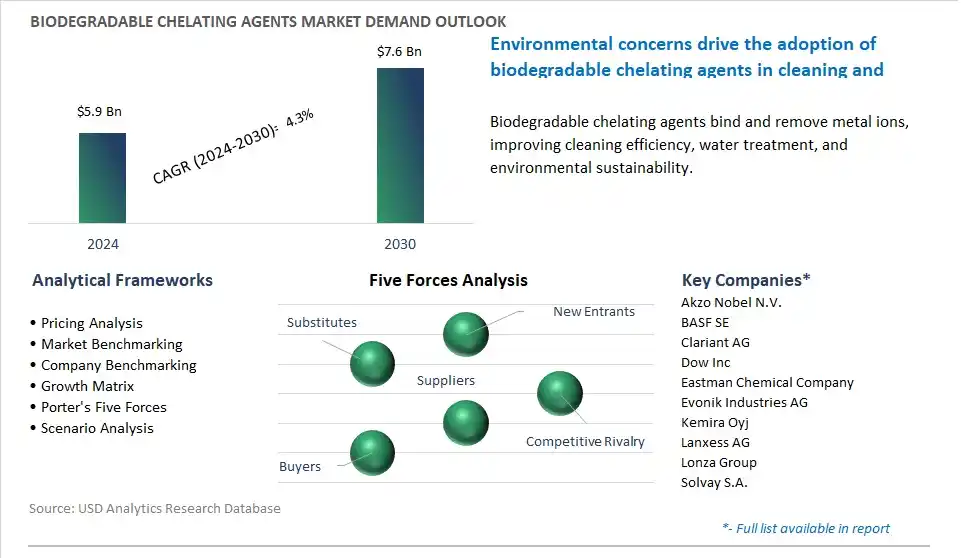
The global Biodegradable Chelating Agents Market is poised to register a 4.3% CAGR from $5.9 Billion in 2024 to $7.6 Billion in 2030.
The global Biodegradable Chelating Agents Market Study analyzes and forecasts the market size across 6 regions and 24 countries for diverse segments -By Chelating Agent (Amino Polycarboxylates, Organophosphonates, Glucaric Acid., Others), By End-User (Household and Personal Care, Water Treatment, Industrial Cleaning, Agriculture, Food and Beverage, Pharmaceuticals), By Formulation (Liquid Formulation, Powder Formulation, Solid Formulation).
An Introduction to Global Biodegradable Chelating Agents Market in 2024
The market for biodegradable chelating agents is experiencing steady growth, driven by the demand for environmentally friendly and sustainable alternatives to conventional chelating agents in various industrial and household applications. Key trends shaping the future of the industry include advancements in green chemistry, biotechnology, and process engineering, enabling the development of chelating agents derived from renewable resources such as plant-based feedstocks, biodegradable polymers, and natural acids. Manufacturers are focusing on innovating chelating agent formulations that offer effective metal ion sequestration, scale inhibition, and cleaning performance while minimizing environmental impact and toxicity hazards associated with conventional chelators such as EDTA and phosphates. Additionally, there is a growing emphasis on regulatory compliance, eco-labeling, and consumer awareness of sustainable product choices, driving the adoption of biodegradable chelating agents as green alternatives that meet stringent environmental and safety standards in various industries such as cleaning and detergency, agriculture, and water treatment. Moreover, advancements in biodegradation kinetics, soil microbiology, and environmental fate studies are driving market innovation, enabling the development of biodegradable chelating agents with enhanced biocompatibility, persistence, and degradation pathways that ensure minimal ecological impact and promote soil and water quality conservation. Overall, the future of biodegradable chelating agents lies in continuous research and development efforts to improve performance attributes, expand application versatility, and promote widespread adoption of sustainable chelation technologies that contribute to resource conservation, pollution prevention, and ecosystem preservation in a rapidly evolving global marketplace.
Biodegradable Chelating Agents Market Competitive Landscape
The market report analyses the leading companies in the industry including Akzo Nobel N.V., BASF SE, Clariant AG, Dow Inc, Eastman Chemical Company, Evonik Industries AG, Kemira Oyj, Lanxess AG, Lonza Group, Solvay S.A..
Biodegradable Chelating Agents Market Dynamics
Biodegradable Chelating Agents Market Trend: Growing Demand for Environmentally Friendly Chemicals
In the Biodegradable Chelating Agents market, a prominent trend is the growing demand for environmentally friendly chemicals. With increasing concerns about environmental pollution and the ecological impact of chemical substances, there's a shift towards biodegradable chelating agents as alternatives to traditional non-biodegradable counterparts. Biodegradable chelating agents offer the ability to complex and sequester metal ions effectively while breaking down into non-toxic byproducts in the environment, reducing the risk of ecological harm. This trend is driven by regulatory pressures, corporate sustainability initiatives, and consumer preferences for eco-friendly products, all contributing to a rising market demand for biodegradable chelating agents across various industries.
Biodegradable Chelating Agents Market Driver: Regulatory Restrictions on Hazardous Chemicals
A significant driver in the Biodegradable Chelating Agents market is regulatory restrictions on hazardous chemicals. Governments and regulatory bodies worldwide are implementing stringent regulations to limit the use of toxic and non-biodegradable chelating agents due to their adverse environmental and health effects. Compliance with these regulations is essential for industries such as agriculture, water treatment, and household cleaning, driving the adoption of biodegradable chelating agents as safer and more sustainable alternatives. This driver is fueled by the need for regulatory compliance, risk mitigation, and the protection of human health and the environment, prompting industries to invest in biodegradable chelating agent technologies and transition away from hazardous chemical alternatives.
Biodegradable Chelating Agents Market Opportunity: Expansion into Green Chemistry Applications
A promising opportunity within the Biodegradable Chelating Agents market lies in the expansion into green chemistry applications. Beyond traditional uses in industrial processes, water treatment, and detergents, there's a growing demand for biodegradable chelating agents in green chemistry applications such as organic synthesis, catalysis, and pharmaceutical manufacturing. Opportunities exist in developing chelating agents with tailored properties such as high selectivity, stability, and biocompatibility for use in environmentally friendly chemical processes and formulations. By targeting these emerging markets and collaborating with research institutions and industry partners, manufacturers can capitalize on this opportunity to diversify their product portfolio, address unmet needs in green chemistry applications, and drive growth in the biodegradable chelating agents segment.
Biodegradable Chelating Agents Market Share Analysis: Amino Polycarboxylates generated the highest revenue in 2024
The largest segment in the Biodegradable Chelating Agents Market is the Amino Polycarboxylates segment. amino polycarboxylates, such as EDTA (ethylenediaminetetraacetic acid) and DTPA (diethylenetriaminepentaacetic acid), are among the most widely used and established chelating agents in various industries, including detergents, cleaning agents, personal care products, water treatment, and agriculture. These chelating agents exhibit strong complexing properties and sequestering capabilities, enabling them to bind to metal ions and prevent their interaction with other compounds, thereby preventing scale formation, corrosion, and undesirable reactions in industrial processes and formulations. Additionally, amino polycarboxylates offer potential advantages such as high stability over a wide pH range, compatibility with other chemicals, and effectiveness at low concentrations, making them versatile and cost-effective solutions for chelation applications. Further, amino polycarboxylates are biodegradable compounds that can undergo microbial degradation in the environment, leading to reduced environmental persistence and toxicity compared to some non-biodegradable chelating agents. Furthermore, regulatory initiatives and environmental concerns drive the demand for biodegradable chelating agents, further boosting the market growth of amino polycarboxylates as preferred alternatives in various industries. Over the forecast period, the combination of widespread use, effectiveness, versatility, biodegradability, and regulatory acceptance positions the Amino Polycarboxylates segment as the largest in the Biodegradable Chelating Agents Market.
Biodegradable Chelating Agents Market Share Analysis: Personal Care segment is poised to register the fastest growth rate (CAGR) over the forecast period to 2030
The fastest-growing segment in the Biodegradable Chelating Agents Market is the Household and Personal Care end-user segment. There is increasing consumer awareness and demand for eco-friendly and sustainable products in household and personal care applications, driven by environmental concerns, health consciousness, and regulatory pressure to reduce the environmental footprint of consumer products. Biodegradable chelating agents offer an attractive solution for formulators seeking to develop greener formulations without compromising performance or efficacy. Additionally, household and personal care products such as laundry detergents, dishwashing liquids, surface cleaners, and personal hygiene products often contain chelating agents to improve cleaning efficiency, prevent scale formation, and enhance product stability. Further, the shift towards green cleaning and sustainable living practices influences consumer preferences and purchasing decisions, leading to increased demand for biodegradable chelating agents in household and personal care products. Furthermore, advancements in biotechnology and green chemistry enable the development of novel biodegradable chelating agents with improved performance characteristics and lower environmental impact, driving innovation and adoption in the household and personal care industry. Over the forecast period, the combination of consumer demand, regulatory pressure, technological advancements, and sustainability trends positions the Household and Personal Care end-user segment as the fastest-growing in the Biodegradable Chelating Agents Market.
Biodegradable Chelating Agents Market Share Analysis: Liquid Formulation segment is poised to register the fastest growth rate (CAGR) over the forecast period to 2030
The fastest-growing segment in the Biodegradable Chelating Agents Market is the Liquid Formulation segment. liquid formulations offer potential advantages over powder and solid formulations in terms of ease of handling, mixing, and application. Liquid chelating agents can be easily dispensed and metered into various formulations, including detergents, cleaners, personal care products, and agricultural chemicals, allowing for precise dosage control and uniform distribution. Additionally, liquid formulations are versatile and compatible with a wide range of aqueous and solvent-based systems, enabling their incorporation into diverse product formulations without affecting product stability or performance. Further, liquid chelating agents exhibit faster dissolution and dispersion kinetics compared to solid or powder formulations, ensuring rapid and homogeneous distribution of the active ingredient in the final product. Furthermore, technological advancements in liquid formulation development, such as microencapsulation, nanoemulsions, and solvent selection, have led to the development of more stable and efficient liquid chelating agents with enhanced performance characteristics and shelf-life stability, driving their adoption in various industries. Over the forecast period, the combination of ease of use, versatility, formulation flexibility, and technological innovation positions the Liquid Formulation segment as the fastest-growing in the Biodegradable Chelating Agents Market.
Biodegradable Chelating Agents Market Report Segmentation
By Chelating Agent
Amino Polycarboxylates
Organophosphonates
Glucaric Acid.
Others
By End-User
Household and Personal Care
Water Treatment
Industrial Cleaning
Agriculture
Food and Beverage
Pharmaceuticals
By Formulation
Liquid Formulation
Powder Formulation
Solid Formulation
Regions Included
North America (US, Canada, Mexico)
Europe (Germany, UK, France, Spain, Italy, Russia, Rest of Europe)
Asia Pacific (China, India, Japan, South Korea, Australia, South East Asia, Rest of Asia)
South America (Brazil, Argentina, Rest of South America)
Middle East and Africa (Saudi Arabia, UAE, Rest of Middle East, South Africa, Egypt, Rest of Africa)
Biodegradable Chelating Agents Companies Profiled in the Market Study
Akzo Nobel N.V.
BASF SE
Clariant AG
Dow Inc
Eastman Chemical Company
Evonik Industries AG
Kemira Oyj
Lanxess AG
Lonza Group
Solvay S.A.
*- List Not Exhaustive
TABLE OF CONTENTS
1 Introduction to 2024 Biodegradable Chelating Agents Market
1.1 Market Overview
1.2 Quick Facts
1.3 Scope/Objective of the Study
1.4 Market Definition
1.5 Countries and Regions Covered
1.6 Units, Currency, and Conversions
1.7 Industry Value Chain
2 Research Methodology
2.1 Market Size Estimation
2.2 Sources and Research Methodology
2.3 Data Triangulation
2.4 Assumptions and Limitations
3 Executive Summary
3.1 Global Biodegradable Chelating Agents Market Size Outlook, $ Million, 2021 to 2030
3.2 Biodegradable Chelating Agents Market Outlook by Type, $ Million, 2021 to 2030
3.3 Biodegradable Chelating Agents Market Outlook by Product, $ Million, 2021 to 2030
3.4 Biodegradable Chelating Agents Market Outlook by Application, $ Million, 2021 to 2030
3.5 Biodegradable Chelating Agents Market Outlook by Key Countries, $ Million, 2021 to 2030
4 Market Dynamics
4.1 Key Driving Forces of Biodegradable Chelating Agents Industry
4.2 Key Market Trends in Biodegradable Chelating Agents Industry
4.3 Potential Opportunities in Biodegradable Chelating Agents Industry
4.4 Key Challenges in Biodegradable Chelating Agents Industry
5 Market Factor Analysis
5.1 Value Chain Analysis
5.2 Competitive Landscape
5.2.1 Global Biodegradable Chelating Agents Market Share by Company (%), 2023
5.2.2 Product Offerings by Company
5.3 Porter’s Five Forces Analysis
5.4 Pricing Analysis and Outlook
6 Growth Outlook Across Scenarios
6.1 Growth Analysis-Case Scenario Definitions
6.2 Low Growth Scenario Forecasts
6.3 Reference Growth Scenario Forecasts
6.4 High Growth Scenario Forecasts
7 Global Biodegradable Chelating Agents Market Outlook by Segments
7.1 Biodegradable Chelating Agents Market Outlook by Segments, $ Million, 2021- 2030
By Chelating Agent
Amino Polycarboxylates
Organophosphonates
Glucaric Acid.
Others
By End-User
Household and Personal Care
Water Treatment
Industrial Cleaning
Agriculture
Food and Beverage
Pharmaceuticals
By Formulation
Liquid Formulation
Powder Formulation
Solid Formulation
8 North America Biodegradable Chelating Agents Market Analysis and Outlook To 2030
8.1 Introduction to North America Biodegradable Chelating Agents Markets in 2024
8.2 North America Biodegradable Chelating Agents Market Size Outlook by Country, 2021-2030
8.2.1 United States
8.2.2 Canada
8.2.3 Mexico
8.3 North America Biodegradable Chelating Agents Market size Outlook by Segments, 2021-2030
By Chelating Agent
Amino Polycarboxylates
Organophosphonates
Glucaric Acid.
Others
By End-User
Household and Personal Care
Water Treatment
Industrial Cleaning
Agriculture
Food and Beverage
Pharmaceuticals
By Formulation
Liquid Formulation
Powder Formulation
Solid Formulation
9 Europe Biodegradable Chelating Agents Market Analysis and Outlook To 2030
9.1 Introduction to Europe Biodegradable Chelating Agents Markets in 2024
9.2 Europe Biodegradable Chelating Agents Market Size Outlook by Country, 2021-2030
9.2.1 Germany
9.2.2 France
9.2.3 Spain
9.2.4 United Kingdom
9.2.4 Italy
9.2.5 Russia
9.2.6 Norway
9.2.7 Rest of Europe
9.3 Europe Biodegradable Chelating Agents Market Size Outlook by Segments, 2021-2030
By Chelating Agent
Amino Polycarboxylates
Organophosphonates
Glucaric Acid.
Others
By End-User
Household and Personal Care
Water Treatment
Industrial Cleaning
Agriculture
Food and Beverage
Pharmaceuticals
By Formulation
Liquid Formulation
Powder Formulation
Solid Formulation
10 Asia Pacific Biodegradable Chelating Agents Market Analysis and Outlook To 2030
10.1 Introduction to Asia Pacific Biodegradable Chelating Agents Markets in 2024
10.2 Asia Pacific Biodegradable Chelating Agents Market Size Outlook by Country, 2021-2030
10.2.1 China
10.2.2 India
10.2.3 Japan
10.2.4 South Korea
10.2.5 Indonesia
10.2.6 Malaysia
10.2.7 Australia
10.2.8 Rest of Asia Pacific
10.3 Asia Pacific Biodegradable Chelating Agents Market size Outlook by Segments, 2021-2030
By Chelating Agent
Amino Polycarboxylates
Organophosphonates
Glucaric Acid.
Others
By End-User
Household and Personal Care
Water Treatment
Industrial Cleaning
Agriculture
Food and Beverage
Pharmaceuticals
By Formulation
Liquid Formulation
Powder Formulation
Solid Formulation
11 South America Biodegradable Chelating Agents Market Analysis and Outlook To 2030
11.1 Introduction to South America Biodegradable Chelating Agents Markets in 2024
11.2 South America Biodegradable Chelating Agents Market Size Outlook by Country, 2021-2030
11.2.1 Brazil
11.2.2 Argentina
11.2.3 Rest of South America
11.3 South America Biodegradable Chelating Agents Market size Outlook by Segments, 2021-2030
By Chelating Agent
Amino Polycarboxylates
Organophosphonates
Glucaric Acid.
Others
By End-User
Household and Personal Care
Water Treatment
Industrial Cleaning
Agriculture
Food and Beverage
Pharmaceuticals
By Formulation
Liquid Formulation
Powder Formulation
Solid Formulation
12 Middle East and Africa Biodegradable Chelating Agents Market Analysis and Outlook To 2030
12.1 Introduction to Middle East and Africa Biodegradable Chelating Agents Markets in 2024
12.2 Middle East and Africa Biodegradable Chelating Agents Market Size Outlook by Country, 2021-2030
12.2.1 Saudi Arabia
12.2.2 UAE
12.2.3 Oman
12.2.4 Rest of Middle East
12.2.5 Egypt
12.2.6 Nigeria
12.2.7 South Africa
12.2.8 Rest of Africa
12.3 Middle East and Africa Biodegradable Chelating Agents Market size Outlook by Segments, 2021-2030
By Chelating Agent
Amino Polycarboxylates
Organophosphonates
Glucaric Acid.
Others
By End-User
Household and Personal Care
Water Treatment
Industrial Cleaning
Agriculture
Food and Beverage
Pharmaceuticals
By Formulation
Liquid Formulation
Powder Formulation
Solid Formulation
13 Company Profiles
13.1 Company Snapshot
13.2 SWOT Profiles
13.3 Products and Services
13.4 Recent Developments
13.5 Financial Profile
Akzo Nobel N.V.
BASF SE
Clariant AG
Dow Inc
Eastman Chemical Company
Evonik Industries AG
Kemira Oyj
Lanxess AG
Lonza Group
Solvay S.A.
14 Appendix
14.1 Customization Offerings
14.2 Subscription Services
14.3 Related Reports
14.4 Publisher Expertise
By Chelating Agent
Amino Polycarboxylates
Organophosphonates
Glucaric Acid.
Others
By End-User
Household and Personal Care
Water Treatment
Industrial Cleaning
Agriculture
Food and Beverage
Pharmaceuticals
By Formulation
Liquid Formulation
Powder Formulation
Solid Formulation
Countries Analyzed
North America (US, Canada, Mexico)
Europe (Germany, UK, France, Spain, Italy, Russia, Rest of Europe)
Asia Pacific (China, India, Japan, South Korea, Australia, South East Asia, Rest of Asia)
South America (Brazil, Argentina, Rest of South America)
Middle East and Africa (Saudi Arabia, UAE, Rest of Middle East, South Africa, Egypt, Rest of Africa)
