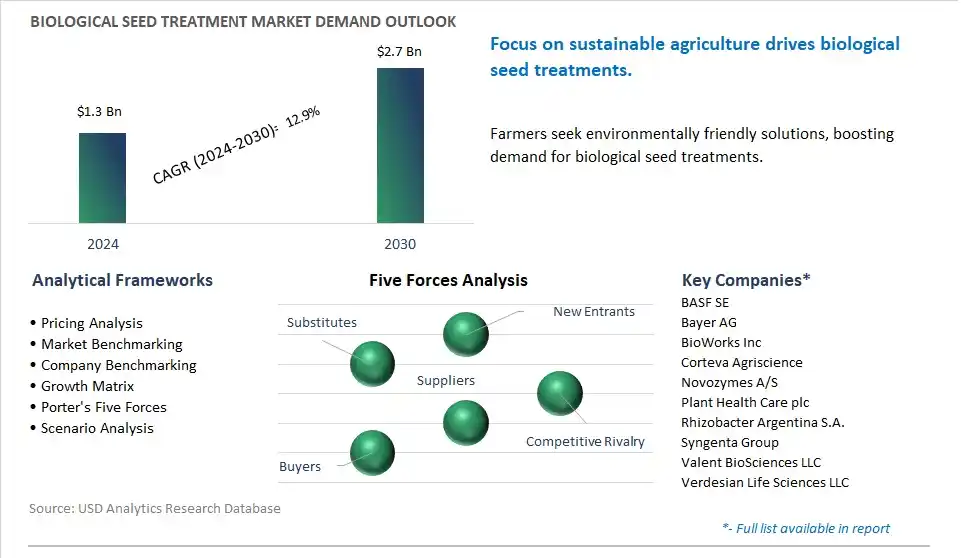
The global Biological Seed Treatment Market is poised to register a 12.9% CAGR from $1.3 Billion in 2024 to $2.7 Billion in 2030.
The global Biological Seed Treatment Market Study analyzes and forecasts the market size across 6 regions and 24 countries for diverse segments -By Crop (Corn, Wheat, Soybean, Cotton, Sunflower, Vegetable Crops, Others), By Type (Microbials, Bacteria, Fungi, Botanical and Others), By Function (Seed Enhancement, Biofertilizers, Biostimulants, Seed Protection, Bioinsecticides, Biofungicides, Others).
An Introduction to Global Biological Seed Treatment Market in 2024
The biological seed treatment market is experiencing rapid growth driven by increasing demand for sustainable agricultural practices, crop yield enhancement, and pest management solutions. Key trends shaping the future of the industry include the growing adoption of biological seed treatments such as microbial inoculants, plant growth-promoting rhizobacteria (PGPR), and beneficial fungi for improving seed germination, root development, and plant vigor. Moreover, there's a rising emphasis on biological seed treatments' compatibility with integrated pest management (IPM) strategies, reducing reliance on synthetic chemical pesticides and promoting natural resistance mechanisms in crops. Additionally, there's a growing trend towards the development of customized seed treatment formulations tailored to specific crops, soil conditions, and pest pressures, offering farmers cost-effective and environmentally friendly alternatives to conventional seed treatments. Furthermore, advancements in microbial technology, formulation science, and seed coating techniques are driving innovation and market competitiveness, enabling biological seed treatment providers to offer a wide range of effective and sustainable solutions for crop protection and yield improvement in the global biological seed treatment market.
Biological Seed Treatment Market Competitive Landscape
The market report analyses the leading companies in the industry including BASF SE, Bayer AG, BioWorks Inc, Corteva Agriscience, Novozymes A/S, Plant Health Care plc, Rhizobacter Argentina S.A., Syngenta Group, Valent BioSciences LLC, Verdesian Life Sciences LLC.
Biological Seed Treatment Market Dynamics
Biological Seed Treatment Market Trend: Growing Demand for Sustainable Agriculture Practices
A prominent trend in the biological seed treatment market is the growing demand for sustainable agriculture practices. With increasing concerns about environmental impact, soil health, and food safety, farmers are seeking alternatives to conventional chemical seed treatments. Biological seed treatments, which involve the application of beneficial microorganisms such as bacteria, fungi, and protozoa to seeds, offer a sustainable solution for pest and disease management, nutrient uptake enhancement, and yield improvement. As consumers become more conscious of the origin and production methods of their food, there is a rising preference for crops grown using biological seed treatments among environmentally conscious farmers, driving market growth and adoption of sustainable agricultural practices.
Biological Seed Treatment Market Driver: Regulatory Support and Shift Towards Integrated Pest Management
A primary driver fueling the biological seed treatment market is regulatory support and the shift towards integrated pest management (IPM) practices in agriculture. Governments, regulatory agencies, and agricultural organizations are promoting the use of biological seed treatments as part of integrated pest management strategies to reduce reliance on synthetic pesticides, minimize chemical residues in food, and protect biodiversity. Additionally, regulatory initiatives promoting sustainable agriculture, organic farming, and reduced pesticide use are driving the adoption of biological seed treatments by farmers worldwide. By complying with regulatory requirements and embracing IPM principles, companies can capitalize on the market driver to expand their biological seed treatment offerings and gain a competitive edge in the evolving agricultural inputs industry.
Biological Seed Treatment Market Opportunity: Expansion into New Crop Segments and Emerging Markets
An opportunity within the biological seed treatment market lies in the expansion into new crop segments and emerging markets to diversify product portfolios and capture untapped market potential. While biological seed treatments are commonly used in major crops such as corn, soybeans, and wheat, there is potential to explore niche crops and specialty markets where biological solutions can offer unique benefits. Industries such as fruits, vegetables, pulses, and ornamentals present opportunities for biological seed treatments to address specific pest and disease challenges while meeting the growing demand for sustainably produced food and ornamental crops. Moreover, there is potential to expand into emerging markets such as Asia-Pacific, Latin America, and Africa, where sustainable agriculture practices are gaining traction, and farmers are seeking innovative solutions to improve crop productivity and quality. By investing in research and development, market expansion, and strategic partnerships, companies can seize the opportunity to penetrate new crop segments and emerging markets, thereby driving growth and market leadership in the biological seed treatment industry.
Biological Seed Treatment Market Share Analysis: Corn Segment generated the highest revenue in the industry
The Corn segment is the largest segment in the Biological Seed Treatment Market for diverse compelling reasons. The corn is one of the most widely cultivated crops globally, with a vast acreage dedicated to its production in various regions. This extensive cultivation of corn translates into a significant market size for biological seed treatments tailored specifically for corn seeds. In addition, corn is a staple crop used in various industries, including food, feed, and biofuel production, contributing to its substantial market demand. Additionally, corn crops are susceptible to a wide range of pests, diseases, and environmental stresses, making seed treatment a critical practice for ensuring crop health, yield optimization, and protection against yield losses. Biological seed treatments offer a sustainable and environmentally friendly approach to crop protection, appealing to farmers seeking alternatives to conventional chemical treatments. Further, the adoption of biological seed treatments in corn production aligns with sustainable agriculture practices, regulatory requirements, and consumer demand for safe and eco-friendly food production methods. Over the forecast period, the combination of extensive corn cultivation, market demand, pest pressures, and sustainability considerations positions the Corn segment as the largest in the Biological Seed Treatment Market.
Biological Seed Treatment Market Share Analysis: Microbials Segment is poised to register the fastest growth rate (CAGR) over the forecast period to 2030
The Microbials segment is the fastest-growing segment in the Biological Seed Treatment Market for diverse significant reasons. The microbials encompass a wide range of beneficial microorganisms such as bacteria, fungi, and other microbes that promote plant growth, enhance nutrient uptake, and protect against pathogens and pests. These microorganisms establish symbiotic relationships with plants, colonizing their roots or aerial parts and providing various benefits that improve crop health and productivity. In addition, advancements in microbial technology and biotechnology have led to the development of novel microbial strains with enhanced efficacy, stability, and compatibility with seed treatment processes. Additionally, microbial seed treatments offer sustainable and environmentally friendly solutions for crop protection and enhancement, aligning with the growing demand for eco-friendly agricultural practices. Further, microbial seed treatments exhibit compatibility with integrated pest management (IPM) strategies, organic farming practices, and conventional crop management systems, making them versatile options for farmers across diverse agricultural settings. As a result, the Microbials segment experiences rapid growth in the Biological Seed Treatment Market due to increasing adoption, technological innovations, and the sustainability benefits offered by microbial-based solutions. Over the forecast period, the Microbials segment's combination of efficacy, versatility, and environmental sustainability positions it as the fastest-growing segment in the market.
Biological Seed Treatment Market Share Analysis: Biostimulants Segment is poised to register the fastest growth rate (CAGR) over the forecast period to 2030
The Biostimulants segment is the fastest-growing segment in the Biological Seed Treatment Market for diverse significant reasons. The biostimulants are increasingly recognized for their ability to enhance plant growth, vigor, and stress tolerance, leading to improved crop yields and quality. Biostimulants contain substances such as amino acids, peptides, humic and fulvic acids, seaweed extracts, and beneficial microorganisms that stimulate physiological processes in plants, including nutrient uptake, root development, and stress response mechanisms. In addition, biostimulants offer versatile applications across various crops and growing conditions, making them valuable tools for farmers seeking sustainable and cost-effective solutions to improve crop performance. Additionally, biostimulant seed treatments complement existing agronomic practices and crop management strategies, enhancing Over the forecast period farm productivity and profitability. Further, biostimulant seed treatments contribute to environmental sustainability by promoting resource-use efficiency, reducing chemical inputs, and mitigating the environmental impact of agricultural practices. As a result, the Biostimulants segment experiences rapid growth in the Biological Seed Treatment Market due to increasing awareness, adoption, and demand for biostimulant-based solutions among farmers, agronomists, and crop producers worldwide. Over the forecast period, the Biostimulants segment's combination of efficacy, versatility, and sustainability positions it as the fastest-growing segment in the market.
Biological Seed Treatment Market Report Segmentation
By Crop
Corn
Wheat
Soybean
Cotton
Sunflower
Vegetable Crops
Others
By Type
Microbials
Bacteria
Fungi
Botanical and Others
By Function
Seed Enhancement
Biofertilizers
Biostimulants
Seed Protection
Bioinsecticides
Biofungicides
Others
Regions Included
North America (US, Canada, Mexico)
Europe (Germany, UK, France, Spain, Italy, Russia, Rest of Europe)
Asia Pacific (China, India, Japan, South Korea, Australia, South East Asia, Rest of Asia)
South America (Brazil, Argentina, Rest of South America)
Middle East and Africa (Saudi Arabia, UAE, Rest of Middle East, South Africa, Egypt, Rest of Africa)
Biological Seed Treatment Companies Profiled in the Market Study
BASF SE
Bayer AG
BioWorks Inc
Corteva Agriscience
Novozymes A/S
Plant Health Care plc
Rhizobacter Argentina S.A.
Syngenta Group
Valent BioSciences LLC
Verdesian Life Sciences LLC
*- List Not Exhaustive
TABLE OF CONTENTS
1 Introduction to 2024 Biological Seed Treatment Market
1.1 Market Overview
1.2 Quick Facts
1.3 Scope/Objective of the Study
1.4 Market Definition
1.5 Countries and Regions Covered
1.6 Units, Currency, and Conversions
1.7 Industry Value Chain
2 Research Methodology
2.1 Market Size Estimation
2.2 Sources and Research Methodology
2.3 Data Triangulation
2.4 Assumptions and Limitations
3 Executive Summary
3.1 Global Biological Seed Treatment Market Size Outlook, $ Million, 2021 to 2030
3.2 Biological Seed Treatment Market Outlook by Type, $ Million, 2021 to 2030
3.3 Biological Seed Treatment Market Outlook by Product, $ Million, 2021 to 2030
3.4 Biological Seed Treatment Market Outlook by Application, $ Million, 2021 to 2030
3.5 Biological Seed Treatment Market Outlook by Key Countries, $ Million, 2021 to 2030
4 Market Dynamics
4.1 Key Driving Forces of Biological Seed Treatment Industry
4.2 Key Market Trends in Biological Seed Treatment Industry
4.3 Potential Opportunities in Biological Seed Treatment Industry
4.4 Key Challenges in Biological Seed Treatment Industry
5 Market Factor Analysis
5.1 Value Chain Analysis
5.2 Competitive Landscape
5.2.1 Global Biological Seed Treatment Market Share by Company (%), 2023
5.2.2 Product Offerings by Company
5.3 Porter’s Five Forces Analysis
5.4 Pricing Analysis and Outlook
6 Growth Outlook Across Scenarios
6.1 Growth Analysis-Case Scenario Definitions
6.2 Low Growth Scenario Forecasts
6.3 Reference Growth Scenario Forecasts
6.4 High Growth Scenario Forecasts
7 Global Biological Seed Treatment Market Outlook by Segments
7.1 Biological Seed Treatment Market Outlook by Segments, $ Million, 2021- 2030
By Crop
Corn
Wheat
Soybean
Cotton
Sunflower
Vegetable Crops
Others
By Type
Microbials
Bacteria
Fungi
Botanical and Others
By Function
Seed Enhancement
Biofertilizers
Biostimulants
Seed Protection
Bioinsecticides
Biofungicides
Others
8 North America Biological Seed Treatment Market Analysis and Outlook To 2030
8.1 Introduction to North America Biological Seed Treatment Markets in 2024
8.2 North America Biological Seed Treatment Market Size Outlook by Country, 2021-2030
8.2.1 United States
8.2.2 Canada
8.2.3 Mexico
8.3 North America Biological Seed Treatment Market size Outlook by Segments, 2021-2030
By Crop
Corn
Wheat
Soybean
Cotton
Sunflower
Vegetable Crops
Others
By Type
Microbials
Bacteria
Fungi
Botanical and Others
By Function
Seed Enhancement
Biofertilizers
Biostimulants
Seed Protection
Bioinsecticides
Biofungicides
Others
9 Europe Biological Seed Treatment Market Analysis and Outlook To 2030
9.1 Introduction to Europe Biological Seed Treatment Markets in 2024
9.2 Europe Biological Seed Treatment Market Size Outlook by Country, 2021-2030
9.2.1 Germany
9.2.2 France
9.2.3 Spain
9.2.4 United Kingdom
9.2.4 Italy
9.2.5 Russia
9.2.6 Norway
9.2.7 Rest of Europe
9.3 Europe Biological Seed Treatment Market Size Outlook by Segments, 2021-2030
By Crop
Corn
Wheat
Soybean
Cotton
Sunflower
Vegetable Crops
Others
By Type
Microbials
Bacteria
Fungi
Botanical and Others
By Function
Seed Enhancement
Biofertilizers
Biostimulants
Seed Protection
Bioinsecticides
Biofungicides
Others
10 Asia Pacific Biological Seed Treatment Market Analysis and Outlook To 2030
10.1 Introduction to Asia Pacific Biological Seed Treatment Markets in 2024
10.2 Asia Pacific Biological Seed Treatment Market Size Outlook by Country, 2021-2030
10.2.1 China
10.2.2 India
10.2.3 Japan
10.2.4 South Korea
10.2.5 Indonesia
10.2.6 Malaysia
10.2.7 Australia
10.2.8 Rest of Asia Pacific
10.3 Asia Pacific Biological Seed Treatment Market size Outlook by Segments, 2021-2030
By Crop
Corn
Wheat
Soybean
Cotton
Sunflower
Vegetable Crops
Others
By Type
Microbials
Bacteria
Fungi
Botanical and Others
By Function
Seed Enhancement
Biofertilizers
Biostimulants
Seed Protection
Bioinsecticides
Biofungicides
Others
11 South America Biological Seed Treatment Market Analysis and Outlook To 2030
11.1 Introduction to South America Biological Seed Treatment Markets in 2024
11.2 South America Biological Seed Treatment Market Size Outlook by Country, 2021-2030
11.2.1 Brazil
11.2.2 Argentina
11.2.3 Rest of South America
11.3 South America Biological Seed Treatment Market size Outlook by Segments, 2021-2030
By Crop
Corn
Wheat
Soybean
Cotton
Sunflower
Vegetable Crops
Others
By Type
Microbials
Bacteria
Fungi
Botanical and Others
By Function
Seed Enhancement
Biofertilizers
Biostimulants
Seed Protection
Bioinsecticides
Biofungicides
Others
12 Middle East and Africa Biological Seed Treatment Market Analysis and Outlook To 2030
12.1 Introduction to Middle East and Africa Biological Seed Treatment Markets in 2024
12.2 Middle East and Africa Biological Seed Treatment Market Size Outlook by Country, 2021-2030
12.2.1 Saudi Arabia
12.2.2 UAE
12.2.3 Oman
12.2.4 Rest of Middle East
12.2.5 Egypt
12.2.6 Nigeria
12.2.7 South Africa
12.2.8 Rest of Africa
12.3 Middle East and Africa Biological Seed Treatment Market size Outlook by Segments, 2021-2030
By Crop
Corn
Wheat
Soybean
Cotton
Sunflower
Vegetable Crops
Others
By Type
Microbials
Bacteria
Fungi
Botanical and Others
By Function
Seed Enhancement
Biofertilizers
Biostimulants
Seed Protection
Bioinsecticides
Biofungicides
Others
13 Company Profiles
13.1 Company Snapshot
13.2 SWOT Profiles
13.3 Products and Services
13.4 Recent Developments
13.5 Financial Profile
BASF SE
Bayer AG
BioWorks Inc
Corteva Agriscience
Novozymes A/S
Plant Health Care plc
Rhizobacter Argentina S.A.
Syngenta Group
Valent BioSciences LLC
Verdesian Life Sciences LLC
14 Appendix
14.1 Customization Offerings
14.2 Subscription Services
14.3 Related Reports
14.4 Publisher Expertise
By Crop
Corn
Wheat
Soybean
Cotton
Sunflower
Vegetable Crops
Others
By Type
Microbials
Bacteria
Fungi
Botanical and Others
By Function
Seed Enhancement
Biofertilizers
Biostimulants
Seed Protection
Bioinsecticides
Biofungicides
Others
Countries Analyzed
North America (US, Canada, Mexico)
Europe (Germany, UK, France, Spain, Italy, Russia, Rest of Europe)
Asia Pacific (China, India, Japan, South Korea, Australia, South East Asia, Rest of Asia)
South America (Brazil, Argentina, Rest of South America)
Middle East and Africa (Saudi Arabia, UAE, Rest of Middle East, South Africa, Egypt, Rest of Africa)
