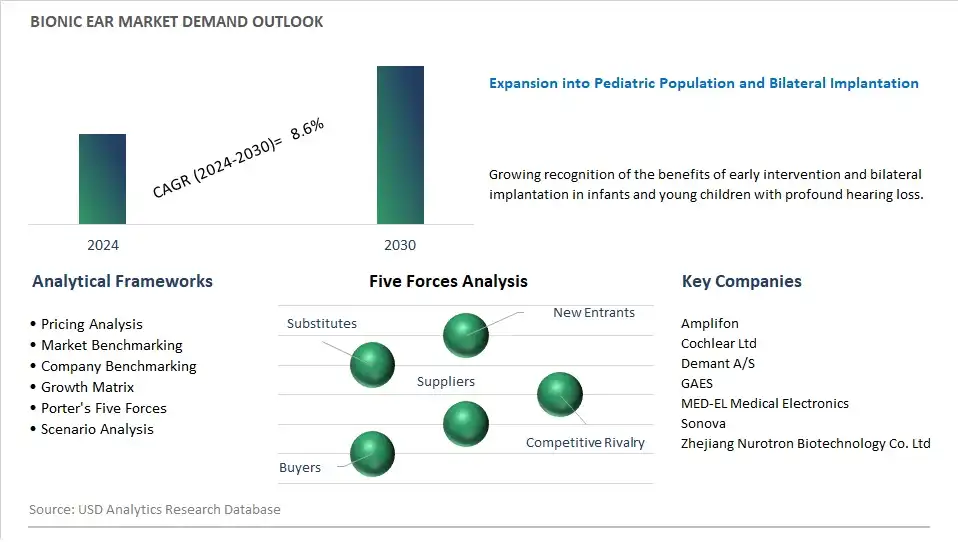
Bionic Ear Market is estimated to increase at a growth rate of 8.6% CAGR over the forecast period from 2024 to 2030.
The Bionic Ear Market study analyzes and forecasts the market size across 6 regions and 24 countries for diverse segments including By Type (Cochlear Implant, Auditory Brainstem Implants, BAHA/BAHS), By End-User (Hospitals, Clinics, Others).
An Introduction to Bionic Ear Market in 2024
The Bionic Ear market in 2024 experiences transformative growth, driven by advancements in neural interface technology, signal processing algorithms, and surgical techniques, enabling profound hearing restoration in individuals with severe to profound hearing loss. Bionic ears, or cochlear implants, bypass damaged sensory hair cells in the cochlea, directly stimulating the auditory nerve to restore sound perception and speech understanding. Ongoing research efforts focus on enhancing implant durability, speech recognition in noisy environments, and music appreciation, addressing the evolving needs and preferences of implant recipients. Regulatory approvals for next-generation cochlear implant systems and expanded indications further drive market expansion, while patient advocacy initiatives and reimbursement policies promote equitable access to bionic ear technology. Collaborative partnerships between medical device manufacturers, research institutions, and healthcare providers propel innovation, ensuring continued advancements in bionic ear technology and improved quality of life for recipients.
Bionic Ear Market Trend: Advancements in Bionic Ear Technology
A significant trend in the Bionic Ear market is the continuous advancements in technology, including improvements in cochlear implant design, signal processing algorithms, and speech processing capabilities. These advancements lead to enhanced sound quality, better speech understanding in noisy environments, and improved integration with digital devices, driving the adoption of bionic ear implants among individuals with hearing loss.
Bionic Ear Market Driver: Increasing Prevalence of Hearing Loss
The primary driver for the Bionic Ear market is the increasing prevalence of hearing loss globally, fueled by factors such as aging populations, exposure to noise pollution, and congenital conditions. As the incidence of hearing impairment rises, there is a growing demand for effective hearing restoration solutions, including cochlear implants. Bionic ears offer a viable option for individuals with severe to profound hearing loss, driving market growth as more people seek intervention to improve their auditory function and quality of life.
Bionic Ear Market Opportunity: Expansion into Pediatric Population and Bilateral Implantation
An opportunity in the Bionic Ear market lies in expanding into the pediatric population and promoting bilateral cochlear implantation. While cochlear implants are commonly used in adults and older children, there is a growing recognition of the benefits of early intervention and bilateral implantation in infants and young children with profound hearing loss. By targeting this demographic and advocating for bilateral implantation, manufacturers and healthcare providers can expand the market reach of bionic ears, offering children the opportunity for optimal speech and language development from a young age. Additionally, advancements in pediatric cochlear implant technology, such as smaller implant sizes and wireless connectivity, further support this opportunity by addressing the unique needs of pediatric patients and their families.
Bionic Ear Market Segmentation
By Type
Cochlear Implant
Auditory Brainstem Implants
BAHA/BAHS
By End Use
Hospitals
Clinics
Others
Geographical Analysis
North America (United States, Canada, Mexico)
Europe (Germany, France, United Kingdom, Spain, Italy, Rest of Europe)
Asia Pacific (China, India, Japan, South Korea, Rest of Asia Pacific)
South America (Brazil, Argentina, Rest of South America)
Middle East and Africa (Saudi Arabia, UAE, Rest of Middle East, South Africa, Egypt, Rest of Africa)
Bionic Ear Market Companies
Amplifon
Cochlear Ltd
Demant A/S
GAES
MED-EL Medical Electronics
Sonova
Zhejiang Nurotron Biotechnology Co. Ltd
Reasons to Buy the Bionic Ear Market Study
• Deepen your industry insights and navigate uncertainties for strategy formulation, CAPEX, and Operational decisions
• Gain access to detailed insights on the Bionic Ear Market, encompassing current market size, growth trends, and forecasts till 2030.
• Access detailed competitor analysis, enabling competitive advantage through a thorough understanding of market players, strategies, and potential differentiation opportunities
• Stay ahead of the curve with insights on technological advancements, innovations, and upcoming trends
• Identify lucrative investment avenues and expansion opportunities within the Bionic Ear Market industry, guided by robust, data-backed analysis.
• Understand regional and global markets through country-wise analysis, regional market potential, regulatory nuances, and dynamics
• Execute strategies with confidence and speed through information, analytics, and insights on the industry value chain
• Corporate leaders, strategists, financial experts, shareholders, asset managers, and governmental representatives can make long-term planning scenarios and build an integrated and timely understanding of market dynamics
• Benefit from tailored solutions and expert consultation based on report insights, providing personalized strategies aligned with specific business needs.
TABLE OF CONTENTS
1 Introduction to 2024 Bionic Ear Market
1.1 Market Overview
1.2 Quick Facts
1.3 Scope/Objective of the Study
1.4 Market Definition
1.5 Countries and Regions Analyzed
1.6 Units, Currency, and Conversions
1.7 Industry Value Chain
2 Research Methodology
2.1 Market Size Estimation
2.2 Sources and Research Methodology
2.3 Data Triangulation
2.4 Assumptions and Limitations
3 Executive Summary
3.1 Global Bionic Ear Market Size Outlook, $ Million, 2021 to 2030
3.2 Bionic Ear Market Outlook by Type, $ Million, 2021 to 2030
3.3 Bionic Ear Market Outlook by Product, $ Million, 2021 to 2030
3.4 Bionic Ear Market Outlook by Application, $ Million, 2021 to 2030
3.5 Bionic Ear Market Outlook by Key Countries, $ Million, 2021 to 2030
4 Market Dynamics
4.1 Key Driving Forces of Bionic Ear Market Industry
4.2 Key Market Trends in Bionic Ear Market Industry
4.3 Potential Opportunities in Bionic Ear Market Industry
4.4 Key Challenges in Bionic Ear Market Industry
5 Market Factor Analysis
5.1 Competitive Landscape
5.1.1 Global Bionic Ear Market Share by Company (%), 2023
5.1.2 Product Offerings by Company
5.2 Porter’s Five Forces Analysis
6 Growth Outlook Across Scenarios
6.1 Growth Analysis-Case Scenario Definitions
6.2 Low Growth Scenario Forecasts
6.3 Reference Growth Scenario Forecasts
6.4 High Growth Scenario Forecasts
7 Global Bionic Ear Market Outlook By Segments
7.1 Bionic Ear Market Outlook by Segments
By Type
Cochlear Implant
Auditory Brainstem Implants
BAHA/BAHS
By End Use
Hospitals
Clinics
Others
8 North America Bionic Ear Market Analysis And Outlook To 2030
8.1 Introduction to North America Bionic Ear Markets in 2024
8.2 North America Bionic Ear Market Size Outlook by Country, 2021-2030
8.2.1 United States
8.2.2 Canada
8.2.3 Mexico
8.3 North America Bionic Ear Market size Outlook by Segments, 2021-2030
By Type
Cochlear Implant
Auditory Brainstem Implants
BAHA/BAHS
By End Use
Hospitals
Clinics
Others
9 Europe Bionic Ear Market Analysis And Outlook To 2030
9.1 Introduction to Europe Bionic Ear Markets in 2024
9.2 Europe Bionic Ear Market Size Outlook by Country, 2021-2030
9.2.1 Germany
9.2.2 France
9.2.3 Spain
9.2.4 United Kingdom
9.2.4 Italy
9.2.5 Russia
9.2.6 Norway
9.2.7 Rest of Europe
9.3 Europe Bionic Ear Market Size Outlook By Segments, 2021-2030
By Type
Cochlear Implant
Auditory Brainstem Implants
BAHA/BAHS
By End Use
Hospitals
Clinics
Others
10 Asia Pacific Bionic Ear Market Analysis And Outlook To 2030
10.1 Introduction to Asia Pacific Bionic Ear Markets in 2024
10.2 Asia Pacific Bionic Ear Market Size Outlook by Country, 2021-2030
10.2.1 China
10.2.2 India
10.2.3 Japan
10.2.4 South Korea
10.2.5 Indonesia
10.2.6 Malaysia
10.2.7 Australia
10.2.8 Rest of Asia Pacific
10.3 Asia Pacific Bionic Ear Market size Outlook by Segments, 2021-2030
By Type
Cochlear Implant
Auditory Brainstem Implants
BAHA/BAHS
By End Use
Hospitals
Clinics
Others
11 South America Bionic Ear Market Analysis And Outlook To 2030
11.1 Introduction to South America Bionic Ear Markets in 2024
11.2 South America Bionic Ear Market Size Outlook by Country, 2021-2030
11.2.1 Brazil
11.2.2 Argentina
11.2.3 Rest of South America
11.3 South America Bionic Ear Market size Outlook by Segments, 2021-2030
By Type
Cochlear Implant
Auditory Brainstem Implants
BAHA/BAHS
By End Use
Hospitals
Clinics
Others
12 Middle East And Africa Bionic Ear Market Analysis And Outlook To 2030
12.1 Introduction to Middle East and Africa Bionic Ear Markets in 2024
12.2 Middle East and Africa Bionic Ear Market Size Outlook by Country, 2021-2030
12.2.1 Saudi Arabia
12.2.2 UAE
12.2.3 Oman
12.2.4 Rest of Middle East
12.2.5 Egypt
12.2.6 Nigeria
12.2.7 South Africa
12.2.8 Rest of Africa
12.3 Middle East and Africa Bionic Ear Market size Outlook by Segments, 2021-2030
By Type
Cochlear Implant
Auditory Brainstem Implants
BAHA/BAHS
By End Use
Hospitals
Clinics
Others
13 Company Profiles
13.1 Company Snapshot
13.2 SWOT Profiles
13.3 Products and Services
13.4 Recent Developments
13.5 Financial Profile
List of Companies
Amplifon
Cochlear Ltd
Demant A/S
GAES
MED-EL Medical Electronics
Sonova
Zhejiang Nurotron Biotechnology Co. Ltd
14 Appendix
14.1 Customization Offerings
14.2 Subscription Services
14.3 Related Reports
14.4 Publisher Expertise
By Type
Cochlear Implant
Auditory Brainstem Implants
BAHA/BAHS
By End Use
Hospitals
Clinics
Others
