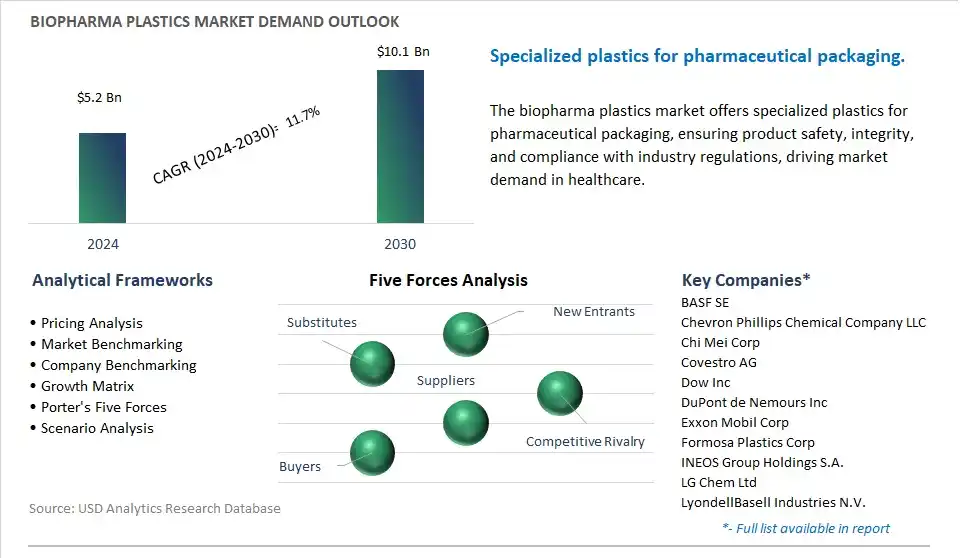
The global Biopharma Plastics Market is poised to register a 11.7% CAGR from $5.2 Billion in 2024 to $10.1 Billion in 2030.
The global Biopharma Plastics Market Study analyzes and forecasts the market size across 6 regions and 24 countries for diverse segments -By Polymer (Polyethylene (PE), Polypropylene (PP), Acrylonitrile Butadiene Styrene (ABS), Polyethylene Terephthalate (PET), Polyvinyl Chloride (PVC), Polytetrafluoroethylene (PTFE), Polycarbonate (PC), Other), By Application (Protective Wear, Containers, Bioreactor Bags, Syringes, Depth Filters, Disposable Medical Connectors, Others).
An Introduction to Global Biopharma Plastics Market in 2024
The market for biopharma plastics is facilitating innovation and safety in pharmaceutical packaging by offering specialized materials that meet stringent regulatory requirements and ensure product integrity throughout the drug manufacturing and distribution process. Key trends shaping the future of this industry include the development of biocompatible, sterilizable, and chemically resistant plastics tailored for pharmaceutical applications such as vials, syringes, IV bags, and packaging films. Additionally, advancements in material science, barrier technologies, and manufacturing processes enable the production of biopharma plastics with enhanced properties such as drug compatibility, stability, and tamper resistance, meeting the evolving needs of the pharmaceutical industry. Moreover, the adoption of quality standards, validation protocols, and regulatory compliance drives market demand for biopharma plastics, fostering innovation and market expansion in this sector. As pharmaceutical companies prioritize patient safety, product quality, and regulatory compliance, the demand for biopharma plastics is expected to continue growing, driving further innovation and development of advanced packaging solutions for the healthcare industry.
Biopharma Plastics Market Competitive Landscape
The market report analyses the leading companies in the industry including BASF SE, Chevron Phillips Chemical Company LLC, Chi Mei Corp, Covestro AG, Dow Inc, DuPont de Nemours Inc, Exxon Mobil Corp, Formosa Plastics Corp, INEOS Group Holdings S.A., LG Chem Ltd, LyondellBasell Industries N.V., Mitsui & Co. Ltd, Saint-Gobain Performance Plastics Corp, Saudi Basic Industries Corp, Solvay S.A., Teijin Ltd, Tekni-Plex Inc, Toray Industries Inc.
Biopharma Plastics Market Dynamics
Biopharma Plastics Market Trend: Shift Towards Single-Use Systems in Biopharmaceutical Manufacturing
A prominent trend in the market for biopharma plastics is the shift towards single-use systems in biopharmaceutical manufacturing. Traditional stainless steel equipment used in biopharmaceutical production requires extensive cleaning and validation procedures between batches, leading to time-consuming processes and increased risk of contamination. Single-use plastic systems, including bioreactors, tubing, and containers, offer a cost-effective and efficient alternative by eliminating the need for cleaning and sterilization. As biopharmaceutical companies seek to streamline their manufacturing processes, reduce operational costs, and increase flexibility, there is a growing adoption of single-use plastic technologies. This is driving market growth for biopharma plastics and spurring innovation in the development of disposable bioprocessing solutions.
Biopharma Plastics Market Driver: Growth in Biopharmaceutical R&D and Manufacturing
A key driver behind the demand for biopharma plastics is the growth in biopharmaceutical research and manufacturing. Biologics, including monoclonal antibodies, vaccines, and cell therapies, are increasingly becoming essential components of modern medicine, offering targeted and personalized treatment options for a wide range of diseases. The biopharmaceutical industry is experiencing rapid growth, driven by advancements in biotechnology, increasing prevalence of chronic diseases, and rising demand for innovative therapies. Biopharma plastics play a crucial role in supporting biopharmaceutical production processes, providing sterile and disposable containers, filtration systems, and fluid handling components. As biopharmaceutical companies expand their manufacturing capacities and develop new biologics, the demand for biopharma plastics is expected to continue growing, driving market expansion and investment in the biotechnology sector.
Biopharma Plastics Market Opportunity: Development of Advanced Biocompatible Materials
An emerging opportunity in the market for biopharma plastics lies in the development of advanced biocompatible materials. While traditional plastics have been widely used in biopharmaceutical manufacturing, there is increasing demand for materials that offer improved biocompatibility, chemical resistance, and performance characteristics. Opportunities exist to develop novel polymers and polymer blends specifically designed for biopharmaceutical applications, including bioreactor linings, cell culture substrates, and drug delivery systems. Advanced biocompatible materials can enhance product safety, reduce extractable and leachables, and improve compatibility with biologics and cell-based therapies. By investing in research and development of innovative materials and collaborating with biopharmaceutical companies and regulatory agencies, suppliers of biopharma plastics can capitalize on new opportunities and drive market growth in the rapidly evolving biotechnology industry.
Biopharma Plastics Market Ecosystem
In the biopharma plastics market, the value chain encompasses diverse critical stages. It begins with feedstock production, where companies including Raízen and Tereos cultivate sugarcane or corn farmers and provide raw materials for bioplastics. Pre-treatment involves specialized companies including LIG Renewable Fuels preparing biomass for efficient conversion. Bio-based monomer production follows, with companies including Myriant Corporation focusing on producing bio-based monomers for biopharma plastics. Bio-based polymer production is then undertaken by biopolymer producers including Evonik, ensuring the creation of biocompatible polymers.
Additives and modifiers are incorporated by companies specializing in biopharma plastics, enhancing functionalities. Compounding and processing involve manufacturers including Weissenberg adapting processes for biopharma plastics, followed by sterilization, where contract service providers ensure sterility. Quality control and testing are crucial stages, with manufacturers including USP providing certification for medical device packaging materials. Regulatory approval is obtained by biopharma plastics manufacturers, followed by distribution to pharmaceutical companies and medical device manufacturers. Further, biopharma plastics find application in various pharmaceutical and medical device uses, representing a critical link in ensuring safe and effective drug delivery and medical device functionality.
Biopharma Plastics Market Share Analysis: Polyethylene (PE) held the dominant revenue share in 2024
Polyethylene (PE) is the largest segment in the Biopharma Plastics Market, owing to its versatile properties and widespread applications in the pharmaceutical industry. PE offers excellent chemical resistance, durability, and flexibility, making it suitable for various biopharmaceutical packaging requirements, including containers, vials, and bags. Its inert nature ensures the integrity and safety of pharmaceutical products, protecting them from contamination and maintaining their efficacy. In addition, PE's compatibility with sterilization methods, such as autoclaving and gamma irradiation, further enhances its suitability for pharmaceutical packaging, ensuring product sterility and compliance with regulatory standards. Additionally, the increasing adoption of single-use systems and the growing demand for biopharmaceutical products, particularly in emerging markets, are driving the demand for PE-based packaging solutions. Further, ongoing innovations in PE formulations, such as the development of advanced grades with enhanced barrier properties and sustainability features, are expected to fuel its growth in the biopharma sector. Overall, PE's versatility, safety, and compatibility with pharmaceutical applications position it as the leading polymer choice in the Biopharma Plastics Market, driving its dominance in this segment.
Biopharma Plastics Market Share Analysis: Bioreactor Bags is the fastest growing market segment over the forecast period to 2030
Among the various applications in the Biopharma Plastics Market, bioreactor bags emerge as the fastest growing segment, showcasing significant expansion due to diverse key factors. Bioreactor bags play a crucial role in biopharmaceutical manufacturing processes, offering advantages such as flexibility, scalability, and cost-effectiveness compared to traditional stainless-steel bioreactors. These bags are widely used for the cultivation of cells, microorganisms, and mammalian cell cultures, facilitating the production of biologics, vaccines, and other therapeutic proteins. The increasing demand for biopharmaceutical products, coupled with the rising adoption of single-use bioprocessing technologies, is propelling the growth of bioreactor bags. In addition, bioreactor bags minimize the risk of cross-contamination and streamline biomanufacturing operations by eliminating the need for cleaning and sterilization between batches, thus reducing downtime and enhancing operational efficiency. Additionally, advancements in bioplastic materials and bag design, aimed at improving product performance, sterility, and sustainability, further contribute to the rapid expansion of this segment. Overall, the versatile applications and operational benefits of bioreactor bags position them as the driving force behind the accelerated growth of the Biopharma Plastics Market.
Biopharma Plastics Market Report Scope-
By Polymer
Polyethylene (PE)
Polypropylene (PP)
Acrylonitrile Butadiene Styrene (ABS)
Polyethylene Terephthalate (PET)
Polyvinyl Chloride (PVC)
Polytetrafluoroethylene (PTFE)
Polycarbonate (PC)
Other
By Application
Protective Wear
Containers
Bioreactor Bags
Syringes
Depth Filters
Disposable Medical Connectors
Others
Biopharma Plastics Market Companies Profiled
BASF SE
Chevron Phillips Chemical Company LLC
Chi Mei Corp
Covestro AG
Dow Inc
DuPont de Nemours Inc
Exxon Mobil Corp
Formosa Plastics Corp
INEOS Group Holdings S.A.
LG Chem Ltd
LyondellBasell Industries N.V.
Mitsui & Co. Ltd
Saint-Gobain Performance Plastics Corp
Saudi Basic Industries Corp
Solvay S.A.
Teijin Ltd
Tekni-Plex Inc
Toray Industries Inc
*- List Not Exhaustive
TABLE OF CONTENTS
1 Introduction to 2024 Biopharma Plastics Market
1.1 Market Overview
1.2 Quick Facts
1.3 Scope/Objective of the Study
1.4 Market Definition
1.5 Countries and Regions Covered
1.6 Units, Currency, and Conversions
1.7 Industry Value Chain
2 Research Methodology
2.1 Market Size Estimation
2.2 Sources and Research Methodology
2.3 Data Triangulation
2.4 Assumptions and Limitations
3 Executive Summary
3.1 Global Biopharma Plastics Market Size Outlook, $ Million, 2021 to 2030
3.2 Biopharma Plastics Market Outlook by Type, $ Million, 2021 to 2030
3.3 Biopharma Plastics Market Outlook by Product, $ Million, 2021 to 2030
3.4 Biopharma Plastics Market Outlook by Application, $ Million, 2021 to 2030
3.5 Biopharma Plastics Market Outlook by Key Countries, $ Million, 2021 to 2030
4 Market Dynamics
4.1 Key Driving Forces of Biopharma Plastics Industry
4.2 Key Market Trends in Biopharma Plastics Industry
4.3 Potential Opportunities in Biopharma Plastics Industry
4.4 Key Challenges in Biopharma Plastics Industry
5 Market Factor Analysis
5.1 Value Chain Analysis
5.2 Competitive Landscape
5.2.1 Global Biopharma Plastics Market Share by Company (%), 2023
5.2.2 Product Offerings by Company
5.3 Porter’s Five Forces Analysis
5.4 Pricing Analysis and Outlook
6 Growth Outlook Across Scenarios
6.1 Growth Analysis-Case Scenario Definitions
6.2 Low Growth Scenario Forecasts
6.3 Reference Growth Scenario Forecasts
6.4 High Growth Scenario Forecasts
7 Global Biopharma Plastics Market Outlook by Segments
7.1 Biopharma Plastics Market Outlook by Segments, $ Million, 2021- 2030
By Polymer
Polyethylene (PE)
Polypropylene (PP)
Acrylonitrile Butadiene Styrene (ABS)
Polyethylene Terephthalate (PET)
Polyvinyl Chloride (PVC)
Polytetrafluoroethylene (PTFE)
Polycarbonate (PC)
Other
By Application
Protective Wear
Containers
Bioreactor Bags
Syringes
Depth Filters
Disposable Medical Connectors
Others
8 North America Biopharma Plastics Market Analysis and Outlook To 2030
8.1 Introduction to North America Biopharma Plastics Markets in 2024
8.2 North America Biopharma Plastics Market Size Outlook by Country, 2021-2030
8.2.1 United States
8.2.2 Canada
8.2.3 Mexico
8.3 North America Biopharma Plastics Market size Outlook by Segments, 2021-2030
By Polymer
Polyethylene (PE)
Polypropylene (PP)
Acrylonitrile Butadiene Styrene (ABS)
Polyethylene Terephthalate (PET)
Polyvinyl Chloride (PVC)
Polytetrafluoroethylene (PTFE)
Polycarbonate (PC)
Other
By Application
Protective Wear
Containers
Bioreactor Bags
Syringes
Depth Filters
Disposable Medical Connectors
Others
9 Europe Biopharma Plastics Market Analysis and Outlook To 2030
9.1 Introduction to Europe Biopharma Plastics Markets in 2024
9.2 Europe Biopharma Plastics Market Size Outlook by Country, 2021-2030
9.2.1 Germany
9.2.2 France
9.2.3 Spain
9.2.4 United Kingdom
9.2.4 Italy
9.2.5 Russia
9.2.6 Norway
9.2.7 Rest of Europe
9.3 Europe Biopharma Plastics Market Size Outlook by Segments, 2021-2030
By Polymer
Polyethylene (PE)
Polypropylene (PP)
Acrylonitrile Butadiene Styrene (ABS)
Polyethylene Terephthalate (PET)
Polyvinyl Chloride (PVC)
Polytetrafluoroethylene (PTFE)
Polycarbonate (PC)
Other
By Application
Protective Wear
Containers
Bioreactor Bags
Syringes
Depth Filters
Disposable Medical Connectors
Others
10 Asia Pacific Biopharma Plastics Market Analysis and Outlook To 2030
10.1 Introduction to Asia Pacific Biopharma Plastics Markets in 2024
10.2 Asia Pacific Biopharma Plastics Market Size Outlook by Country, 2021-2030
10.2.1 China
10.2.2 India
10.2.3 Japan
10.2.4 South Korea
10.2.5 Indonesia
10.2.6 Malaysia
10.2.7 Australia
10.2.8 Rest of Asia Pacific
10.3 Asia Pacific Biopharma Plastics Market size Outlook by Segments, 2021-2030
By Polymer
Polyethylene (PE)
Polypropylene (PP)
Acrylonitrile Butadiene Styrene (ABS)
Polyethylene Terephthalate (PET)
Polyvinyl Chloride (PVC)
Polytetrafluoroethylene (PTFE)
Polycarbonate (PC)
Other
By Application
Protective Wear
Containers
Bioreactor Bags
Syringes
Depth Filters
Disposable Medical Connectors
Others
11 South America Biopharma Plastics Market Analysis and Outlook To 2030
11.1 Introduction to South America Biopharma Plastics Markets in 2024
11.2 South America Biopharma Plastics Market Size Outlook by Country, 2021-2030
11.2.1 Brazil
11.2.2 Argentina
11.2.3 Rest of South America
11.3 South America Biopharma Plastics Market size Outlook by Segments, 2021-2030
By Polymer
Polyethylene (PE)
Polypropylene (PP)
Acrylonitrile Butadiene Styrene (ABS)
Polyethylene Terephthalate (PET)
Polyvinyl Chloride (PVC)
Polytetrafluoroethylene (PTFE)
Polycarbonate (PC)
Other
By Application
Protective Wear
Containers
Bioreactor Bags
Syringes
Depth Filters
Disposable Medical Connectors
Others
12 Middle East and Africa Biopharma Plastics Market Analysis and Outlook To 2030
12.1 Introduction to Middle East and Africa Biopharma Plastics Markets in 2024
12.2 Middle East and Africa Biopharma Plastics Market Size Outlook by Country, 2021-2030
12.2.1 Saudi Arabia
12.2.2 UAE
12.2.3 Oman
12.2.4 Rest of Middle East
12.2.5 Egypt
12.2.6 Nigeria
12.2.7 South Africa
12.2.8 Rest of Africa
12.3 Middle East and Africa Biopharma Plastics Market size Outlook by Segments, 2021-2030
By Polymer
Polyethylene (PE)
Polypropylene (PP)
Acrylonitrile Butadiene Styrene (ABS)
Polyethylene Terephthalate (PET)
Polyvinyl Chloride (PVC)
Polytetrafluoroethylene (PTFE)
Polycarbonate (PC)
Other
By Application
Protective Wear
Containers
Bioreactor Bags
Syringes
Depth Filters
Disposable Medical Connectors
Others
13 Company Profiles
13.1 Company Snapshot
13.2 SWOT Profiles
13.3 Products and Services
13.4 Recent Developments
13.5 Financial Profile
BASF SE
Chevron Phillips Chemical Company LLC
Chi Mei Corp
Covestro AG
Dow Inc
DuPont de Nemours Inc
Exxon Mobil Corp
Formosa Plastics Corp
INEOS Group Holdings S.A.
LG Chem Ltd
LyondellBasell Industries N.V.
Mitsui & Co. Ltd
Saint-Gobain Performance Plastics Corp
Saudi Basic Industries Corp
Solvay S.A.
Teijin Ltd
Tekni-Plex Inc
Toray Industries Inc
14 Appendix
14.1 Customization Offerings
14.2 Subscription Services
14.3 Related Reports
14.4 Publisher Expertise
By Polymer
Polyethylene (PE)
Polypropylene (PP)
Acrylonitrile Butadiene Styrene (ABS)
Polyethylene Terephthalate (PET)
Polyvinyl Chloride (PVC)
Polytetrafluoroethylene (PTFE)
Polycarbonate (PC)
Other
By Application
Protective Wear
Containers
Bioreactor Bags
Syringes
Depth Filters
Disposable Medical Connectors
Others
Countries Analyzed
North America (US, Canada, Mexico)
Europe (Germany, UK, France, Spain, Italy, Russia, Rest of Europe)
Asia Pacific (China, India, Japan, South Korea, Australia, South East Asia, Rest of Asia)
South America (Brazil, Argentina, Rest of South America)
Middle East and Africa (Saudi Arabia, UAE, Rest of Middle East, South Africa, Egypt, Rest of Africa)
