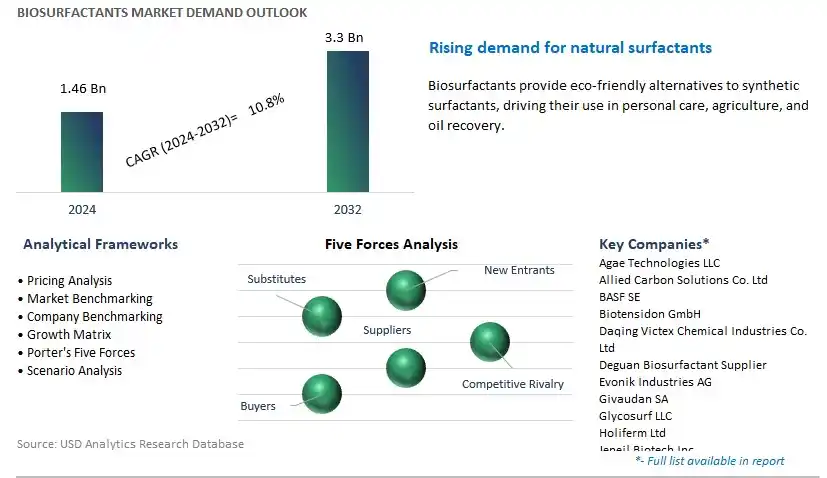
Global Biosurfactants Market Size is valued at $1.46 Billion in 2024 and is forecast to register a growth rate (CAGR) of 10.8% to reach $3.3 Billion by 2032.
The global Biosurfactants Market Study analyzes and forecasts the market size across 6 regions and 24 countries for diverse segments -By Type (Glycolipids, Lipopetides), By Application (Detergents, Personal Care, Food Processing, Agriculture Chemicals, Others).
An Introduction to Biosurfactants Market in 2024
Biosurfactants are surface-active molecules produced by microorganisms such as bacteria, yeast, and fungi, with properties similar to traditional surfactants derived from petroleum sources. These molecules exhibit emulsifying, foaming, wetting, and dispersing properties, making them valuable in various industrial applications, including cleaning products, cosmetics, food processing, agriculture, and oil recovery. The market for biosurfactants is driven by the growing demand for sustainable and environmentally friendly alternatives to synthetic surfactants. Biosurfactants offer advantages such as biodegradability, low toxicity, and compatibility with harsh environmental conditions. They can be produced from renewable feedstocks using fermentation processes, offering a renewable and sustainable alternative to petroleum-based surfactants. Further, advancements in biotechnological processes, genetic engineering, and microbial strain optimization are driving innovation and market growth within the biosurfactants industry. As industries seek greener and more cost-effective solutions, biosurfactants present an opportunity to reduce environmental impact, improve product performance, and meet regulatory requirements.
Biosurfactants Market Competitive Landscape
The market report analyses the leading companies in the industry including Agae Technologies LLC, Allied Carbon Solutions Co. Ltd, BASF SE, Biotensidon GmbH, Daqing Victex Chemical Industries Co. Ltd, Deguan Biosurfactant Supplier, Evonik Industries AG, Givaudan SA, Glycosurf LLC, Holiferm Ltd, Jeneil Biotech Inc, Kaneka Corp, Locus Fermentation Solutions, Rhamnolipid Inc, Saraya Co. Ltd, Solvay S.A., Stepan Company, Wheatoleo, and others.
Biosurfactants Market Dynamics
Market Trend: Growing Preference for Environmentally Friendly Surfactants
A prominent market trend for Biosurfactants is the growing preference for environmentally friendly surfactants driven by increasing awareness of sustainability, regulatory restrictions on synthetic surfactants, and consumer demand for eco-friendly products. Biosurfactants, derived from renewable resources such as microbial fermentation or plant-based sources, offer a biodegradable and non-toxic alternative to traditional surfactants derived from petrochemicals. With concerns over environmental pollution and health hazards associated with synthetic surfactants, there is a rising interest in biosurfactants that offer superior performance while minimizing ecological impact. This trend reflects a broader industry shift towards green chemistry, sustainable manufacturing practices, and corporate sustainability goals, influencing the adoption of biosurfactants across various sectors including personal care, household cleaning, agriculture, and industrial applications.
Market Driver: Regulatory Restrictions and Consumer Preferences
A key market driver for Biosurfactants is regulatory restrictions on synthetic surfactants and consumer preferences for safer, greener alternatives. Regulatory bodies worldwide are implementing restrictions and bans on certain types of surfactants due to concerns over their environmental persistence, toxicity, and potential impact on aquatic ecosystems. Additionally, consumers are increasingly seeking products labeled as "natural," "biodegradable," or "eco-friendly," driving demand for biosurfactants in a wide range of consumer goods. As companies seek to comply with regulations and meet consumer expectations for sustainable products, there is a growing need for biosurfactants that offer effective performance, biodegradability, and low environmental impact, creating opportunities for market growth and innovation in the global surfactants industry.
Market Opportunity: Expansion into Niche Applications and Industries
An attractive opportunity in the Biosurfactants market lies in the expansion into niche applications and industries where biosurfactants can offer unique benefits and advantages over conventional surfactants. Opportunities exist to explore applications in areas such as enhanced oil recovery, soil remediation, pharmaceutical formulations, and food processing, where biosurfactants' biocompatibility, low toxicity, and effectiveness in challenging environments can create value. Collaboration with industry partners, research institutions, and government agencies can facilitate the development of tailored biosurfactant formulations optimized for specific applications and performance requirements. By targeting niche markets and addressing unmet needs, companies can unlock new revenue streams, differentiate themselves from competitors, and capitalize on the growing demand for sustainable surfactant solutions in diverse industries.
Biosurfactants Market Share Analysis: Glycolipids segment generated the highest revenue in 2024
Glycolipids emerge as the largest segment in the biosurfactants market. Glycolipids, such as rhamnolipids and sophorolipids, are naturally derived surfactants produced by microbial fermentation processes. They offer potential advantages over traditional chemical surfactants, including biodegradability, low toxicity, and environmental compatibility. Glycolipids find extensive applications in industries such as agriculture, oil and gas, cosmetics, and food processing, where they are used as emulsifiers, foaming agents, and detergents. Moreover, the increasing demand for eco-friendly and sustainable surfactants, coupled with regulatory restrictions on the use of petroleum-based surfactants, drives the adoption of glycolipids in various industrial applications. Additionally, advancements in biotechnological processes for glycolipid production and the development of novel microbial strains further enhance the efficiency and scalability of glycolipid production, solidifying their position as the largest segment within the biosurfactants market.
Biosurfactants Market Share Analysis: Agriculture Chemicals is poised to register the fastest CAGR over the forecast period
Agriculture chemicals emerge as the fastest-growing segment in the biosurfactants market. Biosurfactants offer significant benefits in agriculture applications, including enhanced soil remediation, improved pesticide dispersion and efficacy, and reduced environmental impact compared to traditional chemical surfactants. They are utilized in agricultural formulations such as herbicides, fungicides, and insecticides to increase their effectiveness and reduce the environmental footprint of agricultural practices. Additionally, biosurfactants help improve soil structure and water retention, leading to increased crop yields and sustainability in agriculture. The growing demand for eco-friendly agricultural solutions, coupled with regulatory initiatives promoting sustainable farming practices, fuels the adoption of biosurfactants in agriculture chemicals. Moreover, advancements in biotechnological processes for biosurfactant production and the development of customized formulations tailored to specific agricultural needs contribute to the rapid growth of this segment within the biosurfactants market. With its potential to revolutionize agricultural practices and address environmental concerns, the agriculture chemicals segment stands as the fastest-growing segment in the biosurfactants market.
Biosurfactants Market
By Type
Glycolipids
-Sophorolipids
-Rhamnolipids
Lipopetides
-Surfactin
-Lechenysin
By Application
Detergents
Personal Care
Food Processing
Agriculture Chemicals
Others
Countries Analyzed
North America (US, Canada, Mexico)
Europe (Germany, UK, France, Spain, Italy, Russia, Rest of Europe)
Asia Pacific (China, India, Japan, South Korea, Australia, South East Asia, Rest of Asia)
South America (Brazil, Argentina, Rest of South America)
Middle East and Africa (Saudi Arabia, UAE, Rest of Middle East, South Africa, Egypt, Rest of Africa)
Biosurfactants Companies Profiled in the Study
Agae Technologies LLC
Allied Carbon Solutions Co. Ltd
BASF SE
Biotensidon GmbH
Daqing Victex Chemical Industries Co. Ltd
Deguan Biosurfactant Supplier
Evonik Industries AG
Givaudan SA
Glycosurf LLC
Holiferm Ltd
Jeneil Biotech Inc
Kaneka Corp
Locus Fermentation Solutions
Rhamnolipid Inc
Saraya Co. Ltd
Solvay S.A.
Stepan Company
Wheatoleo
*- List Not Exhaustive
TABLE OF CONTENTS
1 Introduction to 2024 Biosurfactants Market
1.1 Market Overview
1.2 Quick Facts
1.3 Scope/Objective of the Study
1.4 Market Definition
1.5 Countries and Regions Covered
1.6 Units, Currency, and Conversions
1.7 Industry Value Chain
2 Research Methodology
2.1 Market Size Estimation
2.2 Sources and Research Methodology
2.3 Data Triangulation
2.4 Assumptions and Limitations
3 Executive Summary
3.1 Global Biosurfactants Market Size Outlook, $ Million, 2021 to 2032
3.2 Biosurfactants Market Outlook by Type, $ Million, 2021 to 2032
3.3 Biosurfactants Market Outlook by Product, $ Million, 2021 to 2032
3.4 Biosurfactants Market Outlook by Application, $ Million, 2021 to 2032
3.5 Biosurfactants Market Outlook by Key Countries, $ Million, 2021 to 2032
4 Market Dynamics
4.1 Key Driving Forces of Biosurfactants Industry
4.2 Key Market Trends in Biosurfactants Industry
4.3 Potential Opportunities in Biosurfactants Industry
4.4 Key Challenges in Biosurfactants Industry
5 Market Factor Analysis
5.1 Value Chain Analysis
5.2 Competitive Landscape
5.2.1 Global Biosurfactants Market Share by Company (%), 2023
5.2.2 Product Offerings by Company
5.3 Porter’s Five Forces Analysis
5.4 Pricing Analysis and Outlook
6 Growth Outlook Across Scenarios
6.1 Growth Analysis-Case Scenario Definitions
6.2 Low Growth Scenario Forecasts
6.3 Reference Growth Scenario Forecasts
6.4 High Growth Scenario Forecasts
7 Global Biosurfactants Market Outlook by Segments
7.1 Biosurfactants Market Outlook by Segments, $ Million, 2021- 2032
By Type
Glycolipids
-Sophorolipids
-Rhamnolipids
Lipopetides
-Surfactin
-Lechenysin
By Application
Detergents
Personal Care
Food Processing
Agriculture Chemicals
Others
8 North America Biosurfactants Market Analysis and Outlook To 2032
8.1 Introduction to North America Biosurfactants Markets in 2024
8.2 North America Biosurfactants Market Size Outlook by Country, 2021-2032
8.2.1 United States
8.2.2 Canada
8.2.3 Mexico
8.3 North America Biosurfactants Market size Outlook by Segments, 2021-2032
By Type
Glycolipids
-Sophorolipids
-Rhamnolipids
Lipopetides
-Surfactin
-Lechenysin
By Application
Detergents
Personal Care
Food Processing
Agriculture Chemicals
Others
9 Europe Biosurfactants Market Analysis and Outlook To 2032
9.1 Introduction to Europe Biosurfactants Markets in 2024
9.2 Europe Biosurfactants Market Size Outlook by Country, 2021-2032
9.2.1 Germany
9.2.2 France
9.2.3 Spain
9.2.4 United Kingdom
9.2.4 Italy
9.2.5 Russia
9.2.6 Norway
9.2.7 Rest of Europe
9.3 Europe Biosurfactants Market Size Outlook by Segments, 2021-2032
By Type
Glycolipids
-Sophorolipids
-Rhamnolipids
Lipopetides
-Surfactin
-Lechenysin
By Application
Detergents
Personal Care
Food Processing
Agriculture Chemicals
Others
10 Asia Pacific Biosurfactants Market Analysis and Outlook To 2032
10.1 Introduction to Asia Pacific Biosurfactants Markets in 2024
10.2 Asia Pacific Biosurfactants Market Size Outlook by Country, 2021-2032
10.2.1 China
10.2.2 India
10.2.3 Japan
10.2.4 South Korea
10.2.5 Indonesia
10.2.6 Malaysia
10.2.7 Australia
10.2.8 Rest of Asia Pacific
10.3 Asia Pacific Biosurfactants Market size Outlook by Segments, 2021-2032
By Type
Glycolipids
-Sophorolipids
-Rhamnolipids
Lipopetides
-Surfactin
-Lechenysin
By Application
Detergents
Personal Care
Food Processing
Agriculture Chemicals
Others
11 South America Biosurfactants Market Analysis and Outlook To 2032
11.1 Introduction to South America Biosurfactants Markets in 2024
11.2 South America Biosurfactants Market Size Outlook by Country, 2021-2032
11.2.1 Brazil
11.2.2 Argentina
11.2.3 Rest of South America
11.3 South America Biosurfactants Market size Outlook by Segments, 2021-2032
By Type
Glycolipids
-Sophorolipids
-Rhamnolipids
Lipopetides
-Surfactin
-Lechenysin
By Application
Detergents
Personal Care
Food Processing
Agriculture Chemicals
Others
12 Middle East and Africa Biosurfactants Market Analysis and Outlook To 2032
12.1 Introduction to Middle East and Africa Biosurfactants Markets in 2024
12.2 Middle East and Africa Biosurfactants Market Size Outlook by Country, 2021-2032
12.2.1 Saudi Arabia
12.2.2 UAE
12.2.3 Oman
12.2.4 Rest of Middle East
12.2.5 Egypt
12.2.6 Nigeria
12.2.7 South Africa
12.2.8 Rest of Africa
12.3 Middle East and Africa Biosurfactants Market size Outlook by Segments, 2021-2032
By Type
Glycolipids
-Sophorolipids
-Rhamnolipids
Lipopetides
-Surfactin
-Lechenysin
By Application
Detergents
Personal Care
Food Processing
Agriculture Chemicals
Others
13 Company Profiles
13.1 Company Snapshot
13.2 SWOT Profiles
13.3 Products and Services
13.4 Recent Developments
13.5 Financial Profile
Agae Technologies LLC
Allied Carbon Solutions Co. Ltd
BASF SE
Biotensidon GmbH
Daqing Victex Chemical Industries Co. Ltd
Deguan Biosurfactant Supplier
Evonik Industries AG
Givaudan SA
Glycosurf LLC
Holiferm Ltd
Jeneil Biotech Inc
Kaneka Corp
Locus Fermentation Solutions
Rhamnolipid Inc
Saraya Co. Ltd
Solvay S.A.
Stepan Company
Wheatoleo
14 Appendix
14.1 Customization Offerings
14.2 Subscription Services
14.3 Related Reports
14.4 Publisher Expertise
By Type
Glycolipids
-Sophorolipids
-Rhamnolipids
Lipopetides
-Surfactin
-Lechenysin
By Application
Detergents
Personal Care
Food Processing
Agriculture Chemicals
Others
Countries Analyzed
North America (US, Canada, Mexico)
Europe (Germany, UK, France, Spain, Italy, Russia, Rest of Europe)
Asia Pacific (China, India, Japan, South Korea, Australia, South East Asia, Rest of Asia)
South America (Brazil, Argentina, Rest of South America)
Middle East and Africa (Saudi Arabia, UAE, Rest of Middle East, South Africa, Egypt, Rest of Africa)
