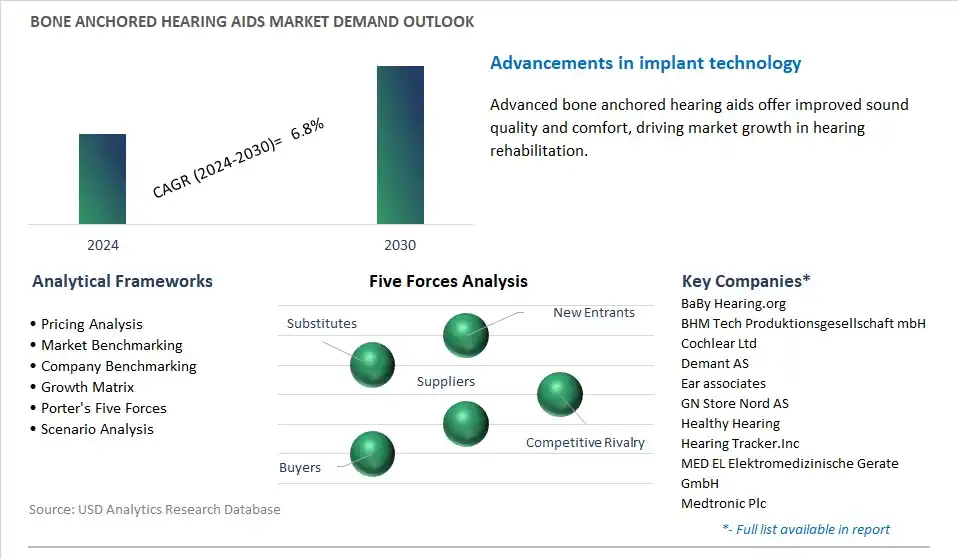
Bone-Anchored Hearing Aids (BAHA) Market is estimated to increase at a growth rate of 6.8% CAGR over the forecast period from 2024 to 2030.
The global Bone-Anchored Hearing Aids (BAHA) Market Study analyzes and forecasts the market size across 6 regions and 24 countries for diverse segments including By Type (Sensorineural hearing loss, Conductive hearing loss, Others), By End-User (Adults, Pediatrics).
An Introduction to Bone-Anchored Hearing Aids (BAHA) Market in 2024
The Bone-Anchored Hearing Aids (BAHA) Market comprises hearing aid systems that utilize bone conduction technology to transmit sound vibrations directly to the inner ear through the skull bone. These devices are beneficial for individuals with conductive hearing loss, single-sided deafness, or certain types of hearing impairments. In 2024, the BAHA market emphasizes advancements in implantable BAHA devices, wireless connectivity features, and improved hearing outcomes, catering to individuals seeking effective hearing solutions and improved quality of life.
Bone-Anchored Hearing Aids (BAHA) Market Competitive Landscape
The global Bone-Anchored Hearing Aids (BAHA) Industry is highly competitive with a large number of companies focusing on niche market segments. Amidst intense competitive conditions, Bone-Anchored Hearing Aids (BAHA) Companies are investing in new product launches and strengthening distribution channels. Key companies operating in the Bone-Anchored Hearing Aids (BAHA) Industry include- BaBy Hearing.org, BHM Tech Produktionsgesellschaft mbH, Cochlear Ltd, Demant AS, Ear associates, GN Store Nord AS, Healthy Hearing, Hearing Tracker.Inc, MED EL Elektromedizinische Gerate GmbH, Medtronic Plc, Micropoint Bioscience Inc, Natus Medical Inc, Oticon Medical AS, Phonak Ltd, Sonova AG, Starkey Laboratories Inc, The Johns Hopkins Health System Corp, WS Audiology AS.
Bone Anchored Hearing Aids Market Trend: Advancements in Hearing Aid Technology and Implantable Devices
A prominent trend in the Bone Anchored Hearing Aids market is the advancements in hearing aid technology and implantable devices for treating conductive hearing loss, single-sided deafness, and mixed hearing loss, driven by innovations in sound processing algorithms, implant design, and surgical techniques that enhance hearing performance, comfort, and patient satisfaction. With increasing demand for personalized hearing solutions, improved speech intelligibility, and enhanced quality of life for individuals with hearing impairments, there is a shift towards bone anchored hearing aids (BAHA), cochlear implants, and osseointegrated devices that offer superior auditory outcomes, durability, and cosmetic appeal, driving market growth in implantable hearing solutions.
Bone Anchored Hearing Aids Market Driver: Rising Incidence of Hearing Loss and Auditory Disorders
A significant driver for the Bone Anchored Hearing Aids market is the rising incidence of hearing loss and auditory disorders worldwide, attributed to factors such as aging population, noise-induced hearing damage, congenital anomalies, and otologic conditions that affect hearing function and communication abilities. As the prevalence of hearing impairment increases, particularly among elderly individuals and pediatric populations, there is a growing need for effective hearing rehabilitation solutions that restore auditory function, improve speech perception, and enhance quality of life, driving market demand and investment in bone anchored hearing aids and implantable hearing devices.
Bone Anchored Hearing Aids Market Opportunity: Expansion into Pediatric and Geriatric Hearing Solutions
An opportunity for market expansion and product diversification in the Bone Anchored Hearing Aids market lies in expanding into pediatric and geriatric hearing solutions tailored to the unique needs and preferences of children and older adults with hearing impairments. By developing age-appropriate devices, accessories, and rehabilitation programs for pediatric patients with congenital hearing loss or developmental delays, as well as specialized hearing aids, assistive listening devices, and communication strategies for elderly individuals with age-related hearing loss or cognitive decline, hearing aid manufacturers and healthcare providers can address unmet needs, improve treatment outcomes, and enhance quality of life for diverse patient populations, thereby creating new opportunities for market growth, customer engagement, and value-added services in the dynamic field of audiology and hearing healthcare.
Market Share Analysis: Sensorineural Hearing Loss is the fastest growing segment in the Bone Anchored Hearing Aids industry
The Sensorineural Hearing Loss segment emerges as the fastest-growing category among Bone Anchored Hearing Aids (BAHA). This growth is attributed to several factors, including advancements in technology and increasing awareness among patients and healthcare providers. Sensorineural hearing loss, characterized by damage to the inner ear or auditory nerve, is a prevalent type of hearing impairment affecting a significant portion of the population globally. BAHA devices designed for sensorineural hearing loss utilize bone conduction technology to bypass the damaged outer or middle ear and directly stimulate the cochlea, enabling individuals with this type of hearing loss to perceive sound more effectively. As technological innovations continue to enhance the performance and functionality of BAHA devices, they are becoming increasingly sought after by individuals with sensorineural hearing loss seeking improved hearing outcomes. Moreover, the growing recognition of the benefits of BAHA among healthcare professionals, coupled with expanding access to healthcare services, particularly in pediatric populations, further contributes to the accelerated growth of the Sensorineural Hearing Loss segment within the Bone Anchored Hearing Aids market.
Bone-Anchored Hearing Aids (BAHA) Market Segmentation
By Type
Sensorineural hearing loss
Conductive hearing loss
Others
By End-User
Adults
Pediatrics
Geographical Analysis
North America (United States, Canada, Mexico)
Europe (Germany, France, United Kingdom, Spain, Italy, Rest of Europe)
Asia Pacific (China, India, Japan, South Korea, Rest of Asia Pacific)
South America (Brazil, Argentina, Rest of South America)
Middle East and Africa (Saudi Arabia, UAE, Rest of Middle East, South Africa, Egypt, Rest of Africa)
Bone-Anchored Hearing Aids (BAHA) Companies
BaBy Hearing.org
BHM Tech Produktionsgesellschaft mbH
Cochlear Ltd
Demant AS
Ear associates
GN Store Nord AS
Healthy Hearing
Hearing Tracker.Inc
MED EL Elektromedizinische Gerate GmbH
Medtronic Plc
Micropoint Bioscience Inc
Natus Medical Inc
Oticon Medical AS
Phonak Ltd
Sonova AG
Starkey Laboratories Inc
The Johns Hopkins Health System Corp
WS Audiology AS
* List not Exhaustive
Reasons to Buy the Bone-Anchored Hearing Aids (BAHA) Market Study
• Deepen your industry insights and navigate uncertainties for strategy formulation, CAPEX, and Operational decisions
• Gain access to detailed insights on the Bone-Anchored Hearing Aids (BAHA) Market, encompassing current market size, growth trends, and forecasts till 2030.
• Access detailed competitor analysis, enabling competitive advantage through a thorough understanding of market players, strategies, and potential differentiation opportunities
• Stay ahead of the curve with insights on technological advancements, innovations, and upcoming trends
• Identify lucrative investment avenues and expansion opportunities within the Bone-Anchored Hearing Aids (BAHA) Industry, guided by robust, data-backed analysis.
• Understand regional and global markets through country-wise analysis, regional market potential, regulatory nuances, and dynamics
• Execute strategies with confidence and speed through information, analytics, and insights on the industry value chain
• Corporate leaders, strategists, financial experts, shareholders, asset managers, and governmental representatives can make long-term planning scenarios and build an integrated and timely understanding of market dynamics
• Benefit from tailored solutions and expert consultation based on report insights, providing personalized strategies aligned with specific business needs.
TABLE OF CONTENTS
1 Introduction to 2024 Bone-Anchored Hearing Aids (BAHA) Market
1.1 Market Overview
1.2 Quick Facts
1.3 Scope/Objective of the Study
1.4 Market Definition
1.5 Countries and Regions Analyzed
1.6 Units, Currency, and Conversions
1.7 Industry Value Chain
2 Research Methodology
2.1 Market Size Estimation
2.2 Sources and Research Methodology
2.3 Data Triangulation
2.4 Assumptions and Limitations
3 Executive Summary
3.1 Global Bone-Anchored Hearing Aids (BAHA) Market Size Outlook, $ Million, 2021 to 2030
3.2 Bone-Anchored Hearing Aids (BAHA) Market Outlook by Type, $ Million, 2021 to 2030
3.3 Bone-Anchored Hearing Aids (BAHA) Market Outlook by Product, $ Million, 2021 to 2030
3.4 Bone-Anchored Hearing Aids (BAHA) Market Outlook by Application, $ Million, 2021 to 2030
3.5 Bone-Anchored Hearing Aids (BAHA) Market Outlook by Key Countries, $ Million, 2021 to 2030
4 Market Dynamics
4.1 Key Driving Forces of Bone-Anchored Hearing Aids (BAHA) Industry
4.2 Key Market Trends in Bone-Anchored Hearing Aids (BAHA) Industry
4.3 Potential Opportunities in Bone-Anchored Hearing Aids (BAHA) Industry
4.4 Key Challenges in Bone-Anchored Hearing Aids (BAHA) Industry
5 Market Factor Analysis
5.1 Value Chain Analysis
5.2 Competitive Landscape
5.2.1 Global Bone-Anchored Hearing Aids (BAHA) Market Share by Company (%), 2023
5.2.2 Product Offerings by Company
5.3 Porter’s Five Forces Analysis
5.4 Pricing Analysis and Outlook
6 Growth Outlook Across Scenarios
6.1 Growth Analysis-Case Scenario Definitions
6.2 Low Growth Scenario Forecasts
6.3 Reference Growth Scenario Forecasts
6.4 High Growth Scenario Forecasts
7 Global Bone-Anchored Hearing Aids (BAHA) Market Outlook by Segments
7.1 Bone-Anchored Hearing Aids (BAHA) Market Outlook by Segments, $ Million, 2021- 2030
By Type
Sensorineural hearing loss
Conductive hearing loss
Others
By End-User
Adults
Pediatrics
8 North America Bone-Anchored Hearing Aids (BAHA) Market Analysis and Outlook To 2030
8.1 Introduction to North America Bone-Anchored Hearing Aids (BAHA) Markets in 2024
8.2 North America Bone-Anchored Hearing Aids (BAHA) Market Size Outlook by Country, 2021-2030
8.2.1 United States
8.2.2 Canada
8.2.3 Mexico
8.3 North America Bone-Anchored Hearing Aids (BAHA) Market size Outlook by Segments, 2021-2030
By Type
Sensorineural hearing loss
Conductive hearing loss
Others
By End-User
Adults
Pediatrics
9 Europe Bone-Anchored Hearing Aids (BAHA) Market Analysis and Outlook To 2030
9.1 Introduction to Europe Bone-Anchored Hearing Aids (BAHA) Markets in 2024
9.2 Europe Bone-Anchored Hearing Aids (BAHA) Market Size Outlook by Country, 2021-2030
9.2.1 Germany
9.2.2 France
9.2.3 Spain
9.2.4 United Kingdom
9.2.4 Italy
9.2.5 Russia
9.2.6 Norway
9.2.7 Rest of Europe
9.3 Europe Bone-Anchored Hearing Aids (BAHA) Market Size Outlook by Segments, 2021-2030
By Type
Sensorineural hearing loss
Conductive hearing loss
Others
By End-User
Adults
Pediatrics
10 Asia Pacific Bone-Anchored Hearing Aids (BAHA) Market Analysis and Outlook To 2030
10.1 Introduction to Asia Pacific Bone-Anchored Hearing Aids (BAHA) Markets in 2024
10.2 Asia Pacific Bone-Anchored Hearing Aids (BAHA) Market Size Outlook by Country, 2021-2030
10.2.1 China
10.2.2 India
10.2.3 Japan
10.2.4 South Korea
10.2.5 Indonesia
10.2.6 Malaysia
10.2.7 Australia
10.2.8 Rest of Asia Pacific
10.3 Asia Pacific Bone-Anchored Hearing Aids (BAHA) Market size Outlook by Segments, 2021-2030
By Type
Sensorineural hearing loss
Conductive hearing loss
Others
By End-User
Adults
Pediatrics
11 South America Bone-Anchored Hearing Aids (BAHA) Market Analysis and Outlook To 2030
11.1 Introduction to South America Bone-Anchored Hearing Aids (BAHA) Markets in 2024
11.2 South America Bone-Anchored Hearing Aids (BAHA) Market Size Outlook by Country, 2021-2030
11.2.1 Brazil
11.2.2 Argentina
11.2.3 Rest of South America
11.3 South America Bone-Anchored Hearing Aids (BAHA) Market size Outlook by Segments, 2021-2030
By Type
Sensorineural hearing loss
Conductive hearing loss
Others
By End-User
Adults
Pediatrics
12 Middle East and Africa Bone-Anchored Hearing Aids (BAHA) Market Analysis and Outlook To 2030
12.1 Introduction to Middle East and Africa Bone-Anchored Hearing Aids (BAHA) Markets in 2024
12.2 Middle East and Africa Bone-Anchored Hearing Aids (BAHA) Market Size Outlook by Country, 2021-2030
12.2.1 Saudi Arabia
12.2.2 UAE
12.2.3 Oman
12.2.4 Rest of Middle East
12.2.5 Egypt
12.2.6 Nigeria
12.2.7 South Africa
12.2.8 Rest of Africa
12.3 Middle East and Africa Bone-Anchored Hearing Aids (BAHA) Market size Outlook by Segments, 2021-2030
By Type
Sensorineural hearing loss
Conductive hearing loss
Others
By End-User
Adults
Pediatrics
13 Company Profiles
13.1 Company Snapshot
13.2 SWOT Profiles
13.3 Products and Services
13.4 Recent Developments
13.5 Financial Profile
List of Companies
BaBy Hearing.org
BHM Tech Produktionsgesellschaft mbH
Cochlear Ltd
Demant AS
Ear associates
GN Store Nord AS
Healthy Hearing
Hearing Tracker.Inc
MED EL Elektromedizinische Gerate GmbH
Medtronic Plc
Micropoint Bioscience Inc
Natus Medical Inc
Oticon Medical AS
Phonak Ltd
Sonova AG
Starkey Laboratories Inc
The Johns Hopkins Health System Corp
WS Audiology AS
14 Appendix
14.1 Customization Offerings
14.2 Subscription Services
14.3 Related Reports
14.4 Publisher Expertise
