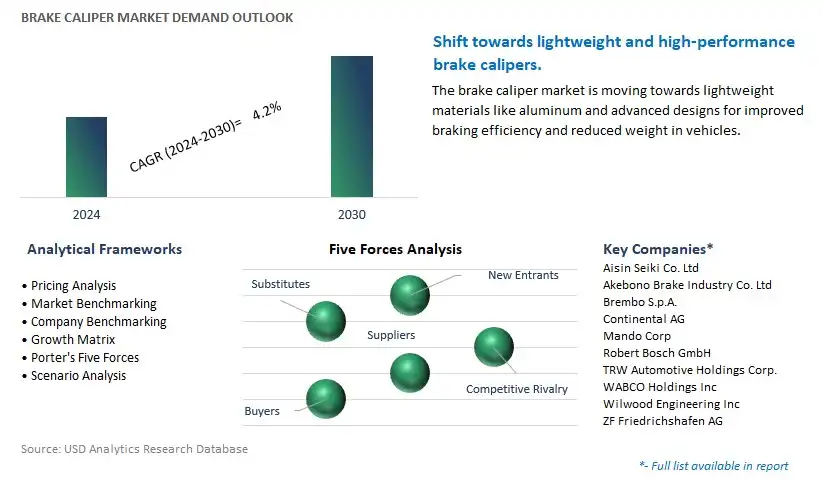
Brake Calliper Market is estimated to increase at a growth rate of 4.2% CAGR over the forecast period from 2024 to 2030.
The global Brake Calliper Market study analyzes and forecasts the market size across 6 regions and 24 countries for diverse segments including By Type (Floating brake caliper, Fixed brake caliper), By Piston Material (Aluminum, Steel, Titanium, Phenolics), By Manufacturing Process (High pressure die casting, Gravity die casting), By Vehicle (Passenger car, Commercial car, Two-wheeler), By Sales Channel (OEM, Aftermarket).
An Introduction to Global Brake Calliper Market, 2024
The brake caliper market in 2024 serves as a crucial component of automotive braking systems, providing the mechanism responsible for applying pressure to the brake pads, thereby clamping them against the brake discs or drums to generate stopping force. Brake calipers play a vital role in controlling vehicle speed and ensuring safe and efficient braking performance. With the increasing emphasis on vehicle safety, performance, and driving dynamics, the demand for high-quality brake calipers continues to grow. Manufacturers in this market focus on developing calipers that offer precise control, heat dissipation, and durability while meeting stringent regulatory requirements and industry standards. Moreover, as vehicles evolve with advancements in electrification, automation, and lightweighting, brake calipers integrate features such as electronic actuation, lightweight materials, and aerodynamic designs to enhance efficiency and performance. With a strong emphasis on reliability, performance, and innovation, the brake caliper market contributes to the safety and driving experience of vehicles across various segments, including passenger cars, commercial vehicles, and high-performance sports cars.
Brake Calliper Competitive Landscape
The global Brake Calliper market is highly competitive with a large number of companies focusing on niche market segments. Amidst intense competitive conditions, Brake Calliper Companies are investing in new product launches and strengthening distribution channels. Key companies operating in the Brake Calliper Market Industry include- Aisin Seiki Co. Ltd, Akebono Brake Industry Co. Ltd, Brembo S.p.A., Continental AG, Mando Corp, Robert Bosch GmbH, TRW Automotive Holdings Corp., WABCO Holdings Inc, Wilwood Engineering Inc, ZF Friedrichshafen AG.
Brake Caliper Market Trend: Transition Towards Electric and Hybrid Vehicles
A prominent trend in the Brake Caliper market is the transition towards electric and hybrid vehicles. With the global automotive industry shifting towards electrification to reduce emissions and improve fuel efficiency, there's a growing demand for brake calipers specifically designed for electric and hybrid vehicles. These vehicles have unique braking requirements due to regenerative braking systems and different weight distribution compared to traditional internal combustion engine vehicles. Manufacturers are responding to this trend by developing lightweight, high-performance brake calipers that can effectively manage the braking needs of electric and hybrid vehicles while maximizing energy regeneration. This trend reflects a broader industry focus on sustainable transportation solutions, driving market growth and opportunities for brake caliper manufacturers to innovate and capture market share in the rapidly expanding electric vehicle segment.
Brake Caliper Market Driver: Increasing Emphasis on Vehicle Safety and Performance
The primary driver propelling the growth of the Brake Caliper market is the increasing emphasis on vehicle safety and performance. With advancements in automotive technology and stringent safety regulations, there's growing pressure on automakers to equip vehicles with high-performance braking systems that ensure optimal stopping power, stability, and control in various driving conditions. Brake calipers play a crucial role in the overall braking system, exerting force on the brake pads to generate friction and slow down or stop the vehicle. As consumers prioritize safety and performance when purchasing vehicles, there's a corresponding demand for brake calipers that deliver superior performance, reliability, and durability. Additionally, the rise of high-performance and luxury vehicle segments further drives demand for advanced brake calipers with features such as lightweight construction, multi-piston designs, and advanced materials to enhance braking performance and vehicle dynamics.
Brake Caliper Market Opportunity: Integration of Advanced Materials and Manufacturing Techniques
An Market Opportunity ripe for exploration within the Brake Caliper market is the integration of advanced materials and manufacturing techniques. With advancements in materials science, engineering, and manufacturing technology, there's significant potential to improve the performance, efficiency, and sustainability of brake calipers. Manufacturers can capitalize on this Market Opportunity by researching and developing innovative materials such as carbon fiber composites, aluminum alloys, or ceramic materials that offer superior strength-to-weight ratio, heat resistance, and corrosion resistance compared to traditional materials. Additionally, there's potential to optimize manufacturing processes, such as casting, machining, or additive manufacturing, to enhance product quality, consistency, and cost-effectiveness. By integrating advanced materials and manufacturing techniques, brake caliper manufacturers can differentiate their products, meet evolving customer demands for high-performance braking solutions, and stay ahead of the competition in the dynamic automotive market.
Brake Calliper Market Segmentation
By Type
Floating brake caliper
Fixed brake caliper
By Piston Material
Aluminum
Steel
Titanium
Phenolics
By Manufacturing process
High pressure die casting
Gravity die casting
By Vehicle
Passenger car
Commercial car
Two-wheeler
By Sales Channel
OEM
AftermarketGeographical Analysis
North America (United States, Canada, Mexico)
Europe (Germany, France, United Kingdom, Spain, Italy, Rest of Europe)
Asia Pacific (China, India, Japan, South Korea, Rest of Asia Pacific)
South America (Brazil, Argentina, Rest of South America)
Middle East and Africa (Saudi Arabia, UAE, Rest of Middle East, South Africa, Egypt, Rest of Africa
Brake Calliper Companies
Aisin Seiki Co. Ltd
Akebono Brake Industry Co. Ltd
Brembo S.p.A.
Continental AG
Mando Corp
Robert Bosch GmbH
TRW Automotive Holdings Corp.
WABCO Holdings Inc
Wilwood Engineering Inc
ZF Friedrichshafen AG
*- List not Exhaustive
TABLE OF CONTENTS
1 Introduction to 2024 Brake Calliper Market
1.1 Market Overview
1.2 Quick Facts
1.3 Scope/Objective of the Study
1.4 Market Definition
1.5 Countries and Regions Analyzed
1.6 Units, Currency, and Conversions
1.7 Industry Value Chain
2 Research Methodology
2.1 Market Size Estimation
2.2 Sources and Research Methodology
2.3 Data Triangulation
2.4 Assumptions and Limitations
3 Executive Summary
3.1 Global Brake Calliper Market Size Outlook, $ Million, 2021 to 2030
3.2 Brake Calliper Market Outlook by Type, $ Million, 2021 to 2030
3.3 Brake Calliper Market Outlook by Product, $ Million, 2021 to 2030
3.4 Brake Calliper Market Outlook by Application, $ Million, 2021 to 2030
3.5 Brake Calliper Market Outlook by Key Countries, $ Million, 2021 to 2030
4 Market Dynamics
4.1 Key Driving Forces of Brake Calliper Industry
4.2 Key Market Trends in Brake Calliper Industry
4.3 Potential Opportunities in Brake Calliper Industry
4.4 Key Challenges in Brake Calliper Industry
5 Market Factor Analysis
5.1 Value Chain Analysis
5.2 Competitive Landscape
5.2.1 Global Brake Calliper Market Share by Company (%), 2023
5.2.2 Product Offerings by Company
5.3 Porter’s Five Forces Analysis
5.4 Pricing Analysis and Outlook
6 Growth Outlook Across Scenarios
6.1 Growth Analysis-Case Scenario Definitions
6.2 Low Growth Scenario Forecasts
6.3 Reference Growth Scenario Forecasts
6.4 High Growth Scenario Forecasts
7 Global Brake Calliper Market Outlook by Segments
7.1 Brake Calliper Market Outlook by Segments, $ Million, 2021- 2030
By Type
Floating brake caliper
Fixed brake caliper
By Piston Material
Aluminum
Steel
Titanium
Phenolics
By Manufacturing process
High pressure die casting
Gravity die casting
By Vehicle
Passenger car
Commercial car
Two-wheeler
By Sales Channel
OEM
Aftermarket
8 North America Brake Calliper Market Analysis and Outlook To 2030
8.1 Introduction to North America Brake Calliper Markets in 2024
8.2 North America Brake Calliper Market Size Outlook by Country, 2021-2030
8.2.1 United States
8.2.2 Canada
8.2.3 Mexico
8.3 North America Brake Calliper Market size Outlook by Segments, 2021-2030
By Type
Floating brake caliper
Fixed brake caliper
By Piston Material
Aluminum
Steel
Titanium
Phenolics
By Manufacturing process
High pressure die casting
Gravity die casting
By Vehicle
Passenger car
Commercial car
Two-wheeler
By Sales Channel
OEM
Aftermarket
9 Europe Brake Calliper Market Analysis and Outlook To 2030
9.1 Introduction to Europe Brake Calliper Markets in 2024
9.2 Europe Brake Calliper Market Size Outlook by Country, 2021-2030
9.2.1 Germany
9.2.2 France
9.2.3 Spain
9.2.4 United Kingdom
9.2.4 Italy
9.2.5 Russia
9.2.6 Norway
9.2.7 Rest of Europe
9.3 Europe Brake Calliper Market Size Outlook by Segments, 2021-2030
By Type
Floating brake caliper
Fixed brake caliper
By Piston Material
Aluminum
Steel
Titanium
Phenolics
By Manufacturing process
High pressure die casting
Gravity die casting
By Vehicle
Passenger car
Commercial car
Two-wheeler
By Sales Channel
OEM
Aftermarket
10 Asia Pacific Brake Calliper Market Analysis and Outlook To 2030
10.1 Introduction to Asia Pacific Brake Calliper Markets in 2024
10.2 Asia Pacific Brake Calliper Market Size Outlook by Country, 2021-2030
10.2.1 China
10.2.2 India
10.2.3 Japan
10.2.4 South Korea
10.2.5 Indonesia
10.2.6 Malaysia
10.2.7 Australia
10.2.8 Rest of Asia Pacific
10.3 Asia Pacific Brake Calliper Market size Outlook by Segments, 2021-2030
By Type
Floating brake caliper
Fixed brake caliper
By Piston Material
Aluminum
Steel
Titanium
Phenolics
By Manufacturing process
High pressure die casting
Gravity die casting
By Vehicle
Passenger car
Commercial car
Two-wheeler
By Sales Channel
OEM
Aftermarket
11 South America Brake Calliper Market Analysis and Outlook To 2030
11.1 Introduction to South America Brake Calliper Markets in 2024
11.2 South America Brake Calliper Market Size Outlook by Country, 2021-2030
11.2.1 Brazil
11.2.2 Argentina
11.2.3 Rest of South America
11.3 South America Brake Calliper Market size Outlook by Segments, 2021-2030
By Type
Floating brake caliper
Fixed brake caliper
By Piston Material
Aluminum
Steel
Titanium
Phenolics
By Manufacturing process
High pressure die casting
Gravity die casting
By Vehicle
Passenger car
Commercial car
Two-wheeler
By Sales Channel
OEM
Aftermarket
12 Middle East and Africa Brake Calliper Market Analysis and Outlook To 2030
12.1 Introduction to Middle East and Africa Brake Calliper Markets in 2024
12.2 Middle East and Africa Brake Calliper Market Size Outlook by Country, 2021-2030
12.2.1 Saudi Arabia
12.2.2 UAE
12.2.3 Oman
12.2.4 Rest of Middle East
12.2.5 Egypt
12.2.6 Nigeria
12.2.7 South Africa
12.2.8 Rest of Africa
12.3 Middle East and Africa Brake Calliper Market size Outlook by Segments, 2021-2030
By Type
Floating brake caliper
Fixed brake caliper
By Piston Material
Aluminum
Steel
Titanium
Phenolics
By Manufacturing process
High pressure die casting
Gravity die casting
By Vehicle
Passenger car
Commercial car
Two-wheeler
By Sales Channel
OEM
Aftermarket
13 Company Profiles
13.1 Company Snapshot
13.2 SWOT Profiles
13.3 Products and Services
13.4 Recent Developments
13.5 Financial Profile
List of Companies
Aisin Seiki Co. Ltd
Akebono Brake Industry Co. Ltd
Brembo S.p.A.
Continental AG
Mando Corp
Robert Bosch GmbH
TRW Automotive Holdings Corp.
WABCO Holdings Inc
Wilwood Engineering Inc
ZF Friedrichshafen AG
14 Appendix
14.1 Customization Offerings
14.2 Subscription Services
14.3 Related Reports
14.4 Publisher Expertise
By Type
Floating brake caliper
Fixed brake caliper
By Piston Material
Aluminum
Steel
Titanium
Phenolics
By Manufacturing process
High pressure die casting
Gravity die casting
By Vehicle
Passenger car
Commercial car
Two-wheeler
By Sales Channel
OEM
Aftermarket
